
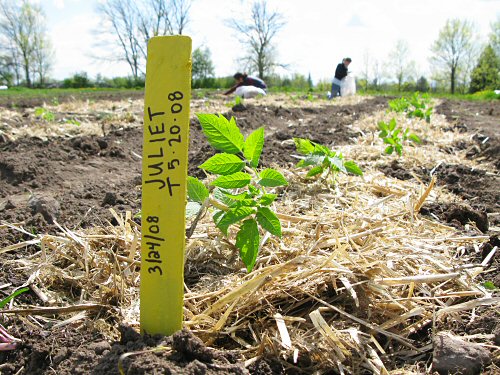
Especially compared to yesterday, today’s mainly sunny, quite warm weather added up to a glorious day in the field. Lynn, Raechelle and Shannon were all on hand, plus the inadvertent pet chicken, Colonel Saunders (I guess there’s no going back to the flock for him now, he’s been separated for a few days and probably wouldn’t be welcome, but, uh, he will be eaten…). It’s so absolutely fun to do even the most potentially tedious tasks (like hand-weeding between tiny green onion seedlings—done!) in a group with such a happy vibe. Besides a good amount of weeding, and putting ALL the chickens outdoors for the first time (those White Rocks don’t seem to want to do anything chicken-normal on their own, except eat), we transplanted the first 100 tomatoes. These were the deluxe early starts (Juliet, Striped German, Big Beef, Stupice), and they got the best transplant treatment ever: a deep, dug hole with a generous amount of compost, burying to the topmost leaves, a thorough watering in, mulching with the oat straw, and then, floating row cover over top for the coming few cold nights—it’s hard to imagine this is a…commercial operation, especially when you’re selling toms for only $1.50-2/lb. :) We mulched directly around the plants with straw, I’ll fill out the rows with grass mulch as soon as there’s enough. On the marker stake, there’s the variety, seedlng start date, and today’s transplanting date. At the other end of the row, Raechelle and Lynn mulch (Shannon seems to mysteriously avoid the occasional snapshots most of the time…). With all of the recent cold, we’re definitely at least a week behind the last couple of years in transplanting and in growth, but with a few hot, sunny days to complement the decent amount of rain we’ve been getting (not usual in recent years at this point), we might even catch up… Anyhow, a fine day!
Fieldwork
Not THAT cold…
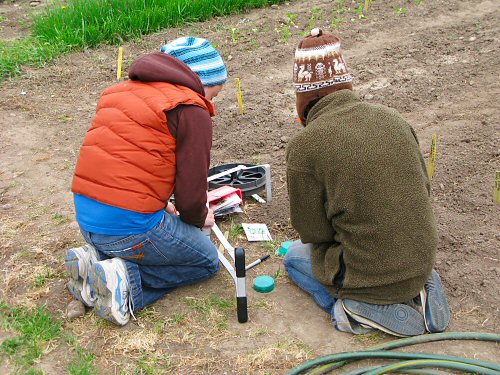
It’s not really as cold as the picture might make it look, but May continues to be an overall chilly one. The hats and extra layers are more a personal preference, but I’ve been wearing a lined flannel workshirt over my regular clothes much of the time. Here, as Lynn and Shannon sort seed for numerous smaller plantings in the herb garden, it’s about 60°F (15°C), cloudy and the kinda damp that can give you a shiver if you’re not a little bundled up. Shannon, sporting an illustrated, ear-flapped cap brought from her travels (it gets cold, especially at higher altitudes, even near the equator), has been back in Canada for less than a month after spending two years on farms in Central and South America, and is still getting used to the local weather. Lynn, in hoodie, vest and classic Canadian cold-weather headgear, was just…chilly! The slowdown in both crop and weed growth from the cold is quite noticeable, still, things are definitely moving along now… Weed watch, and the start of serious WEEDING, is on…
Grass mulch, Season 2
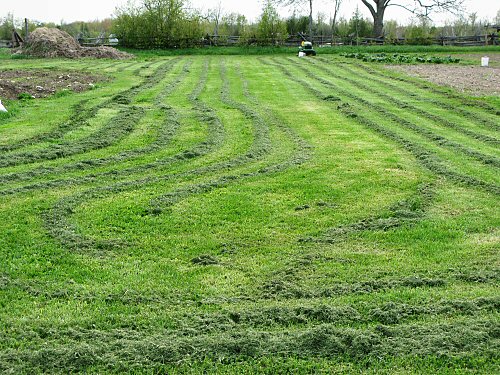
The grass seemed just long enough for a productive mulch cut without overloading the John Deere riding mower, so today was the day to start season 2 in the grass mulch experiment. This is just one part of the total mowing area: including the field perimeter and another big area behind where I’m standing to take the photo, there’s maybe four times that much (this area is being kept clear for the eventual bigger greenhouse). The JD’s deflector forms those nice mini-windrows instead of scattering the cut, making raking it up much quicker. I’m still not sure if the time it takes to mow, hand-rake and bag will be worth it on a larger scale: will the work be offset by savings in irrigation and weeding, and maybe better yield, for the crops that’ll be mulched? It takes a lot of big, packed leaf bags to properly mulch just a few beds… Well, we’ll soon find out!
Herb garden time…
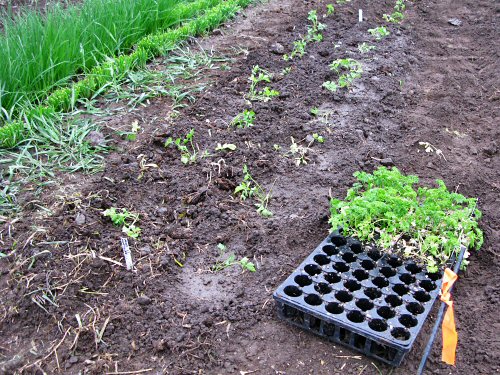
It’s right in the middle of the spring garden rush, for sure. but we’re in that little lull of sorts between direct seeding and transplanting the hardy and cool-soil-germinating crops (brassicas, peas, carrots, lettuce, etc) and waiting on temperature to transplant the more tender guys (tomatoes, eggplant, peppers, cucurbits). This year, for the last three weeks or so, we’ve been cooler by a few degrees than recent Mays, both days and nights, which slows things down a bit more, as I don’t see an advantage in planting out some of the tender stuff early by a week or two, since the extra growth probably wouldn’t add up to much. Sooo, there’s more time now—a longer lull—to concentrate on the kinda B-iist crops (I don’t like putting it that way, but for practical purposes, well, some ARE more important to the overall market garden than others…). That means the herbs and flowers are getting great extra attention: earlier planting, dividing established growths of sage, thyme, oregano, much needed weeding… Today, I did the parsley. There are several varieties, I couldn’t resist seeing how they’d compare. For curly: Krausa Market, Green Pearl, Green River, Green Forest. For flat-leaf: Plain Italian and Hilmar. At the top left of the pic, some chives, up and thriving from last year’s planting, and you can see the well-established grass in the path that is being meticulously forked and pulled, drawing out the runners by hand, sifting with fingers to leave all the top soil. This is what I think of as really hardcore, basic gardening: crawling around, hands-in-the-dirt work, where you’re literally attending to each plant. It’s incredibly relaxing, soothing, really, so much…fun, alone or with others. Of course, this particular approach doesn’t scale up too well! Tiny farming comes in so many shades, degrees, intensities… It’s great! :)
Onions and potatoes go in
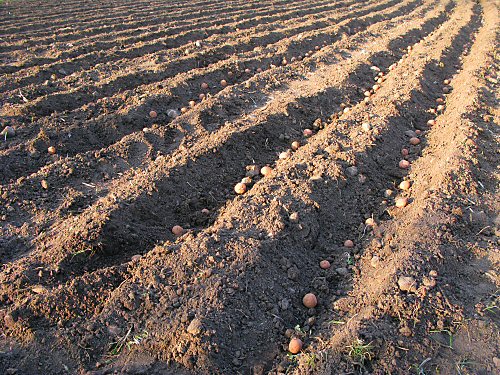
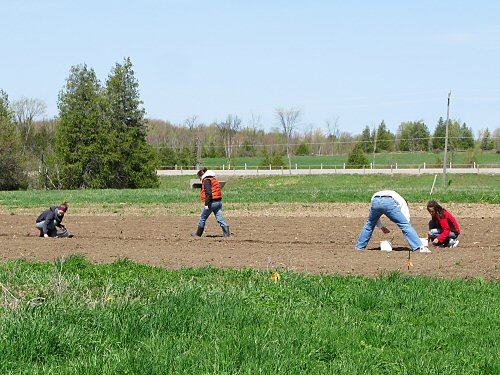
A satisfying planting day: all of the onion sets (around 2,500) and 300 lbs (136kg) of potatoes are in.
For the onions, Raechelle (first day in the field), Lynn, Jamie (a new CSA member), Shannon (here for a month), and I made quick work of the onions: Stuttgarter yellow cooking and yellow Spanish.
It’s amazing how much fun people working together in a garden can be, there’s a positive, happy, energy that I think comes from sharing time in the dirt (maybe that’s just the tiny farming romantic in me, but I think not… :). Plus, potentially tedious tasks are done in no time!
For an encore, Shannon and I polished off the potatoes, finishing just as the sun set and another chilly evening set in. This year, I used the furrower attachment on the Horse walking rototiller to plow what turned out to be excellent trenches, in ground that had been tilled up about a week ago. Varieties are Yukon Gold, Chieftan (red), and Kennebec. In this batch, all varieties were about chicken egg-sized, so, no need to cut ’em into pieces. In-row spacing is 12″ (30cm), between row is 24″ (60cm), with a bit wider path every two rows. We covered them by hand-raking. In all, 40 x 50′ (15m) rows, which is about 2000 plants.
Every year, I’ve tried a different potato approach. Last year, I made much shallower trenches with a hoe. As far as set-up, this time around was the best yet.
The onions are in a bit later than usual, I’ve had them done as early as mid-April, but no worries, and potatoes are around the usual timing. I grow a relatively small quantity of both of these crops, they always sell out, and they feel like a good fit for CSA and farmers’ market from the middle of summer on, so having them at the absolutely earliest date isn’t that important at this stage. And what would tiny farming be without lots of room to improve?! :)
Spring fieldwork continues
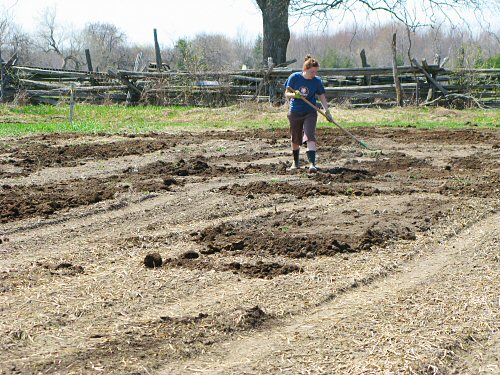
Bed preparation and first seeding continue. Today, Lynn’s tiny farming experience broadened to include rakes, and using them to spread compost. Moderately hard work in the heat, but it was a fairly small area. Overall, things are generally on schedule, but at least a week behind last year for the earliest stuff (and first peas were in last year on April 3rd!). Also, after the lingering snow, conditions changed practically overnight, but with the extremely hot, dry week, despite some watering in, the crops seeded so far are slower to germinate (we need rain!), and may come up a little thin when they do. So far, peas, spinach, beets, radish, all-lettuce mesclun and green onions have gone in over the last few days, and everything but the peas got one watering… I should have direct-seeded leek and parsnips in, but I’m kind of waiting for some rain. Also coming up in the next day or two, carrots and Swiss chard. And there’s a mountain of onion sets and seedlings ready to go, plus a few other transplants. And potatoes arrived today…
How odd…
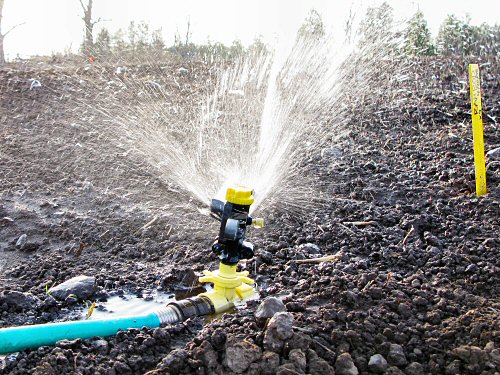
It’s like we’ve gone directly from winter to summer. Less than a WEEK since the ground dried out enough to walk on it and till it, I’m actually out there WATERING… This is really odd.
I’m sure we’ve had unseasonably hot Aprils before, where watering in newly seeded crops was necessary, still, it’s only common sense to chalk this up as another of the consistently bizarre weather events we’ve been having in the last three years or so… In other words: global warming, I guess.
“Normally,” April is a good month once it warms up, because our rather heavy clay-loam soil holds moisture well, and just post-snow, it’s wet enough that you don’t have to water in what you’ve seeded. A spring bonus!
Instead, what’s going on here is, in a handful of days, the top inch or more of the ground has dried out completely in the unusual heat. That means shallowly-sown seed, like spinach, lettuce, radish, beets, and chard, is sitting in perfectly dry soil.
I put in peas at around 1.5″ (4.25cm), and they were just barely in nice, moist earth. But these other guys, what can I do?
I considered setting the seeder deeper, but that could just bury them too far for good, quick germination (I’ve messed around with too deep before…).
Or, out with the sprinkler.
I don’t like using sprinklers, I don’t have water to waste, but here, it’s much the more reasonable alternative to hand-watering a 50’x100′ area, when there’s so much else to do.
The pond irrigation isn’t yet set up, so the water’s coming from the barn well, where there’s such low pressure that only the cheapest, most lightweight garden sprinkler will oscillate, where better quality, heavier duty ones shoot a stream of water straight ahead and won’t budge.
Irrigation comes early, and cheap gear is every once in a while…good!