
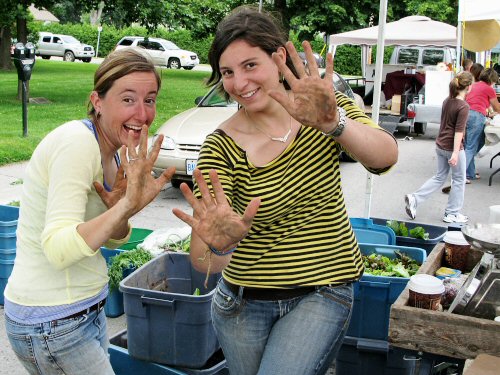
Over the last couple of weeks, we’ve been experimenting again with rinsing versus…not rinsing. This comes up a couple of times every year, where I think (or someone suggests) that rinsing various veggies is not necessary: to save time, to improve storage, to preserve nutrients,…the reasons vary. (For me, the time-saving is always a big attraction!) Sometimes, crops just have to be rinsed to cool them down quickly if harvested in the heat, or because they’re really mucky from heavy, mud-splashing rain. In any case, this week, we didn’t rinse the carrots, beets and beet greens, so sorting at the market was a bit messy. That’s Lynn and Maria, happily dirty-handed… The conclusion is usually the same: when the harvest is really kinda muddy, which is often the case this year with all the rain and wet ground, a quick rinse is better all around, for handling and for presentation. Still, the experimentation continues!
Harvest
Kids in the field
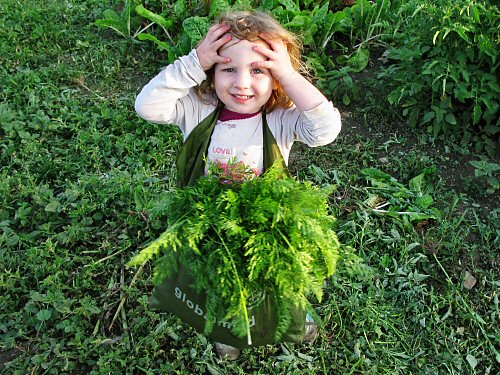
A fair number of kids have dropped by the farm, parents in tow, but today was the first time since I’ve been doing the tiny farm blog WITH PEOPLE INCLUDED, that smaller children figured directly into the fieldwork picture. Michelle, whom I’ve known for 4-5 years from the farmers’ market, and who now comes by to help harvest on Fridays, dropped in today with her three…kids. There’s the impossibly cute and BUSY Violet, age two (above), who was into a bit of everything, like collecting carrots and eating every veggie she got her hands on. Allie (6) was really helpful, harvesting carrots with Lynn and Maria, harvesting beets and cauliflower with me, totally pulling her weight. Big brother Michael (8) kept Violet out of trouble here and there, but mainly chatted with me in some depth about his rugby and hockey teams, his parents views towards his sports performance, the video game he’s currently playing,…and other stuff. While Michelle cut a huge amount of all-lettuce mesclun, the kids hung out, did some useful fieldwork, and overall contributed in a surprisingly great way to the harvest afternoon vibe… Another happy side of the Tiny Farm Experience!
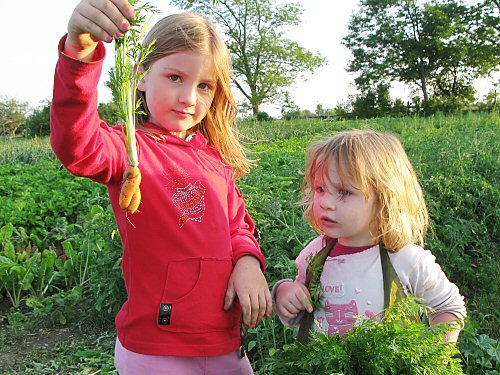
Fun with carrots…
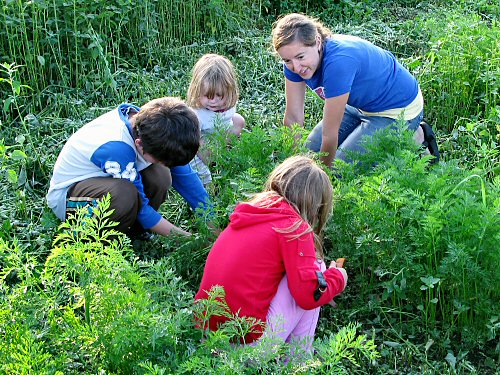
Lynn conducts an impromptu field seminar, featuring…carrots.
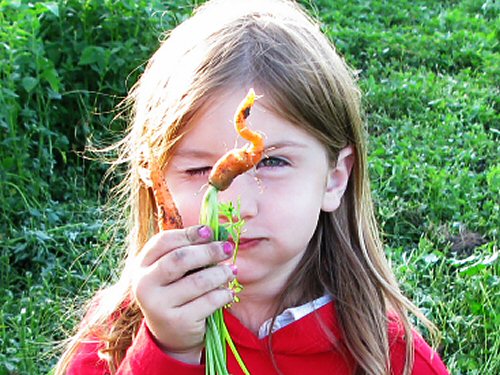
Allie eats and inspects carrots at the same time…
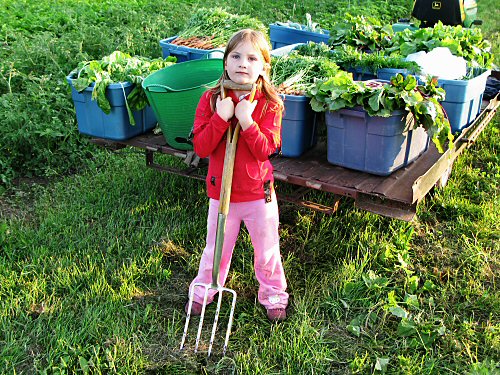
Strike a pose… Kids in the TFE!
Still a lot of greens…
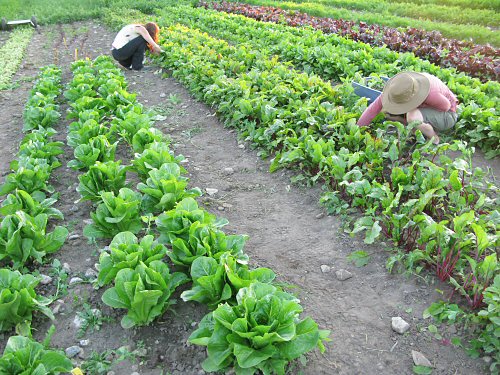
The Friday harvest is still greens-heavy, with beet greens in several varieties leading the way. Here, as the afternoon winds down and the temperature cools, Michelle and Lynn thin the second beets planting of Scarlet Supreme, with Chioggia and Bull’s Blood off to the right. There’s also the fourth planting of all-lettuce mesclun, just cut on the far left, and in the center, Panther romaine, miraculously spared by the earwigs and in excellent shape and taste, to be cut next… Elsewhere, cauliflower, parsley, the last of the spring spinach and peas,…
Pick your own CSA share pick-up
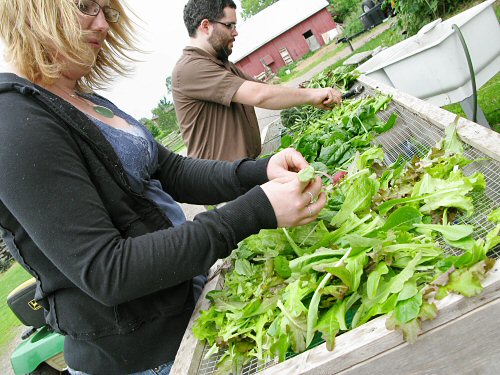
CSA shareholders coming to the farm this year are encouraged to harvest as much of their share as they feel like! Here, it’s sorting through mesclun and spinach on the screen table, removing bad leaves and the odd weed, before packing in their own bags. This approach is great fun all around, with me explaining what to do and helping out when needed. There are only a couple of on-farm pickups (most are at the farmers’ market), so this approach might be a little more personalized than if the number of shareholders was bigger. Regardless, this DIY approach is a tiny farm first that seems to work!
Broccoli from the weeds
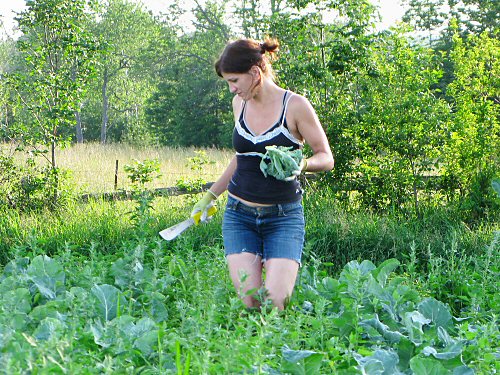
Michelle harvests the first broccoli from knee-deep in weeds. After taking off the row cover, it made more sense to wait a few days till harvest and then turn the whole bed under, than to spend precious fieldwork time weeding the paths—a race for the broccoli to beat the weeds before they went to seed…
Green on green
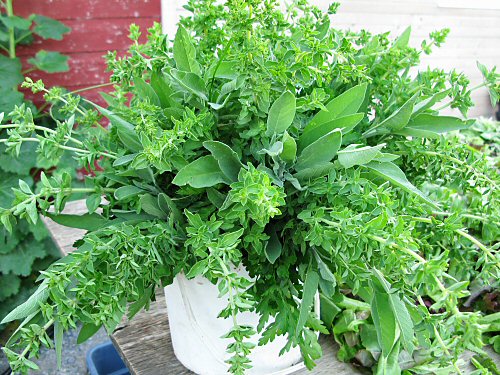
Tiny farming has given me an extra appreciation for the color GREEN, in different shades, shapes, textures, combinations. Green on green. My favorite greenscape so far is probably row upon row of different varieties of bush beans, each with their own shade, deep and dark, to delicately lime-hued. Today’s small harvest of sage, oregano and flat-leaf parsley, stashed in a bucket of water and headed for small bundles in the CSA shares, had a great green look. The photo, especially at this size, doesn’t really capture the simple, entrancing effect, but I guess it’s the next best thing!
Tiny harvest!
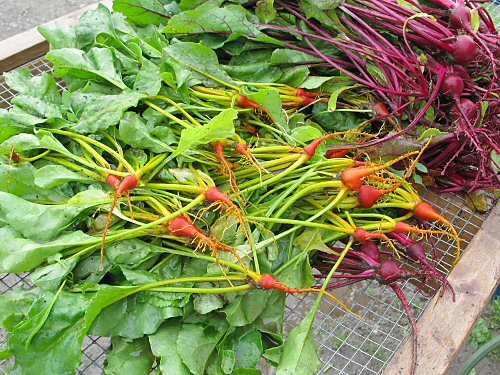
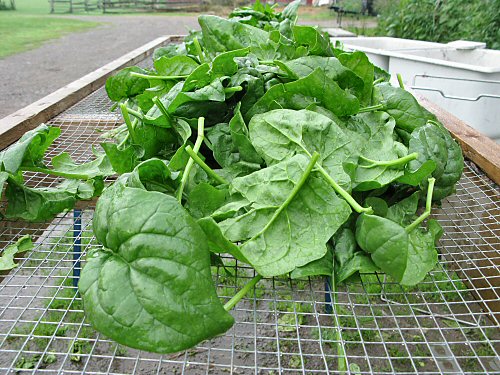
Spent the early morning harvesting a few CSA shares for a Monday drop-off. This is the first week of shares, and they’re still small, mainly greens… There are many tiny farming routines, things you’d probably never do in a bigger operation, that I find extremely relaxing and fun: the final rinsing and putting together of a handful of shares is one of them (it’s not really economical to separately harvest and drop off less than 10 shares or so, this is an…exception). There’s something deeply satisfying about this final post-harvest step, with the veggies together at their finest, the memory of the different quick individual harvests—picking, cutting, pulling—still fresh, that’s…cool! The spinach (above) was quickly dunked in cold well water to rinse off dirt splashed up from recent rain, then allowed to drip dry for a bit on the screen table.
Picked two types of beet greens, Golden Detroit and Scarlet Supreme. The stems are a little long on these—it all depends on the density of the rows, the weather, the harvest timing, leaf size is the luck of the draw since these are really thinnings, they’re not being grown just for the greens. Still young and tender, the baby beets and all can be cooked up, or the leaves used raw in salad (or as a salad!). Really tasty…
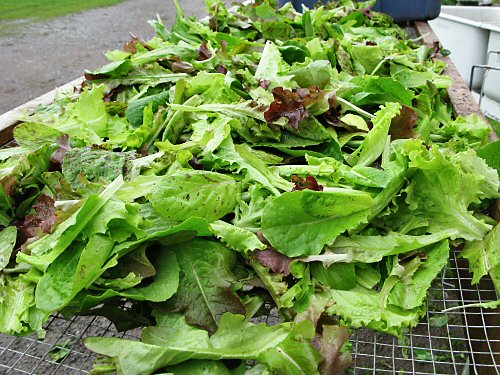
And mesclun, of course. This all-lettuce salad mix is a staple crop this year as usual, always on my mind! This cut’s nice and clean! Unrinsed—I let the morning dew dry off a bit on the screen table… More simple pleasures for the simple of mind! ;)