Dog days of summer (a few)

The muggy wave continues, the sixth day or so of bright, swelteringly humid heat. Today was only 21°C (72°F), but the Humidex (or whatever exactly They call it) says it’s the equivalent to us humans of 40°C (110°F). It does feel that way. I can’t recall ever hearing a spread that big—quite weird, or maybe the Humidex got more accurate…

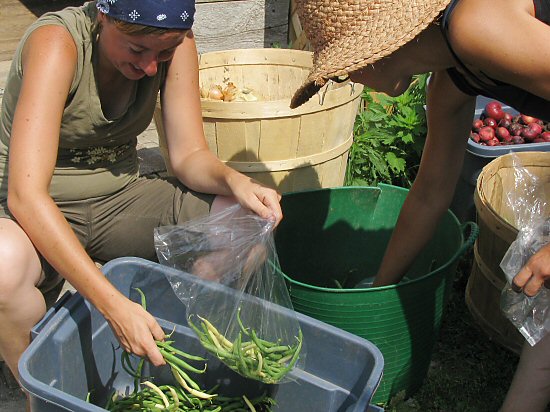
A smaller crew than usual this Monday morning as we harvested for CSA shares. Lynn and Mel (above) were out earlier, hitting the field at 7 am, partly to get a jump on the heat, partly because they both had to leave earlier as well. Michelle arrived around 8:30. Tara was tied up preparing for a short trip. Jordan, another Monday regular, is away for a couple of weeks, on various visits around the north-east.

People in the field. I still find it mildly unlikely and extremely cool each time one of our tiny field crews assembles for a day. Sometimes it’s a crew of two, other times, usually harvest Fridays and Mondays, the numbers swell (big for a tiny farm!).

We all head to the field for different reasons and different returns. The work is never endlessly tedious, we don’t go out and, say, pick beans for 8 hours, but we do get a lot done, and everyone does a bit of everything. You can find a little instant closure, where the start and end of a thing are all right at hand. You can learn to small-scale farm. You can chill out, take time to think—garden meditation while breathing some relatively fresh, country air and dabbling in the dirt. Chatting while veggie gardening can be great. It’s whatever you want it to be…

Today, it was hot. The shares were done by noon as planned. It’s all good! :)
Chickens, frozen

Frozen chickens

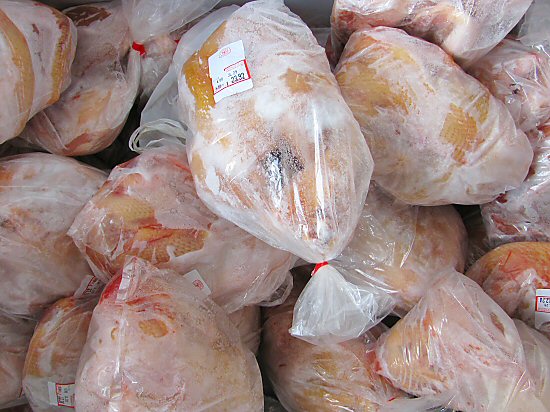
There they are: 38 newly processed chickens, freezing solid in the chest freezer (39 minus the one we took to roast fresh). It’s the last stop before the table on what was a pretty fine meat bird run.

Like everything else on the tiny farm (and in life in general!), when you get down to freezing chickens, there are the details. What I noticed this year is the amount time it takes to actually freeze chickens solid. This wasn’t quite as apparent last year, when we started with under 20 processed birds. Here, checking out the new freezer’s manual, I loosely followed the advice against freezing too much at once. I put in half, around 20 chickens, for a few hours, then added the rest. I’ve also been rotating them—they freeze faster when they’re exposed—but after a day, they’re not all rock hard.

I have it in mind that the faster you freeze stuff, the better it is when you thaw it out: firmer, not mushy. Something about smaller ice crystals doing less cellular damage. Sounds plausible to me!

Luckily, the chickens came heavily pre-chilled from the processing house. Processing your own in any sort of quantity, I imagine you need a fair bit of refrigerator space to cool them down, or a walk-in cooler, or lots of chest freezers. Another thing to look into for…the future!

Of course, the whole freezing thing is another puzzle. It’s quick and easy, and works really well for all kinds of food. Newer chest freezers seem quite energy efficient: this 15 cu ft one uses 400 kWh a year, which is like keeping a 60W lightbulb on for 9 months (at current electricity rates around here, that’s about $50). Doesn’t sound so bad, and there’s room for lots more in there. Still, we’re trusting a lot to yet another plug…

FINALLY, there’s the sticker, another fine feature of commercially-processed chicken. The meat is Ontario government-inspected (a provincial inspector is always on-site, that’s the law), which is indicated by a little logo on the label. Plus you get the date, weight down to two decimal places of precision, AND a price-per-pound of your choice. I picked $4. These birds are for our own use—not for sale—but it’s always fun pulling out an EXPENSIVE farm chicken for dinner, as long as it’s priced kinda within reason…

So it’s…colors!

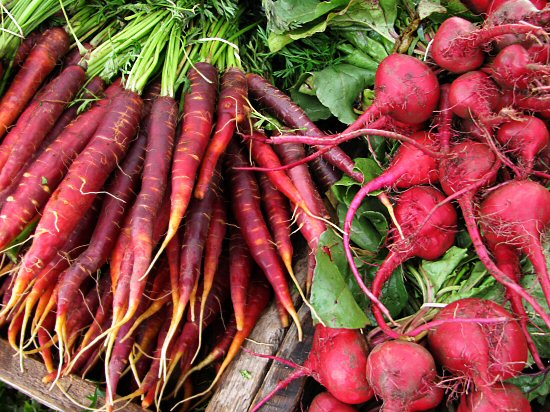
Purple Haze carrots, Chioggia beets

Cloudy, coolish weather continues, and the growing’s so slowwww…  At the farmers’ market today, instead of all-new main season veggies, it’s kinda more of the same. No super-early tomatoes (Stupice!), not even BEANS (not even the super-early yellow wax beans…). But the root crops are doing well with the rain, and their colors are…refreshing. Here, purple Purple Haze carrots, and radish-red Chioggia beets, freshly misted, drenched with…color. That’s nice… :)

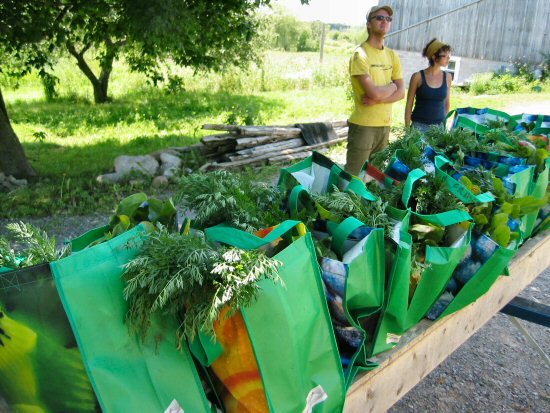
Packing shares: done!

CSA shares are packed for another Monday of on-farm pick-up! It’s one of those great hits of momentary satisfaction to see them all, 100% absolutely and finally done, waiting to be collected. Mel, Jordan (above), Michelle, and Tara were all in the field, and the whole harvest went by kinda quickly, maybe three hours. I’m also figuring out the easiest ways to use different spots around the new farm. Today, as a temporary improvement, we moved the long screen table into a tree-shaded part of the drive, allowing us to line up the bags in one row, instead of grouping them on two smaller tables indoors in a shed (it’s all in the details! :). Keeping the packing space uncluttered is kinda critical if you don’t want to spend half your time rechecking shares to make sure that they’ve got everything. When the set-up works, filling shares is really suprisingly satisfying.  On the tiny farm, assembly lines can be fun!

In the share: baby leaf lettuce salad mix, baby zucchini, cauliflower, garlic scapes, young carrots, beets, new potatoes, curly& flat-leaf parsley.

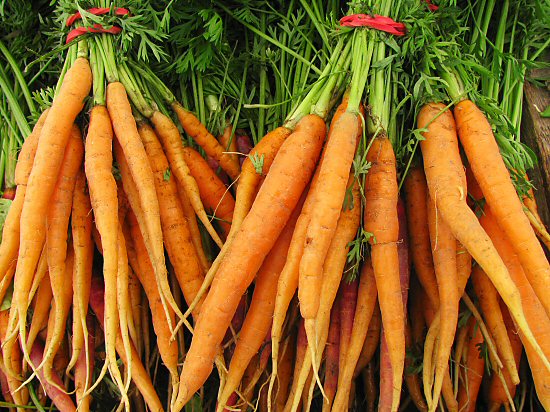
Baby veggies go to market

You can’t go wrong with baby carrots, it seems. They are, well, cute (I’ve heard people say that way more than once). So you can buy them and eat them, or maybe stick ’em in a clear vase full of water for a while (idea!)… In any case, these Nelson carrots are not only fun to look at, and small, they’re pretty tasty! Nice crunch, and good sweetness for summer. Because of the kinda slow-growth in this cloudy weather, we took the time to do a second carrot thinning, just to harvest these (often, at this point, they’d be bigger, and we’d start digging up whole rows).

Also along for the ride, and sold out quite early, baby beets, mostly the candy-striped Chioggia (below), with a few red Kestrel in there. And, a couple of varieties of lettuce, the super-red Granada oakleaf and the butterhead Kendo. Both have a strong, bold taste, able to hold their own in sandwiches or…anywhere else. Plus, not in sight, all-lettuce mesclun (well, baby leaf mix).

Along with the last of the Sugar Ann snap peas, that was it for a fairly rainy, kinda rained-out Saturday at the farmers’ market… Still, fun!

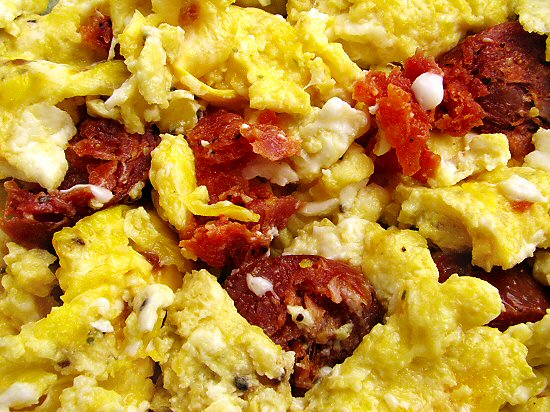
Farm eggs with hot sausage

A week after arrival, the 25 Shaver Red Sex Link ready-to-lay layers are starting to lay. That’s good. We’re up to 7-8 eggs a day, and most are just shy of Small (on the official egg scale), but the numbers are improving daily. Much watching and counting…you can easily get kinda obsessed by it all. Getting up to speed!

Meanwhile, after three months without, fresh-daily eggs are back on our farm menu! Today, my first taste: 4-5 small eggs, scrambled with olive oil and salt, topped up with chunks of semi-dry Hungarian hot sausage from the farmers’ market. Pretty good!

Local beef

A cool change with the much bigger farmers’ market we’re at this year is the easy access to lots more local food from other market vendors. We’re there every Saturday, and so are they! (Nothing better for really appreciating a farmers’ market than being both a seller and a buyer…).

The biggest change for me is, suddenly, there’s all sorts of LOCAL MEAT. There’s beef, bison, chicken, emu, rhea (ostrich-like), plus a cured-meat-and-sausage vendor, a butcher, and more (venison and elk, I think, and there must be pork in there as well). Still haven’t gone through it all, but I have started to taste my way through the beef. This week, I’m on to a second beef farm.

My sampling approach is simple: buy a steak cut (I prefer rib) and some ground, expensive and…less so. In the first taste test, the beef was certified organic and 100% grass-fed. Today’s, also certified, is fed a combination of grass (pasture in summer, hay in winter, of course) and corn silage, all grown on their farm.

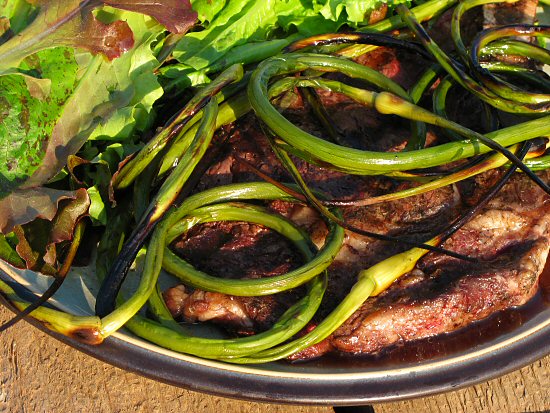
The meal is pretty local: rib steak, grilled to medium-rare and lightly salted, topped with grilled garlic scapes, tossed in a salt, pepper and olive oil, and our all-lettuce mesclun, just cut, with a drizzle of olive oil and a splash of apple cider vinegar.

The scapes are from our market stand neighbors (it’s so sad not having our own fall-planted garlic in the garden this year!), happen to be organic, gotten on a trade for mesclun. The beef was purchased for full price (vendors give each other a 10% discount here, but I didn’t bother to identify myself just for the savings, I’m sure we’ll get to know each other over the summer…!).

All in all, totally tasty, and even easier to buy and cook than to write about! :)