
First day at the new farmers’ market

Our space at the farmers' market

Here’s our so-far-unoccupied space at the new farmers’ market… This photo was accidental, clicked while checking some camera setting or the other. But when I saw it on the computer, it reminded me of the totally transient nature of farmers’ markets (and tiny farming in general!). Here we are, standing in a rectangle of asphalt marked out by some yellow lines, a PARKING SPACE, that transforms for a few hours into our little veggie emporium. All of the intention and energy of the tiny farm, concentrated…RIGHT HERE?! In a giant parking lot. Kinda weird… Life is what you make it, I guess! And I do love going to market! :)

Showed up at the 7am start of summer market opening day, to make an appearance, check things out (like, our new spot!), meet some of the other vendors, buy some food. Tara will also be here every Saturday, plus others when they can, but for the next couple of weeks at least, we won’t be setting up, and some veggie vendors won’t be here till June.

This market is at least 4-5 times bigger than the one we attended at the old farm. It’ll be a big change, with more small-scale organic growers offering similar veggie selections, and also way more people, but none of the familiar faces I’ve gotten to know, in many cases over 5-6 years. That last part is sad, but overall, it’s exciting.

Our stall is in a central spot—the empty space beside the round, yellow “honey” sign (below)—which seems good. Upfront in the photo is an array of unseasonably available produce—nice sweet peppers for early May!—from one of the several larger vendors who presumably buy at least part of their menu where the supermarkets do: a local food issue that’s concerning, but doesn’t upset or anger me the way it does some—everything tends to shake out…

We’re located beside another tiny farm, and I chatted with neighbor Anna about whether that might be a plus or not, if people have to choose from similar things on both stands. We’ll see, but it sounds to me like more choice, MORE FUN, and from what I’ve heard so far, all the small growers usually sell out by the end of the morning anyway. I bought some wild leek from our neighbors, a bag of great mixed baby greens from another aisle, an excellent bag of mixed sprouts…there’s lots to buy at the market when you’re not tied to your own veggie stand!

So, in its own exploratory way, our new season at the new farmers’ market begins…!!
Mixing and repotting

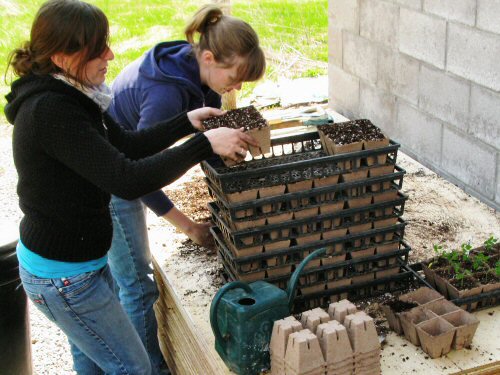
Filling peat pots

Today’s featured task: potting up tomatoes from plug sheets to 3″ peat pots. As with many things here this season, this is a little later than usual, by a week or so, as the new farm set-up gets squared away. (It should all even out sometime in June.)

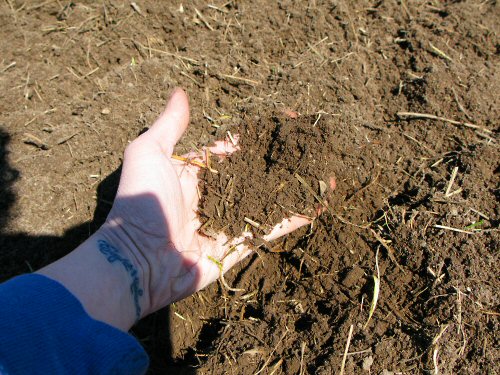
This batch of seedling mix is about 50% compost, 25% peat and 25% perlite. Lynn and Andie did the blending on top of a stack of 4×8 plywood, using a shovel, and hand-crumbling clumps of peat and compost. With a little experience, it’s easy to judge a mix by squeezing it (or you can just follow a recipe exactly), but a fairly foolproof test, when using compost or soil, is to water-in a loosely packed pot: if the mix collapses into a muddy muck, you need (lots) more perlite/vermiculite/peat. Water should flow through leaving things still kinda fluffy.

Between tomatoes, peppers and eggplant, we’ll end up with maybe 900 potted-up transplants, aimed for the field in about three weeks. I’d decided to stop using peat pots this year because you have to keep buying them (they’re planted with the seedling). BUT: it’s so busy, there was no time for soil blocks, hadn’t had a chance to find a supplier for reasonably priced, small bulk quantity (reusable!) plastic pots, and we found an inexpensive peat pot supplier in town (they’re usually ordered and delivered), so it’s peat once again this year…

Direct seeding

Direct seeding is going ahead at a careful pace. There’s a fair amount of broken up sod in the mix, and it would be nice for it to have more time to settle in and decompose, also for any bits of live grass to start poking up so they can be disrupted again with a light tilling… But we can’t just wait around. Spinach, beets, and radish went in a few days ago, just after the first peas. More peas went in yesterday (Connor for the first time wrestles with the kinda heavy and unwieldy Planet Jr., above, and ends up doing fine on a trial row). Now, the watching and waiting is on for the first plants to emerge in the field…

Disc action

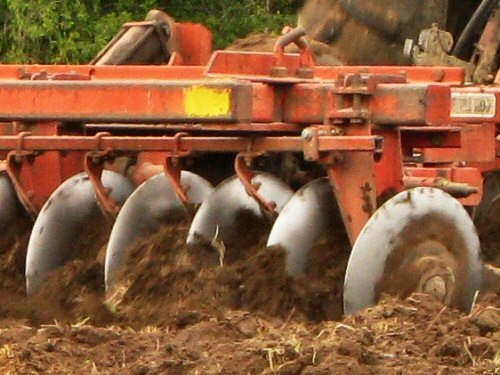
It’s steel in the field… Big machine work was the tiny farm highlight today, not the machinery itself but the intense and much-needed sod-busting action. Peter, a (certified organic) beef and grain farmer on the next two (much bigger) farms down the road,  dropped by just ahead of a bit of a rainstorm, to disc the fields he’d moldboarded in the fall. There was time for two passes on the south field, then the weather hit, bringing plowing to a sudden stop as the ground almost instantly got too slippery and soft.

My experience with big tractor work is limited. Maybe someday I’ll get more involved with heavy machinery—to watch, at least, big machines are fascinating and…cool. Or perhaps I’ll go the other way, d/evolving all the way to Fukuoka-like farming with little more than an intricate method and a stick… Probably stay somewhere in between… :)

In any case, this is all one-time stuff. The double row of discs do some serious pizza-cutter work on the dense, moldboarded strips, so we’ll be able to rototill more easily and effectively, without tearing the little tiller apart. And then, the soil food web can rebuild.

Elsewhere, earlier, I direct seeded the first spinach, beets and radish. Following their progress in the new garden ground will be interesting…

Hoophouse end walls

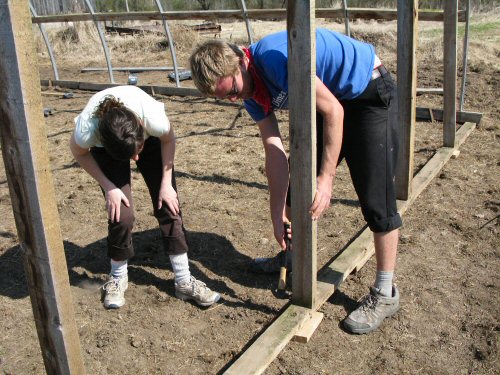
With the clamoring demand for greenhouse space around here, getting the hoophouse finished now that the frame is up is a PRIORITY. Yet here we are, a week later, framing the end walls and installing the wood along the sides for the roll-up section of the sidewalls. A stretch of wet, cold weather was the main cause for delay. Plus a really long list of other critical things to do at the same time.

For maximum satisfaction on the tiny farm, you want things to effortlessly flow along, from one small task or specific problem, to the next (IMHO, of course!). Right now, there are lots of phone calls to be made, things to follow up on, info to find, bits to write and forms to fill, stuff to source and buy, all sorts of more abstract, open-ended, DISTRACTING activity. Eventually, it will settle down into a more-or-less all-garden flow…

In the pic, Jordan and Lynn work on reassembling the end walls. The ground isn’t absolutely level, there’s a gap to fill underneath the 2×4’s along the bottom (the sill plate). This isn’t a problem as the weight of the hoophouse sits on the 4×4’s running along the sides—they’re firmly anchored, so we’re set.

In this case, we can’t cut the studs longer to extend the wall, because we’re going to reattach the existing, pre-cut plastic. Everything has to come together the way it was. I should’ve numbered and marked each rib and piece of wood as it came apart. I’d usually have thought of that, but in this case, I only marked the main plastic, so that we could reverse it. Now, fitting it back together is a little puzzle… After this, there’s not much more to do, just wait for a windless day to skin with plastic. Onwards!

Tiny machine action

Beautiful weather, around 60°F (15°C) in the full-on sun, with a crisp undercurrent of a breeze… What could be nicer for the first full day of fieldwork?! Lynn, Mel and Jordan came by at 8:30 am, and Tara joined in a little later on. We’re still working on preparing the beds, so the main action was raking and ROTOTILLING…busting up that sod. And everyone’s gearing up for the season, learning where things are and how to do…stuff. Like…rototilling! Mel tries her hand at it for the first time (above)—the Kubota compact tractor is as reliable, steady, and undaunting as ever…

Tara also rototills for the first time. Here, she executes what looks like a nimble little turn

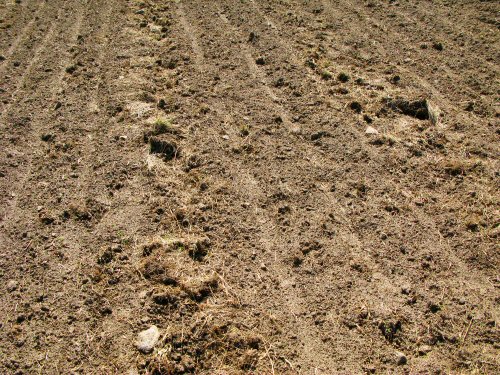
Mel inspects the results of a pass with the rototiller, checking out the effect of tilling at different speeds. And the tiny farming goes on… (Photos 2 and 3 by Mel)

Managing seedlings

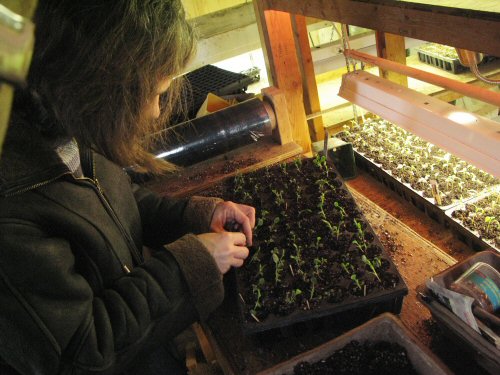
It will soon be time to move many of the seedlings to roomier quarters—there’s only so much space under the lights, so the greenhouse has to go up soon! Timing is getting trickier by the day, but we’re still doing fine. Here, Tara, at the very start of her tiny farming career, manages her first tray of cauliflower, splitting cells with two seedlings, and filling any empty spots. There’s not always time for this sort of micro-gardening, but there is right now…!