
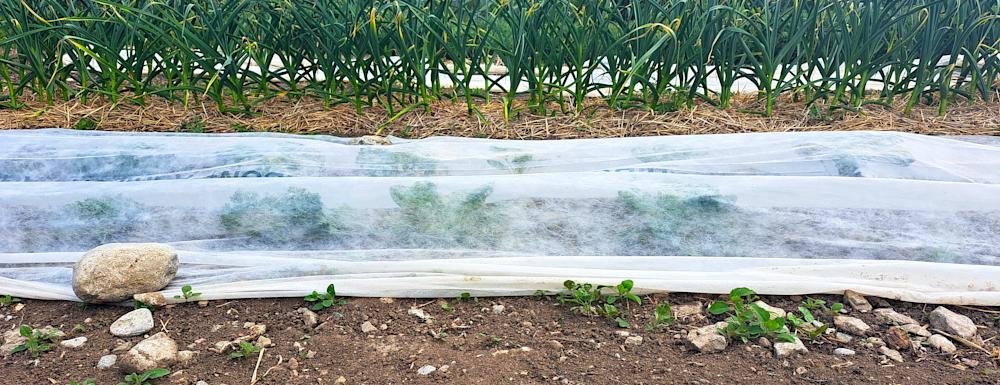
Kale and Brussels sprouts are tucked away under floating row cover (with straw-mulched garlic in the back). This is usually to protect them from flea beetles that can devour the seedlings. This year, unfortunately, it’s also a deterrent to the sudden invasion of groundhogs. Invasion isn’t the right word if we’re talking about numbers, as my best guess is that there are only two doing the damage. Their work, though, is so far somewhat alarming. They have a particular taste for lettuce; they’ve already gone under and through the cover to get a it. But in the last couple of weeks, it seems they’re out to at least sample just about everything. Since last year, and especially this spring, I’ve seen several groundhogs in the general area, which is new and a lot. Last season, there was a little veggie munching, but nothing out of hand. So, to a point, live and let live. This time around, seems like it could get more serious. As far as pests and disease, from year to year, if it’s not one thing, it’s another…
Pests & Disease
Turkey vulture on patrol
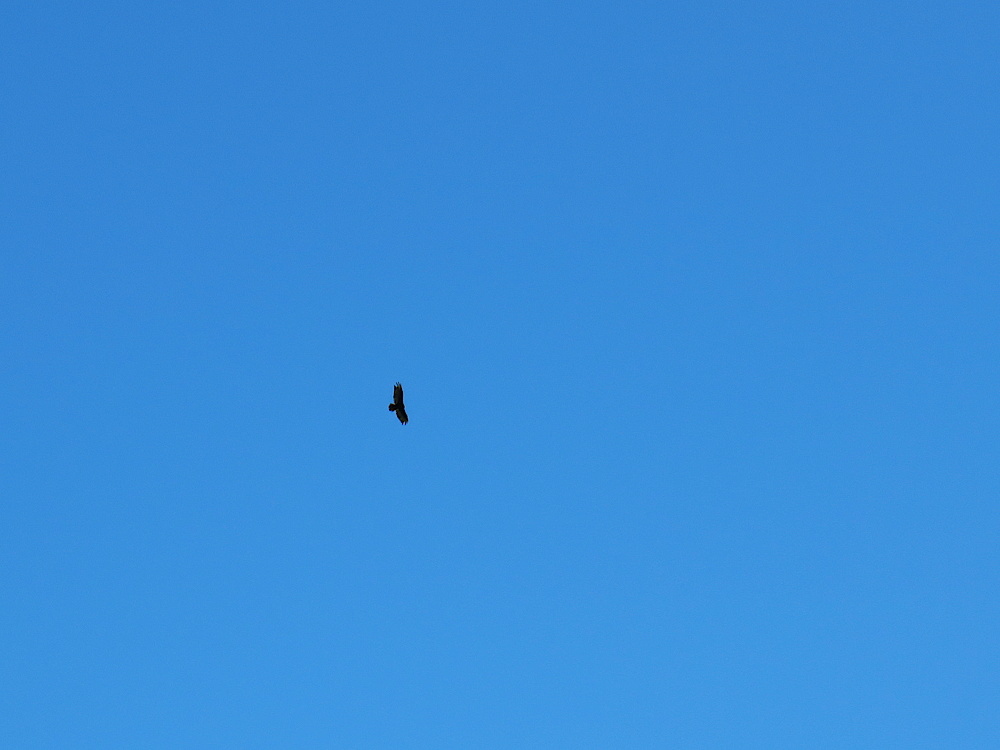
A turkey vulture lazily circling way up, looking for dead flesh. I’m not entirely sure of my bird ID, but pretty sure. These guys circle all the time, barely moving their wings. I used to happily imagine they were some kind of hawk, on patrol over the vegetable patch, the clear, weeded rows a perfect background for spotting rabbits, maybe even zeroing in on seedling-munching field mice and voles. It was a pleasant thought bubble, burst when I eventually looked into it. The overall boxy shape, the fingered wingtip feathers, the patient gliding loops with little flapping, all seemed to say, “Vulture! Turkey vulture!”
Greens, protected!
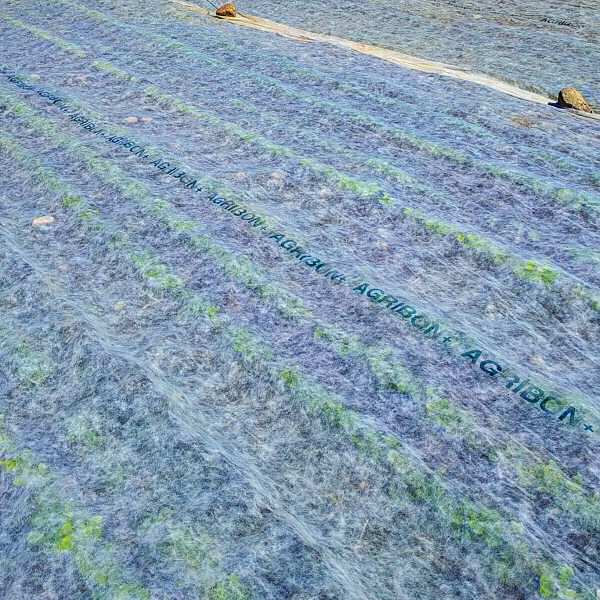
Floating row cover, weighed down and made semi-transparent by water, is all that stands between fine young brassica greens and the scourge of the flea beetle. The cover is placed right after seeding, weighed down by rocks every 12.5′ feet, briefly rolled back for weeding, and progressively loosened as the greens grow—we use 14′ wide sheets on 10′ wide beds. This medium-weight cover has worked as a good all-round solution, offering a few degrees of frost protection, and more durable than a lighter, insect-only weight, which would allow better light transmission (this medium weight one is 85%) and better air circulation, but also be more likely to tear.
In the greenhouse: bok choi vs flea beetle
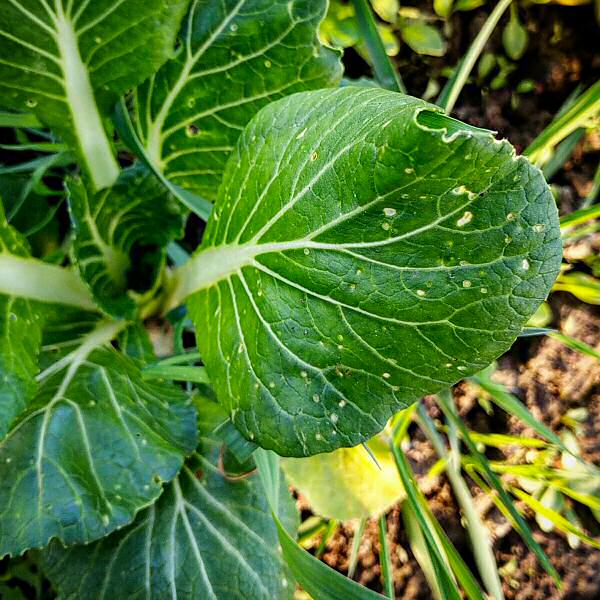
Everyone loves the greenhouse! The warmth, the wind break…crops, weeds, all plants love it in here. Now it seems flea beetles have acquired the taste as well. For whatever reason, the FBs usually stayed out of the (much smaller) little greenhouse, but here in the new big house—munch, munch, munch—bok choi is under attack. Hoped for a free pass on FBs in here as well, instead, it’s row cover. Learning as we go…
Weed ID-ing in the Digital Age
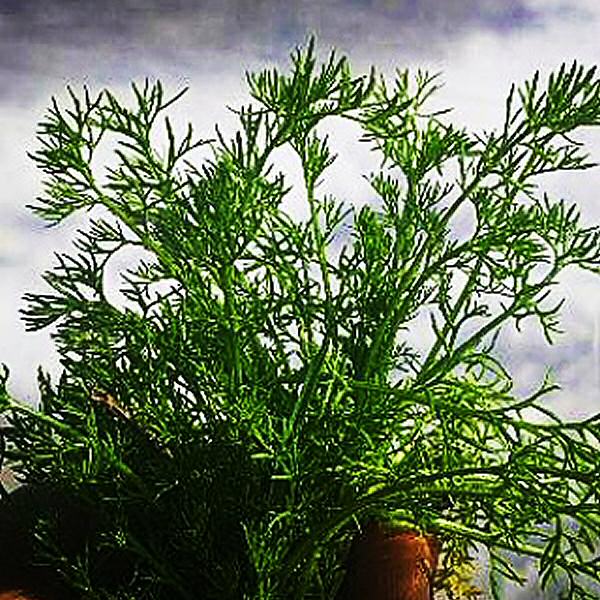
Wormwood of some sort, this weed from the greenhouse, according to our best guess from a selection of possibilities offered up by the smart smartphone plant identification app I’ve been playing with/trying out. There are several such apps for Android: this one’s called Like That Garden—”See a plant, take a photo, and find out what it is – instantly!” It got the highest ratings, and is free, so I grabbed it.
Like the advertising says, it’s that simple to use. With the app, you take a snapshot of the mystery plant that’s saved as a low rez image (above) and sent off into the ether where it’s checked against a vast plant photo database, several possibilities soon return, with multiple images for each, and you pick the one most likely (I suppose in some cases, only one choice comes back, but so far, that hasn’t happened). The technology is all about advanced image recognition and visual searches, very…digital. Trying it out on a few plants, it’s worked quite well.
While this app is doing fine, I have a great (effective) weed book as well. Is the app a novelty toy, or a serious tiny farming tool? Or will the smartphone be accidentally dropped in a puddle and destroyed before we get a chance to decide? Only time will tell…
CPBs
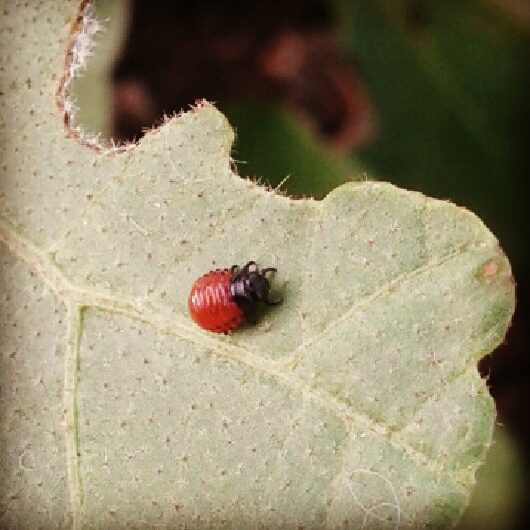
Pre-squish: Brand new Colorado potato beetle, larva about the size of a match head, on eggplant. Around the leaf edge, older damage done by bigger CPBs. Recently, for whatever reason, they’ve been around but not in numbers enough to be a big problem. The crazily erratic weather of the last few fears seems to have obliterated regular pest cycles, so we just see ’em and pick ’em…whenever.
Praying mantis visit
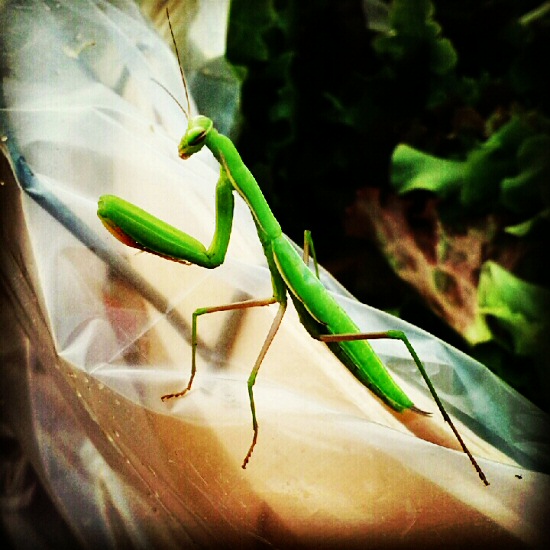
It came with the greens. A praying mantis perched on the edge of a lettuce mix harvest basket and took the ride in. Kool kat, with a wraparound look. Friendly, too, if insects can be, calm at least, let it walk on my hand to transfer it to a fence post. Don’t see them often, so I looked ’em up and…yikes! “Sexual cannibalism is common among mantises in captivity, and under some circumstances may also be observed in the field. The female may begin feeding by biting off the male’s head (as they do with regular prey), and if mating has begun, the male’s movements may become even more vigorous in its delivery of sperm.” Kinky and kinda brutal. But reading on, it seems this behavior may be induced by the distractions of being constantly observed in the lab, and not a normal practice. There we go again, messin’ with stuff. Well, this one got away. In the wild, it’s considered a beneficial insect for the veg patch, a massive hunter that eats “most pest insects, mites, eggs, or any insect in reach.” Nice. And it’s apparently the only insect to hunt moths at night, and the only one fast enough to catch flies and mosquitoes. Go, mantis!