
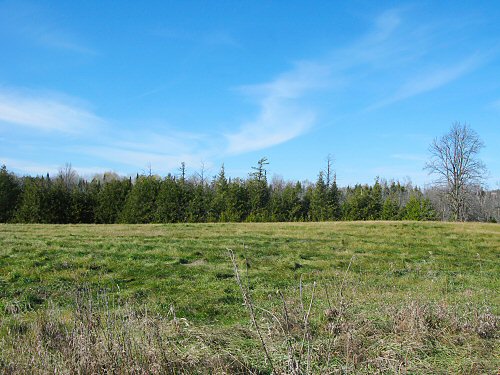
Spent the day at Tara & Michael’s farm, my second visit, and a beautiful day it was. I took the time to walk around alone, checking out the fields for veggie garden locations. It was a great feeling, deeply exciting, to look out over new farmland, and start to apply all of the things I’ve learned from six seasons of tiny farming in one place to another. The field in the pic has about two acres of fairly flat land that looks good. There’s also a south-facing slope that looks perfect for a small, early spring garden to take advantage of the faster post-snow drainage and quicker soil warming that a southern incline provides. I checked for twitchgrasss (nope!), and signs of other invasive weeds (it’s all hay that’s grown out to mainly grass). From a couple of samples, the soil seems like a clayey loam, similar to what I’ve been working, but it’ll be easier to see when it’s plowed up. Looks good so far, clean and ready for tiny farming action! Nothing like a fresh challenge to force you to review your thoughts and experiences, and discover conclusions you may not even know you’d come to. At least, that’s how it feels for me. Change is in the air! It’s excellent!!
Planning
Middle of the day at the market
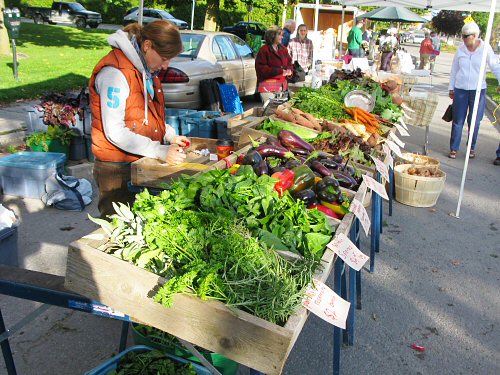
Here’s another slice of the action at the Saturday farmers’ market: recent market posts covered the beginning and the end, this is…the middle. In the first two pics, it’s about 9am—the market’s been open for two hours, but in colder weather like today, most people start showing up about now. This is the first time we’ve extended the stand by adding a new section with four more bins, quite an occasion, since I’ve been using the same 7-tray set-up for five seasons, almost since the beginning. It’s also the last day of tender crops, with a final harvest of eggplant and peppers. Lynn, vested against the chill, in the first pic looks like she’s making up more signs: red market on light brown card stock…
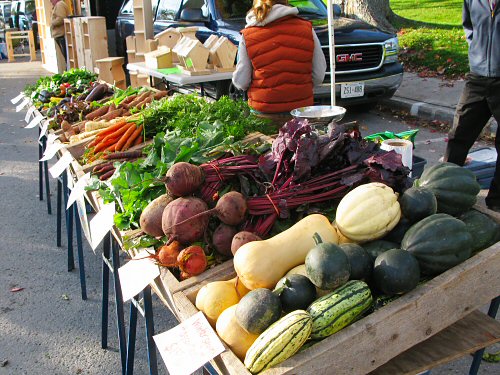
The shallow trays are easy to fill, it doesn’t take much to create a nice display. As things are sold, the display is refreshed from bins kept in the shade. The trays aren’t ideal for all veggies. Winter squash are harder to sort through, but there’s also a full assortment in bushel baskets that people can look through, with the trays more for display…
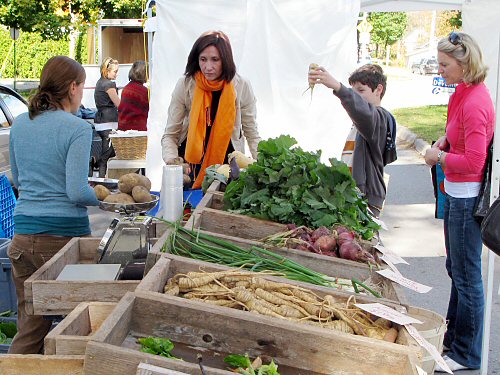
Jump ahead to about 11:30. It’s warmed up considerably, into a beautiful, summer-like day. This is Canadian Thanksgiving weekend, and the traffic has been pretty good. Traffic has died down in the last half hour, some crops are sold out, but people come by till the end…
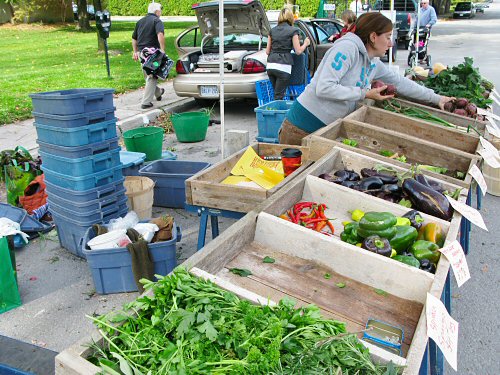
It’s now about 12:40. The market ends at 1, and we have until 1:30 before the street is opened up again. Most vendors start packing up early, around 12:30, but we always wait till the official end. Today, we’re pretty well sold out: the only veggies left in a bit of quantity compared to what we started with are some mostly very tiny eggplant, curly and flat-leaf parsley, Red Russian flat-leaf kale, and some winter squash. With things like kale, not exactly a universally popular green, sales are inexplicably random: usually low, but on some days, you can’t have enough. So, you always bring as much as you can (within reason!). Anyhow, a really satisfying and fun market day is almost done…
Night work
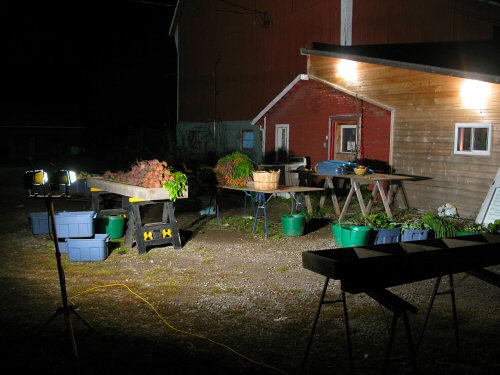
In the fall, post-harvest work doesn’t necessarily end when the sun goes down (it’s dark by about 7:30pm right now). Actually, this year the fall Friday harvest has gone great, with Lynn, Libby and usually Michelle knocking things off in the field by around 5pm, with only bundling and rinsing to go. But I’ve been wrapping up with the crew by 6, taking a break, and doing whatever’s left on my own…later at night. It’s something I’m used to from the first few seasons, when the mainly solo harvest usually went straight through until 11pm or midnight. Tonight was the first time I’ve hauled out the light stand this year. It’s around 10pm, the two lights specally installed on the side of the Milkhouse for this purpose are on (they’re both regular 100W bulbs, the full plan is to install floodlight fixtures), and there are twin 250W all-weather halogens on a stand. It’s not perfect lighting, but quite enough to get the job done without stumbling around. Tonight is a quick set-up to rinse carrots and beets. Full-on post harvest lighting includes a second light stand, with both set higher up and beaming down, and floodlights properly positioned, to give pretty good 360° coverage of the work area, and enough illumination to watch the mud wash off…
The Omnivore’s Dilemma
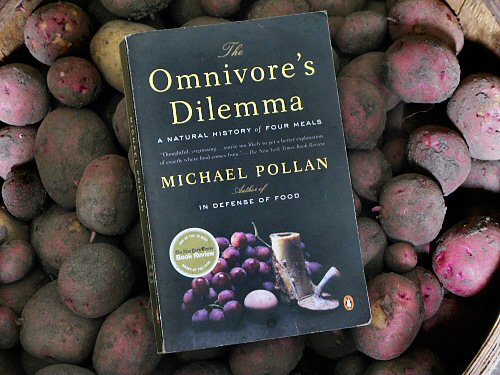
Since I mentioned buying this book a while ago, I might as well wrap it up! I recently, finally read Michael Pollan’s The Omnivore’s Dilemma: A Natural History of Four Meals, an investigative reporter’s full-on indictment of modern food. It came out in 2006, but with all of the praise and recommendation I’d heard from people around me and online, it almost felt like I was waaaay behind a life-changing, or at least, EYE-OPENING, experience. In fact, I’d read excerpts and heard Pollan speak on radio and TV, and I had a pretty good idea of what the book would be like: HIGHLY ENTERTAINING and densely packed with condensed bits of accessible scientific explanation, intriguing and disturbing facts, and involving eyewitness accounts. OD definitely delivered on all counts.
I read it over a couple of days, a real page-turner! For a week afterward, choice nuggets of often alarming info swirled in my head. And then, the details started to fade. It’s now a couple of weeks later, and a few choice bits remain. I really like the idea of being driven by the complementary opposing forces of neophilia and neophobia (kinda like the angel and the devil, sitting on each shoulder…), and that we humans developed big, powerful brains in order to figure out what to eat (something like that). The description of grass farming was absorbing. Mushroom hunting sounds…extreme! And so forth. Oh yeah, and we’re feeding ourselves crap!
The one big downside of this sort of intensely involving overview, covering so much territory in just 400 pages, is that you can’t absorb that much in a practical way. So, you’re entertained in an agri-suspense/thriller/horror style. The result: if you weren’t already convinced (I was…), you’re now likely quite certain that our food industry and the food it produces are both…horrifying (that’s not good!). You also hang on to some interesting facts that you didn’t know before, maybe stuff that you’ll go on to explore. And perhaps all this will fuel some significant personal action (that would be good).
All in all, OD is engagingly written edutainment, and I’d recommend it as a good read. As for its life-changing impact, the mileage no doubt varies.
Veg variety
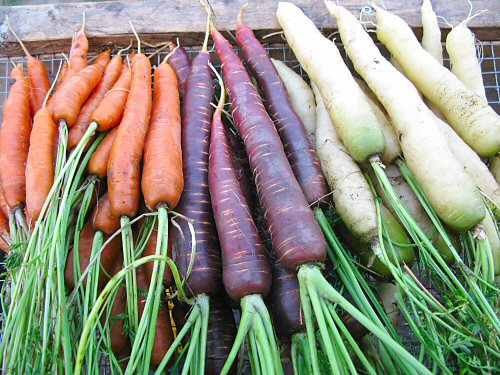
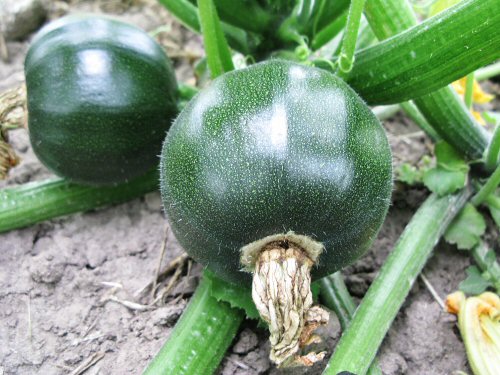
This isn’t the first time I’ve pondered the question of variety on TFB, but the consideration recurs, so here’s another take… It would seem to be all around easier to grow just one variety of each veg crop, but that wouldn’t be any fun! One round, red beet, one big, round, red tomato, one shell pea, and so on. That’s the standard approach for most of the other full market garden growers at our small farmers’ market. There is SOME variation: green and yellow snap beans, maybe French Breakfast (red and white) radishes along with the standard round red ones, a few types of winter squash… Which is cool. Why bother growing three or more types of orange carrot, let alone orange (Nelson), purple (Purple Haze), and white (White Satin, for the first time this year)? I dunno. By growing several varieties of each veg crop, I’ve learned a bit, like the performance difference between hybrid and open pollinated varieties (in general, the OP tend to do better when field conditions get a little extreme, but that’s not a….scientific conclusion!). It’s not to be a novelty act, the guy at the market with the purple carrots, golden beets and round, yellow cucumbers. Or the round Eightball zucchini (below). If efficient tiny farming was the sole goal, I don’t have a really compelling…justification for all of the complicating seed ordering, transplant organizing, and extra direct seeding work it takes to grow as many different crops as I can, and numerous varieties of each. On the other hand, growing and offering variety, choice, and the non-standard make tiny farming so much fun. Which sounds good to me! It seemed like the thing to do from when I first pored over a seed catalog six years ago, and nothing’s changed my mind since! :)
Fall crops
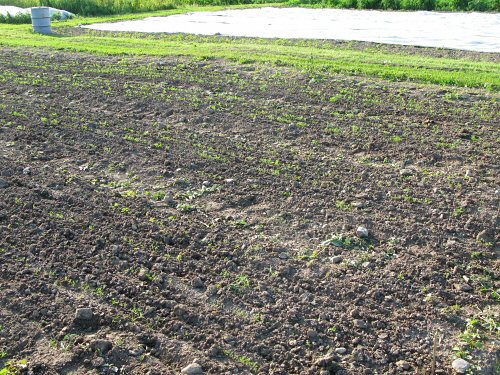
Not much to look at, yet, but the last plantings of 50-day-plus fall crops are doing fine. Here, carrots and, protected from flea beetles by floating row cover, one of two sections of brassicas, including broccoli, cauliflower and kale. There’s a bit of timing risk here, depending on the weather, if growing goes slow, they might not make it to maturity in time for market. But the sun’s been shining for a couple of days now, and the long range forecast is for more of the same. If all goes well, these will be ready for harvest through October!
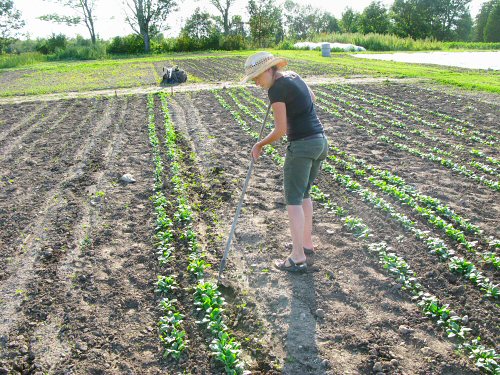
And the summer-seeded spinach couldn’t be doing better. There are two plantings, the first on July 22, and the second (left of the photo) a couple of weeks later. Here, Lynn hoes the first set: in this summer’s wet, cooler, cloudier conditions, germination was absolutely solid, as good as or better than regular spring seedings. Fall spinach has never been this good, by far. Excellent!
Bean watch
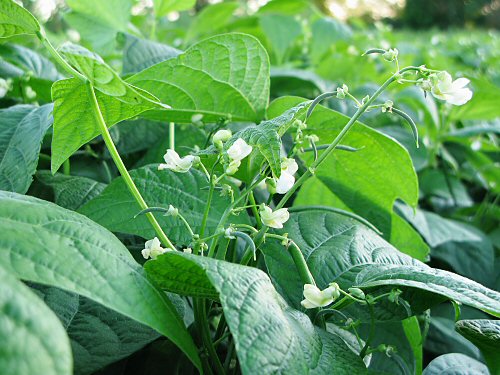
The second bean planting is setting and sizing up nicely, but we didn’t have beans at the farmers’ market today, after a good first and second picking of the first crop over the last two weeks. With succession planting, snap beans are usually a continuous harvest once they start, right through to a killing frost (usually in September, but with row cover, now extended into October in the last couple of years—more of that global warming, I guess). This year, cloudy weather slowed growth and the timing didn’t work out for continuity. There are a couple of ways to insure non-stop beans. Planting really frequently doesn’t work, because if the plantings are too close together, like, only a week or two apart, any two are likely to sync up, either by germinating at different speeds, or catching up during growth (both due to weather), and you’ll have too much one week, and not enough the next. Over-planting is the easiest way to go: if you have a lot ready at once, usually you can hold in the field a week past optimum harvest time and still have good quality, that is, nothing too oversize or woody. Of course, harvesting when ready, then storing in a cooler is the surest way: beans do quite well in cool storage, a good week in the most casual cooler conditions. But of course, there’s fresh and there’s FRESH!