
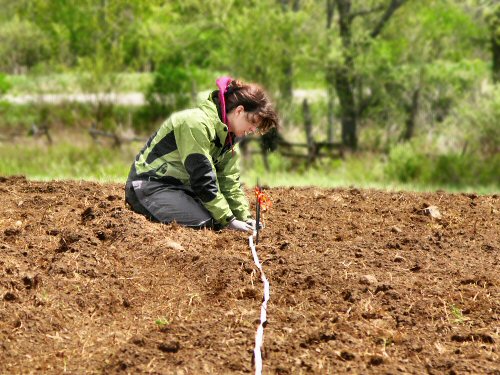
Nice sun, but kinda cool and definitely windy. Michelle came by for a day of mostly organizing and arranging: managing seedlings, and measuring and staking out garden sections (now, according to the new garden map). We’re once again using 50′ (15.2m) squares as the basic garden unit. The 100′ (30.5m) reel-up vinyl measuring tape is the handiest tool for this, as we walk up and down and around, a person on each end of the tape, calling out measurements and planting fluorescent-flagged stakes… There’s a satisfying sense of order when a freshly tilled section is staked out. All those neat squares tell you, you are master of your garden, and things are well under control! :)
Planning
Map day!
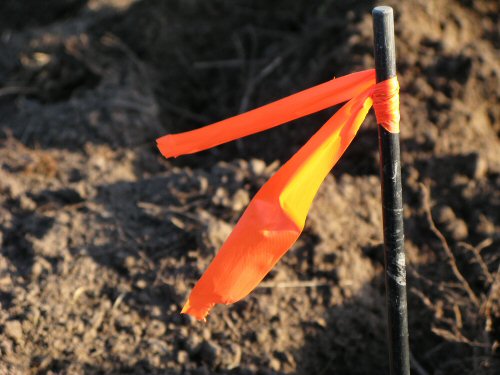
Finally, the first production map for this new market garden! Usually, it’s a good idea to get a detailed map done early in the winter, before making up the main seed orders (or, if that’s where you’re at, before taking inventory of your vast store of saved seed!). Here, with our hasty start-up in late November, and piecemeal plowing of sections over the last month, it’s been hard to tell how much area would be ready when. This morning, Peter down the road disked the final large area, and as the sun set, I walked around staking out sections with fluorescent marking tape, then sketched out the first production map. Each square is 50′ x 50′ (15m x 15m). To be filled in…
Transplanting team…
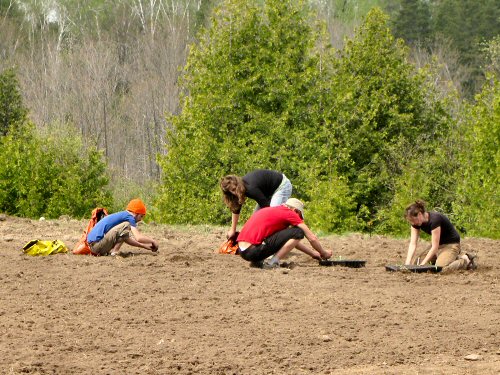
Another big Friday showing of people in the field: Chris, Libby, Jordan and Lynn transplant broccoli and cauliflower, while Andie is on a solo rototilling mission in the other field. Later, everyone got together to plant a few hundred onion seedlings and sets. And some other stuff got done.
Although we’re in the thick of it as far as timing and weather and urgency to get things out, our spring schedule is slower than it could be, and the field days are so far fairly laid back. Slowing things down is the start-up stuff: a ton of tillage to do (working in the grassy remnants of last year’s hay field), water for irrigation to put in place, electricity to run, chickenhouse to build, and a long list of other basic things that we have to put in place along with starting the season’s crops. Getting it all rolling together on this new farm, now that’s fairly intense!
Hoophouse end walls
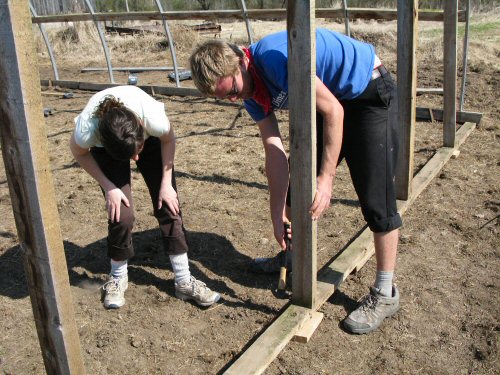
With the clamoring demand for greenhouse space around here, getting the hoophouse finished now that the frame is up is a PRIORITY. Yet here we are, a week later, framing the end walls and installing the wood along the sides for the roll-up section of the sidewalls. A stretch of wet, cold weather was the main cause for delay. Plus a really long list of other critical things to do at the same time.
For maximum satisfaction on the tiny farm, you want things to effortlessly flow along, from one small task or specific problem, to the next (IMHO, of course!). Right now, there are lots of phone calls to be made, things to follow up on, info to find, bits to write and forms to fill, stuff to source and buy, all sorts of more abstract, open-ended, DISTRACTING activity. Eventually, it will settle down into a more-or-less all-garden flow…
In the pic, Jordan and Lynn work on reassembling the end walls. The ground isn’t absolutely level, there’s a gap to fill underneath the 2×4’s along the bottom (the sill plate). This isn’t a problem as the weight of the hoophouse sits on the 4×4’s running along the sides—they’re firmly anchored, so we’re set.
In this case, we can’t cut the studs longer to extend the wall, because we’re going to reattach the existing, pre-cut plastic. Everything has to come together the way it was. I should’ve numbered and marked each rib and piece of wood as it came apart. I’d usually have thought of that, but in this case, I only marked the main plastic, so that we could reverse it. Now, fitting it back together is a little puzzle… After this, there’s not much more to do, just wait for a windless day to skin with plastic. Onwards!
Compressed air and rototiller repair
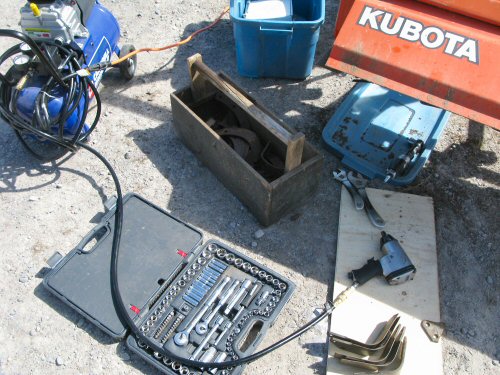
Looks like a whole lotta gear for swapping out one broken rototiller tine. Two bolts. BUT, this was a chance to try out the air tools with the new, tiny (8 gallon) compressor. So far, all it’s done is inflate tires.
The compressor is a smaller-scale replacement for the heavy duty one at the old farm. It’s not an absolutely essential bit of gear, but it does a lot of farm work: inflating, cleaning out things like screens and filters with blasts of compressed air, loosening big nuts and bolts (impact wrench), and removing lots of nuts quickly (air ratchet). And it can do more. I use it at least once or twice a week.
This unit is the top end of the home handyman line. The smaller tank means it can’t put out full pressure continuously for too long.
Sometimes, getting “home” gear for the tiny farm just doesn’t make sense, the equipment isn’t up to what you need it for, or, it breaks. But you often don’t need or can’t afford the same heavier equipment as, say, a more tractor-driven farm. Then, the choice is to rent/hire, or buy lighter duty IF it will really work.
Buying used equipment is another great approach, but, you need lead time—you want a tool there when you need it, not only after a good deal comes along—and you need extra buying skills to make sure you’re getting good used gear…
In this case, compressed air is used quite frequently, I couldn’t justify the cost of a commercial/industrial compressor, and I wanted it right away (here, the difference was two or three hundred dollars, and that adds up). Of course, I figured this one would work out, but you don’t know for sure until you try!
The impact wrench did just fine for de-bolting and re-bolting (I finished tightening up by hand). Now I know this little compressor can handle all the usual tasks on a tiny farm scale. Another CHECK on the new-farm, getting-set-up list. That’s good!
A brief return to winter
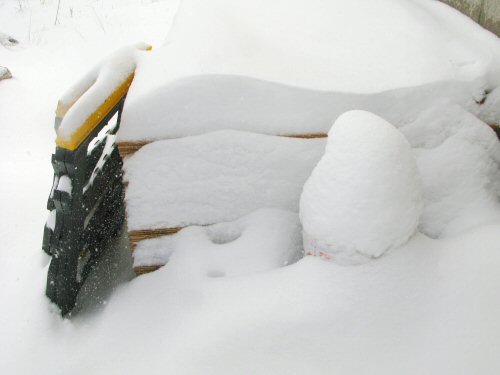
It snowed fairly steadily yesterday and today, transforming everything with that pretty but kinda unwanted winter wonderland effect. Looks like around 4-6″ (10-15cm) so far… (I don’t keep track of snowfall the way I do rain!) This isn’t forecast to last, it should warm up and be all gone in 3-4 days, and then the temperature is supposed to jump. Drying out time…
That first day of being able to actually work the field is always so different each year, especially the last 4-5 crazy weather years. Two years ago, peas went in the first week of April. Last year, it went from too-wet-to-work, to needing irrigation, in one mid-April week. Who knows how it’ll go this time around.
With the new garden, extra steps like disking, rototilling, and waiting a bit for the grass to break down some more, not to mention, prepping the ground for and putting up the greenhouse, make timing particularly critical. The farmers’ market officially starts in less than FOUR WEEKS. CSA shares begin second or third week of June. I can feel the adrenaline bubbling up just writing about it: timing and the WEATHER! :)
The great WARM outdoors!
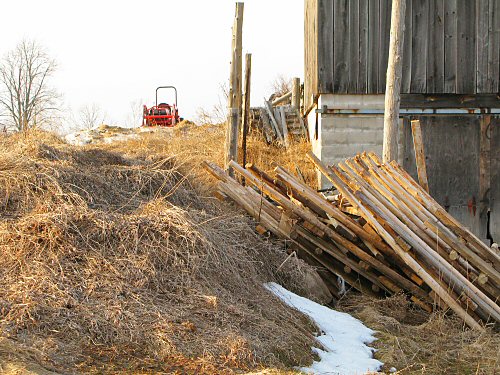
Ahhh, yes, THIS is what warm weather feels like! For the first time this year, the temperature topped 60°F (15°C), with a hazy sun and a gentle breeze. We’ve had some melt-off days already, but this one tastes like spring! Usually, there’s a day like this sometime in February, so it’s been a long time coming, and makes me wonder how even crazier the rest of the weather will be. No worries…today feels great.
The photo is a good to-do list for when real spring comes and the ground is dry enough to work and get around on. There’s a jumble of spare lumber taken from the barn when we cleared an area for the new seedling room—it needs to be sorted and stacked, and some of it will be the new chickenhouse! (Only patches of snow are left on much of the land, but I’m sure it’ll be back before it’s really gone.) The abundantly overgrown grasses that partially surround the barn and border the moldboarded garden areas is a big clean-up job. And, up the slope, the Kubota compact tractor calmly waits for after the hired-big-tractor disking and the compost spreading, when we do the final tilling of the garden beds. Coming soon. Cool!