
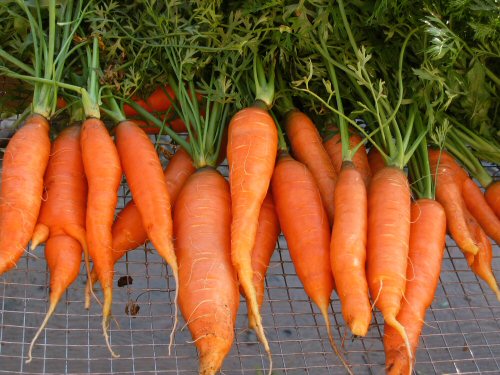
Left to their own devices, these heirloom Touchon carrots grew all over the place, an assortment of shapes and sizes. They’re in a bed where the mid-summer germination was spotty, and uneven spacing no doubt had a lot to do with it. Compared to our other mainstay carrot, the generally uniform Nelson hybrid, Touchons definitely show a lot more individual carrot character… As a trained-from-birth first-world consumer, I guess I’ve tended to automatically favor uniformity in many little things, like…carrots. On the tiny farm, that training’s being undone!
Veggies
Big sky
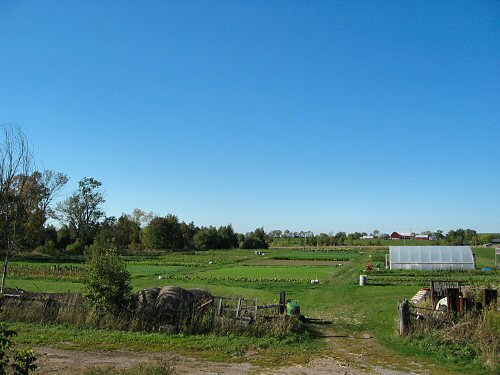
Autumn, what autumn? A finer summer’s day it would be hard to imagine… A warm, gentle sun in an absolutely cloudless sky. A silky soft breeze, without a trace of stultifying midday heat. Here’s the widest view possible with this camera, from the highest vantage point around: the market garden where I spend so much of my time! It all still seems a little odd to me, but I wouldn’t want to give it up!!
Rye arrives!
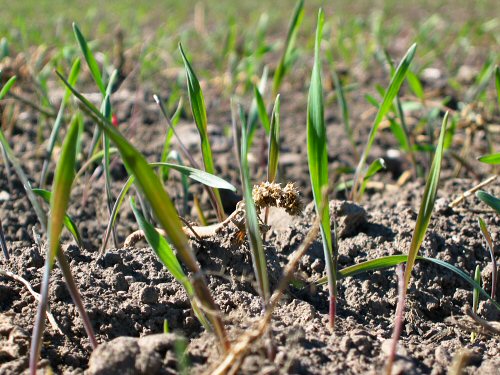
Where the oats arrived with a dramatic, iridescent splash of green, the fall rye made a much more sedate entrance, so much so that I didn’t notice it until today. It probably emerged a couple of days ago. It’s looking great! I dunno why I’m so extremely pleased by these green manure cover crops…but I am! The rye comes with a lot of promise. It probably won’t winterkill, instead, start up again in spring, making it good for sections that won’t be planted out till May. It thrives in cool weather, also making it great for fall and spring service. And it may have an allelopathic effect on PIGWEED, meaning that, on a plant-produced chemical level, future pigweed may suffer… That’s nice. On the caution side, if it gets too well-established, it could be a little tough to eradicate. No worries. I won’t seed it on sections that’ll be used for the earliest spring planting (there won’t be time to till it in), but otherwise, I’ll spread this around everywhere I can for the next month or so and see what happens!
Little bundles for market
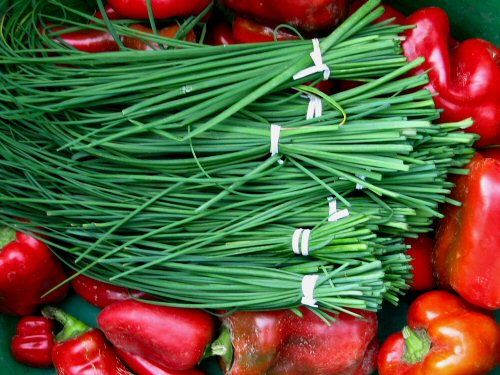
As things slow down in the garden and crops finish for the year, there is more time for really tiny harvests of this and that. Fifteen bundles of chives, a couple dozen small but tasty red peppers—little hauls like these add variety and incremental sales at the farmers’ market stand. I imagine you can afford to spend time on this kind of thing only on a really small, hand-cultivated farm. The veggie line-up for today’s market: carrot, mesclun, potato, onion, garlic, beet, summer squash, tomato, green onion, parsley, a few eggplant, peppers, cabbage and cauliflower, a little spinach and chives…
Cabbage and cauliflower
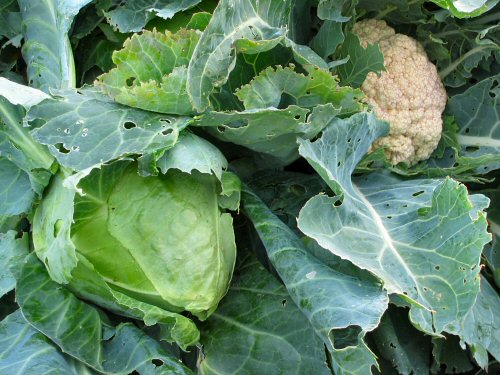
A pointy English cabbage (Early Jersey Wakefield) and a hybrid 55-day cauliflower (Early Dawn), side by side on the harvest wagon—not too common a sight! The main crop brassicas (broccoli, cauliflower, cabbage, kale,…) are easy to grow but harder to maintain when conditions get rough. Vicious flea beetle attacks on seedlings (and occasionally, when they really swarm, on mature plants) last from spring well into August. Floating row cover is a must. This in turn makes weeding difficult: either the weeds build up under the cover, or there’s a whole lot of uncovering and recovering to do. Then, the effects of regular drought can be brutal on big brassicas, and our spot irrigation doesn’t always keep up with their thirst. When more permanent drip irrigation is in place, the brasscia situation will get a lot better (next year!). Right now, every successful haul is a particular pleasure!
Mesclun, mesclun, everywhere!
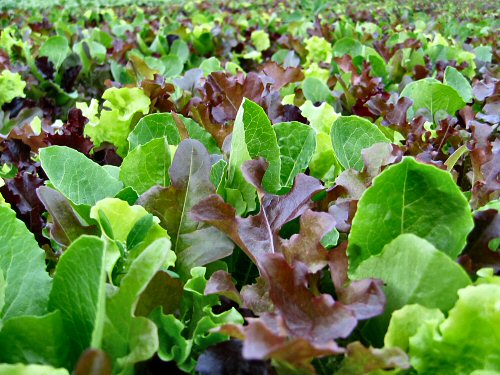
As I check things out for the Friday harvest, it’s mesclun, mesclun, as far as the eye can see. Well, as far as fits in the camera’s eye, held down at leaftop over three new 50′ beds. But it feels like a whole lotta mesclun, after a month of tight supply of this mainstay tiny farm crop. After one really poor succession planting (the seventh of the season), things got steadily better. Now, we’re on a healthy second cut of five beds that look set for even a nice third trimming, and these new ones have sized up in time for harvest tomorrow… Sweet!
Watering till the end!
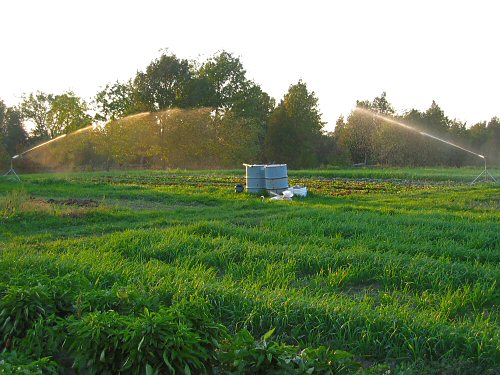
Although there’s still plenty of moisture in the ground from recent rains, there’s no harm in supplying a little more to take advantage of the relative abundance of heat and sunshine that we’re getting, even as the days get shorter. After a couple of near-zero nights last weekend, it’s all spring and summer conditions now, and forecast for the next week at least: warm, sunny days and oddly warm nights. More freak weather: it’s conceivable that the first killing frost, averagely due tomorrow, doesn’t show up for…another month! Weird…