
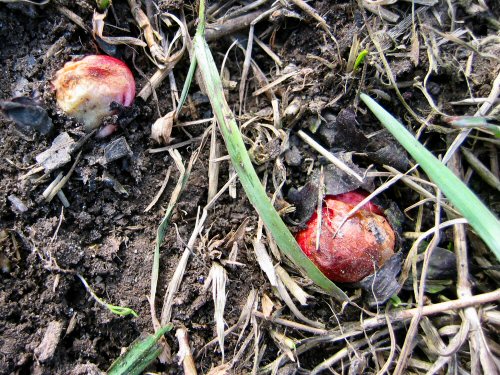
Debacle may be a little strong, the future of my newly established rhubarb patch is not absolutely dire, but it’s not looking perky just yet. I’ve so far managed to spot only half a dozen of the 50 odd transplants I set out last year in spring. I’d ambitiously dug up part of an ancient patch in the house garden (it needed thinning anyway), divided out a ton of roots, and planted at least 50 on 3′ centers (hopefully, I’ll be able to count ’em in a couple more weeks) in a permanent spot in the garden field. I can’t quite remember what I was thinking: eventually, rhubarb for an entire village?! Problem became the low priority of rhubarb in the busy year, upkeep of the patch got away from me, and it grew over quite heavily with grass and other weedy items. Also, fewer, denser plantings might’ve been a better idea. But rhubarb is tough, I dunno if it can be smothered by mere other plants… We’ll soon see!
Veggies
Rosemary cloned
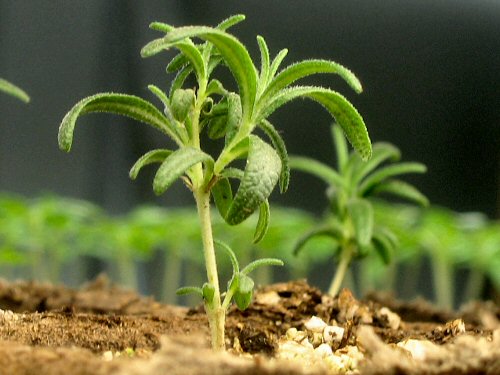
The little gamble on propagating rosemary from frail cuttings paid off at 20%. Out of about 40 starts, eight took root, this without any sort of rooting compound. I put them in 3″ peat pots yesterday. They’re headed for the summer herb garden.
First direct seeding of the year!
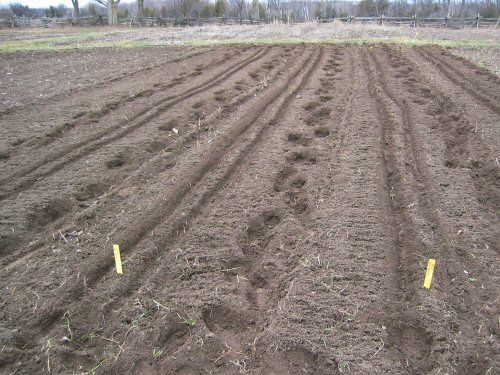
O the excitement and satisfaction. The first 400′ of snap peas (Sugar Ann) are in! This is the first seed to hit the field this year!!
It’s a low-risk gamble for two-three extra early bushels for the market. With over a week of cold days, subzero nights and even snow ahead till mid-month, the peas may germinate unevenly, and there’s little more annoying and unproductive than picking a not-dense-enough pea planting (you pick forever to get relatively little).
Last year, I seeded out this early with two varieties, and neither worked out as well as the next seeding 10 days later.
Here you see the results of my current bed marking technique: using a 100′ reel-type measuring tape, I mark the path centers on both ends with a label stake, walk ’em out, and pull up the stakes. Presto!
These beds are 4-1/2′ wide. The spacing between the double rows is a little wide to what I usually do (4-5″), but the freshly tilled soil made maneuvering the Earthway seeder close to the first row difficult (tight double rows for bush peas let the plants support each other and you don’t have to weed between).
It’ll work out! Delicious edible-pod peas in 60 days?!
Chives
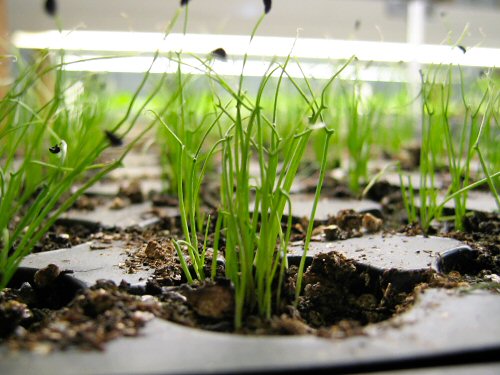
More tiny greenery from the trays! Chives are doing well, they’ve already been out in the sun and wind for a few days to toughen them up, and will be heading to the greenhouse soon to make way for others under the lights. Also in the herb collection this year: sage, parsley, thyme, rosemary, cilantro, dill, oregano, basil, and possibly fennel, marjoram and savory.
Floating row cover!
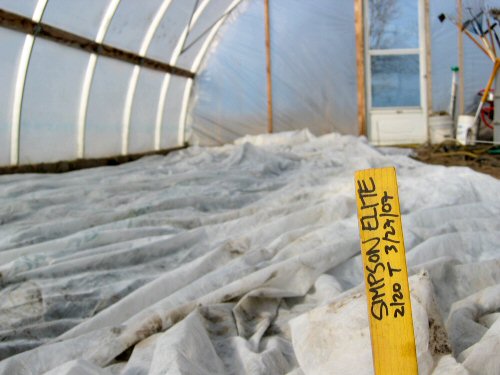
It’s around 8:30 in the morning and I’m about to uncover the early lettuce. Floating row cover is a very lightweight spunbonded polyester, light enough not to crush seedlings when laid down directly on top. It lets in water and sunlight, and also retains heat, to differing degrees depending on weight. This one is medium weight, my all-purpose cover. It transmits 85% of sunlight and keeps the temperature 3-4°F warmer when the surrounding air is around zero. Over the last couple of nights, the greenhouse low was 19°F (-7°C)—the lettuce can take a little freezing, and would probably manage without cover. Still, every edge helps, and this one’s easy. Floating row cover is a common sight around here throughout the year, it’s my main organic alternative to pesticides (it keeps out certain flying insects on certain crops at certain critical times) and also gives you an edge in getting things out early and keeping them out late. Beat that frost!
True leaves
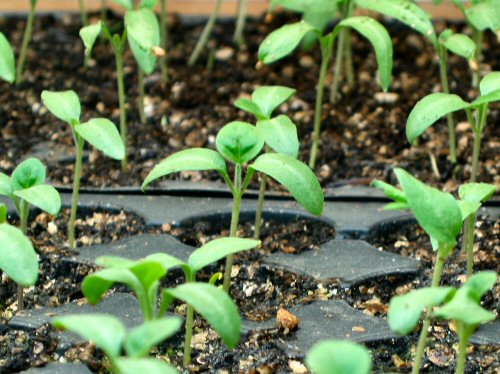
True leaves are starting to appear in the first trays of eggplant and peppers (that’s Dusky, and Vittoria behind, both eggplant). It’s around 20 days from seeding. Rapid growth is on the way!
Fill your head!!
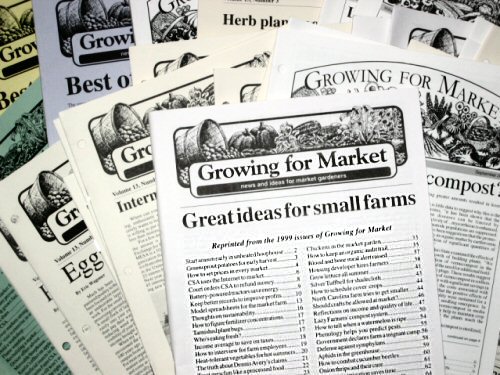
My box of back issues finally arrived. Reading through it may cause my head to explode (so many things to try, so little time :), but I’ll take the chance! This is the entire collection, seven years worth, of a fantastic market gardeners’ monthly newsletter called Growing for Market. Tiny farming lies in a kind of information nowhere land between gardening and large-scale agriculture. Most of what I do is straight from gardening methods, but the scale is a little…bigger, with things to do and problems to solve that just don’t happen in even a very large personal garden. Meanwhile, commercial farming info is all about tractors and agrochemicals and acres of one crop at a time. All wrong. So where do you learn the best way to stake 500 tomato plants, or how to keep veggies fresh for half a day at a hot outdoor summer market?