
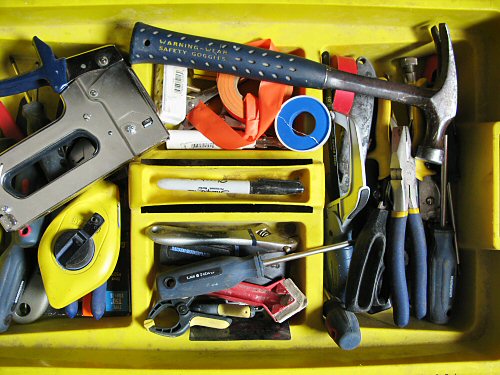
If I happened to be looking for monthly tiny farming themes, this particular January is clearly all about chickens and tools (and thinking about stuff!). It’s not the usual January routine around here. Normally, I’d be hanging the lights back on the light racks, checking out my seed starting gear—plug sheets, trays and the like get hit by a certain amount of damage and destruction each year—and generally cleaning up and rearranging the Milkhouse for seedling production. This year, with the move to the new farm, there’s nothing much to do on this end, until the new seedling room is built. So, it’s been back and forth—this weekend was there. The tools in the photo, a fairly small part of my ever-expanding collection of essential farm maintenance gear, aren’t what’s mostly being used, it’s mainly the chop saw, sawzall, cordless drill, and a lot of measuring and marking as we frame and insulate the lower barn space. But I’ve been lugging this chest each way, just in case I need tools at either end… As for the chickens, well, it’s water, feed and eggs every day!
Tools
Demo to go
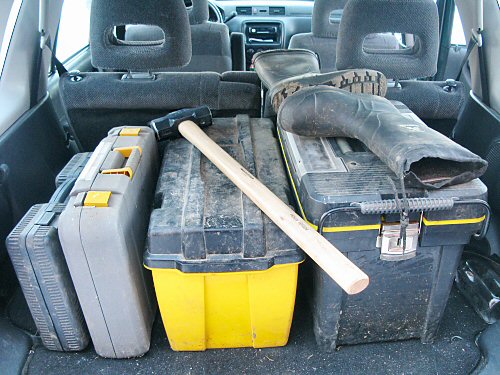
The plan was to spend tomorrow at a nearby, soon-to-be tiny farm, helping build a winterized seedling room in the barn. Day 1: a little demolition and clean-up. This didn’t work out because of a snow storm warning, so after an overnight visit to a nearby town, we returned and I unpacked. False start. Still, this was another mini milestone for me, a first, loading up my tools for an off-farm job! This is all gear assembled bit by bit while working on projects here on the farm, guided by the tools I’d borrowed from Bob. Every purchase, I knew exactly what it was for and how it would come in handy again. Although I’m far from an experienced rough carpenter/farm fixer, choosing tools yesterday made me realize how much I’ve learned. The feeling of place and context really struck me, how the little memories of using each tool tied into the overall tiny farming fabric. It may seem ODD to be celebrating such basic stuff, but it reminded me how unsettlingly disconnected things can get: the job you go to every day, the weekend shop project at home, the weekly grocery run, endless other routines that have no real connection to each other, except in your head. Not like on the tiny farm, where one thing leads another… Hmm. :)
Drive shed clean-up continues
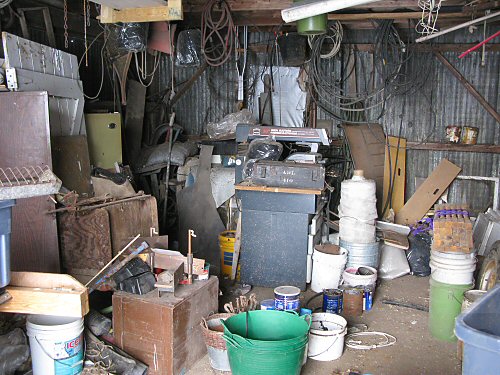
You can see the back wall! The fairly massive, once-in-a-century farm clean-up continues, and the two-floor drive shed, home of a million parts and pieces of not-junk, is an action center. I can’t imagine how one could capture a real feel for all of the stuff that was in there, you had to poke around and experience it first-hand. It was literally packed to the rafters with EVERYTHING. There were all sorts of shelves, racks, parts drawers, crates, boxes, a couple of decommissioned fridges used as storage, stuff hanging off endless nails and hooks, and much of it in murky half-darkness. All of that is being slowly and carefully peeled away. The superficial mess of tiny farming gear from a couple of weeks back is long sorted out. And as cluttered as this one corner still looks, that’s nothing compared to what was there even a few days ago. What impresses me now is not seeing, but FEELING the amount of life and time it’s taken to accumulate all of this, through having built and fixed so many things, with unexpected parts and tools that’ve magically appeared out of there. This is the history of a generations-old family farm recorded in its spare parts, methodically being unravelled… The whole clean-up is fascinating and kinda awesome to observe, in a low-key, mildly melancholy, wheels-keep-turning way… Life on a farm!
Stacking cages
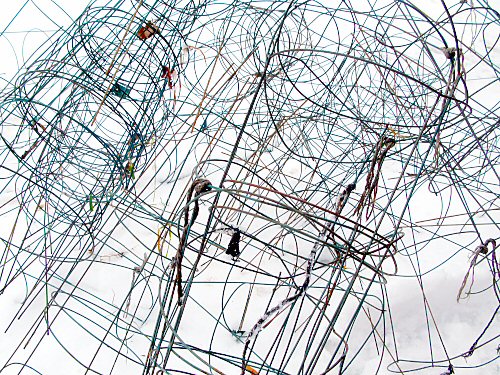
The backdrop of snow turned the puzzle of sorting tomato cages into a bit of abstract art. I don’t use these exclusively, most of the 500-600 plants each year are tied to stakes or sprawled. But the cages get used, too. After every season so far, I’ve been determined to move beyond these lightweight wire gizmos to a more robust tomato support solution, but come spring and the transplanting rush, I end up with even more of ’em. They work great for the first eight weeks after transplanting, but once the toms really get going, they’re kinda useless, too short and not strong enough to hold up the plants. At the end of the season, they have to be hacked and torn out of the tangle of dead toms. And then, they have to be bent back in shape and stacked, tossing the ones where the rings have broken from the spines. I’d left this last little task till today, and now it’s done: the before (above) and after, around 200 cages, stacked and ready to store. Next season, something new!
Chickens at work
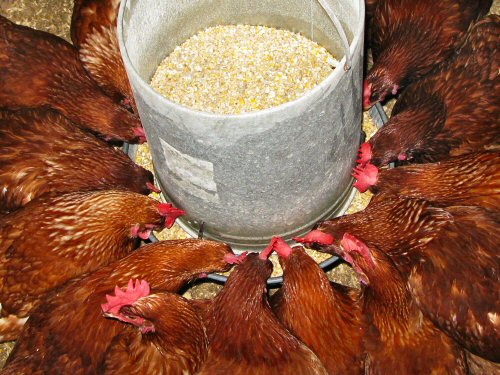
The Shaver Red Sex-Link laying hens are doing fine in the fairly chilly chickenhouse, eating up a storm, looking and sounding healthy and happy, and producing away. They’ve been in artificial light days for the last couple of months, about 16 hours made up of daylight extended by a 60W bulb on a timer that’s on till 11pm. I’m curious whether at least some of the girls would really stop producing for the winter if the light dropped below 15 hours for even a single day. I don’t actually want to see it happen, but what if there’s a power failure? Hmmm… Kerosene lamp? In any case, fall egg production has so far stayed steady at about 20-23 a day for the 25 girls… Chickens are easy, you don’t have to know a lot to raise them casually, but there is a lot you could know. And of course, the more you know, the less you need! My winter chicken reading is Storey’s Guide to Raising Chickens.
Battery change
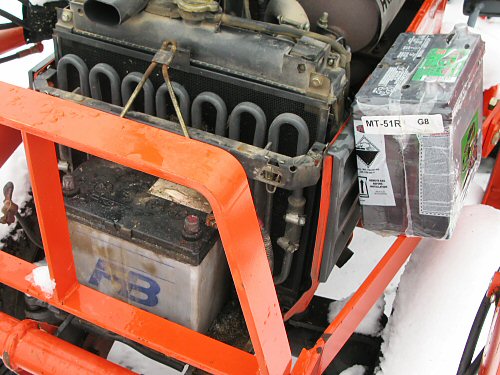
There’s nothing remarkable or even that interesting about changing a battery—routine maintenance on the tiny farm—EXCEPT… Today, I finally got around to replacing the battery, for the first time, on the Kubota compact tractor. It was a quick and simple operation that put instant new life into the trusty little tractor. It also made me realize how fond one can become of a MACHINE. I know this is nothing new: for example, car lovers. For me, though, it’s a first. Like, I love my wheel hoe, but it is such a simple tool, the attachment is more to the idea of it than to the machine itself. The complex workings of the tiny tractor, however, are largely a mystery to me. I can maintain it, and fix an increasing number of things, and I understand the general principles it runs on, but mostly, I simply trust that turning the key will bring it to life. And it hasn’t failed me over the years, faithfully and reliably performing its tiny farming tasks, asking little in return (it’s even good on diesel!). So here I find myself, strangely, with a deep affection for a machine… Cheers! This new $100 Mega-tron II battery is on me! :)
Farm gothic?
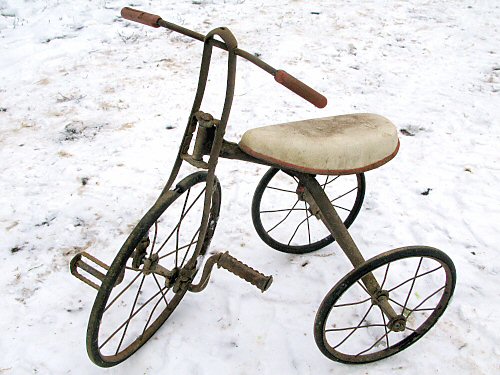
All sorts of old things are being unearthed as the entire farm gets a thorough, top-to-bottom, no-drawer-unpulled going through, something that probably hasn’t been done in a century. There are all kinds of finds, like horse-drawn plows and a farm-built chicken defeathering machine. Today’s most intriguing item for me: an old, iron tricycle (with an upgrade, a much newer seat). No-one here is sure, but the guess is that it’s gotta be a good hundred years old. Except for the plastic seat, which looks more like the last 30-50 years. It’s cool because the design and construction are soothingly simple (and easily fixable), although it looks like it delivers a bumpy ride on those solid rubber tires, especially on gravel in the barnyard. For some reason, though, I also find it mildly creepy… Imagining the squeakily-pedaling ghosts of farm children past, I guess. Yikes… :)