Big egg

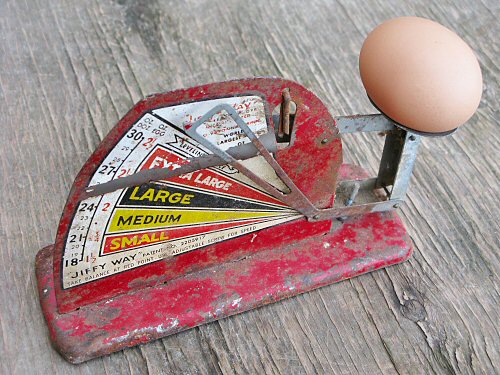
Every few days, at two dozen a day, along comes one very big egg. It’s hard to see with the chipped paint on the old egg scale, but these big guys take it right off the chart. Beyond measurement by this technology. Poor girls (I think, or maybe not). They’re too big to fit into extra-large egg cartons, they won’t let the cartons close, so I put ’em aside and eat them. They’re pretty big, fat eggs!

Farm video

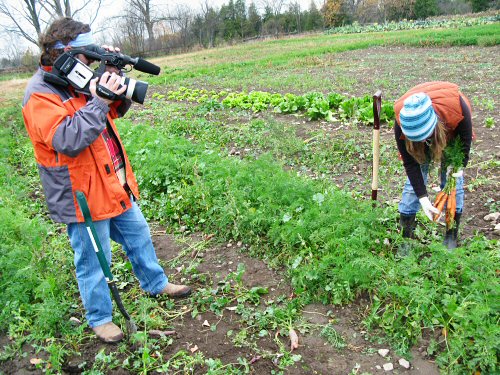
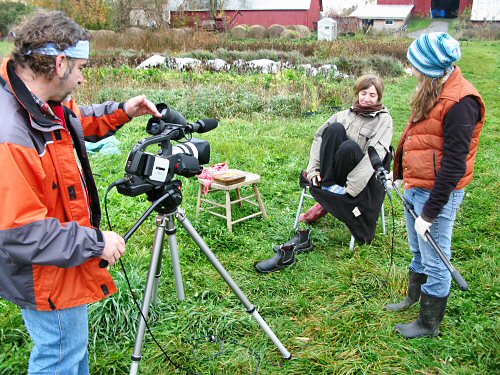
A bit of unusual activity in the field today, a mini-video interview! Raechelle and Lynn brought their friend David, who brought some video gear. The whole thing was casual, the video being mainly to record our impressions of tiny farming for a possible magazine article. Still, with the tripod and the boom mic, a certain “we’re on TV!” flavor hit the field for a couple of hours. We each did a sit-down interview (it was fun watching Lynn rustle up sound bites to describe the simple pleasures of…fieldwork), then David taped some atmosphere: digging carrots, chasing chickens,… And we had cake! Earlier this season, we had our own, self-styled, TFE version of a photo shoot for a newspaper article. Now, this! Are we becoming increasingly…media-friendly?! ;)

The incredible shrinking harvest!

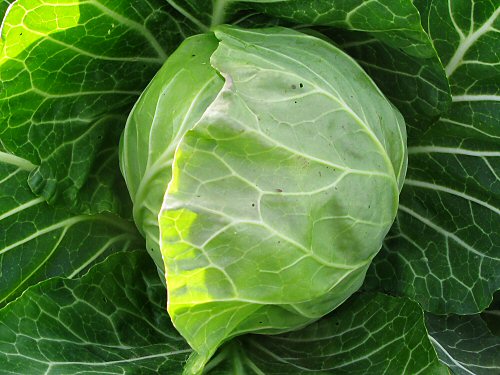
The Friday harvest is shrinking. This is the second to last of the year, and the last for CSA members, and we’re down to mainly root veggies. Some of the last cabbage planting has firmed up, and we’re picking them as “baby,” about 1-2 lbs (450-900g) each (multiplanted, the yield is good, the size really convenient for cooking, and the taste quite fantastic). And there are beets, carrots, parsnips, plus onions, garlic and other storage crops. And some lettuce… As the harvest gets shorter, so do the days, and I’m out rinsing beets and carrots after dark once again. Try not to get wet when it’s COLD…!

Middle of the day at the market

Here’s another slice of the action at the Saturday farmers’ market: recent market posts covered the beginning and the end, this is…the middle. In the first two pics, it’s about 9am—the market’s been open for two hours, but in colder weather like today, most people start showing up about now. This is the first time we’ve extended the stand by adding a new section with four more bins, quite an occasion, since I’ve been using the same 7-tray set-up for five seasons, almost since the beginning. It’s also the last day of tender crops, with a final harvest of eggplant and peppers. Lynn, vested against the chill, in the first pic looks like she’s making up more signs: red market on light brown card stock…

The shallow trays are easy to fill, it doesn’t take much to create a nice display. As things are sold, the display is refreshed from bins kept in the shade. The trays aren’t ideal for all veggies. Winter squash are harder to sort through, but there’s also a full assortment in bushel baskets that people can look through, with the trays more for display…

Jump ahead to about 11:30. It’s warmed up considerably, into a beautiful, summer-like day. This is Canadian Thanksgiving weekend, and the traffic has been pretty good. Traffic has died down in the last half hour, some crops are sold out, but people come by till the end…

It’s now about 12:40. The market ends at 1, and we have until 1:30 before the street is opened up again. Most vendors start packing up early, around 12:30, but we always wait till the official end. Today, we’re pretty well sold out: the only veggies left in a bit of quantity compared to what we started with are some mostly very tiny eggplant, curly and flat-leaf parsley, Red Russian flat-leaf kale, and some winter squash. With things like kale, not exactly a universally popular green, sales are inexplicably random: usually low, but on some days, you can’t have enough. So, you always bring as much as you can (within reason!). Anyhow, a really satisfying and fun market day is almost done…

Night work

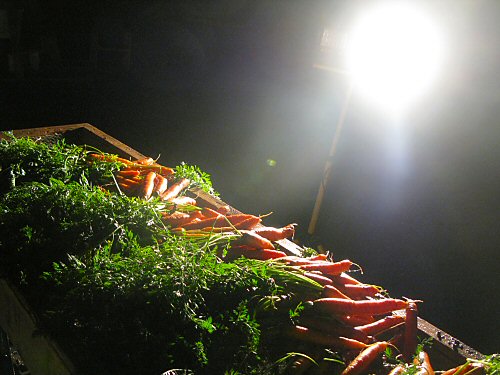
In the fall, post-harvest work doesn’t necessarily end when the sun goes down (it’s dark by about 7:30pm right now). Actually, this year the fall Friday harvest has gone great, with Lynn, Libby and usually Michelle knocking things off in the field by around 5pm, with only bundling and rinsing to go. But I’ve been wrapping up with the crew by 6, taking a break, and doing whatever’s left on my own…later at night. It’s something I’m used to from the first few seasons, when the mainly solo harvest usually went straight through until 11pm or midnight. Tonight was the first time I’ve hauled out the light stand this year. It’s around 10pm, the two lights specally installed on the side of the Milkhouse for this purpose are on (they’re both regular 100W bulbs, the full plan is to install floodlight fixtures), and there are twin 250W all-weather halogens on a stand. It’s not perfect lighting, but quite enough to get the job done without stumbling around. Tonight is a quick set-up to rinse carrots and beets. Full-on post harvest lighting includes a second light stand, with both set higher up and beaming down, and floodlights properly positioned, to give pretty good 360° coverage of the work area, and enough illumination to watch the mud wash off…

Sweet potato harvest

From planting back in mid-June, it’s been 3-1/2 months to the sweet potato harvest. The variety, Beauregard, is listed as 80-100 days to maturity, although, like potatoes, you can dig them up anytime, as soon as the tubers have formed. The vines are frost-sensitive, and the tubers shouldn’t be left in the ground if the tops are frost-killed, so I’ve been gambling with the first frost timing in order to let them grow for as long as possible. Today seemed like a good time to start. This has indeed been a really easy, pest- and disease-free crop, requiring only a little weeding until the vines filled in. Harvesting turned out to be equally easy. After digging up a few plants to see how the tubers grow, Lynn, Toshiko and I set up a quick hand-harvesting system: remove the vine, loosen the soil with a digging fork, scrabble around for the taters.

The soil had quite a lot of moisture from recent rains, so we had to spend a little extra time brushing off clumps of clayey earth. We left them for a couple of hours to dry in the breeze, then collected them in bins and brought them into the Milkhouse. By the book, sweet potatoes could use 10-14 days of curing at 80-85°F (25-28°C) . In part, this allows some of the starch to convert to sugar, making them…sweeter. That sort of HEAT isn’t available around here right now, but for this first time around, and too small a quantity for really long-term storage, I’m not too concerned. I baked some a couple of days ago, and they already taste good. Let’s see what a week or two indoors does for ’em!

This week’s share

Another rather nice fall CSA share this week! Thanks to no killing frost so far, we’re still picking beans (Jade), peppers (Gypsy, Ace, Cayenne Long Slim), and zucchini (Golden Dawn III). There’s also winter squash (Table Gold acorn), cauliflower (Minuteman), onions (Stuttgarter), beets (Scarlet Supreme), carrots (Nelson, Purple Haze), spinach (Spargo, Bloomsdale), parsley (Green River curly, Plain Italian flat), and garlic (Music). Plus a newsletter. Monday shares are left at a drop-off spot, with shareholders’ names printed on the handles…