
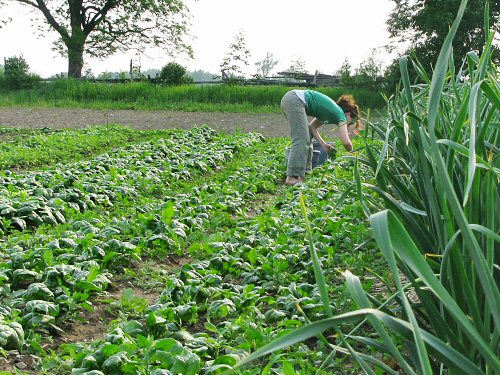
Friday harvest and it’s still all greens: spinach, all-lettuce mesclun, beet greens! Despite the recent heat and ample rain, the overall amount of cloudiness that came with all the rain of the last 40 days has slowed things down quite a bit. It’s still early on, but I’m anticipating next week and the start of CSA shares, when the prospects look to be about the same. Not even RADISHES are growing too quick. Lynn, Erin (harvesting above, right beside the garlic) and Mike were along for a few hours to help out. And there are LOTS of greens for market!! (Guest photo by Lynn)
Weather
Row cover everywhere
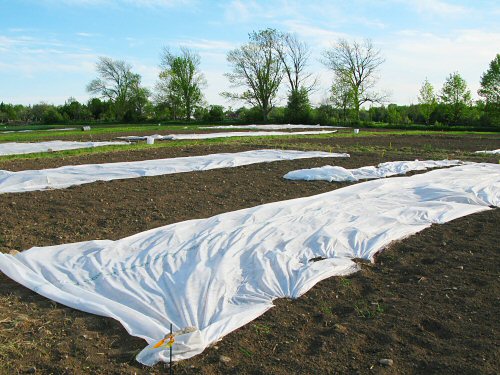
It was impossible to capture all the floating row cover outposts scattered around the feel in just one shot. This pic shows maybe a third of the area under the light, white, spunbond polyester protection. Right now, it’s being used as protection from two separate things: frost and bugs. Let’s see, it’s on all the cucurbits (so far, that’s cucumber, summer and winter squash, and pumpkin) to protect from the cold and striped cucumber beetles, on tomatoes against cold (and coming off in a few days), on the brassicas (broccoli, cauliflower, and the like) against ravaging flea beetles but not the cold (coming off when the plants are fairly big and can withstand the FBs). I’ve used row cover from Year 1, far as I can remember (there are NOTES and even pics…somewhere). Initially, I really didn’t like it, it looked so…unearthy, synthetic,…not part of the garden. BUT, the alternatives, like planting later, ending harvest earlier in fall, temporary wind breaks and cold air channels, trap crops, and all sorts of complex interplanting (so one crop protects another), encouraging beneficial insects, more elaborate timing (basically, closer second guessing of insect cycles and the weather), not to mention a completely adapted, semi-permaculture set-up where everything is at home no matter what, were all way out of what I could handle as I dove into tiny farming with the intention of heading to the farmers’ market in the first season. Floating row cover lets me extend the season by at least a couple of weeks at each and, and I can avoid all pesticides (and there are some killer insecticides allowed even in certified organics) and a lot of bug grief (stemming from lots of LOSS). I still don’t really LIKE row cover, though, the way I like, say, my Sneeboer three-tine cultivator or even the Horse rototiller (I can understand how the Horse is built, get if fixed, or do without). More and more lately, I wonder when FRC will become insanely expensive, or real scarce, or just plain run out… It’s as oil-based as they come, and kind of in a high tech product class of its own. This year, in a small fit of…paranoia (?), I actually ordered a new 1,000’x14′ (300mx4.3m) roll, even though I have enough for this season at least. It’s not much of a stockpile, but, carefully managed, it could get me through 3-4 more years along with what’s on hand, at this tiny farming scale… Oh, well, the more you know, the less you need is what I believe. I’m learning as I go. Keep farming long enough, and I’m sure I’ll get beyond the cover if it doesn’t run out on me first…! :)
Where we’re at…
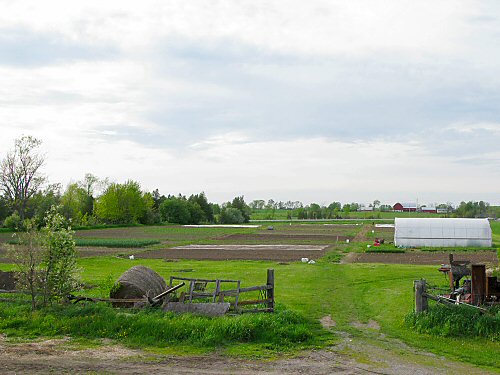
If you can average a month’s weather with one photo, this is pretty well it for the days of May this year, hovering between bright and sunny and gloomy and overcast, veering one way or another for a day or two, or even from one end of the day to the other. The freezing nights have just let up, which is good. We’ve also been getting a nice amount of rain: the month’s average so far is that magic inch-a-week (25mm), the veggie gardening rule of thumb for perfect rainfall. Many hours of dragging around and positioning hoses and sprinklers, and gassing up the irrigation pump, have been SAVED! That’s a big bonus, the total opposite of the last two years. The field is clear and amazingly weed-free (at a distance, at least)—more sun would benefit both the direct-seeded crops and the (kinda evil) pigweed. Less sun and cooler temperatures are also great for transplanting, which is the main thing going on right now. So it’s a toss-up, but I’m slightly more liking the colder, cloudier weather for now than not. As if I had a choice… :)
Slow…
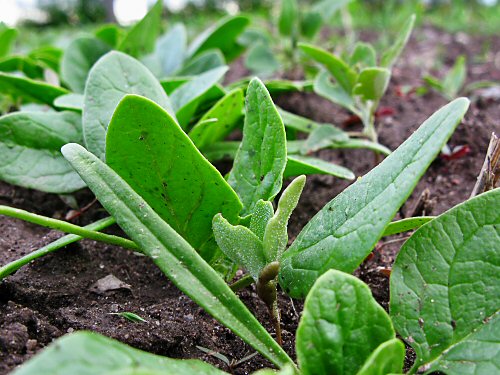
When you look back at last May on this tiny farm, overall, the state of the field isn’t all that different, BUT, the really cool nights for much of the month have slowed growth noticeably. Compare the first planting of spinach today, to the near ready crop of a week earlier last season. It’s the same for mesclun, beets, and chard. Snap beans are taking forever to germinate. And so forth. We’ll definitely be going to market at least a week later with the first field spinach and lettuce. Oh well, with all of the different crops going, bad weather for some benefiting others, it’ll overall catch up and more or less even out, I’m sure. It just about always does…
Work for a dreary day
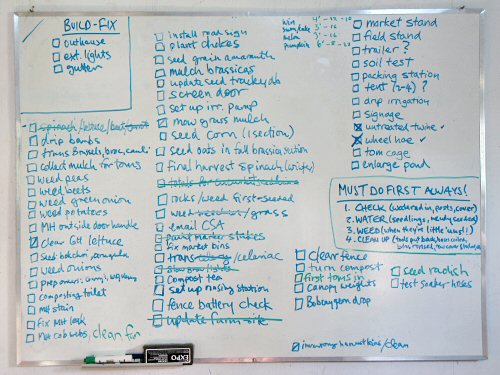
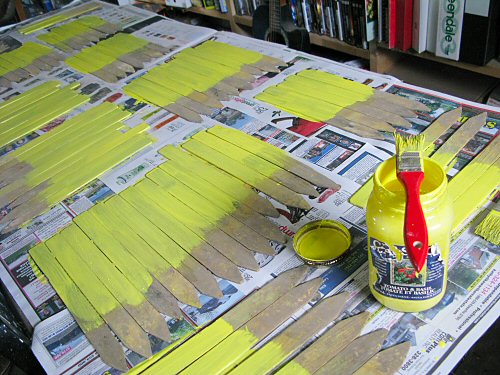
Rain is usually the only thing that stops work in the field, and not even that on harvest days, but this crazy cold May has had it’s particularly nasty, stay-inside days, and today was one of ’em. With a sharp, damp wind, and temperature around 50°F (10°C), stepping outside instantly set you to shivering. It wasn’t THAT bad, of course, and I think it was so off-putting mainly because of the sudden shocks of drastic day-to-day changes we’ve been having lately. In any case, there was no super-urgent fieldwork, that couldn’t wait a day, so we decided to hide out and do…indoor stuff. Bad weather days have their place on the tiny farm, you can catch up on all sorts of things that might get put off otherwise, and later get in the way or interrupt your…flow. Today, we repainted garden marker stakes (these guys are kinda expensive, you don’t wanna waste ’em) with a thinned out latex exterior paint. I’d only done this once before, by dipping (it took 4-5 years to accumulate enough that a good number were so written on and faded, they needed a little makeover!). This time, I figured a brush would be quicker, which it was (except, don’t use a newspaper liner, the paint makes it soggy and then it sticks; for the other side, we just painted on the table directly, and wiped up afterwards).
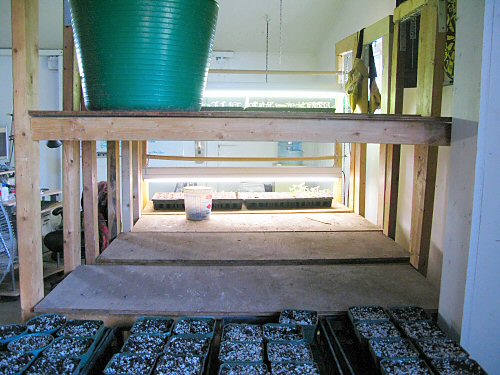
Other pleasantly sheltered jobs included removing the lights and chains to turn the grow racks into harvest bin storage (left a couple of lights on for a last few seedlings) and packing up the lightbox set-up to free up space, reorganizing part of the drive shed with all the farmers’ market gear, doing some work on the enclosure for the composting toilet, seed starting for another wave of broccoli and cauliflower transplants, making some calls,… Most of these weren’t on the whiteboard task list of the most important things for the next few days. For the to-do list, I used to use the notebook I carry in my back pocket everywhere, but since last season, with Conall full-time, I switched to the big board (it joined the smaller harvest board), to make it easier to SHARE the fun with everyone…!
It’s mostly immediate stuff. The list on the top right is bigger projects and purchases to keep in mind. The “Must do first always!” is a distillation of things to do every day, kinda like a day-to-day framework for tiny farming fieldwork, meant for anyone helping in the field on a regular basis—it’s a work in progress! :)
First market 2008…
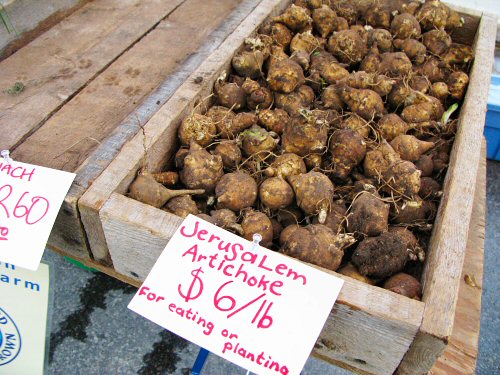
Heavily overcast, downright chilly, with rain threatening at any moment…still, a great first day at the market! In all the excitement, I forgot to take a picture of the stand as it was when we started, it looked good for a tiny spread of three trays… We sold out of mesclun and spinach in a couple of hours, while the Jerusalem artichoke, a veg that like as not had NEVER before been seen at this market, lasted all day but turned out to be a bit of a hit, with maybe 10lbs (4.5kg) sold! A bit of sage, thyme, oregano and chives rounded things out. This early in the season, the vendors were almost all crafts and prepared stuff—baked goods, cheese curd, maple syrup,…—and crafts, plus bedding plants and some fresh produce: storage potatoes, rhubarb, one stand with wild leek… And the traffic wasn’t huge, no surprise, especially with the weather. BUT, chatting with other vendors and regular customers for the first time after the winter was excellent! Really, connecting with people through fresh food at the farmers’ market makes tiny farming all make sense to me…
Not THAT cold…
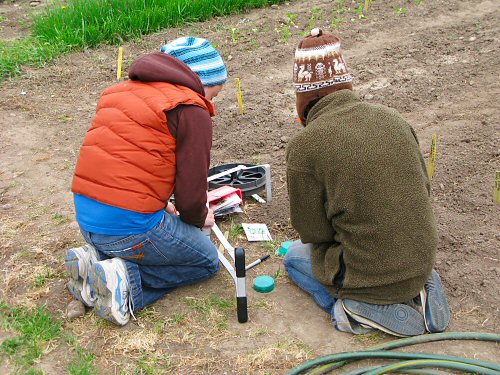
It’s not really as cold as the picture might make it look, but May continues to be an overall chilly one. The hats and extra layers are more a personal preference, but I’ve been wearing a lined flannel workshirt over my regular clothes much of the time. Here, as Lynn and Shannon sort seed for numerous smaller plantings in the herb garden, it’s about 60°F (15°C), cloudy and the kinda damp that can give you a shiver if you’re not a little bundled up. Shannon, sporting an illustrated, ear-flapped cap brought from her travels (it gets cold, especially at higher altitudes, even near the equator), has been back in Canada for less than a month after spending two years on farms in Central and South America, and is still getting used to the local weather. Lynn, in hoodie, vest and classic Canadian cold-weather headgear, was just…chilly! The slowdown in both crop and weed growth from the cold is quite noticeable, still, things are definitely moving along now… Weed watch, and the start of serious WEEDING, is on…