Proper spring begins Saturday! I’m positive. Meanwhile, here’s today’s barren view from the bench, facing west, just outside the greenhouse. After a long summer’s day working in the field, this is the place to be to watch the sun go down… Coming soon!
Chickenhouse progress
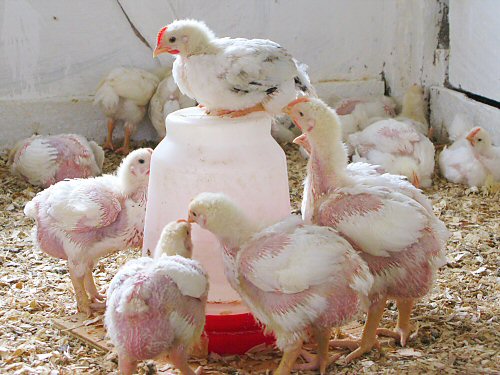
Work on the Chickenhouse has been moving along. It’s not a huge job, but all of the little bits and pieces take time, including foraging through the barn and drive shed for material to recycle. Here, you can see the bottom of the new door between the main sections, for baby meat birds coming in a couple of weeks, and the mature layers, due in June. And there are six new nest boxes. Most of the boxes I’ve seen in photos have a top, which I gather is partly to discourage roosting on the walls and the subsequent crapping into the nests. But I’m fully deferring to Bob’s design, based on his decades of all-around farming. He says it shouldn’t be problem. For me, I’ve been doing my chicken reading and chicken chatting, but it’s mainly learn as you go with Bob in the lead on this one!
Jack the Miniature Donkey has been amiably hovering around, checking out the construction with his head stuck in the door. Here, he’s hanging close to the Chickenhouse even when no-one’s home. The chickens will soon be his neighbors. He’s a friendly fellow, also quite territorial, and he can kick, so he ought to be good for protecting that flank! All in all, I’m really incredibly excited. I guess the city guy in me is still in there looking out… ;)
Early spring rounds
A gray and gloomy, windy day…but WARM. Well, fairly above freezing for the most part, and with a little rain, yesterday’s speeded-up melting continued. But we’re still a ways off from actually doing any work in the field. So, another pretty laid-back day. Lynn came by for her weekly installment of tiny farming. Out in the greenhouse, moving tables around and some hand-watering (those barrels of snow water are coming in handy!). In the Milkhouse, more seed starting: 400 more tomatoes, and a tray of leeks (a little late for this batch, but still better than direct-seeding). For her very first time starting seedlings, Lynn seeded 19 varieties into a 200-cell plug tray (10 each, 20 of one). Clearly, I trust her…accuracy. Working in the tiny cells, changing seed every row, and keeping track of names requires a bit of concentration. A little wandering attention, and who knows what tomatoes would be growing where… Living on the edge! :)
Field appears
Finally, a bit of a change in the weather: several degrees above freezing and steady on-and-off light rain. Although the air has been cold for the last couple of weeks, the sun has been doing its thing, heating up any patches of open ground and slowly melting the snow away from underneath. So, just a little extra help, and we see ground in no time. This drawn-out melt-off means water is puddling everywhere, freezing and thawing overnights, gradually seeping in. I think this is a good thing: our clayey (clay-loam) soil, with its high water-holding capacity, will be saturated to the max, and hold water longer, well into spring, a good break for the first seeds in. This is my theory… Y’know, there’s an upside to almost everything!
First tomato: 2008
Here’s the very first tomato seedling to emerge and spread its seed leaves: a Striped German (a big, bi-color heirloom, one of my top 3-4 favorites over the last couple of years). This is six days after seeding. I don’t usually keep track THIS closely of the seedling action, but with the unusually slow, uneven emergence of most of the peppers and eggplant—new ones are still just breaking out, two weeks after seeding?I’m watching every little move right now with the toms as well. And there’s that fine MACRO feature on the new camera, always happy to take notes…
This year’s early lettuce…
The end-of-March scene in the greenhouse is a lot different than last year, when the growing area was neatly filled with early lettuce. This time around, the early effort has turned into a much more spotty affair. The lettuce started WAY early at the end of January, and held back because of extreme cold earlier in the month, grew and REALLY stretched in the trays, and I only put about half in the ground, just to see what’ll happen. Filling in, there are a couple of beds of direct-seeded, all-lettuce mesclun. The idea of making it to the first market day (this year, it’s Saturday, May 3) is fine if everything else is humming along, but given the slow-leaving winter this year, chances are I’d rather be in the field or doing some other outdoor stuff on the farm at that point than spending a good part of a May day at market with a small quantity of greens, just for show. With this year’s early lettuce and the weather, I’m no longer in such a rush!
Seedling action
The main tiny farming action is with the seedlings now; even if the snow melted off tomorrow (which it won’t), it’d still take a sunny, windy couple of weeks, give or take, for the field to dry out enough to fully work. Indoors, with the new grow rack, there is still space, but there’s also quite a bit left to be started, including most of the tomatoes. And some of the seedlings are beginning to call out for MORE ROOM. The rosemary (above) did really well, germinating steadily over several weeks, to the point where there are up to four and five crowded in 1.5″ (3.75cm) diameter cells. And the celeriac (celery root; below), a trial crop this year and the only one started in flats not cells (I sprinkled a packet of seed across two fibre trays), is healthy, dense and stretching. Transplanting tiny seedlings is fun at first few, but can get tedious, especially if you have hundreds to do in a session. To save on time and tedium, I try to avoid potting up by sowing into final locations whenever it makes sense. One way or another, the trays inevitably start adding up, until there’s not enough LIGHT to go around. Into the equation, there’s the barely heated seedling greenhouse and the WEATHER: as soon as it’s reasonably warm enough at night, I can move the hardier stuff out—this month, at least every other night has dropped down to around 5°F (-15°C)… And that’s what this stage of the action is all about: adjusting lighting, timing and starting cell size and, as always, gambling on the weather…!