
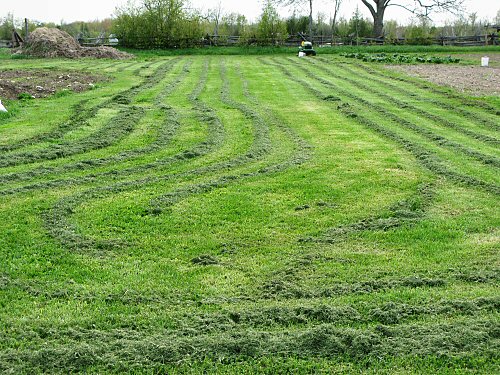
The grass seemed just long enough for a productive mulch cut without overloading the John Deere riding mower, so today was the day to start season 2 in the grass mulch experiment. This is just one part of the total mowing area: including the field perimeter and another big area behind where I’m standing to take the photo, there’s maybe four times that much (this area is being kept clear for the eventual bigger greenhouse). The JD’s deflector forms those nice mini-windrows instead of scattering the cut, making raking it up much quicker. I’m still not sure if the time it takes to mow, hand-rake and bag will be worth it on a larger scale: will the work be offset by savings in irrigation and weeding, and maybe better yield, for the crops that’ll be mulched? It takes a lot of big, packed leaf bags to properly mulch just a few beds… Well, we’ll soon find out!
Greenhouse upgrades
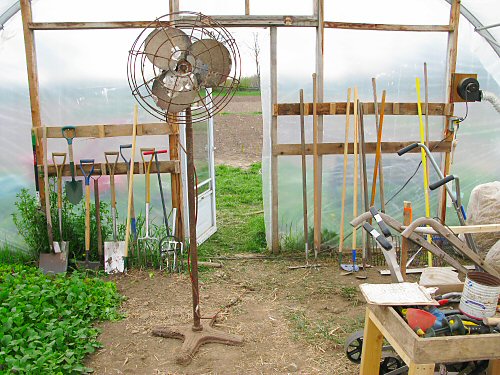
Another cloudy, cool, kinda chilly day. There’s always fieldwork to do, but this type of weather is also good for building, fixing, organizing…indoors. Today, some long-planned greenhouse upgrades. They may not look like much, but it’s a pretty big bunch of improvements! As part of Shannon’s kinda intensive “this is what I do around here,” hands-on experience (with full narration!) on this tiny farm, I showed her how to use a couple of basic power tools—cordless drill, chop saw—and she built simple legs for a wooden tray that I use for various small, often-used bits of gear (the tray’s shallowness is an automatic organizer: things can’t get really buried!). Really simple, rough carpentry, but if you haven’t used tools much or at all, and then you build something that’s immediately used in the course of the farming day…it all makes more sense! At the other end of the hoophouse, I put up another wooden crosspiece for leaning long-handled tools, and we separated the most-used and put the least used at the other end. Again, by avoiding a pile of stuff, everything’s easy to grab and put away. And then, we pounded a couple of 2×2 wooden stakes into the ground (pounding with a mini-sledgehammer was also on the farm experience menu today, I pound a lot of stakes for tomatoes every year as well…), and screwed another 2×2 as a crosspiece to make a leaning rack for the seeders and the wheel hoe (you can see one end on the right of the pic, one of the posts has orange tape on top). Finally, a machinery addition, a big, old, rusty, dangerous-looking high-volume fan on a really heavy iron stand. I’ve been meaning to work on greenhouse ventilation for ages…but always ended up using much smaller home-type fans. This one, which was actually being stored in the chickenhouse, I hadn’t noticed till now. It moves a ton of air, and reduces the temperature a full 10-15°F in the middle of a hot day. Cool! To look at, these little building projects are absolutely basic and kinda primitive, but they’re quick, easy, solid cheap, and really make a huge difference when you actually use them… (I just noticed in the pic how the right side of the end wall seems to be sagging, it doesn’t look that way at glance, I should check it out and see what’s up…)
Seedlings away!
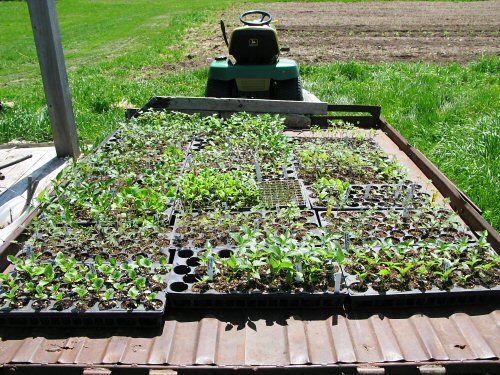
Things can change suddenly on the tiny farm. I picked today to move the majority of seedlings to the greenhouse. Although this was MUCH later than hoped for earlier this year, it’s all about the (recently COLD) weather, and I didn’t want to spend much on heat. But you can’t wait forever. There’ll probably be at least a couple of freezing nights in the next two weeks, but it IS getting to mid-May, and these guys will be out in the field, one way or another, before the end of the month. So, it’s out of the Milkhouse and onto the trailer behind the little John Deere riding mower for a little trip…
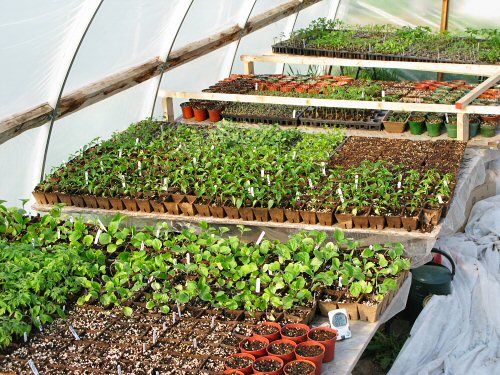
The greenhouse tables are now just about full, and that’s with a fourth one added a week or so ago. Plus, there are a few more trays of plug sheets on the ground off to the right. Lots more seedlings than ever before… On the closest table, there’s the (excellent) digital min-max thermometer/hygrometer, recording critical highs and lows, right after the fact! New this year are those red and green plastic pots (with cukes, squash, pumpkins, melons)—I decided to stop using the 3″ peat pots and try soil blocks, BUT, I didn’t feel like learning about block making right in the rush, so I used the last of the peat and then dipped into the collection of plastic pots I’ve been given over the years. (I’ll get the soil block maker in the summer, so I can play around with it first…)
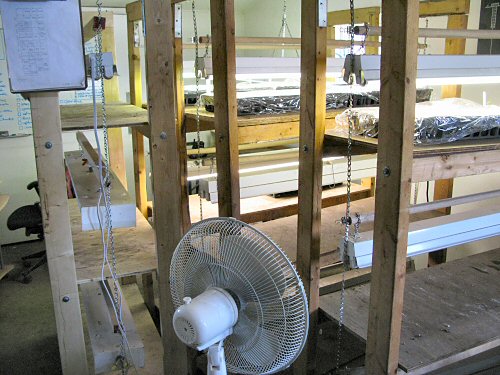
It’s always a little…sad when bright, cheerful gear goes dark and empty… There are still a few trays of really young tomatoes, brassicas, and a couple of other late-started things, but the grow rack days are just about over for the year. We’ll soon be stowing the lights and chains, and presto, instant rolling racks for harvest bins. Transplants for late spring and summer will get started in the greenhouse…
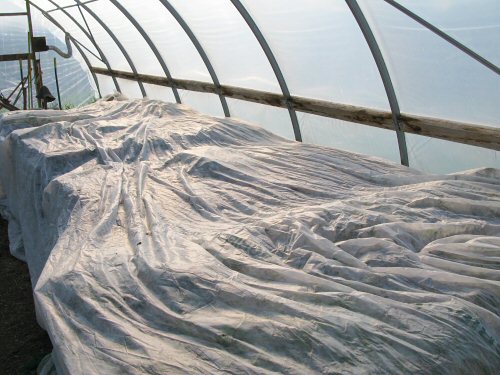
And so, the seedling greenhouse gets tucked in for its first full-house night of the season. Boy, imagine if something WENT WRONG in there… :)
Rinsing station gear comes out
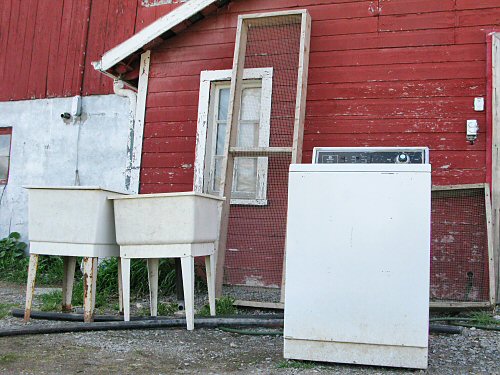
Today was the day I decided to bring out the rinsing gear! Upfront for its fourth (or fifth?) season, the trusty Maytag washer turned giant salad spinner. Once again, after a winter in the unheated drive shed, it started up (on Spin, of course) without a protest. (Maybe it’ll get a cool paint job this year, finally?!) Leaning up against the Milkhouse wall, there’s the original, square screen table (formerly used to sift gravel), and beside it, the new one I built last year—just add sawhorses… On the left, the pair of laundry tubs. Drainage pipes lie on the ground… First harvest can’t be far off!
Herb garden time…
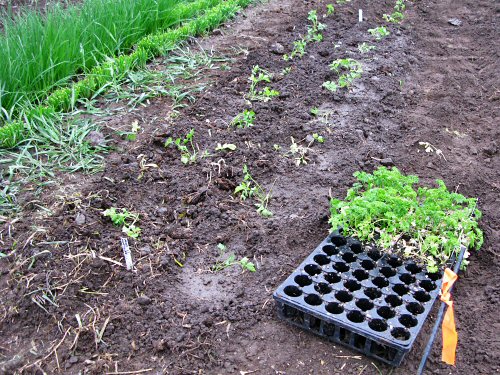
It’s right in the middle of the spring garden rush, for sure. but we’re in that little lull of sorts between direct seeding and transplanting the hardy and cool-soil-germinating crops (brassicas, peas, carrots, lettuce, etc) and waiting on temperature to transplant the more tender guys (tomatoes, eggplant, peppers, cucurbits). This year, for the last three weeks or so, we’ve been cooler by a few degrees than recent Mays, both days and nights, which slows things down a bit more, as I don’t see an advantage in planting out some of the tender stuff early by a week or two, since the extra growth probably wouldn’t add up to much. Sooo, there’s more time now—a longer lull—to concentrate on the kinda B-iist crops (I don’t like putting it that way, but for practical purposes, well, some ARE more important to the overall market garden than others…). That means the herbs and flowers are getting great extra attention: earlier planting, dividing established growths of sage, thyme, oregano, much needed weeding… Today, I did the parsley. There are several varieties, I couldn’t resist seeing how they’d compare. For curly: Krausa Market, Green Pearl, Green River, Green Forest. For flat-leaf: Plain Italian and Hilmar. At the top left of the pic, some chives, up and thriving from last year’s planting, and you can see the well-established grass in the path that is being meticulously forked and pulled, drawing out the runners by hand, sifting with fingers to leave all the top soil. This is what I think of as really hardcore, basic gardening: crawling around, hands-in-the-dirt work, where you’re literally attending to each plant. It’s incredibly relaxing, soothing, really, so much…fun, alone or with others. Of course, this particular approach doesn’t scale up too well! Tiny farming comes in so many shades, degrees, intensities… It’s great! :)
Chickens just wanna eat…
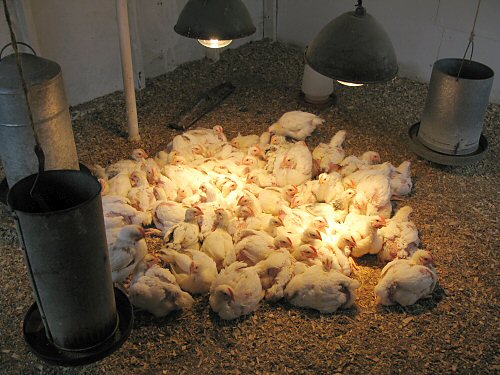
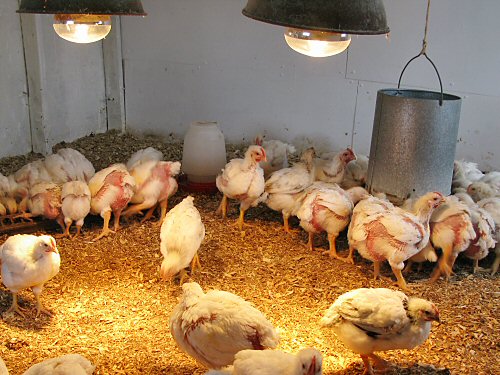
The chickens are blowing up! At least, the White Rock Cornish X super-converting chickens are, turning feed into meat at a startling rate. The 10 or so Frey’s Special Dual Purpose are sleek and speedy, and all their feathers are in, but I guess that’s not what a truly modern meat bird is supposed to be like. Most of the White Rocks are double the size of the Frey’s. When I think of the chickens these last few days, it’s a vision of pink, partially-feathered butts in the air, circled round the feeder… Oh well, we’ll see what happens when we get them outside and cut back a bit on FOOD…
Meanwhile, despite entirely different sizes, speeds and eating habits, they’re still all getting along. My first chicken adventure continues…
Frost is pretty when…
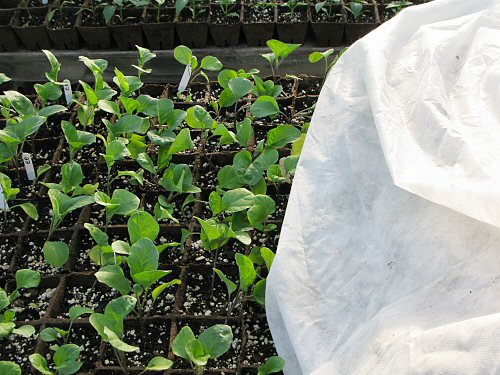
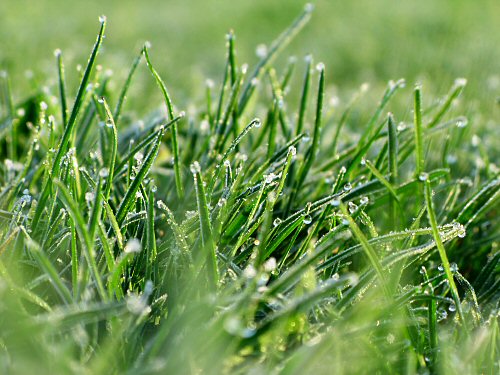
The days have warmed up now, mostly around 60-70°F (15-20°C), but the nights are unusually cold, dropping sometimes to freezing or a few degrees above. Frost burning off in the early morning sun is pretty when you don’t have anything in the field for it to kill, which I don’t… Let’s see: broccoli, cauliflower, radish, carrots, spinach, chard, beets, peas, parsnips, all-lettuce mesclun, tatsoi-mustard-arugula-bok choi mix… Nope, no worries there. (Funny thing, while pea plants are hardy, I believe the pods aren’t… I’ve never seen that in action, fall peas haven’t worked for me so far, and I don’t think there’ll be frost 40 days from now when this year’s first peas come in…). Meanwhile in the unheated greenhouse, although I’ve only fired up the kerosene heater once, just to be safe, row cover goes on all the tender stuff (toms, eggplant, peppers, and now, cukes, pumpkin, melons and squash, just about to poke up): on in the evening, off in the morning, better safe than toasted!
