
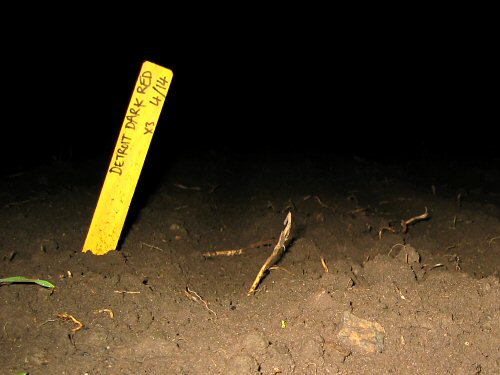
Nights are warming up now, so it looks like I won’t be cruising through the near pitch black field much longer, checking temperature in the greenhouse. There’s not much to see or do out there after dark.
Carrot science
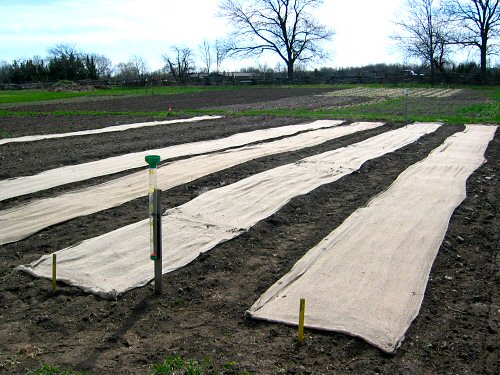
Welcome to my carrot lab! Carrots have been my biggest early spring headache. In cool weather, they take forever to germinate, 2 or 3 weeks, and by that time, the chance of weed competition is pretty good, and just about anything growing around the tiny seedlings makes excruciatingly time-consuming surgical hand weeding a necessity. What to do? Last year, I tried IRT (plastic) mulch over the bed. This worked great, heating up the soil, speeding germination to 7 days, and keeping weeds down. Problem was, miss the germination window (when a good number have emerged) by a few hours or a day, and the seedlings got toasted in the heat. Too delicate a balance. So, a new approach, something I’d read about. It involves a double layer of (untreated!) burlap. Simple. The burlap acts as a mulch to retain moisture and increase soil temperature, and it also allows in water and some light. What could be easier?!?! Now, all it has to do is WORK! (Update: it worked like a charm…)
Off to the hoophouse
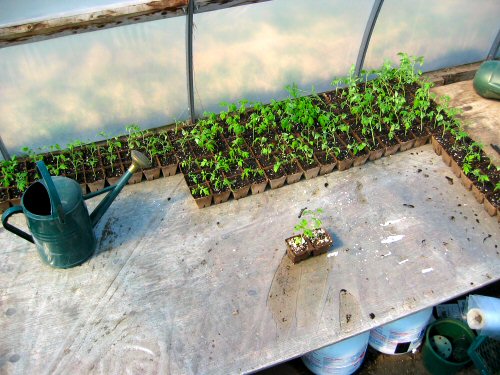
The first set of tomatoes is now in the unheated (but heatable!) hoophouse. They’re freshly installed in 3″ Jiffy pots (peat pots that can be planted), watered in, and awaiting the first night’s cold. It’s supposed to go down to 3°C (37°F), which isn’t bad, but it’s always chillier in the field than in the forecast. Peeking out from under the table, two fat little propane tanks: round about midnight, I’ll be on temperature patrol, ready to fire up the propane construction heater if it looks like a freeze. Working the night shift. Farming after dark!
The spreader
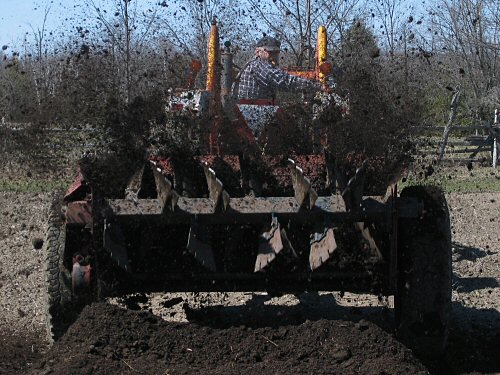
Last of the big machine work! Bob using the spreader to drop off a pile of compost for distribution by shovel (shot two days ago). There is something really satisfying in this crazy world about technology that is straightforward, like a giant fan-blade device for tossing manure far and wide! Today, I finished rototilling the new section, ending the main tractor work. From here, most of the fieldwork is done by hand—the biggest machine is the little Kubota. Later on in the day, it rained, only 5mm but enough to save hours of watering-in newly seeded beds. Time to start keeping track of the rain…
Garlic, now!
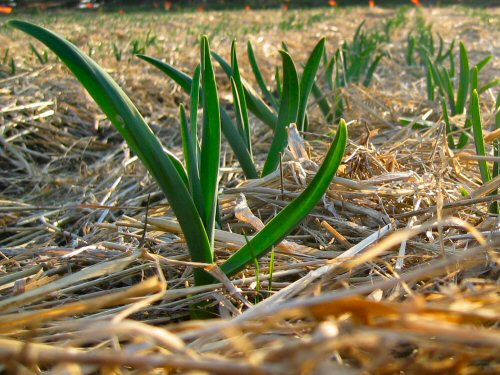
Garlic is shooting up once again. Although we’re only five days into a nice warm weather stretch, this year’s crop of Music seems to be at almost the same place as last year’s garlic in the all-mild April of 2006. You can see it growing by the day. Elsewhere in the field, things are moving ahead faster and with more on the go than ever before, with Conall (the all-new organic grower) picking up new field skills practically by the hour. Let’s see how things continue to shape up!
Get it in, get it done!
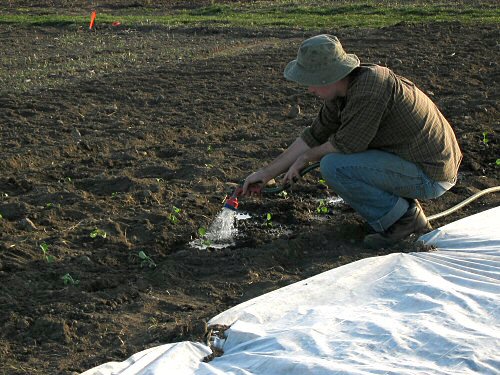
Conall, the all-new organic grower, starting from scratch as our first full-season, full-timer, waters in transplants. Today we set out three more beds of brassicas—so far, there’s cauliflower, broccoli, Brussels sprouts, bok choi—prepared beds for a dozen more crops, set up the irrigation pump for the season, cleaned out the winter storage area of the barn, turned the composting windrow….and more. Still, it’s the rush-to-get-it-in-get-it-done time of the year, and the days never seem long enough (although, they’re getting longer!!).
First field transplant of the year
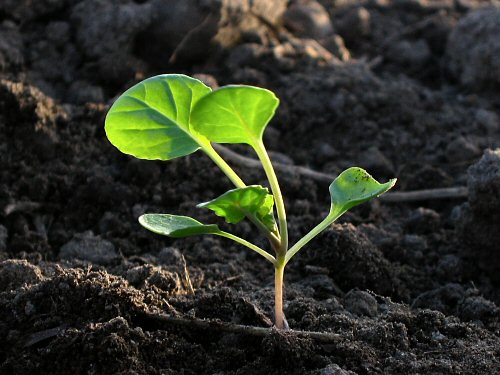
This little Jade Cross Brussels sprouts seedling, only four weeks old, is first into the open field. The weather remains pretty well perfect, warm and sunny, and we’re steadily chipping away at the list of crops waiting to be started right away. Today, besides the Brussels sprouts, the first three beds of mesclun, and a whole lot of bed preparation!