Finally, frost!

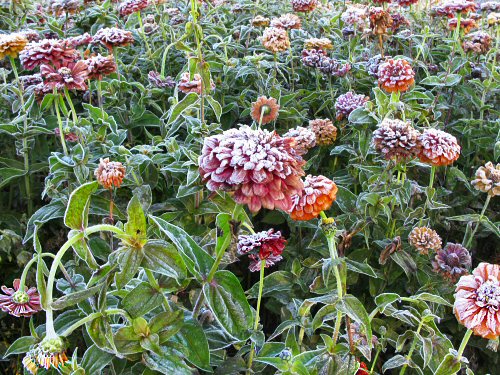
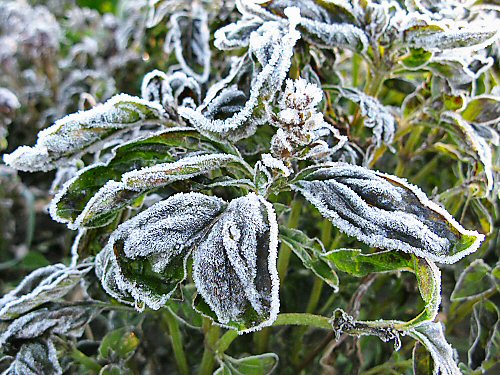
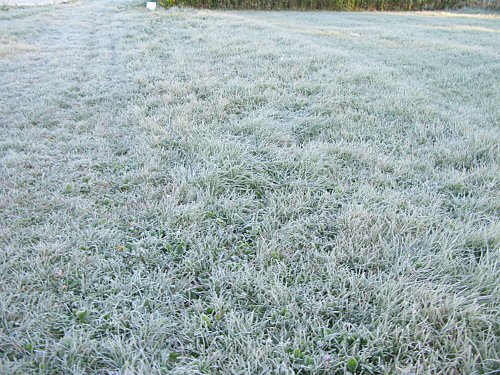
Overnight, the first real killing frost finally hit. A couple of nights it had gotten close, touching some plants in the field, but this was the real deal. At 8am, the lower end of the garden was still in the shadow of the drive shed, and the frost still hadn’t burned off. Basil (above), the tenderest crop in the field, is the first thing I check in the morning for frost damage. Right beside, the zinnias are goners, but still holding color—as the day progresses, they’ll shrivel and turn brown…

All in all, nothing unexpected or terrible—sooner or later, frost always arrives, and this time, the eggplants and peppers under row cover did fine. Besides, frost in the early morning light is pretty…

Bus stop

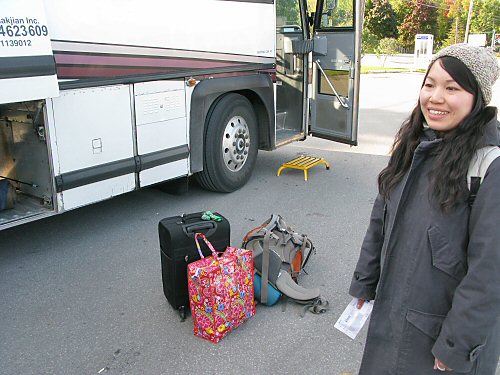
We drove Toshiko to the bus stop in town this evening. After her two weeks on the farm, trimming garlic, digging sweet potato, slinging veggies at the farmers’ market, she’s heading out again, first to Toronto and then Montreal for a few days of sightseeing, then on to the southern US and Mexico for the winter. After that, she plans to continue studying English in Vancouver for an extended period, before heading back to Japan. With the WWOOFers of the last couple of seasons—from Japan, Germany, Spain—there’s definitely been an international flavor on this very local, tiny farm. It’s fascinating to think about how far these hands have come, to do simple tasks in a field for a while, then vanish down the road. As a non-driver, growing veggies full-time for sale very nearby, I have minimal direct involvement with travel. But its effects are all around and often on my mind. I find myself calculating the distance people drive to get to the farm or the farmers’ market. I’m alert to the increasing number of Mennonites clop-clopping by with horse-and-buggy. I think about the routes traveled by the tools and supplies I pick up at the big chain stores in town. I sometimes imagine leaving the farm, on my own and without driving, catching the once daily bus that would plug me back into the world of cities (at least two-thirds of the PLANET now lives in cities!), where travel is condensed to nothing. Standing with Toshiko at the bus stop today kicked up a lifetime of memories of big city living, the oddness of flying across an entire ocean in a few hours, sometimes with hardly a day’s notice and not a second thought, and then the last few YEARS spent tending a tiny patch of FIELD, barely moving beyond a single line of sight. Hmmm… What a wiggly world. :)

Cold-weather harvest

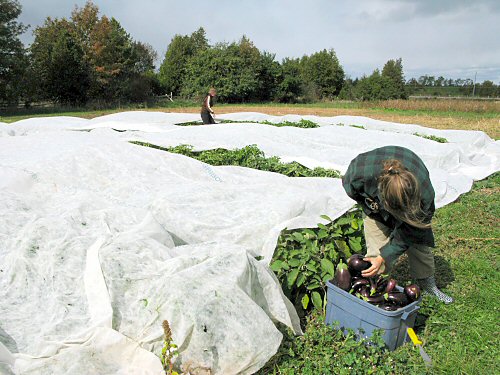
Some days now, the temperature is in the +/-20°C (50°F) range, and nights hover around the freezing point—not that cold, but comparatively so when other days shoot up to summery highs. I’m now keeping the row cover permanently on the eggplant and peppers, they’re no longer out there to grow—not enough sun—the field is now simply a convenient storage system. Picking from under cover, pulling back only as much as necessary, we take what we need for and leave the rest. There’s probably two more week’s worth of sweet and hot peppers, and at least another week of baby eggplant to go after today…

Bundling up a bit kinda seems to be the general choice. Libby and Lynn are in winter outerwear mode, down to insulated rubber boots, while Toshiko, who finds it colder here than at home in Japan, keeps warm with layers. Seasons change…

Digging up potatoes

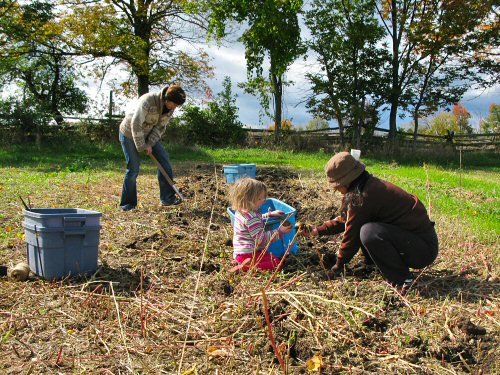
There’s still about 1,000′ of potatoes to dig, a few Yukon Gold, lots of Kennebec, and maybe a bed of Chieftain. This time around, it’s a bit of an unconventional approach. Some beds were kinda…weedy, so a week back, I mowed them all down. Now, the trick is to find the rows. Once a couple of plants are located, I run twine between stakes at either end to mark the row for easier digging. Michele and Toshiko were today’s crew, with young Violet checking things out. Simple fieldwork for a pleasantly cool fall day…

Sweet potato harvest

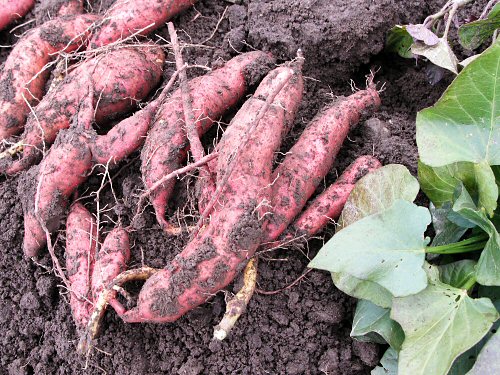
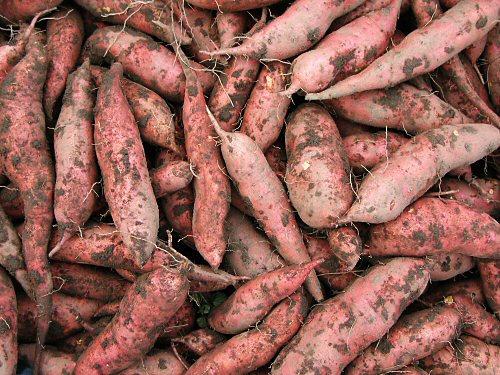
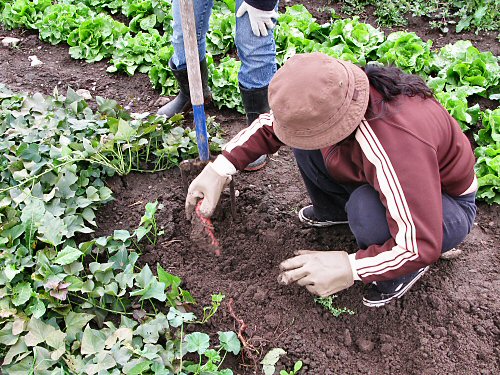
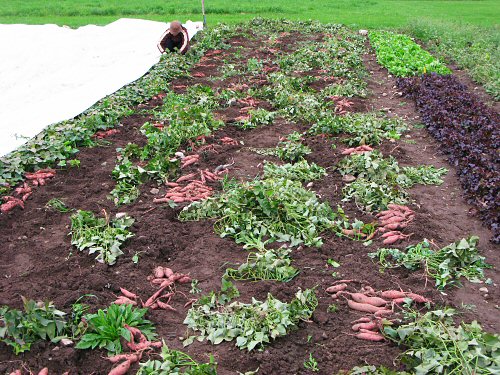
From planting back in mid-June, it’s been 3-1/2 months to the sweet potato harvest. The variety, Beauregard, is listed as 80-100 days to maturity, although, like potatoes, you can dig them up anytime, as soon as the tubers have formed. The vines are frost-sensitive, and the tubers shouldn’t be left in the ground if the tops are frost-killed, so I’ve been gambling with the first frost timing in order to let them grow for as long as possible. Today seemed like a good time to start. This has indeed been a really easy, pest- and disease-free crop, requiring only a little weeding until the vines filled in. Harvesting turned out to be equally easy. After digging up a few plants to see how the tubers grow, Lynn, Toshiko and I set up a quick hand-harvesting system: remove the vine, loosen the soil with a digging fork, scrabble around for the taters.

The soil had quite a lot of moisture from recent rains, so we had to spend a little extra time brushing off clumps of clayey earth. We left them for a couple of hours to dry in the breeze, then collected them in bins and brought them into the Milkhouse. By the book, sweet potatoes could use 10-14 days of curing at 80-85°F (25-28°C) . In part, this allows some of the starch to convert to sugar, making them…sweeter. That sort of HEAT isn’t available around here right now, but for this first time around, and too small a quantity for really long-term storage, I’m not too concerned. I baked some a couple of days ago, and they already taste good. Let’s see what a week or two indoors does for ’em!

This week’s share

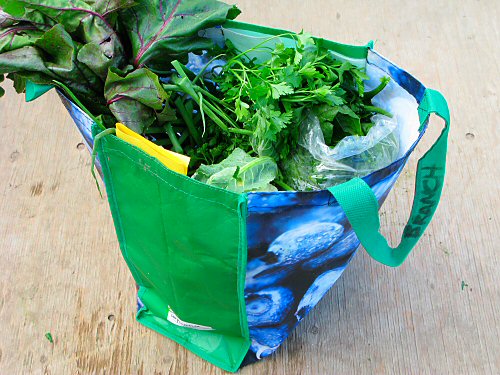
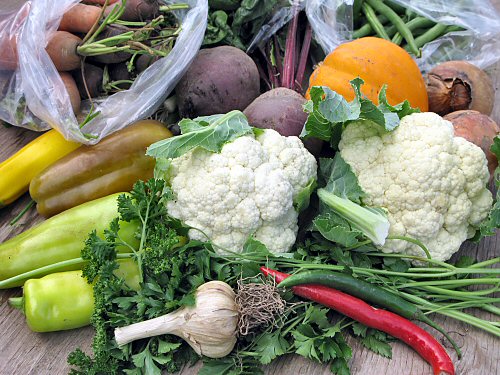
Another rather nice fall CSA share this week! Thanks to no killing frost so far, we’re still picking beans (Jade), peppers (Gypsy, Ace, Cayenne Long Slim), and zucchini (Golden Dawn III). There’s also winter squash (Table Gold acorn), cauliflower (Minuteman), onions (Stuttgarter), beets (Scarlet Supreme), carrots (Nelson, Purple Haze), spinach (Spargo, Bloomsdale), parsley (Green River curly, Plain Italian flat), and garlic (Music). Plus a newsletter. Monday shares are left at a drop-off spot, with shareholders’ names printed on the handles…

Friday harvests get quicker!

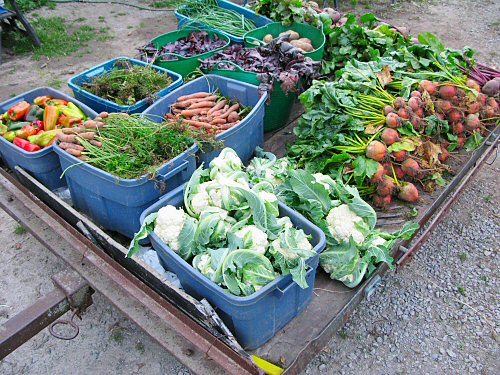
Friday harvests are getting quicker as the season winds down. This has happened at least for the last couple of years. Where earlier in the season, we finish around 8-9pm, we’re now mostly wrapped up by 5 or 6, and sometimes with less people than during the summer. I’m not quite sure why this happens. Probably, a big part of is that everyone out there in the field is now experienced and comfortably fast. Also, many of the crops in the weekly veg line-up are pre-harvested: garlic and onions first, and now, winter squash, pumpkins, potatoes and the new sweet potatoes. Still, it’s a pretty big harvest, and quantities are the same now as earlier in the year. Then there’s the shortening days—it’s starting to get dark around 7:30 pm now, down from 9:30 in late June-early July—and CHILLY WEATHER that likely speed us up! Anyhow, this is the most time I’ve spent wondering why—whatever the reasons, getting done quick is good! The trailer-load in the pic is about half of the day’s field haul, and there’s also the pre-harvested stuff. In this week’s harvest, in no particular order: carrots (2 varieties), cauliflower, beets (3 varieties), sweet peppers (several varieties), hot peppers (several varieties), green onions, spinach (2 varieties), summer squash (3 varieties), beans, tomato (several varieties), parsley, basil, all from the field, plus, pre-harvested, garlic, potatoes, winter squash (several varieties) and onions (2 varieties).