Suddenly, this morning, it’s cold! For this time of year, that’s a forecast of 4°C (39°F) all day, and -6°C (21°F) overnight. Brrrr… Maybe it’s just me, but I didn’t even notice the leaves turning in their usual intense explosion of reds and yellows, this time around, the trees kinda just went bare with a minimum of flash, and here we are! Round about now, this is as good a day as any to pick as the end of the old season, start of the new farming year!
Autumn
Parsnip root flashback
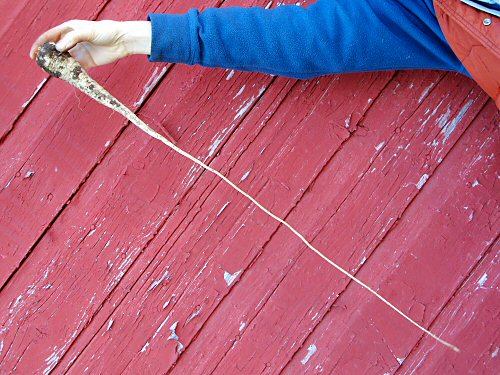
This harvested parsnip root only hints at the massive root systems that plants have down there. Mature parsnips can root down to 9 feet (2.7m), and spread up to 3′ (0.9m) in the top 10″ (25cm) of soil. Other garden veggies are generally as impressive in the root department. When we harvest, most of the delicate root network is torn off, and we only get to see the bigger, tougher parts, the taproot or the root ball. This pic is from an old post I ran into, a flashback to Oct. 2008: there’s more words and another long-rooted-parsnip pic at Root love! (The arm-and-hand model is Lynn.)
Well-thinned carrots, growing well!
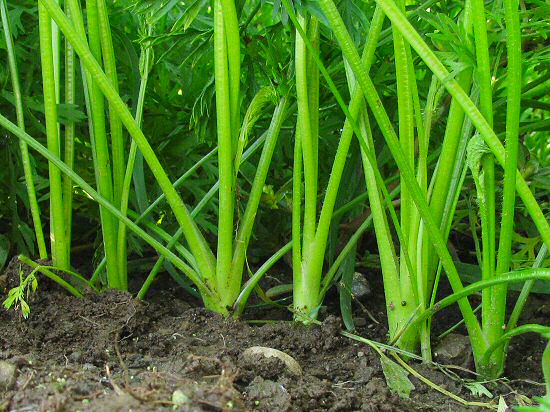
Checking in on the fairly massive time investment we made in thinning 800′ of late-planted Touchon carrots—and it’s paying off! Not that there was any doubt that thinning works, it’s just so…tedious. After laying down carrot seed thick (in other words, after using the Earthway seeder), we spent hours removing thousands of extra seedlings. Because these guys went in so late, I wanted to give ’em every shot at making the best of good weather and sizing up while they could. Now, the effect of 1″ (2.5 cm) spacing really shows. We still kept them pretty tight, thinning a few short stretches to 2″ (5 cm) for comparison, but mostly did them like this, aiming/hoping for a big yield of fairly slender full-size carrots towards the end of October. You can see, second from right, a little one that escaped. It may seem obvious, I’ve found appropriate spacing is easy to overlook or downplay. When you’ve actually seen the massive difference it usually makes, it’s hard to ignore! Think better seeder. :)
More local food, cooking!
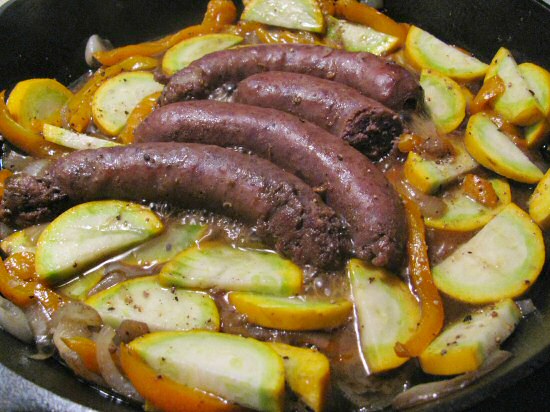
OK, perhaps not the MOST appetizing of food photos, but the point is, that’s how it looked, and it tasted great—more all-local, dead-simple cookery! Here we have my first time with this grass-feed beef honey garlic sausage from a few miles down the road—I could actually taste…honey; unusual and good! Alongside in the cast iron pan, sweet orange pepper (Orange Sun), the very last, slightly green zucchini (Golden Dawn III), and a mess of yellow cooking onion, all from the field. A little imported olive oil, salt and fresh ground black pepper, let braise-simmer for a while—an hour or so, with the zucchini added near the end—and…Bob’s yer uncle! Delicious, nutritious (I’m pretty sure), fun. :)
Peppers turn color!
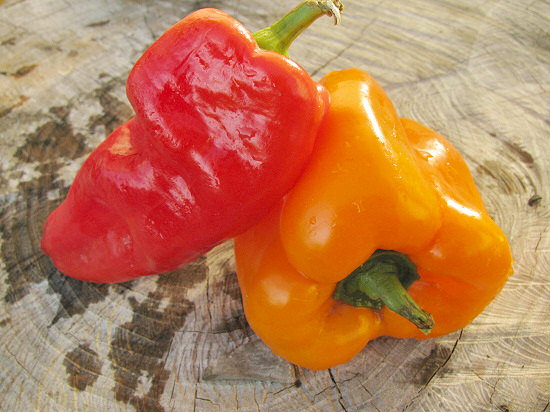
Red and orange peppers! It’d be nice if this was a normal sight, but with our short season and often as not inconsistent heat and sun—peppers love decent heat—peppers that fully turn color are fairly unusual in this market garden. Because they’re more uncertain, I’ve tended to give them lower priority, often transplanting them at the end of the queue, which doesn’t improve their chances. I also usually don’t mulch—peppers appreciate decent mulch of any sort (plastic especially, it’s so…efficient), the heated earth seems to really help them grow.
This year, we lucked out with the weather—unfortunately, we also planted the smallest amount of peppers ever. Oh, well, that’s how the garden gambling goes! Here we have Gypsy, a tapered hybrid that has a rather quick 65-day maturity, but takes longer to go from its pretty yellow-lime green starting color to…sweet red. I’ve grown this for a while, it always comes through, a tasty, prolific, all-purpose pepper that’s nice even when it’s not red. And then there’s the open-pollinated, heirloom Orange Sun, from seed I’ve had for years, a blocky bell pepper that needs a full 80 to 90 days, that I’ve seldom seen beyond its dark green initial color, now in a satisfyingly deep, rich orange. Taste changes with color, smoothing and sweetening—these guys are delicious!
After market
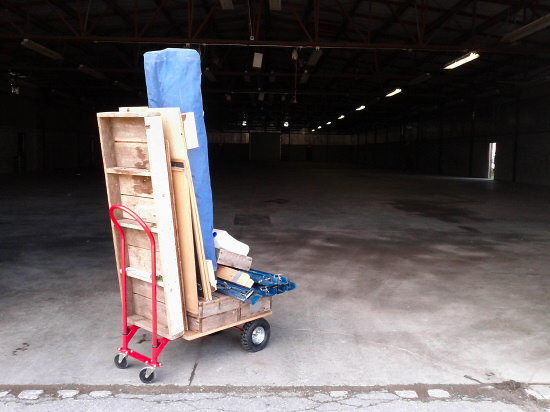
Around 1:25 p.m. and it’s just about time to head out from the farmers’ market, which officially ends at 1. This season, we’ve been storing the entire farm stand in the communal cage where vendors can leave stuff from Saturday to Saturday. The stand is quite the compact set-up, once it’s torn down and stowed away…efficiently. On the dolly, there’s the 10’x10′ E-Z UP canopy, half a dozen folding metal sawhorses and the plywood boards that turn them into tables, a pair of chalkboards, rough cut cedar display trays (a strip of four, and singles), pieces of 2×4 used to prop up the trays, and a plastic water jug used as a canopy weight (we normally have four, but this year we’ve been lashing the canopy legs to one of our neighbors, so weighting the four corners isn’t necessary). The only thing missing, besides the veg, of course, is our market box, which is a bin containing scales, bags, signage and so forth. Most farms come to market stand and all, as we did until last season’s start of…commuter farming—living off-farm—when logistics made leaving this gear at market a lot simpler. Anyhow, this huge exhibition hall houses the indoor market on Saturdays, November through April, and the big parking lot outside is where the summer outdoor market is located. The cage, a chain link fenced corner, is out of sight to the right. And that’s just about ALL the details. :)
Bush cord meter
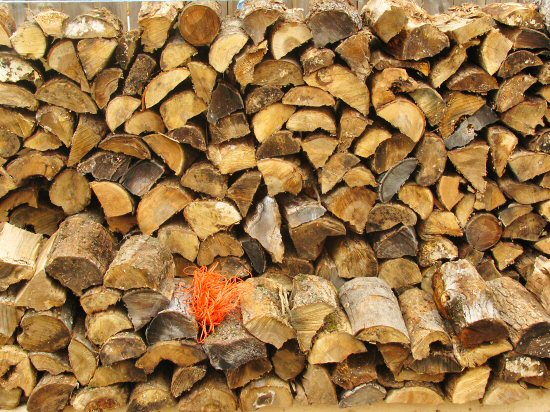
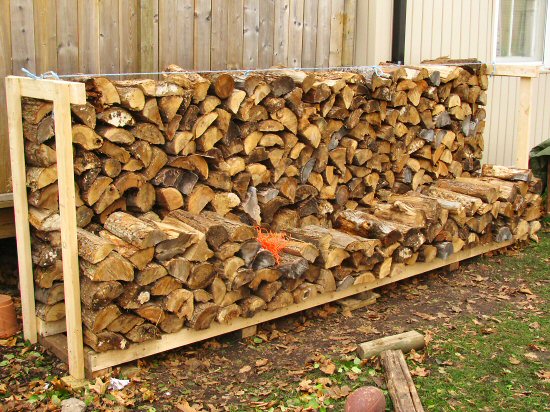
Our first wood order of the season arrived a week ago, just as we ran out of the leftover from last year. It’s a bush cord. At least, that was what was ordered, bought and paid for. One bush cord of well-seasoned hardwood, in 16″ pieces. The wood is great on the seasoning end, but when I finished stacking it today, in our custom-built, holds-one-bush-cord rack (below), even taking into account the wood we burned over the last week, we are CLEARLY WAY SHORT!!
I’m kinda shocked at how short we are. When I looked into what exactly a bush cord comprises, the definition seemed pretty clear: 4’x4’x8′ of tightly stacked wood. A volume measure. With 16″ pieces, that equals one long 24′ row, 4′ high. “Tightly stacked” is a little vague, but after asking around, and looking at photos, it seems like common sense: you don’t fit the wood together like a jigsaw puzzle, just stack it nice and solid. OK.
I built a simple rack out of 2x4s that should fit…exactly one bush cord. Of standard 16″ pieces. It’s kind of a bush cord meter. To fit in the narrow side yard, the rack has two 12′ rails, with 4′ high ends. I stacked it reasonably solidly. And we seem to be at least 1/3 (that’s 33%!!!)…short.
The firewood guy came recommended, he’s apparently been doing this for decades, how could this BUSH CORD be so off? It’s a mystery. I’m new to firewood, maybe the counts are loose, but this is extreme. I’m on the phone…