
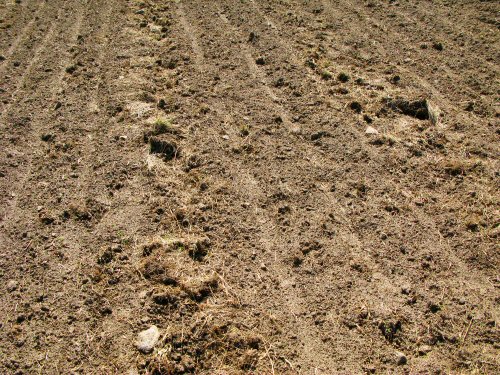
Direct seeding is going ahead at a careful pace. There’s a fair amount of broken up sod in the mix, and it would be nice for it to have more time to settle in and decompose, also for any bits of live grass to start poking up so they can be disrupted again with a light tilling… But we can’t just wait around. Spinach, beets, and radish went in a few days ago, just after the first peas. More peas went in yesterday (Connor for the first time wrestles with the kinda heavy and unwieldy Planet Jr., above, and ends up doing fine on a trial row). Now, the watching and waiting is on for the first plants to emerge in the field…
seed
Potatoes delivered
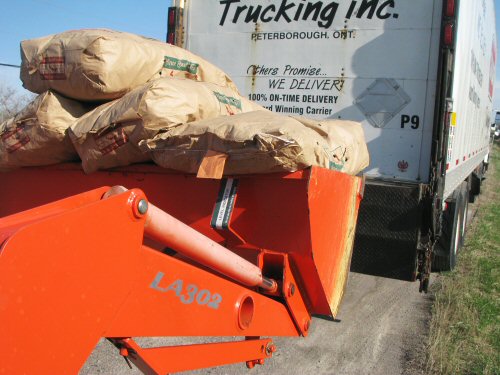
Seed potatoes arrived today, all the way from tiny PEI (Canada’s potato province!). It’s still difficult to find certified organic potato stock, especially in more-than-home-garden-less-than-big-farm quantities, so it’s back to Veseys for another 300 super-expensive pounds, from 1,000 miles (1,600 km) away. Not too local, but that’s part of the certified organic game, finding seed… This year, the delivery charge upped the price by 60%—it’s expensive to truck stuff.
Unloading. The lane to the barn is narrow, has an obstructive tree right beside a slight but critical bend, slopes upwards, and falls off on one side—big trucks don’t even try to get in. We have to unload at the side of the not-too-busy 2-lane secondary road. Once again, the Kubota compact tractor makes up the difference, this time standing in as a forklift replacement.
Transport trucks it seems often don’t have elevating tailgates that can handle weight, they’re set up for forklift loading, so if you don’t have a handy farm forklift, you have to unstrap the pallet and hand-bomb everything off by the piece. The truck drivers are usually really helpful. This was just six 50lb sacks, two each of Penta (like Yukon Gold), Chieftain (red), and Gold Rush (russet-type), so we’re done in no time!
Machines can communicate: See ya!
Direct-seeding peas
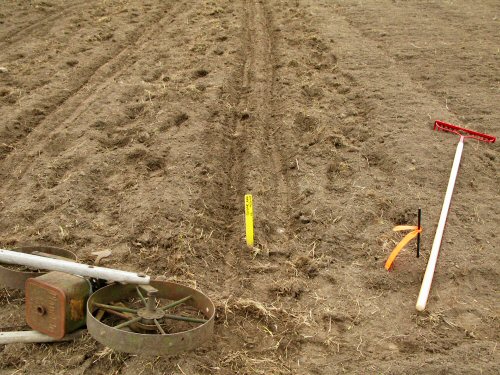
The first direct-seeded crop went in today: Sugar Ann snap peas. As usual, the peas were inoculated with Rhizobium bacteria: dampen the seed with a little water, sprinkle with inoculant powder, and shake.
Rhizobium bacteria enter legume roots and form a symbiotic relationship with their hosts, producing plant-usable nitrogen in exchange for carbohydrates and other nutritious goodies from the plants. The net result is…more nitrogen for all! Or as the inoculant package says: “bigger yields and better quality”!
Sounds great. I take it on faith (in the science, I guess), since I haven’t actually observed the with-and-without inoculation difference. I have a couple of times planted without, but I wasn’t taking measurements…
Each legume (peas, beans, clover, etc) needs its own species or strain of Rhizobia. Luckily, there are packets of premixed assortments that cover the common veggie legumes. What I’ve been using, called simply enough, Garden Inoculant, is good for beans, peas, lima beans and sweet peas.
The bacteria do establish in the soil so that they’re available from year to year, but I’m not sure how long and in what quantities it takes to get set up with the strains you need—until I find out, I’ll inoculate every time…
Then it’s on to the seeder. I’m using the older, heavier, probably-antique Planet Jr. over the usual Earthway.
And minutes later, 3oo’ (91m) done. It’s an almost painfully small start for April 20, but I’m figuring that every few days I leave the broken up sod to break down more, the better off we’ll be. Soon, though, all the rest of the early direct seeded crops will just have to go in!
Tomatoes galore
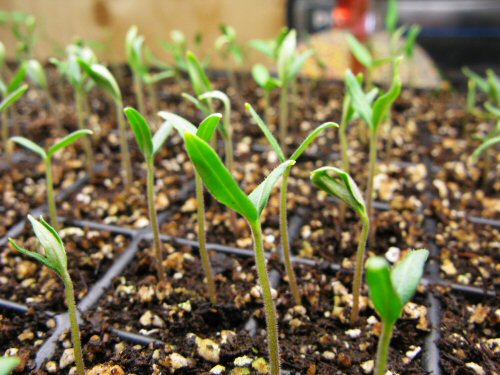
Tomato seedlings are suddenly everywhere! We planted out the whole of this year’s line-up in a couple of days, starting a week ago. The first tray (above) started popping in just 4 days! There are over 60 varieties, including around a dozen cherries. Except for half a dozen hybrids, they’re all heirloom.
Heirloom tomato seed seems to be more quirky than the hybrids, with noticeably different germination speeds and rates from variety to variety, and year to year. Here, we’re waiting on Cherokee Purple from some leftover 2006 seed—one’s up, there in the distance, the rest may come along soon, or not. Meanwhile, right beside, three rows of 2008 CP are up and at ’em, so we’re covered either way.
I haven’t really looked into all this—setting up more efficient storage than my current airtight-bags-and-cool-place method, whether the plastic lined packets from the big seed companies do better than the plain paper ones from many smaller seed houses, presoaking seed for some crops in a kelp solution or whatever, and so forth—because there isn’t much older seed, and most seem to do just fine. So much to try, so little time… Luckily, it always works out!
Kale in survival mode
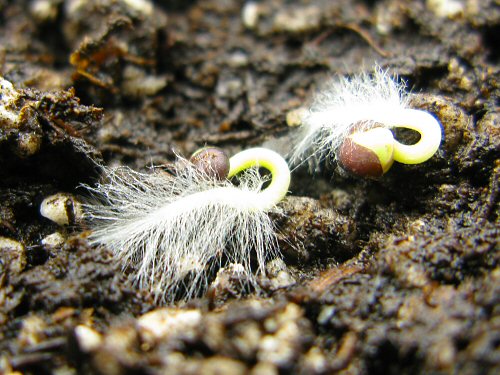
At first, it looks like some sort of horrible, fuzzy mold, about to devour your newly germinated seeds. But when you get really up close, it turns out to be superfine, hairlike extensions growing from the radicle. These kale sprouts pushed themselves right out of the seedling mix, probably because they weren’t pressed in and covered deeply enough.
Kale, broccoli, cauliflower and other brassicas do this in a very visible way during a surface emergency, sending out a mass of fine root hairs in search of water. Root hairs are normal below ground, but I’ve only really noticed them growing exposed on brassicas, other newly emerged seedlings with bared roots usually seem to just dry up. An unusual glimpse of what plants are up to with their vast root systems down below.
Given half a chance—a little surface moisture—these guys can actually manage to burrow down and root themselves. Pretty cool trick.
Seeding as we go…
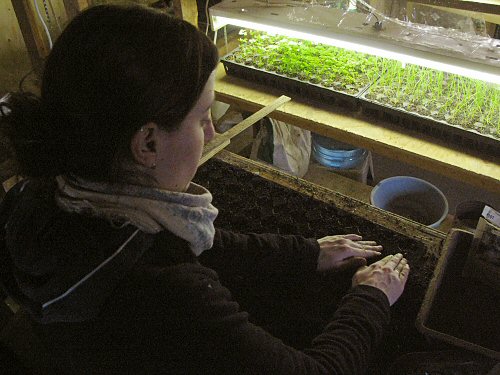
It’s spring! The ground is clear, hasn’t snowed in a while, but it’s still cold, and the tiny farming action remains mainly indoors. We’re steadily filling up the racks (here, Lynn populates a plug sheet with Red Russian kale; under the lights, parsley and onion). I’m spreading things out a lot more than usual, instead of starting a whole lot on one day. We’ll see what difference a few days or a couple of weeks make to the various veg… It likely won’t be much, but some interesting things could happen if we get really drastic week-to-week weather changes around transplant time, like we did last year. An experiment!
More seedlings appear
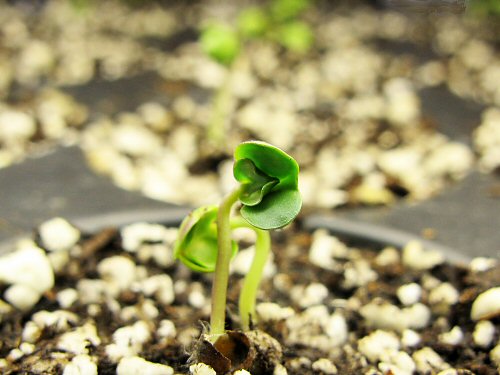
The brassicas—cabbage, broccoli, cauliflower, kale, and so much more—are satisfying at seeding time because they usually come up quick. This tray of Early Dividend broccoli is popping only three days after seeding. I don’t take notes about days to germination, except occasionally here on the blog, but I’m surely watching, especially with older seed. So far this year, with the seedling room usually around 65-68°F (18-20°C), the trays covered with clear plastic, using new seed, it’s been brassicas in 3 days, onions starting around 5. Where brassicas usually come up all at once, over a couple of days, onions can take a week to emerge right across a tray… Details! They’re everywhere! Some seem useful, some seem not.