
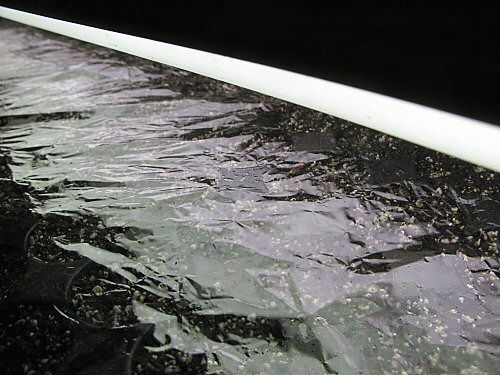
This is it, the official start of the new growing season (since there wasn’t time to plant out garlic in the fall at the new farm)! I seeded a fresh packet of 1,000 Red Wing red onion seeds in three 72-cell plug sheets. That’s 4-5 seeds per cell—after the good results last season, I’m going the multi-plant route again, 3-4 onions in one spot, instead of singles. There are lots more onions and leek to come, including sets, this is the beginning. I’m still at the old farm, the new seedling room is not quite ready, so I’ll be starting a few more things here in the next couple of days, and take them along on the move! For the Red Wing, I hung a couple of lights on one of the light racks. As usual, the trays are covered in plastic wrap to hold heat and moisture. This tiny farm marches on!
seed
Old broadcast seeder
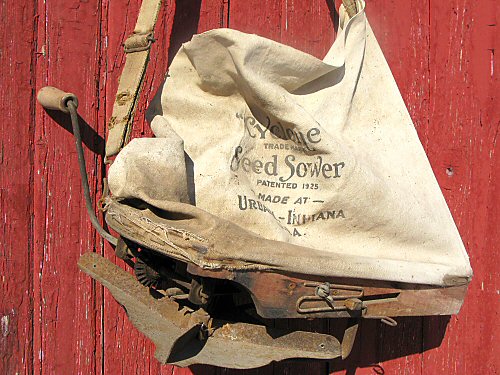
Found this antique broadcast seeder hanging on a nail in the drive shed, the Cyclone Seed Sower, made in Urbana, Indiana, sometime way back when (patented 1925). The canvas is torn, but it’s otherwise in good working order. Dunno exactly when it was last used, in the last decade or two. With a little patching—in a hurry, even duct tape would work—and a few drops of oil, it’d be good to go. In this case, time hasn’t improved on design: this seeder is essentially identical to the modern version I use, except the cloth and wood and most of the metal have been replaced by plastic. Operation is simple: fill the bag with seed, adjust the size of the opening, and start walking while cranking the handle—seed hits the plate and gets flung out by the ribs (here’s a more detailed description). Simple, then and now!
Main order done!
Five hours and done! This year’s main seed order was a first: finished in one session! Usually, it takes two. My head was starting to spin a little, but I felt COMPELLED by the late date to keep going (although I don’t think I’ve ever been much earlier, I always just plan to be). Guess I’m getting…better. A small order went in a while ago, for early starters like onions. This is all the rest!
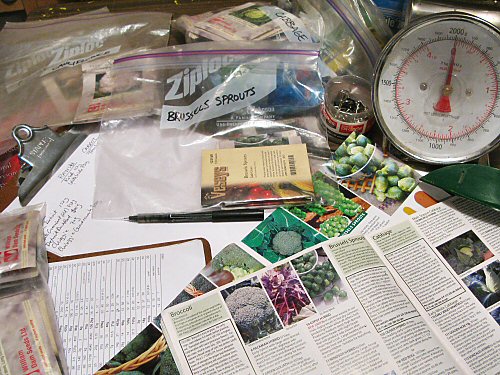
It’s a comfortably familiar routine. I cleared an end of a work table and set things out. A couple of clipboards, one with the always-handy, slightly magical seed calculator sheet. Catalogs from the main two seed houses I use. A scale for weighing heavier seed, and seed in larger quantities. A seed scoop for checking what’s left in packets (pour out, pour back!). Tiny (3/4″/19mm) bulldog clips, great for clipping together packets. And sitting by the table, three Rubbermaid bins that hold the precious seed inventory in freezer-weight ziploc storage bags.
First, I weighed the bulkier stuff: beans, peas, larger quantites of beets, radish, and so on, stored in their own bags. Then, I settled in, going through ziplocs, more or less alphabetically, from arugula to tomatoes. See what’s left, decide what more I need. Check the catalogs, try not to go wild with extra packets of stuff, “just to try”—the amount of seed needed per veggie is already worked out on that calculator sheet. A few of the ziploc bags have only a couple of packets of seed, each a different variety, like the Brussels sprouts in the pic. Most have 10-20. Tomatoes are getting near 200. It’s a lot to go through, but it’s like hooking up again with old friends. Easy. Fun. And I’m done!
Hitting the books
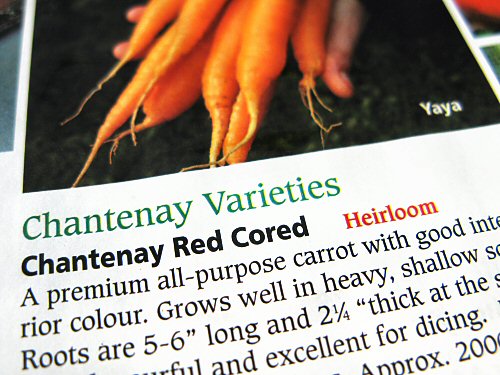
The first new seed catalog came in three weeks ago, but the first from the two seed companies I mostly use arrived on Friday. Today, I took a quick look, checking to see what’s new, but mainly making sure that reliable stand-bys are still around. Dusky eggplant, that manages to come through in the craziest conditions. Rich, earthy Bloomsdale spinach (open pollinated!). Earlivee sweet corn for its speed and it’s more-corn-less-sugar, not-overly-sweet taste (it’s…gone!). Early Dividend broccoli and First Crop beets, planted in spring for their reliably extreme earliness. The shortlist goes on. Most of ’em are still there! The ones that fall off tend to be open-pollinated varieties, as they make way for “better” hybrids… These catalogs are convenient, but I wonder when I’ll get around to seed-saving for real. Progress!
First catalog
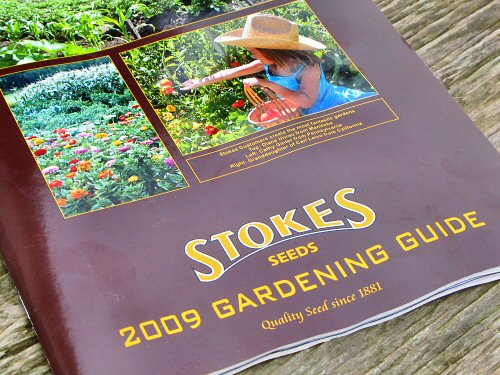
In today’s mail, the first seed catalog of the season! They start arriving around this time every year, it’s always been EXCITING, and now is no different. What I said last year just about covers it once again. I strive to live in the moment and enjoy every day, but….SPRING IS COMING!
Pumpkins and pigweed
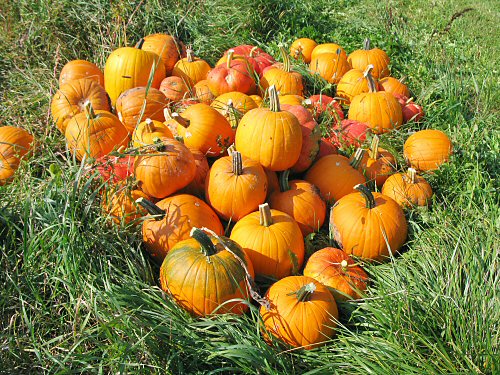
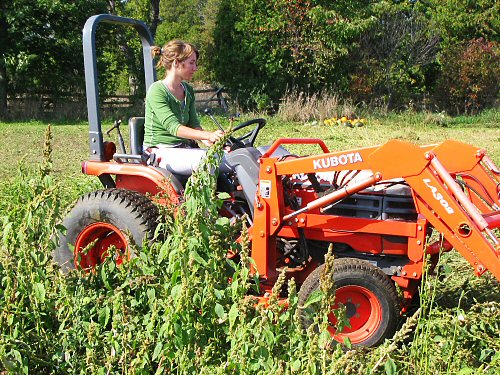
Today, the pumpkins came in, wrested from a jungle of pigweed gone wild. Every year, a few of the 40 50’x50′ sections that make up the 2.5 acre garden get a little overrun with one weed or another (usually, pigweed). This year’s pumpkin patch was a good example, with pigweed growing unchecked for a good six weeks—no time made to weed, not IMPORTANT enough a crop—until today, when Raechelle used the belly-mounted 52″ mower deck on the Kubota compact tractor to mow it down!
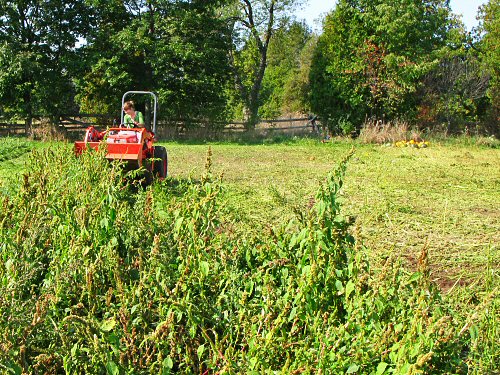
Of course, this is exactly what you DON’T EVER DO in a garden: allow weeds to flourish and go to seed, then mow them down, broadcasting seed everywhere… Oh, well. The alternative, pulling the pigweed by hand, then carting it off, we also do when necessary—see the Pigweed Mountain—but once in a while, I go for the instant gratification of seeing a section clean and clear in an hour or two. The millions of pigweed seeds, ensuring healthy future generations for years to come, will be dealt with…later. (As long as we weed on time next time around, how bad can it get?! :) Anyhow, it’s all part of the grand experiment! Guest pumpkin photo by Lynn.
Potato fruit
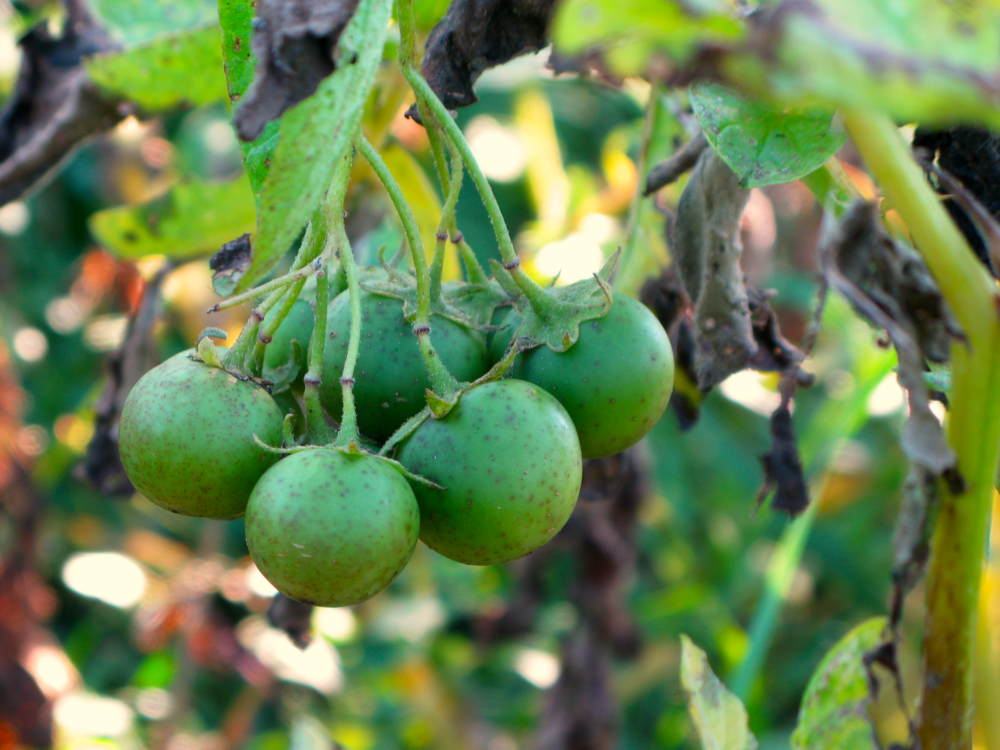
Here’s something I haven’t seen before in my, uh, six years of growing potatoes: green, tomato-like, walnut-sized potato fruit. Bob hadn’t seen ’em either, in 40 plus years of farming. I hit the web for education.
These are genuine fruit (also called berries), but not that common. Usually, potato flowers just drop off. Pollination can be an issue, but even when pollinated, little details of the season’s growing conditions can make the the difference. When fruit do form, they’re more likely found on certain varieties, like Yukon Gold. This year, there were fruit on just about every Chieftain plant, here and there on the Kennebec, and none that I noticed on the Yukon Gold. Since they suddenly appeared this year on two varieties I regularly grow, I’d guess it was about the weather!
Each fruit contains 300-500 seeds that don’t come true: planting them doesn’t result in the same potatoes as the parent plant or each other, there’s lots of genetic variation, each seed will produce a genetically different plant! Potato breeders plant out thousands of seeds, check out the results, then keep replanting the most desirable potatoes for many years or generations to get new commercial varieties—this is the traditional way new potatoes are bred.
Meanwhile, it takes only two seasons and one generation to breed a new potato, so for the small farm or home garden, as opposed to the big potato breeder, this seems worth a try. At least as an experiment. Harvest seed one season—you can hand-pollinate to cross two varieties—plant out the next and select the best-looking plants. The tubers (potatoes) from each individual plant are ready to go: planting out the tubers will produce genetically identical plants.
But there’s a kinda big BUT: even though a potato grown from a tuber is genetically the same, you can’t be sure how its genetic makeup will react to different growing conditions. For example, it may be the perfect potato after a wet summer, and quite different after a dry one. (That’s why professional breeders check over several generations, and now there’s also high tech genetic analysis, to make sure it will be the same potato in the full range of growing conditions.) Still, at the very least, fun to see what happens!
And, the fruit are poisonous, rich in solanine, not for eating. Potatoes, tomatoes, peppers, eggplant and tobacco are all members of the “deadly nightshade” family, all prone to having toxic parts (potato fruit are somewhat similar to little, hard green tomatoes). Interesting!
Since this is such a popular post, being dug up over and over via Google, I’ve started to update the article as I discover more. The post sounds the same as it always did, just surgically filled out a bit with more info. This is unusual. In general, I don’t edit old blog posts, and clearly mark the updates when I do!