Mon, Mar 31, 2008 · Filed under Spring, Weather

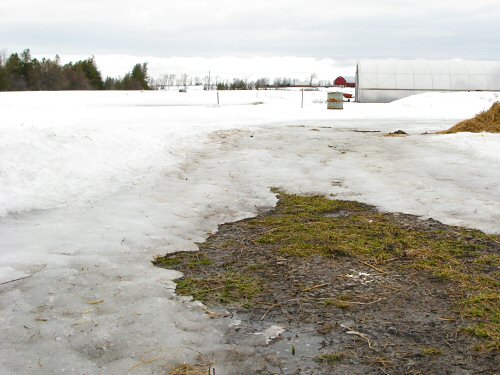
Finally, a bit of a change in the weather: several degrees above freezing and steady on-and-off light rain. Although the air has been cold for the last couple of weeks, the sun has been doing its thing, heating up any patches of open ground and slowly melting the snow away from underneath. So, just a little extra help, and we see ground in no time. This drawn-out melt-off means water is puddling everywhere, freezing and thawing overnights, gradually seeping in. I think this is a good thing: our clayey (clay-loam) soil, with its high water-holding capacity, will be saturated to the max, and hold water longer, well into spring, a good break for the first seeds in. This is my theory… Y’know, there’s an upside to almost everything!

Permalink
Sun, Mar 30, 2008 · Filed under Indoors, Seed starting, Spring, Veggies

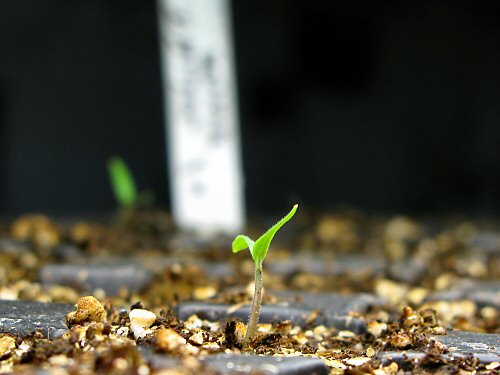
Here’s the very first tomato seedling to emerge and spread its seed leaves: a Striped German (a big, bi-color heirloom, one of my top 3-4 favorites over the last couple of years). This is six days after seeding. I don’t usually keep track THIS closely of the seedling action, but with the unusually slow, uneven emergence of most of the peppers and eggplant—new ones are still just breaking out, two weeks after seeding?I’m watching every little move right now with the toms as well. And there’s that fine MACRO feature on the new camera, always happy to take notes…
Permalink
Sat, Mar 29, 2008 · Filed under Fieldwork, Greenhouse, Seed starting, Spring, Veggies

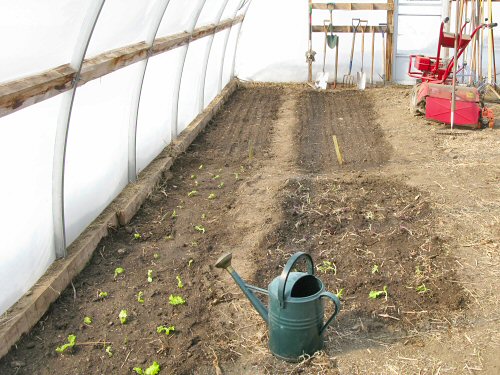
The end-of-March scene in the greenhouse is a lot different than last year, when the growing area was neatly filled with early lettuce. This time around, the early effort has turned into a much more spotty affair. The lettuce started WAY early at the end of January, and held back because of extreme cold earlier in the month, grew and REALLY stretched in the trays, and I only put about half in the ground, just to see what’ll happen. Filling in, there are a couple of beds of direct-seeded, all-lettuce mesclun. The idea of making it to the first market day (this year, it’s Saturday, May 3) is fine if everything else is humming along, but given the slow-leaving winter this year, chances are I’d rather be in the field or doing some other outdoor stuff on the farm at that point than spending a good part of a May day at market with a small quantity of greens, just for show. With this year’s early lettuce and the weather, I’m no longer in such a rush!
Permalink
Fri, Mar 28, 2008 · Filed under Indoors, Seed starting, Spring, Veggies

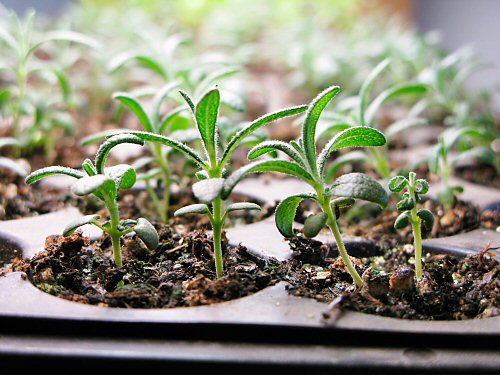
The main tiny farming action is with the seedlings now; even if the snow melted off tomorrow (which it won’t), it’d still take a sunny, windy couple of weeks, give or take, for the field to dry out enough to fully work. Indoors, with the new grow rack, there is still space, but there’s also quite a bit left to be started, including most of the tomatoes. And some of the seedlings are beginning to call out for MORE ROOM. The rosemary (above) did really well, germinating steadily over several weeks, to the point where there are up to four and five crowded in 1.5″ (3.75cm) diameter cells. And the celeriac (celery root; below), a trial crop this year and the only one started in flats not cells (I sprinkled a packet of seed across two fibre trays), is healthy, dense and stretching. Transplanting tiny seedlings is fun at first few, but can get tedious, especially if you have hundreds to do in a session. To save on time and tedium, I try to avoid potting up by sowing into final locations whenever it makes sense. One way or another, the trays inevitably start adding up, until there’s not enough LIGHT to go around. Into the equation, there’s the barely heated seedling greenhouse and the WEATHER: as soon as it’s reasonably warm enough at night, I can move the hardier stuff out—this month, at least every other night has dropped down to around 5°F (-15°C)… And that’s what this stage of the action is all about: adjusting lighting, timing and starting cell size and, as always, gambling on the weather…!

Permalink
Thu, Mar 27, 2008 · Filed under Fieldwork, Greenhouse, People, Seed starting, Spring

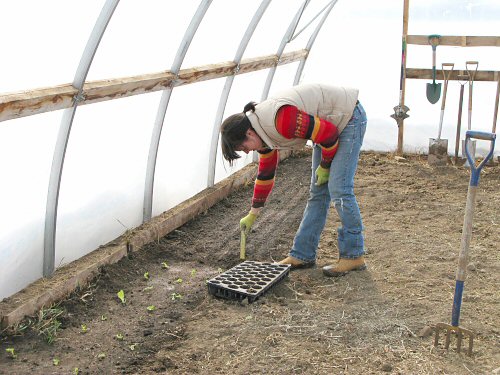
Hannah dropped by today to check things out. She’d gotten in touch through the farm web site, wanted to volunteer for a day or two every week through the season, to learn about small-scale farming and how to grow stuff. No garden experience. We spoke briefly on the phone, but the only way to see is to meet in the field and get hands dirty! It’s amazing how easily people can take to tiny farming when given the chance to dive in. So, a quick tour, and then, to work. She weeded, forked and raked a bed in the greenhouse, transplanted a couple of dozen lettuce, seeded a bed of all-lettuce mesclun using the Earthway seeder (tightly spaced rows), tried out the mini-cultivator (a rototiller attachment on a heavy duty weed eater), drove the Kubota compact tractor and worked the bucket on a big snow bank, trimmed a couple of trays of onion seedlings, checked out the production standards and paperwork for organic certification, and seemed fine with my mildly intense stream of background info and general microfarming explanation. All in three hours. Everything for the first time. She did great, no problem! Just as important, at least for this tiny farm, she seemed to have FUN, had a cool energy, and didn’t make me WONDER when handling machinery, tools and plants! After last year’s great crew, standards are pretty high. Will this season of people in the field go as well or even better? There’s no real advertising or recruiting plan, I’m trusting that, through general word of mouth (and maybe, good karmic energy!), things will…pleasantly unfold. We shall see!
Permalink
Wed, Mar 26, 2008 · Filed under Animals, Planning, Spring

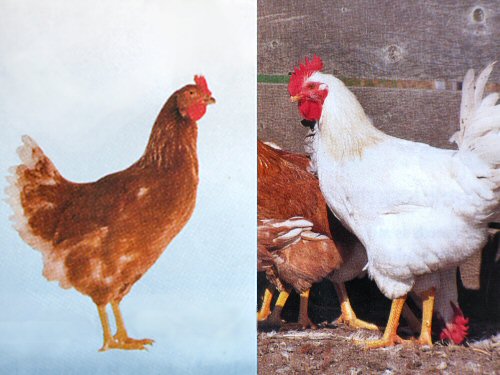
Chickens are on the way! On the left, a reportedly prolific brown egg producer, the Shaver Red Sex-Link. On the right, the reputedly hardy, healthy Frey’s Special Dual Purpose as our meat bird. I almost broke a pretty basic rule on this one—get your questions answered first!—and ordered White Rock Cornish X for meat. Chatting with Bob, we’d decided on the Frey’s Special, but at the last minute—on the phone ordering them from the feed store—I asked about the Frey’s, and was told that “99%” of the small quantity meat birds were “White Rock” (meaning WR Cornish X), that people were often disappointed with the dual purpose for meat, that for meat, White Rock is the way to go. White Rock! White Rock! So I got off the phone, and did some quick extra research. Talked to Bob again, who said the thousands of meat chickens he’s raised were all White Rock, BUT, they have to stay indoors, WR just stand around and EAT, which is why he thought Frey’s would be better for outdoors. Next, hit the Web, and found stories of people successfully free-ranging WRs, even in the heat. BUT, they also said things like: “They did wander around a lot but nothing like the regular birds. They did all the normal bird things just a whole lot less gracefully. Only thing they couldn’t do was perch or fly.” Hmmm… Which took me back to the original stuff I’d read in the hatchery catalog, things like: “Unfortunately, the White Rock’s increased efficiency at feed conversion has not been matched by improvements in the bird’s cardiovascular system. Simply put, too often the bird’s heart just can’t keep up with the rest of its body.” Yikes… Hello flip-over disease (aka Sudden Death Syndrome, aka…heart attacks), which tends to afflict the biggest, healthiest birds… And there’s lots more disease warnings, feeding restrictions, general strict instructions… Extremely fast-growing meat chickens, no doubt, and I’ll probably try some…later, but too weird for now… For good measure, I got through to the Frey’s hatchery. The woman on the phone was great. She said most people just want to produce meat quick and go for the WRs, and they may do OK free-ranging, but really, they’ve been bred for rapid growth in a controlled broiler barn environment, AND, for a hardy, free-ranging, TASTY meat bird, dual purpose are great, friends of hers raise the Frey’s Special and love ‘em. So Frey’s Special Dual Purpose it is, more traditional chickens that grow a little slower and weigh a little less, but can actually have fun, run around, eat insects, scratch in the dirt, and won’t…flip over! There are 50 2-week Frey’s Special cockerels coming either April 16 or 30, and 25 ready-to-lay Red Sex-Link on June 23. Entering the world of CHICKENS, I’m excited! (UPDATE: After writing this post, even minutes after posting this entry, I read the comments below did some more online reading, and switched the order to 40 White Rock Cornish X and 10 Frey’s Special…)
Permalink
Tue, Mar 25, 2008 · Filed under Building & Fixing, Gear, Indoors, Seed starting, Spring, Veggies, Weather

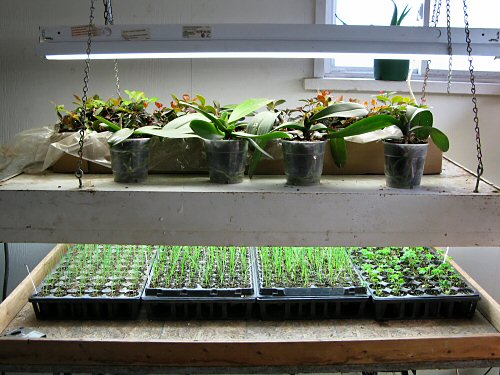
Inside, in the increasingly GREEN Milkhouse, this year’s artificial sun set-up is done. It’s about fitting in as much area-under-lights as possible, while making sure all of the trays are easily reachable, for watering, rotation, thinning. So, there are the four grow racks, and the lightbox (that’s leek, onions and parsley under there), with its second level (why waste a flat surface that comes with chains?!). For now, this extra space is the new spot for the rescued-and-passed-along decorative plants (the heather was too dried out and didn’t make it, the winterberry are doing fine, and the orchids seem OK…), but they’ll eventually be crowded out and moved somewhere else. The shelves are filling up fast… MEANWHILE, outside, it’s snowing and snowing, again. That’s a lot of snow. Around here, we’re definitely off to a later start this year than at least the last couple, but I’m still not particularly put off, not just yet. Although, it’s not supposed to warm up for another week, maybe two…

This is today’s peaceful but uninspiring view of the garden from the north-facing Milkhouse window…
Tags:
heather,
leek,
lighting,
Milkhouse,
onion,
orchid,
parsley,
seedlings,
snow,
winterberry
Somewhat similar posts:
Inside and out…
Orchid, winterberry, heather…
Grow lights, on!
Milkhouse looking out
Roof is working out
Permalink
Mon, Mar 24, 2008 · Filed under Building & Fixing, Spring

Checked out the chickenhouse today to make up a materials list for the renovation. Here’s a view of the south-facing side (the usual daily view is from the barnyard to the east; the barn and silo are to the north, and hidden behind them is the market garden). From this side, it has that ramshackle cabin-in-the-woods look. I quite like it: 200 sq. ft. of open-plan living, big windows for lots of natural light, electricity, running water…instant home! Like most things on the farm, it has its history. The structure is 80-90 years old, purchased 50 years ago from the farm that used to be across the road (now a village subdivision with a bunch of houses, and untended fields), dragged over by tractor, and set on a concrete pad. It was used as a pony barn for a while; harnesses are still hanging on the wall. For the last 15-20 years, it’s housed a few chickens and turkeys, or been unused. Now, it’s back! There’s not much to do, besides a good cleaning: banging in a defensive baseboard (in the pic below, that’s a GNAWED not-so-little hole under the window), a window to fix, nests to build for the layers, and a coat of lime to disinfect and whitewash (that’ll be interesting). Outside, T-bars and chicken wire to fence in yards, and that should be it. Most of the materials we can salvage on-farm: the fencing stuff, lime, and plywood should be all that requires cash! There are even a bunch of feeders lying around. All these bits from the past, unused and still in place after years and decades, would be a little creepy, if we weren’t coming across them on the way to getting new things started!

Permalink
Sun, Mar 23, 2008 · Filed under Building & Fixing, Gear, Seed starting, Spring, Winter

New lumber turns into new grow rack. This adds a fourth to the set, a measure of tiny farm growth. I started with two in Year 1, built another one last year (Year 5). It’s not like the focus here is on rapid expansion…this is the speed of staying tiny! ;) Although I don’t build these often, it seems to get quicker every time. Well under a hundred dollars of wood, wheels, screws, bolts, brackets, hooks and chains, plus a chop saw, a drill and a couple of hours, and there it is! Light fixtures are extra. In the pic, the shelves still have to go on. Lying across the middle supports is one of the four old fluorescent fixtures, given to me instead of being tossed in the trash. Not only free, they’re BETTER: the tubes are spaced further apart than in the standard shop lights I’ve been using, the light will spread more evenly over a larger area—for the seedlings, a lot less leaning and stretching…
Permalink