
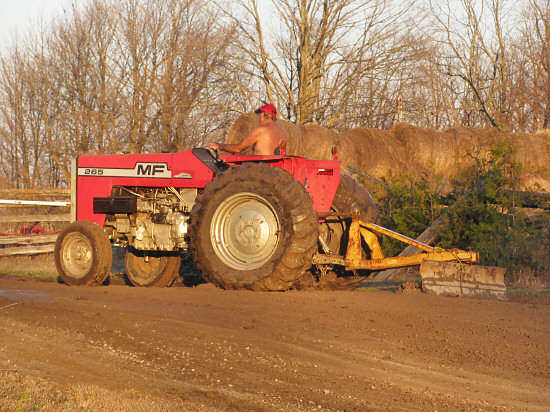
Wayne doing early evening yardwork SHIRTLESS on one of his trusty old tractors means it’s gotta be summer, right?! Well, this is actually only the first day of spring, a balmy 27ºC (80ºF) day that even managed to get the sweat rolling just a bit around midday walking around the field, and cooled down gently as it pulled into dusk. Nice, but freaky. Late March in the last few years around here has often been pretty clear of snow, but day after day of summer temperatures like this…not nearly. Birds are twittering, the grass is greening, and garlic is already pushing up through the mulch. Crazy weather continues…
Tools
Equipment for large-scale agriculture is too big or too expensive, and many home gardening tools don’t work efficiently on larger jobs or break easily. Tiny farming on plots up to two or three acres requires its own special gear…
Patchy frost
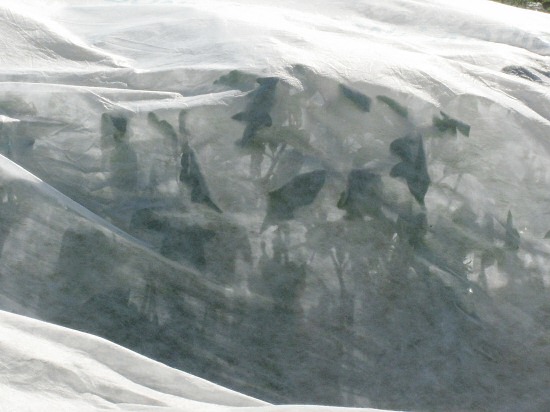
[Fri, Sep 16, 2011] First frost wasn’t too bad at all, a patchy frost that hit the field lightly, and in some areas, hardly at all. Still, the row cover, over some beans, peppers, eggplant, and a couple of beds of cherry tomato, worked out well, the exposed plants in those areas did get mildly to quite well…toasted. In the pic, we have Dusky eggplant, under its thin layer of salvation. Raising the floating row cover with a few non-pointy sticks, so it’s not pressing on the leaves, is a good idea—moisture often collects where the leaves touch the cover, freezes, and can deliver some pretty severe leaf burn. But for mature plants at this point in the season, I usually don’t worry about that—it’s different with seedlngs at the other end—and just float on the cover and leave it at that!
After market
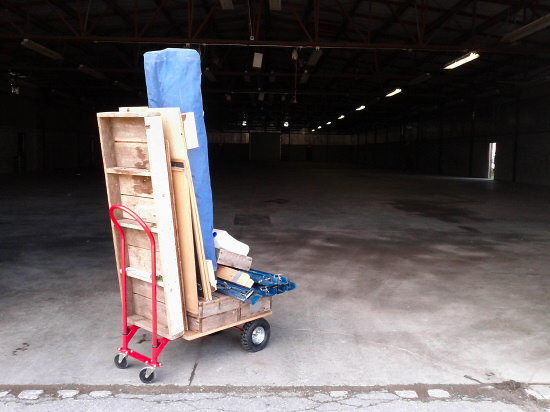
Around 1:25 p.m. and it’s just about time to head out from the farmers’ market, which officially ends at 1. This season, we’ve been storing the entire farm stand in the communal cage where vendors can leave stuff from Saturday to Saturday. The stand is quite the compact set-up, once it’s torn down and stowed away…efficiently. On the dolly, there’s the 10’x10′ E-Z UP canopy, half a dozen folding metal sawhorses and the plywood boards that turn them into tables, a pair of chalkboards, rough cut cedar display trays (a strip of four, and singles), pieces of 2×4 used to prop up the trays, and a plastic water jug used as a canopy weight (we normally have four, but this year we’ve been lashing the canopy legs to one of our neighbors, so weighting the four corners isn’t necessary). The only thing missing, besides the veg, of course, is our market box, which is a bin containing scales, bags, signage and so forth. Most farms come to market stand and all, as we did until last season’s start of…commuter farming—living off-farm—when logistics made leaving this gear at market a lot simpler. Anyhow, this huge exhibition hall houses the indoor market on Saturdays, November through April, and the big parking lot outside is where the summer outdoor market is located. The cage, a chain link fenced corner, is out of sight to the right. And that’s just about ALL the details. :)
Frost protection time again
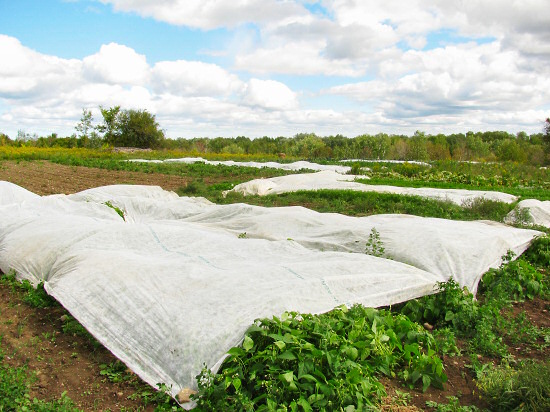
The frost-warning forecast from a couple of days ago, for 1°C (34°C), moved up a day to tonight. so there’s row cover all over the field. Some of it was floated out against the possibility of frost, the rest, as so-far-effective deer deterrent. Up front, around 800′ of snap beans, just starting to form, are bundled up against the cold. Then, row cover over carrots, and farther, lettuce, has been in place for a few days, and seems to still be keeping the deer from munching. In the distance, peppers and eggplant are under frost protection. Elsewhere, we’ve covered a few beds of cherry tomatoes to prepare for tonight. Winter squash and pumpkins are mostly in, and summer squash and cucumbers are finished, and the rest out there are hardy enough, and that’s about it!
A little extra watering in
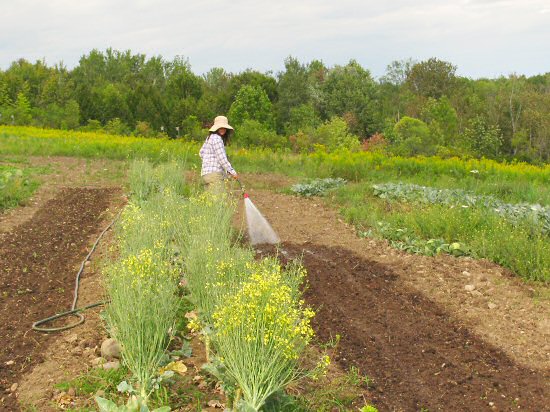
The last-plantings-of-the-season fun continues as we watch the weather and hope these crops get a jump before cool temperatures and weaker sun start to seriously slow things down. More sun is the main thing, right now, and that’s been going well. Our last beds of spinach, lettuce, radish and Asian greens, direct seeded a week ago, got well-rained in the day after seeding, and they’re all coming up now. Still, it’s been fairly windy and dry since, so we decided to hand water them, to help ’em all along. Here, Tracy uses the RedHead water breaker to gently lay down a little flood (behind her that’s broccoli, exploded: tiny broccoli flowers from unharvested heads that we take to market as a free edible flower salad garnish). In this section, 100′ x 5 rows of lettuce mix, and the same of Bloomsdale spinach… Grow, little plants, grow! :)
Last in!
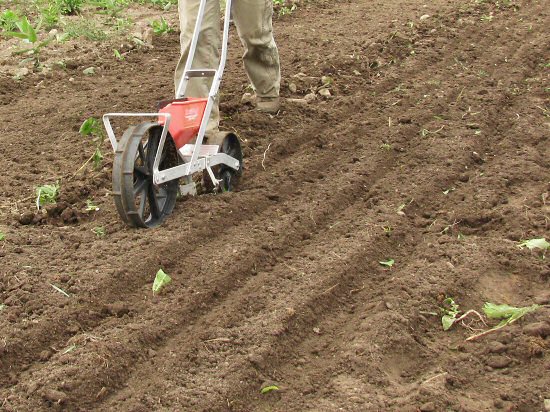
Today, the last direct seeding of the season: spinach, radish, Asian greens mix, arugula, and a lettuce blend for baby leaf… Here, Tracy does the honors with the always-generous Earthway seeder, laying down thick lines of Rebel radish. But is it…too late? Well, who knows?! In good summer conditions, all of these crops can be ready to harvest in 40 days or so from seeding, but the sun is getting weaker now. Hopefully, this round will come up fast, catch the last of the reasonably strong light through September—there WILL be lots of sun!—then continue growing slowly until ready for the last couple of markets through the end of October. That is the…plan. Fresh young veggies at season’s end are a welcome treat! If it doesn’t work out, oh well (and we may get a chance to do a few days at the indoor market in November). In any case, we have the space and the seed, and pushing for the absolute latest planting date seems to me always worth the gamble. Seeing what happens is kinda…exciting!
Water, water, everywhere…
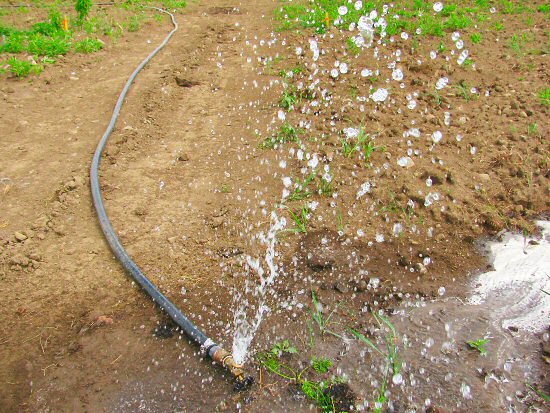
It’s getting dry! A few parts of the field are still wet below the surface, but most of it has gone from pretty well waterlogged a month ago, to dry a couple of inches down, and there’s no rain in sight. The forecast is for heat and sun for the next week at least, with a 60% chance of “showers” on just one day—no holding breath for that. So it’s time to think about spot irrigation.
Step 1, finished this afternoon, is to run a water pipe from the well right through the L-shaped garden. Our watering methods are quite slow and labor-intensive, by hand and with soaker hoses, but on the upside, there’s no huge volume requirement , so the 1″ black plastic pipe already on hand will do fine. Part of the line was already set up, and I added the last 200′ today, for a total of length of about 800′. Taps with quick release connectors are spaced along the line: just plug in a hose as close as possible to where you want to go, drag it out, and there you have it, a little water…everywhere.