
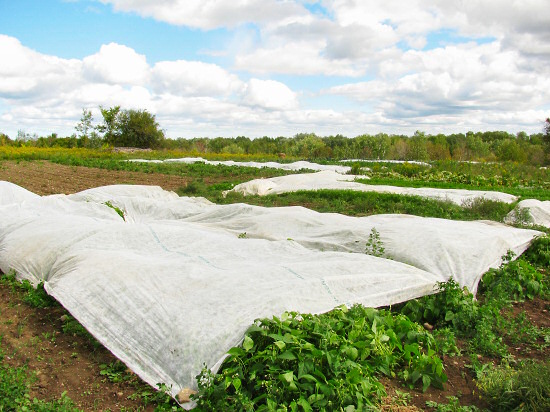
The frost-warning forecast from a couple of days ago, for 1°C (34°C), moved up a day to tonight. so there’s row cover all over the field. Some of it was floated out against the possibility of frost, the rest, as so-far-effective deer deterrent. Up front, around 800′ of snap beans, just starting to form, are bundled up against the cold. Then, row cover over carrots, and farther, lettuce, has been in place for a few days, and seems to still be keeping the deer from munching. In the distance, peppers and eggplant are under frost protection. Elsewhere, we’ve covered a few beds of cherry tomatoes to prepare for tonight. Winter squash and pumpkins are mostly in, and summer squash and cucumbers are finished, and the rest out there are hardy enough, and that’s about it!
Tools
A little extra watering in
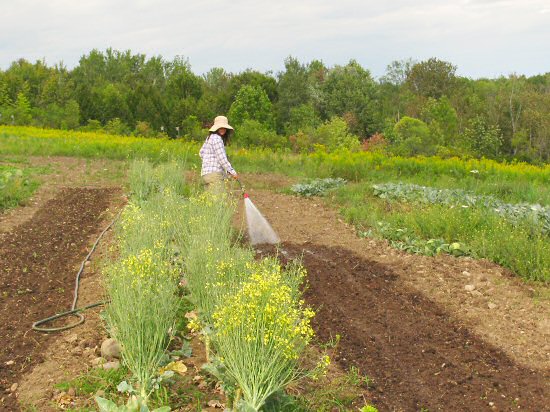
The last-plantings-of-the-season fun continues as we watch the weather and hope these crops get a jump before cool temperatures and weaker sun start to seriously slow things down. More sun is the main thing, right now, and that’s been going well. Our last beds of spinach, lettuce, radish and Asian greens, direct seeded a week ago, got well-rained in the day after seeding, and they’re all coming up now. Still, it’s been fairly windy and dry since, so we decided to hand water them, to help ’em all along. Here, Tracy uses the RedHead water breaker to gently lay down a little flood (behind her that’s broccoli, exploded: tiny broccoli flowers from unharvested heads that we take to market as a free edible flower salad garnish). In this section, 100′ x 5 rows of lettuce mix, and the same of Bloomsdale spinach… Grow, little plants, grow! :)
Last in!
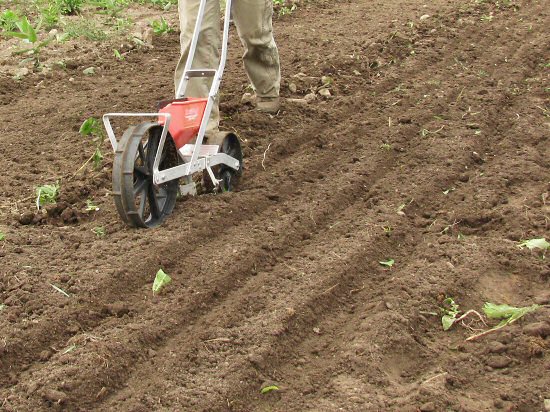
Today, the last direct seeding of the season: spinach, radish, Asian greens mix, arugula, and a lettuce blend for baby leaf… Here, Tracy does the honors with the always-generous Earthway seeder, laying down thick lines of Rebel radish. But is it…too late? Well, who knows?! In good summer conditions, all of these crops can be ready to harvest in 40 days or so from seeding, but the sun is getting weaker now. Hopefully, this round will come up fast, catch the last of the reasonably strong light through September—there WILL be lots of sun!—then continue growing slowly until ready for the last couple of markets through the end of October. That is the…plan. Fresh young veggies at season’s end are a welcome treat! If it doesn’t work out, oh well (and we may get a chance to do a few days at the indoor market in November). In any case, we have the space and the seed, and pushing for the absolute latest planting date seems to me always worth the gamble. Seeing what happens is kinda…exciting!
Water, water, everywhere…
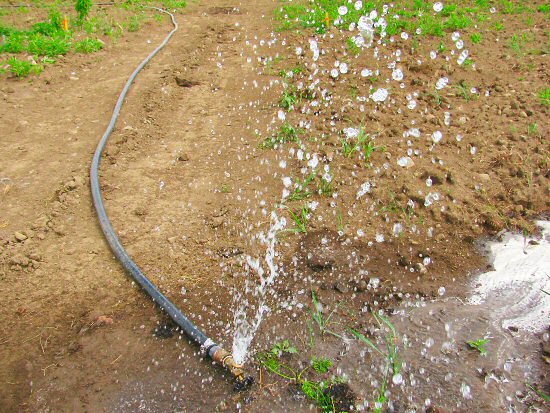
It’s getting dry! A few parts of the field are still wet below the surface, but most of it has gone from pretty well waterlogged a month ago, to dry a couple of inches down, and there’s no rain in sight. The forecast is for heat and sun for the next week at least, with a 60% chance of “showers” on just one day—no holding breath for that. So it’s time to think about spot irrigation.
Step 1, finished this afternoon, is to run a water pipe from the well right through the L-shaped garden. Our watering methods are quite slow and labor-intensive, by hand and with soaker hoses, but on the upside, there’s no huge volume requirement , so the 1″ black plastic pipe already on hand will do fine. Part of the line was already set up, and I added the last 200′ today, for a total of length of about 800′. Taps with quick release connectors are spaced along the line: just plug in a hose as close as possible to where you want to go, drag it out, and there you have it, a little water…everywhere.
Chicken Tractor: The Book
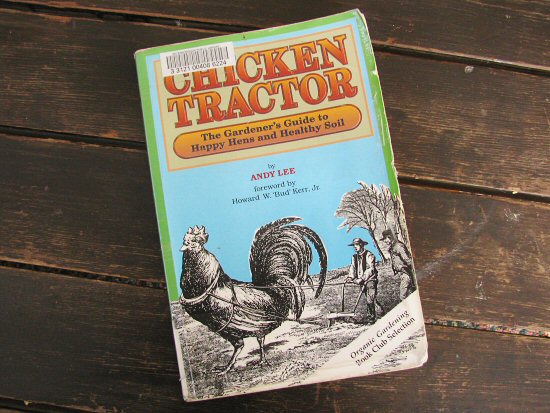
CHICKEN TRACTOR! My book-of-the-moment, a happy find at the municipal library (thanks to Kendall, I rediscovered LIBRARIES a couple of months ago—haven’t held a library card since school days, long, long ago).
The chicken tractor concept is simple, and it’s been chatted about around here quite often over the last few years…but not yet tried. The idea is to provide a mobile enclosure for your chickens, and move them to new sections of land every day or so, rather than keeping them in the usual chickenhouse and yard set-up. The chickens work up a small area of ground and fertilize it with their manure, and then it’s on to the next patch—the birds are always happy with fresh places to scratch and bits to eat, and a large area can be improved in no time. The rig can be any design you come up with that keeps the chickens in, predators out, offers shelter from the weather, and is easily moved. Easy!
Like most good things in smaller-scale farming, the chicken tractor is a startlingly simple and inexpensive approach that offers deep returns on many levels, from food quality to all-round satisfaction. It’s also kind of the EXACT OPPOSITE of high-tech industrial farming gear and methods that make so little sense to me. And the system works for various other farm animals as well, as in well-known (celebrity!) indie farmer Joel Salatin’s chicken-and-beef rotation at Polyface Farm.
So simple, why do you need a book? Well, it’s WINTER around here, all is snow, and reading about growing is the next best thing! In this case, Chicken Tractor, like its to-the-point title, is a perfect example of an energizing just-do-it how-to book, written in enthusiastic, full-on farmer-scientist mode. It’s jam packed with practical instructions and advice, the text assisted by numerous charts and illustrations, with a non-oppressive serving of sustainability philosophy and general food politics worked in, plus chicken trivia (the term “chicken tractor” was apparently coined by permaculture founder Bill Mollison, so now I know).
It’s cool to see this copy so considerately well-worn, although this being the original edition from the mid-1990’s, maybe it hasn’t seen that much use. It was published in 1994, quickly followed in 1998 by an “All New Straw Bale Edition,” with the subtitle upgraded from “The Gardener’s Guide to Happy Hens and Healthy Soil,” to the better-keyworded, “The Permaculture Guide to Happy Hens and Healthy Soil.” In any case, this edition is fun tiny farm reading from the library.
Anyhow, so much for the book review, let’s see how well this year’s chicken tractor plans actually fly! :)
Bush cord meter
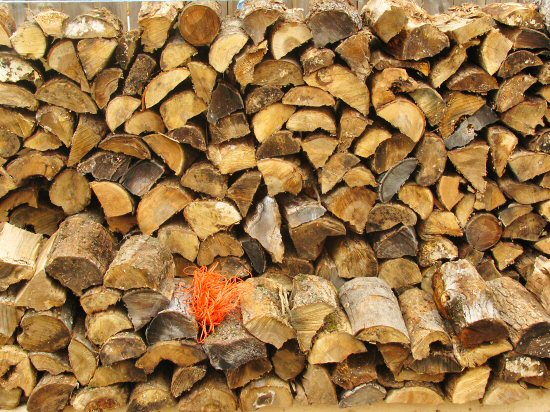
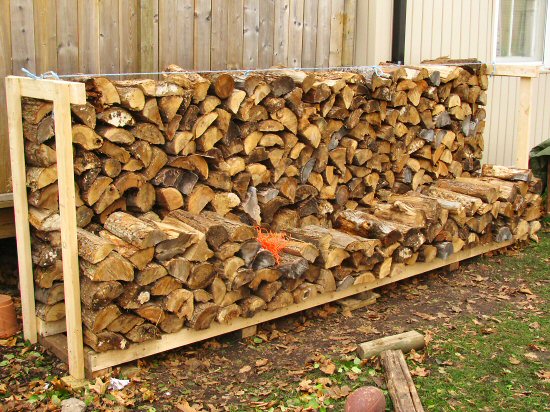
Our first wood order of the season arrived a week ago, just as we ran out of the leftover from last year. It’s a bush cord. At least, that was what was ordered, bought and paid for. One bush cord of well-seasoned hardwood, in 16″ pieces. The wood is great on the seasoning end, but when I finished stacking it today, in our custom-built, holds-one-bush-cord rack (below), even taking into account the wood we burned over the last week, we are CLEARLY WAY SHORT!!
I’m kinda shocked at how short we are. When I looked into what exactly a bush cord comprises, the definition seemed pretty clear: 4’x4’x8′ of tightly stacked wood. A volume measure. With 16″ pieces, that equals one long 24′ row, 4′ high. “Tightly stacked” is a little vague, but after asking around, and looking at photos, it seems like common sense: you don’t fit the wood together like a jigsaw puzzle, just stack it nice and solid. OK.
I built a simple rack out of 2x4s that should fit…exactly one bush cord. Of standard 16″ pieces. It’s kind of a bush cord meter. To fit in the narrow side yard, the rack has two 12′ rails, with 4′ high ends. I stacked it reasonably solidly. And we seem to be at least 1/3 (that’s 33%!!!)…short.
The firewood guy came recommended, he’s apparently been doing this for decades, how could this BUSH CORD be so off? It’s a mystery. I’m new to firewood, maybe the counts are loose, but this is extreme. I’m on the phone…
Global Village Construction Set: Watch This!
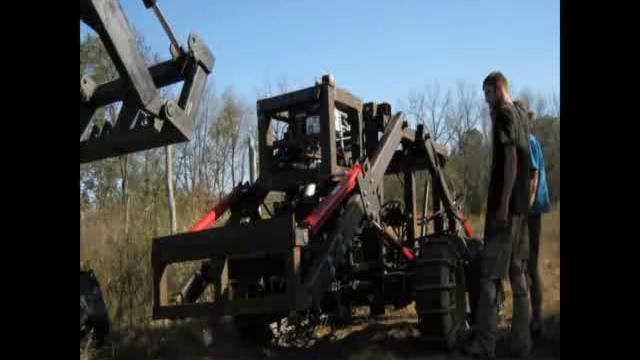
Watching this video made me smile! It wasn’t the kind of smile you do when you’ve seen something cute or funny. This was the deep, involuntary smile of wonder and appreciation and, um, joy, that happens when you see something really cool and admirable. When you see something that…rocks! :)
I’ve been following the adventure at Factor e Farm, through their blog, for maybe three years now, not always diligently, but what they’re up to is always somewhere on my mind. The mission they’re on is incredibly ambitious and fundamental and world-class. You have to read through their blog and wiki, and watch some of their other videos, to get a full feel for what Factor e is up to, but to try and summarize:
Using modern technological knowledge and methods, and very little cash, they are designing and building a set of machines and methods that are open source (plans are free for all), low cost, easy to replicate, highly efficient, simple to maintain, and sustainable to operate, called the Global Village Construction Set, just about everything you would need to build a community, from the house you live in to the food you eat, from scratch.
Or as their blog puts it: “We are farmer scientists – working to develop a world class research center for decentralization technologies using open source permaculture and technology to work together for providing basic needs and self replicating the entire operation at the cost of scrap metal.”
This video is their two-minute introduction:
You HAVE to check it out: Open Source Ecology.