Pumpkins and pigweed

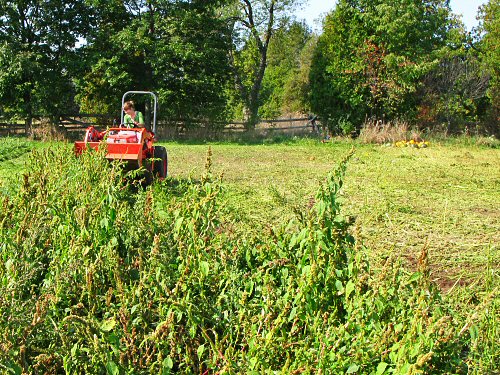
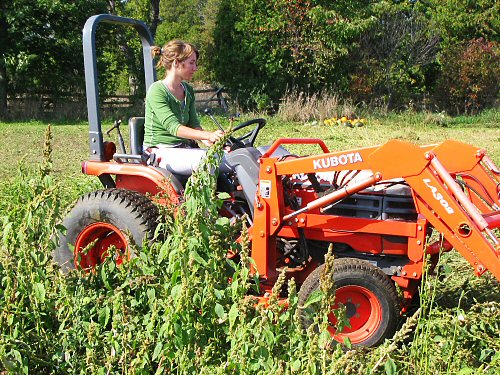
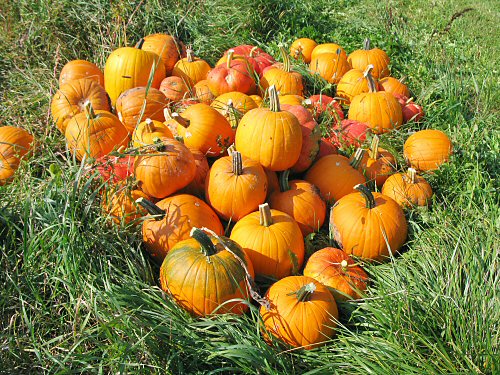
Today, the pumpkins came in, wrested from a jungle of pigweed gone wild. Every year, a few of the 40 50’x50′ sections that make up the 2.5 acre garden get a little overrun with one weed or another (usually, pigweed). This year’s pumpkin patch was a good example, with pigweed growing unchecked for a good six weeks—no time made to weed, not IMPORTANT enough a crop—until today, when Raechelle used the belly-mounted 52″ mower deck on the Kubota compact tractor to mow it down!

Of course, this is exactly what you DON’T EVER DO in a garden: allow weeds to flourish and go to seed, then mow them down, broadcasting seed everywhere… Oh, well. The alternative, pulling the pigweed by hand, then carting it off, we also do when necessary—see the Pigweed Mountain—but once in a while, I go for the instant gratification of seeing a section clean and clear in an hour or two. The millions of pigweed seeds, ensuring healthy future generations for years to come, will be dealt with…later. (As long as we weed on time next time around, how bad can it get?! :) Anyhow, it’s all part of the grand experiment! Guest pumpkin photo by Lynn.

Veg variety

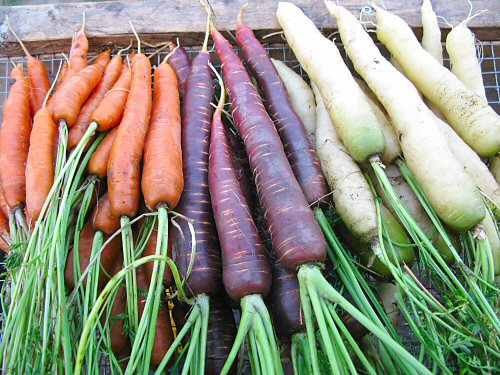
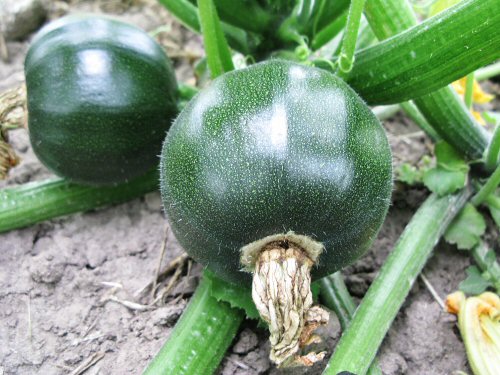
This isn’t the first time I’ve pondered the question of variety on TFB, but the consideration recurs, so here’s another take… It would seem to be all around easier to grow just one variety of each veg crop, but that wouldn’t be any fun! One round, red beet, one big, round, red tomato, one shell pea, and so on. That’s the standard approach for most of the other full market garden growers at our small farmers’ market. There is SOME variation: green and yellow snap beans, maybe French Breakfast (red and white) radishes along with the standard round red ones, a few types of winter squash… Which is cool. Why bother growing three or more types of orange carrot, let alone orange (Nelson), purple (Purple Haze), and white (White Satin, for the first time this year)? I dunno. By growing several varieties of each veg crop, I’ve learned a bit, like the performance difference between hybrid and open pollinated varieties (in general, the OP tend to do better when field conditions get a little extreme, but that’s not a….scientific conclusion!). It’s not to be a novelty act, the guy at the market with the purple carrots, golden beets and round, yellow cucumbers. Or the round Eightball zucchini (below). If efficient tiny farming was the sole goal, I don’t have a really compelling…justification for all of the complicating seed ordering, transplant organizing, and extra direct seeding work it takes to grow as many different crops as I can, and numerous varieties of each. On the other hand, growing and offering variety, choice, and the non-standard make tiny farming so much fun. Which sounds good to me! It seemed like the thing to do from when I first pored over a seed catalog six years ago, and nothing’s changed my mind since! :)

Onions from seed!

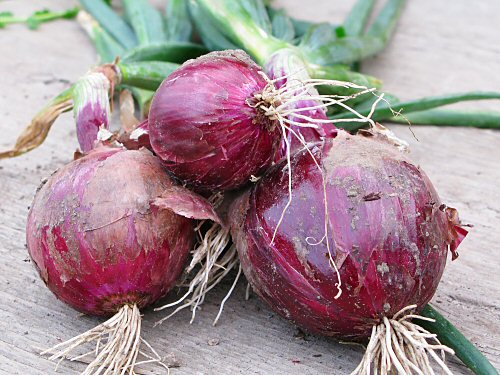
This is the first year I’ve tried growing onion from seed, and they’re doing fine. Today, I pulled up one multi-planting of Red Wing to check ’em out. Multi-planting onions was also a first-time experiment, with 3-4 seedlings transplanted in one spot, at 12″ (30cm) in-row spacing. They’ve done a good job of pushing themselves apart, they’ve stayed pretty round, not flattening out where they touched.

Another thing I was a little concerned about didn’t come to pass. For around a month, the onion seedlings had already been under the usual 14-16 hours a day of fluorescent light on the grow racks, when I read about the possibility of daylength sensitivity at the seedling stage. When the amount of sunlight reaches a certain threshold, over 12 hours or so for long-day varieties, the onions move from leaf growth to producing bulbs. A couple of sources said that premature bulbing can be triggered by too much light too early on, even at the beginning seedling stage, and you’d end up with tiny, marble-sized onions after a season in the field. Other sources disagreed, but in any case, that didn’t happen here! Still, in future, I’ll start long-day onions under reduced artificial light…to be safe.

As usual, the cracked surface of our clayey soil looks rougher than it is: it isn’t really hard, only a thin, dry layer with moist soil right underneath. Here, four out of five seedlings have pushed apart, rotating the stems outward, and grown into decent-sized…onions!

Dirty hands at the farmers’ market

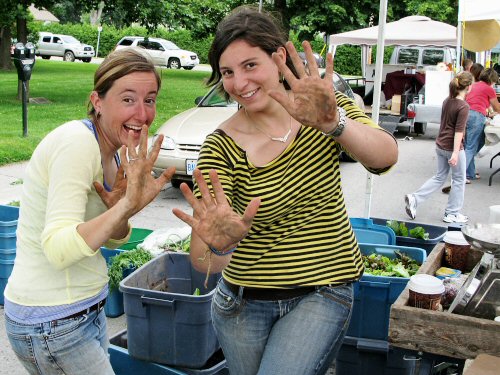
Over the last couple of weeks, we’ve been experimenting again with rinsing versus…not rinsing. This comes up a couple of times every year, where I think (or someone suggests) that rinsing various veggies is not necessary: to save time, to improve storage, to preserve nutrients,…the reasons vary. (For me, the time-saving is always a big attraction!) Sometimes, crops just have to be rinsed to cool them down quickly if harvested in the heat, or because they’re really mucky from heavy, mud-splashing rain. In any case, this week, we didn’t rinse the carrots, beets and beet greens, so sorting at the market was a bit messy. That’s Lynn and Maria, happily dirty-handed… The conclusion is usually the same: when the harvest is really kinda muddy, which is often the case this year with all the rain and wet ground, a quick rinse is better all around, for handling and for presentation. Still, the experimentation continues!

The Endless Salad…

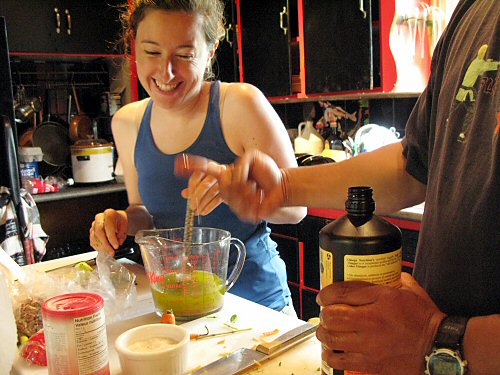
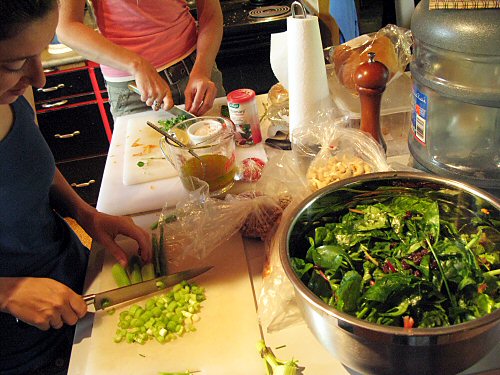
Lunch has turned into a collaborative cooking affair, built around the near-infinite possibilities of the Endless SALAD. Everyone who’s around pitches in: here, Lynn and Melissa chop. We build it from what’s available in the field, plus supplies from the farmers’ market and from the supermarket (with mixed feelings, I’m now buying mostly organic), a variety of raw nuts, and sometimes meat (turkey, chicken, fish, so far). We pick the ingredients, and there can be MANY, by whatever sounds good together. It always works! The salads started last month, when I asked to join Shannon in her vegetarian lunches, and Lynn and Raechelle would fill out the table on the days they were here. This direct connection between growing and cooking and eating and people started last season, with Friday evening dinners after harvest, and the first, occasional all-local-food mini-barbecues, and now it’s become part of everything…

Thinking about it now, this deepening food awareness is happening over what seems like a curiously loooong time, this being Year 6 in the garden. For the first couple of years, I was out in the field alone, spending 10-12 hour days at least six days a week during the main growing season. At the end of the day, I ate TONS of veggies. It was normal to harvest several types of greens for a salad, plus whatever was around for a sauteed side dish, and every three-four days, I’d roast a bunch of root crops. Meat was definitely in there, regular supermarket fare, but almost as a garnish, a small steak or a big pork chop or a chicken breast, on top of a mountain of veggies. I relished dinner every day, partly from the novelty of having grown the better part of my meal, a lot because I has HUNGRY, and mostly, as I remember it, because it simply attracted me: the taste, the super-simple preparation, but also the physical feeling of satisfaction these meals brought. Then, I wasn’t giving much personal thought to nutrition or “local food” or anything like that, it wasn’t a calculated, conscious enjoyment, it seemed simpler, more common sense. During the winters, in between gardens, my old eating habits didn’t change: not much junk food, no instant microwave meals, still, the regular parade of meat-and-starch industrial food type eating, straight from the convenience of the supermarket aisles. It seems a little odd now that this didn’t concern me. Then again, I wasn’t tiny farming to save my health or save the planet, this wasn’t any sort of cause, instead, something I had wandered into, seemingly by chance, that took hold: there was no agenda, only an unfolding path to somewhere cool…hopefully! And then came last year’s people in the field transition. While the garden stayed tiny in size, the intensity increased as really relying on others became a part of it all. Along with that, the food we’re growing has become linked to…daily living, plain and simple, whether it’s sharing meals from the field, or people stocking up on things to take home at the end of the day (not so different from the farmers’ market or CSA, but even more…personal). And this increasingly deeper connection to FOOD, not based on concepts or conscious direction but just on what’s happening, is surprisingly new to me, yet another part of the tiny farm experience, where what should be obvious to us all is revealed in unexpected ways… (Guest photo: Lynn laughing, me tasting, by Raechelle.)

Scaling up the grass mulch

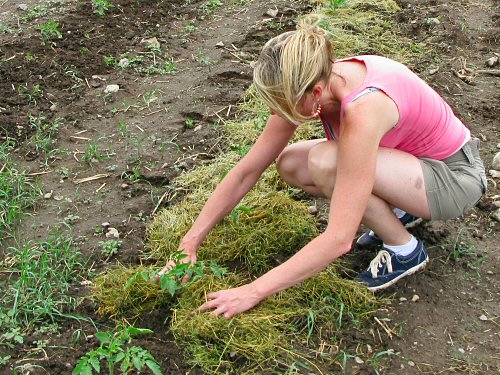
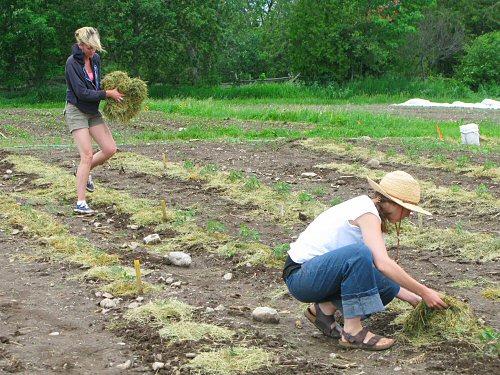
Not the nicest weather today, but good for gardening: not too hot (finally) and not too wet. The grass mulch experiment continues. With all of the recent rain, there’s been good growth, and I’ve cut and gathered quite a bit. Still, the volume of grass mulch available earlier in the season is still unknown, and it takes a lot to cover just one section. Here, Raechelle and Melissa (first time in the field) mulch tomatoes…

Shifting gears for summer…

The spring rush is over, and fieldwork is shifting into summer mode, from mainly planting to mainly weeding and watering, and then, HARVESTING. Seedlings for the most important crops and varieties are in, although there’s still quite a lot to transplant.

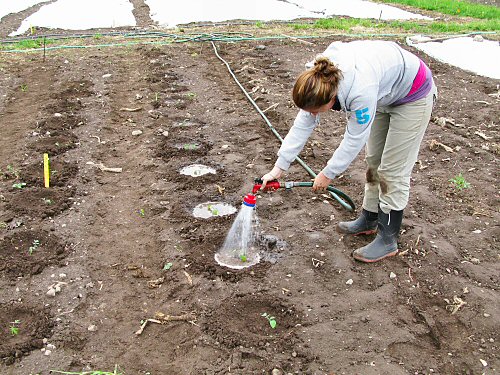
Here, we’ve just finishing another 100 or so tomatoes, with Lynn watering them in (the Redhead water breaker is GREAT, delivers as much water as you’ve got pressure, while softening the flow so that you’re not smashing or burying the seedlings). Creating a little basin around each seedling makes the most of hand watering in.

In my continuing experiment with shortening seedling production time, these are the youngest toms to go out ever, a third set started at the beginning of May, with their first true leaves now just coming in!

There are also more squash, melons, and a few more toms to transplant—in years past, I’d’ve been concerned about the date, but I’m learning to adapt the season’s resources (time, people, irrigation capacity,…) to the WEATHER.

Keep the workflow balanced is my new first mantra, so we also spent a few hours weeding today (Ryan dropped by to help for a few hours, he’s a new CSA-er this year who is also about to move his family to their own tiny farm at the end June!), instead of rushing on the last transplants.

It’s hard to measure, but for this type of small, diverse market gardening, in this time of extreme weather, things quite often don’t work out as they traditionally should. For example, the recent rain and cold, and now, more heat, have created a situation where the dominant weeds—pigweed, mallow, and lamb’s quarters—are seemingly slow, but are in fact about to explode. Weeding now will probably save way more time and deliver more harvest than putting off weeding just to transplant a few more beds a few days earlier.

I dunno, I’m figuring this out as I go, but I think traditonal garden rules and timing have to be increasingly bent as the weather gets crazier… I guess you could say: EXCITING TIMES! :)