
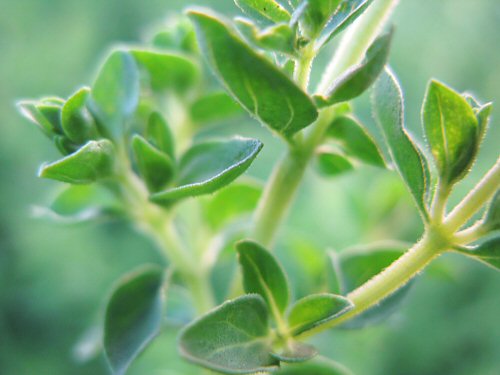
A solo weeding day for me. There’s lots of mostly PIGWEED, shooting up faster than the crops, loving the rain and bursts of heat, with or without sunshine. So, a photo of WEEDS, or a random, up-close look at…oregano? I went for the oregano, which is doing great after thinning the three-year-old patch earlier this year…
pigweed
Checking under row cover
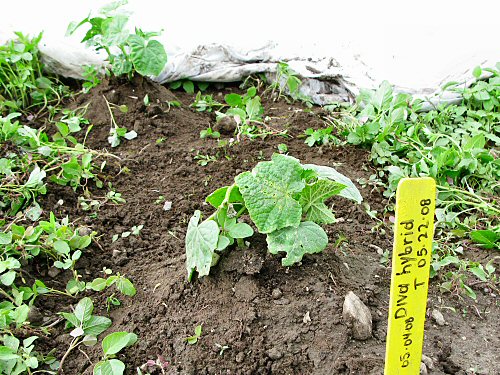
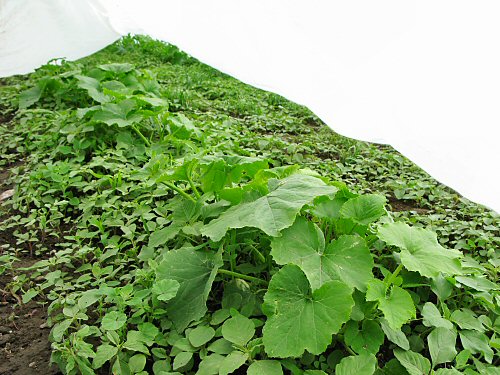
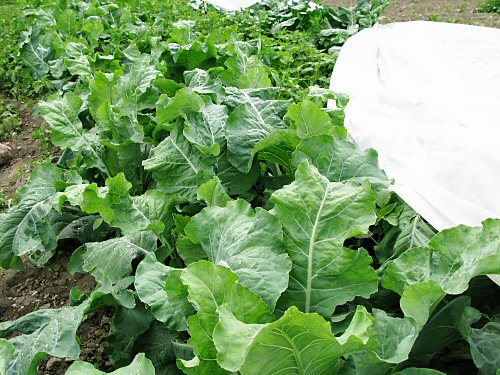
Three weeks ago, it was floating row cover everywhere. So, what was it worth? Today, I checked things out. Overall, growth has been startlingly slow, due to the lack of sun. This is really noticeable in the summer squash (above), which could be huge at this point, but…aren’t. Under cover, these zucchini (I didn’t check the variety) are doing fine, no cucumber beetle damage, but of course, weeds are doing fine as well: unmolested under there, pigweed runs rampant. I’ll take the cover off here in another week or so, and then there’ll be a whole lotta weeding to do… I removed the cover from the first beds of cauliflower (Snow Crown) and broccoli (below), they’re big enough to take a little flea beetle munching. The leaves have shaded out much of the potential weed action in the beds, but you can see a nice collection in the path (top center, where the row cover ends). The plants look untouched, although the flea beetles managed to get under and at the kale and collards, (they’re out of sight just to the left)—I left them covered, back in a week. If there’s any doubt about what the FBs will do, just check the radishes, which grow MUCH faster than these guys and can survive the damage…
Back with the cucurbits, the cucumbers are the most noticeably slow: after a month, they’re hardly bigger than the transplants they started as (hope it’s all going into the roots!)… I’ve cleared away the weeds between a couple of the plants, beetle damage is minimal (they tend to get in at the ends of rows, where the cover can get blown up by the wind), but there are weeds everywhere. Cover goes back on here for a while. Weird stunting weather and floating row cover: not the most peaceful and inspiring natural garden combo, but it should all straighten out in a bit… ;)
Thinning and weeding
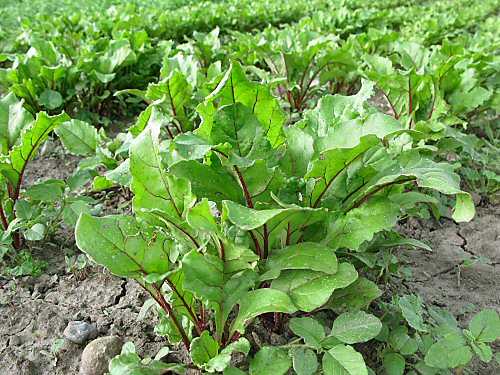
The first beet greens have sized up: lush and looking delicious, they’re ready to harvest. I love beet greens, both raw in salad, and lightly sauteed in olive oil and/or butter (a kind of deluxe spinach). I’ve never grown them as a separate crop, instead, they’re a happy byproduct of thinning the beets—removing the extra plants so that the remaining beets have room to grow. So the greens are both a harvest crop…and a weed. (I guess this is a continuation of yesterday’s post about WEEDS!) As you can see below, with the exception of a few gaps where nothing germinated, the first-planted beets are growing quite solid in their rows, which means a lot of plants have to be removed, maybe as much as 6-8 out for every one left behind (did you know, beet “seed” is actually tiny dried beet fruit containing several seeds?). There’ll be so much from four or five 3-row beds of beets, I won’t be able sell, eat, store or give away all of the greens that’ll pile up, but I can’t leave them in to stunt each other, so at at some point, the thinning becomes…weeding. Funny how that works! :)
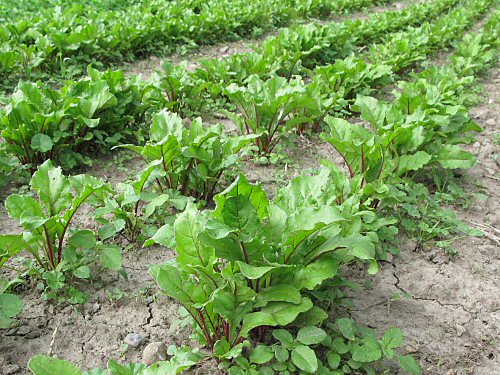
Meanwhile, after a quite intensive weeding by hand and hoe a few days ago, the beet beds and paths are in fine shape, with only some growth near the plants that’ll come out during the thinning. (The cracks in the ground are what happens with our heavyish clay-loam soil: it’s not at all concrete-solid, it’s nicely moist, but as the surface dries out, it tends to…crack.) As far as overall weeding, with some quick touch-up hoeing along the way, these beds should be fine till harvest in 3-4 weeks (maybe earlier for some). The increasing leaf cover will keep down weeds near the plants, and the increasingly narrow paths and between-row strips can be quickly walked down with the weed hoe. It should be…sweet! On the other hand, in the potato patch…
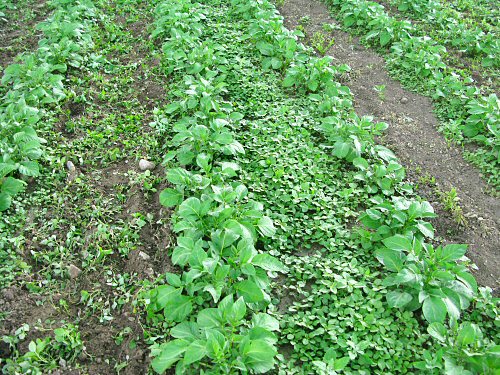
…things have gotten a little crazier. A dense and vigorous mix of mostly pigweed and some lamb’s quarters has carpeted one of the two potato sections. Here, you can see the difference a pass with the wheel hoe makes. On the left, a just-hoed path still looks pretty green. In the middle, it’s untouched and looking a little scary. I’d call this…Stage 2: leave these little guys just a few days longer, and it’ll be a fight to hoe as the pigweed stems in particular will start to get tougher. On the right, a path weed-hoed a couple of days ago (I was on the way through while walking back from hoeing another area)—after a day of sunshine, the cut and uprooted weeds dry up, and you can see how much weeding you’ve really done. There’s still a lot of close work around the plants, but the potatoes are really shooting up now, so once that final weeding is done, the plants will shade out and prevent germination of whatever weed seed’s still near the surface. On the other potato section, the weeds aren’t nearly so…dense. On this one, some of last year’s weeds obviously went to seed, which really increases this year’s population. It almost fee;s like a closed system: what work you get away with not doing now, you eventually pay for later, usually with a little interest…
Crops among the weeds
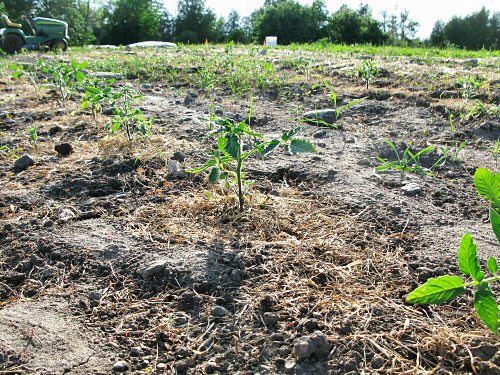
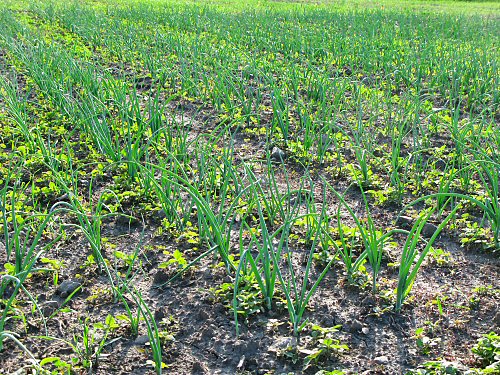
Weeded with the wheel hoe and hoop hoe, the onions looked impressively clear just six days ago, but after a few days of heat and moisture, the tiny weeds that were left shot up to the point where it’s time to do it all over again. Pigweed and lamb’s quarters, along with outbreaks of grass, are working to take over. It may look like a lot was missed. but weeding intensity depends on the crop. With onions, weeds tend to cluster close to the stems, so it usually seems easier to work more quickly and come back again, than spend double or triple the initial time, getting painstakingly close all around each plant (that’s how it seems, maybe not!). With the first section of tomatoes (below), things aren’t so advanced on the weed front, but there’s more grass in this area, and it’s still hard to see the crops in the general green haze of unwanted stuff growing. Hopefully, there will be enough grass mulch ready soon so we can extend the coverage between plants, and then onto the paths. This battle against weeds is the big one. All across the garden, both the veggies and what’s growing with them are at different stages, and require different weeding approaches. Typically, if you’re not using herbicides, tractor cultivation is the quickest way to keep the majority of the weed population down by working between rows. Even then, in-row weeding (between the plants) is still a hand job. It’s a LOT of work, and every few days that a section is not handled, the amount of work required increases as the weeds grow bigger and harder to kill. In a smaller market garden like this, with relatively short 50′ (15m) beds, the tractor is not an option; hand tools and methods rule. The idea is not to keep up this battle year in year out, but to progressively work smarter to reduce the load, through better timing and various techniques: mulching is the most obvious one, but there are lots of things to try. It’s not overnight, but things do improve as you go…!
Where we’re at…
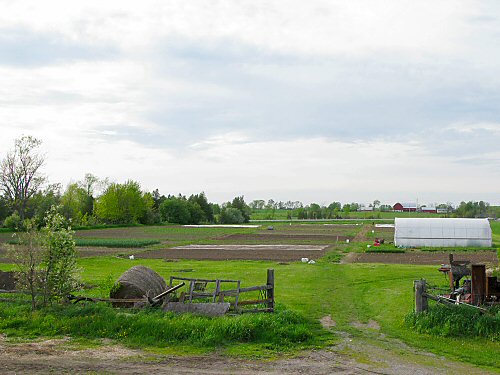
If you can average a month’s weather with one photo, this is pretty well it for the days of May this year, hovering between bright and sunny and gloomy and overcast, veering one way or another for a day or two, or even from one end of the day to the other. The freezing nights have just let up, which is good. We’ve also been getting a nice amount of rain: the month’s average so far is that magic inch-a-week (25mm), the veggie gardening rule of thumb for perfect rainfall. Many hours of dragging around and positioning hoses and sprinklers, and gassing up the irrigation pump, have been SAVED! That’s a big bonus, the total opposite of the last two years. The field is clear and amazingly weed-free (at a distance, at least)—more sun would benefit both the direct-seeded crops and the (kinda evil) pigweed. Less sun and cooler temperatures are also great for transplanting, which is the main thing going on right now. So it’s a toss-up, but I’m slightly more liking the colder, cloudier weather for now than not. As if I had a choice… :)
Peas appear
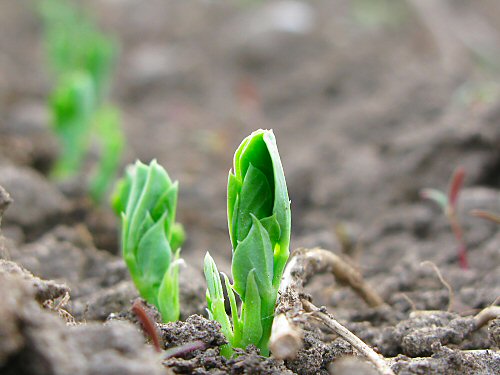
The first peas suddenly popped. A bit of welcome action in the field, amidst all the dryness and slow germination. These are Sugar Ann snap peas, edible pod. There’s 1000′, double rows, 3-4″ row spacing. They’re coming up well in stretches, but a lot haven’t yet appeared. Well, there should be some real rain tonight! On the right of the pic, a fine example of PIGWEED doing its stuff as well, keeping pace with the gardening effort all on its own. (Yes, lying on your stomach in the dirt is the easiest way to get the macro centered on these little guys!)
Rye arrives!
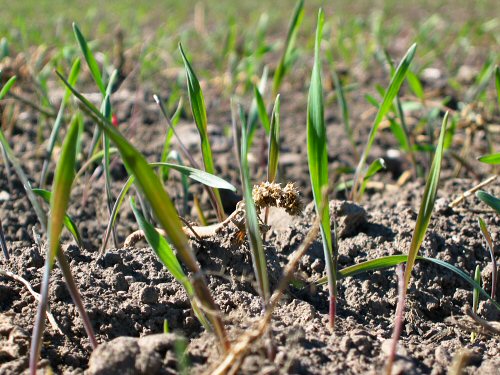
Where the oats arrived with a dramatic, iridescent splash of green, the fall rye made a much more sedate entrance, so much so that I didn’t notice it until today. It probably emerged a couple of days ago. It’s looking great! I dunno why I’m so extremely pleased by these green manure cover crops…but I am! The rye comes with a lot of promise. It probably won’t winterkill, instead, start up again in spring, making it good for sections that won’t be planted out till May. It thrives in cool weather, also making it great for fall and spring service. And it may have an allelopathic effect on PIGWEED, meaning that, on a plant-produced chemical level, future pigweed may suffer… That’s nice. On the caution side, if it gets too well-established, it could be a little tough to eradicate. No worries. I won’t seed it on sections that’ll be used for the earliest spring planting (there won’t be time to till it in), but otherwise, I’ll spread this around everywhere I can for the next month or so and see what happens!