
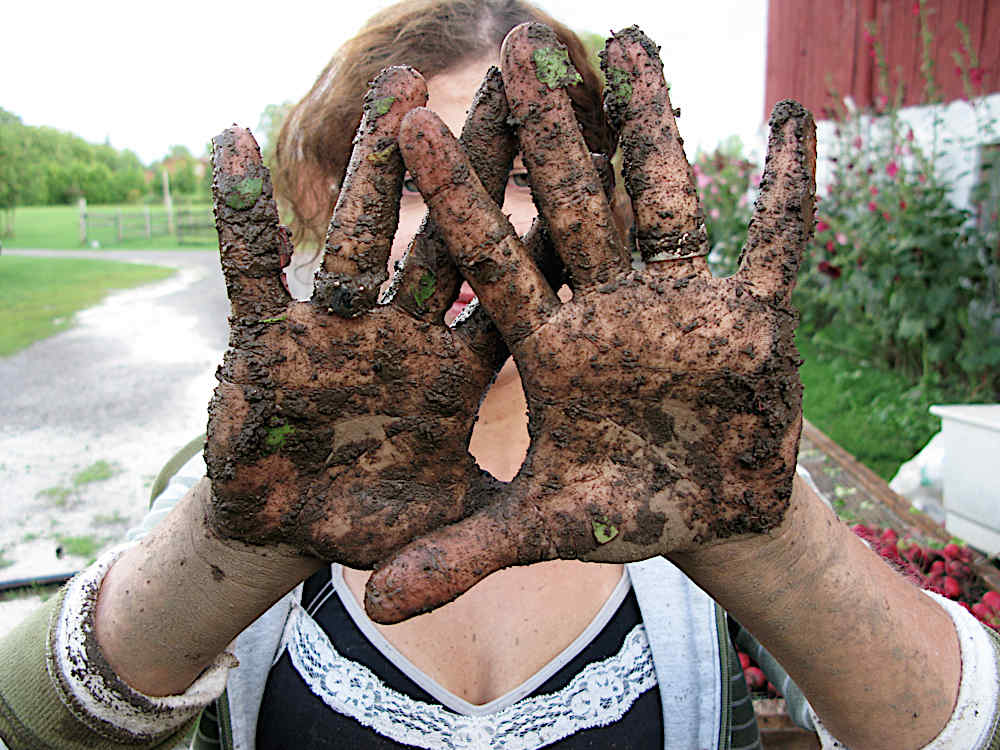
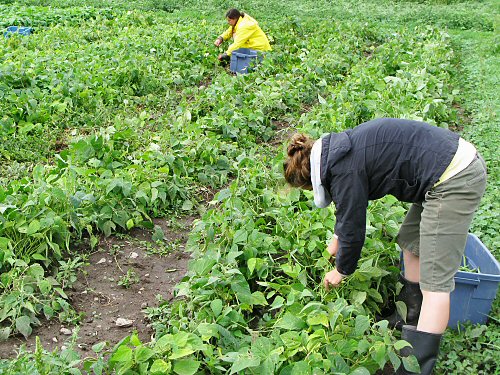
Have I mentioned that it’s been RAINING a lot all summer, like, a few times a day? We’ve taken to planning the Friday harvest to fit the slots between downpours, using…weather radar on the web! It works pretty well, checking the national and local maps, you can see precipitation quite accurately up to 3-4 hours out (it’s a little…high tech, but so is this crazy weather!). To avoid a late morning downpour, we started picking beans—finally, our first snap bean harvest of the year!—first thing in the morning (Maria, Lynn and that’s my bin at the top left of the pic below), so that we wouldn’t be messing with wet bean plants (they really don’t like being touched when wet, they get…diseased). That was pretty satisfying, picking about five bushels before the first shower, which arrived as foreseen. And so it went for the day. You can work between the daily rains, but mud avoidance is not an option—Michelle illustrates!
Year: 2008
What’s new at the farmers’ market…
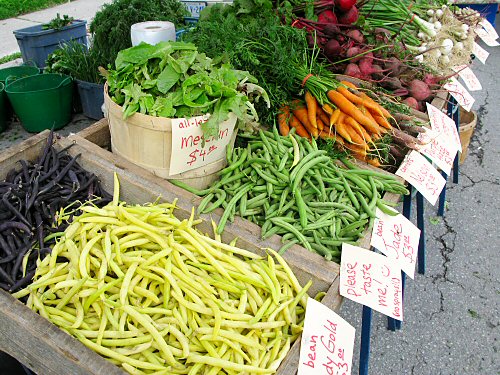
Ahhh, something new on the farmers’ market stand: BEANS in three colors (we had the first green beans last week)! There’s yellow (Indy Gold), purple (Royal Burgundy), and of course, green (Jade). One way I watch the season unfold is through the debut market days for the headliner crops, the big people pleasers. Lettuce is always the first up, a hit partly because it’s the first fresh veg of the season. Then, roughly in order, there’s spinach, peas, carrots, beans, garlic, and tomatoes. Strawberries and corn are also standard hits around here, but we don’t grow berries, and when we do have corn, it’s only for CSA shares. I find it odd that these particular veggies are so generally popular. What about delicate and delicious summer squash, lightly grilled? Versatile and tasty beets, diced and broiled, or grated raw with carrots in salad? Beet greens and Swiss chard, sauteed in butter and olive oil? The list goes on and on… Just about ALL of the 20+ basic garden veggies we grow are equally great to me, but that’s not the case for most people. Curious…
Burlap expires
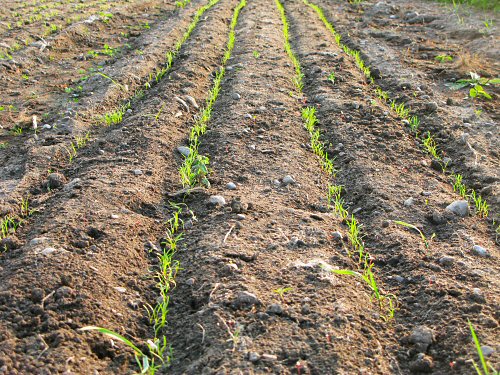
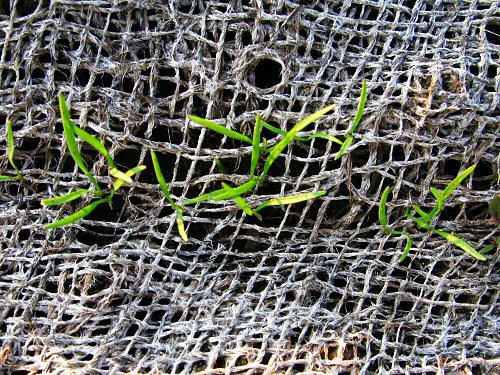
After a nice long ride, the burlap (of the burlap carrot germination method) is finally breaking down, shredding as we fold it up off the final carrot beds of the season.
Even in this wet weather, the burlap makes a big difference, probably because it holds the soil heat—the difference is clear at the ends of the beds, where the seed drills extend past the burlap, and germination has barely started.
I haven’t been keeping accurate count, but this batch has done at least eight seedings over the last two years. At about $30 a bed for a double layer of burlap (100’/30m) over a 50′ (15 m) x 4 row bed, that makes it less than $4 per 200′ (60m) of carrots, more than worthwhile. If we’d taken better care of it during this wet weather, mainly by making sure it dried out quickly, it may’ve even lasted for a seeding or two more.
Like floating row cover, burlap is an outside input that I don’t like to rely on, but for now…it works!
Flowers galore
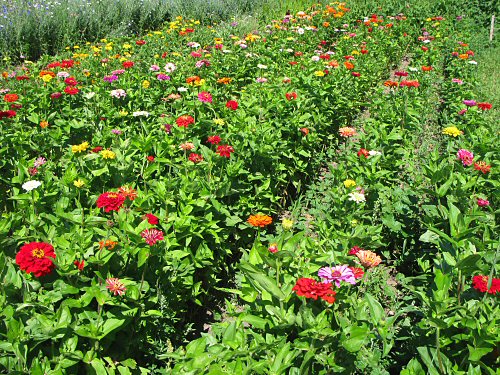
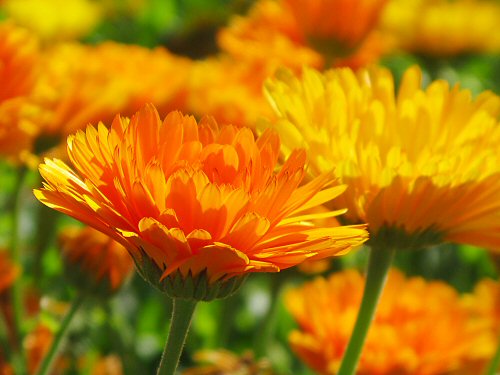
The flower sections have pretty well taken off over the last month, with the several beds of zinnias (above, directly below) offering up the biggest splash of color. We’re not harvesting the flowers, this season is a trial run, but they get regularly cut by everyone working in the field, and by a couple of CSA members, so they’re not out of control or going to waste. Besides, they’re pretty to look at, right there at the bottom of the field…
Since we’re not harvesting, I’m really not learning much about the world of cut flowers, beyond the growing. There’s lots of detail, like exactly when to cut for maximum vase life, and where to cut on multi-flowered plants. Right now I’m somehow not focussed on learning cut flower stuff that I don’t have an immediate, practical use for. So I just watch and enjoy…
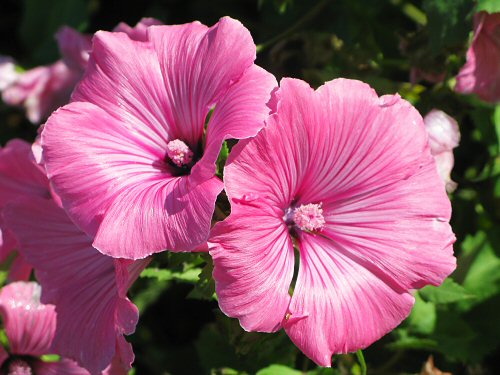
Lavatera has broken out in the last couple of weeks.

And sunflowers are in fine form (this variety’s called Sunrich Pro)…!
Scrabbling for potatoes
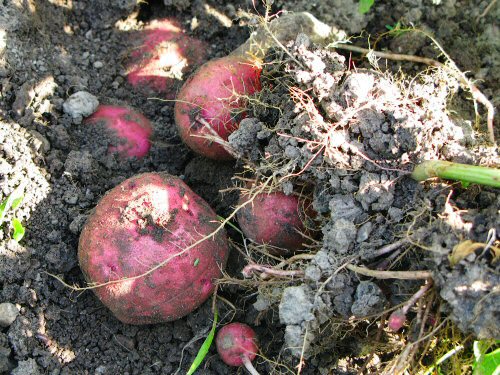
Thursdays are potato harvest days. Without a walk-in cooler, the main weekly harvest for CSA and Saturday farmers’ market is mostly confined to Fridays, with potatoes being one of the few crops that can be done a day or two ahead. Towards the end of the season, we dig up all the remaining spuds in one shot, but until then, it’s easier to go weekly. And since I don’t sell potatoes in bulk, curing them for storage is not an issue. It’s a tiny harvest, and the method of choice goes with it. Simply pull up each plant—they’re at 12″ (30cm) spacing—and scrabble around! Fingers work great. I used to use a digging fork, but that’s more work than it’s worth, and potatoes often get skewered. By hand, it takes 20-30 minutes per bushel (about 50lbs/23kg), really fast this year with quite huge potatoes after all the rain, and sometimes stretching to maybe 40 minutes if they’re small and the ground is drier and harder (this’ll happen in a really dry year, where potatoes get little or no irrigation). When the ground is dry, especially in clayey soil like ours that can get really hard, a hand tool like a trowel or tined cultivator can be good to break things up here and there after pulling. I kind of like how primitive the method is, and most people who try it REALLY seem to enjoy it. For the 2-3 bushels we need most weeks, it’s quick and effective! The variety here is Chieftain…
Post-harvest aftermath
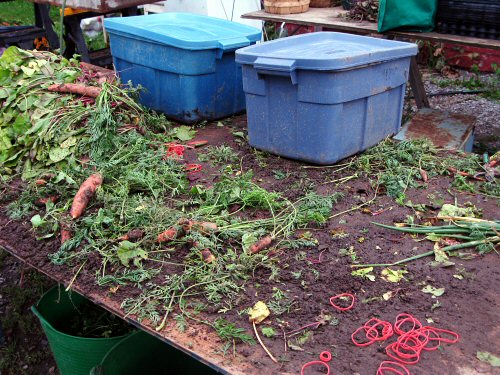
Sorting and packing after harvest—post-harvest processing!—is in good part a wet job, made a lot messier in rainy weather when root crops come in with a load of mud attached. Once again this season, the main work surface for sorting is a 4’x8′ sheet of plywood set on sawhorses. Actually, we added a second table, so now there are…two. Here, we’ve just finished sorting and bundling carrots, which then went for a rinse on the screen table. Sometimes, rinsing is done first, depending mostly on who’s doing what and what else is going on. In the closed blue bins, which hold a little over a bushel each, are carrots already bundled, rinsed and ready to go. This week, there are four bins of carrots, around 160 lbs (73kg). The residue is sorted out: here, damaged carrots will probably be topped and kept for house use, and the greens (there are some beet greens as well at the end of the table) are fed to the goats, some to the chickens, and the rest onto the compost pile. Then the table is hosed off. Couldn’t be simpler or wetter!