As the afternoon shadows get longer, Michelle checks out the harvest board to see what’s left to do for tomorrow’s farmers’ market. This same whiteboard is now in its third season of service, a little worse for the wear, with the surface no longer coming clean, and one edge of the frame fallen off (it’s lying there, right behind, waiting for repair), but fully functional. As long as I remember to keep it out of the rain and too much sun, it could have a few years in it yet. And I’ve grown to really like it. The shiny WHITENESS is a little glaring and kinda office-like—I considered switching to a chalkboard—but the printing stands out so well… It makes things clear, which is always good!
Tools
Equipment for large-scale agriculture is too big or too expensive, and many home gardening tools don’t work efficiently on larger jobs or break easily. Tiny farming on plots up to two or three acres requires its own special gear…
Chickens, frozen
There they are: 38 newly processed chickens, freezing solid in the chest freezer (39 minus the one we took to roast fresh). It’s the last stop before the table on what was a pretty fine meat bird run.
Like everything else on the tiny farm (and in life in general!), when you get down to freezing chickens, there are the details. What I noticed this year is the amount time it takes to actually freeze chickens solid. This wasn’t quite as apparent last year, when we started with under 20 processed birds. Here, checking out the new freezer’s manual, I loosely followed the advice against freezing too much at once. I put in half, around 20 chickens, for a few hours, then added the rest. I’ve also been rotating them—they freeze faster when they’re exposed—but after a day, they’re not all rock hard.
I have it in mind that the faster you freeze stuff, the better it is when you thaw it out: firmer, not mushy. Something about smaller ice crystals doing less cellular damage. Sounds plausible to me!
Luckily, the chickens came heavily pre-chilled from the processing house. Processing your own in any sort of quantity, I imagine you need a fair bit of refrigerator space to cool them down, or a walk-in cooler, or lots of chest freezers. Another thing to look into for…the future!
Of course, the whole freezing thing is another puzzle. It’s quick and easy, and works really well for all kinds of food. Newer chest freezers seem quite energy efficient: this 15 cu ft one uses 400 kWh a year, which is like keeping a 60W lightbulb on for 9 months (at current electricity rates around here, that’s about $50). Doesn’t sound so bad, and there’s room for lots more in there. Still, we’re trusting a lot to yet another plug…
FINALLY, there’s the sticker, another fine feature of commercially-processed chicken. The meat is Ontario government-inspected (a provincial inspector is always on-site, that’s the law), which is indicated by a little logo on the label. Plus you get the date, weight down to two decimal places of precision, AND a price-per-pound of your choice. I picked $4. These birds are for our own use—not for sale—but it’s always fun pulling out an EXPENSIVE farm chicken for dinner, as long as it’s priced kinda within reason…
Chickens to meat
The White Rock Cornish X meat birds are now…meat! Today was to-the-processing-house day. Up at 5:15 a.m. to get them rounded up for the trip. And it seemed to be a pleasant one for them. They arrived looking laid-back and content after a breezy 35-minute drive. This was gonna end up their “one bad day,” but so far, so chill.
To save an hour plus round-trip drive to pick up cages from the processor, we decided to load ’em directly in the trailer. The original idea was to cover it with a tarp, but I waited till the last minute (this morning at dawn) to fit it, and there was no easy way to get the tarp secure. So, a last-minute solution that turned out great: snow fencing and wire.
Three sections were cut from a roll, overlapped, and fastened with twists of light-gauge electric fence wire. Really quick, secure, easy. Perfect! At the processor, I helped hand off the birds right through the slaughterhouse door. And that was it: back at 5:30 p.m. for the pick-up.
The trip was smooth, but the end was still a little impersonal: in one processor house door, out the other. I hope to fill in that last killing step soon.
So there we are, 39 free-ranged chickens, after what seemed to be a happy, active, fast-growing, 11-week life, are now government-inspected, weighed (average about 7lbs/3kg), packed in plastic, and pre-chilled for the freezer. This seems pretty close to sane meat production. Chicken dinner!
Weighing chickens
Carrot-burlap method gets a twist
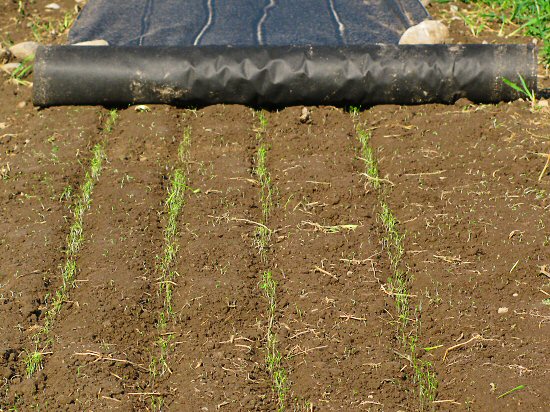
Here’s one of the more extreme displays of crazily labor-intensive tiny farming technique. Andie surveys our work, the result of deciding to try landscape fabric in place of burlap to help carrot seed germination. It’s actually a double experiment, because one of the beds is green onions.
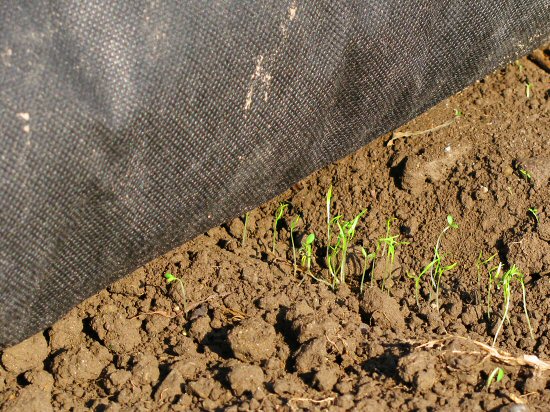
The burlap method has been the way to start carrots around here for the last two seasons: tried and true. The main purpose is to preserve moisture in the seed drills, and the increase in heat helps as well.
After a good run, the first round of burlap expired, and I couldn’t find rolls of it in time for this season (I know it’s out there, somewhere). But, I spotted this gear, landscape fabric, a porous plastic mulch used to permanently suppress weeds in…landscaping. It’s light, and just wide enough (3’/30 cm) to cover 4 rows of carrots (that’s a little closer than usual for the bunching onions). I tried it on two beds earlier in the season, and it works fine!
One little problem: it tears easily, so how to hold it down? With the burlap, we made wire staples out of heavy gauge wire. Here, we placed a LOT of heavy rocks, close enough together that there’s no room for the wind to get under and start really pulling. This does the trick for now, but overall, it’s a little TOO intense. The hunt for burlap: still on!
Another rainbow
It’s almost “yet another rainbow,” but not quite. We’ve seen a good collection so far this season, including quite spectacular horizon-to-horizon double rainbows two nights in a row. Which means there’s been lots of rain, and all the cloudiness that goes with it. It’s nowhere near as miserably wet as last season, though—rainfall this year has actually been great, averaging around the golden inch-a-week (2.5cm-a-week)—but 4-5 mainly cloudy days out of 7 is slowing things down.
How slow? The first summer squash that should’ve popped in size in a few sunny days, has been slowly expanding for well over a week. Root crops like beets, carrots, potatoes, aren’t affected as much, and seem to love the rain. But toms, peppers, eggplant and the whole cucurbit family (squash, melons, cucumber) are in slow motion, maybe a week or two from where they’d be with lots of sun.
Still, all in all, everything is growing along well enough, and we’re bound to hit a sunny stretch. Right?
In the photo, a third planting of green and yellow snap beans, with scare ball in place to scare off birds (it seems to work). To the right, a freshly tilled section, waiting for a third planting of spinach… This weather’s great for summer spinach!
Extending the chickenhouse
First day of summer, and the day before the arrival of 25 20-week-old, ready-to-lay Shaver Red Sex Link CHICKENS. Clearly, time to begin building out their new home. It shouldn’t take too long! :) Working on and off through the day, the frame went up, and by early evening, the plywood flooring is down, the door is built (on the right) and even a first plywood panel is up. A little more work tomorrow, and we should be good to go. No problem!