Compost spreading: another way…

Spreading compost with a rake

When there’s a whole small section to cover, spreading compost with the Kubota compact tractor bucket is a lot faster and more efficient than the painstaking bed-by-bed method. This has been my usual approach for spot spreading, usually for 50’x50′ squares. Covered in reverse: the roughly distributed compost is quickly raked out (looks like a lot of work, but only takes 5-10 minutes!), before being rototilled in.

The real trick is backing up while dumping, rotating the bucket up and down. As long as the compost is flowing and not too clumped, this works great, gets a lot of the job done.

After a little experimentation, we came up with a simple debagging method, Lynn demonstrates: slit the bag in the bucket, then quickly flip it, pull up, and give it a couple of shakes. This compost is quite heavy (35% moisture, the label says?! expensive certified organic water…), so it quite easily tumbles out… And there we go, tiny methods for the tiny farm!

Spot the tiny farm!

Rototilling on the Kubota

What’s in a photo? Depends what you’re looking for! Take this pic of Andie, rototilling today with the Kubota. Pretty straightforward: woman, machine, field. BUT, can you spot practically  EVERY main part of a really tiny farm (at least, of this one), represented right here?

It’s mostly hand work, but there’s some gear: Of course, we have the Kubota compact tractor, flagship of an motley assortment of gear specifically suited to tiny farming. It’s rugged, very much a diesel TRACTOR, but small, and designed more for the big estate crowd than agriculture. Around here, though, it’s the workhorse machine, a people multiplier with its bucket and essential 48″ rototiller. As far as I know, rototillers aren’t core gear on tractor farms, but it’s our ONLY field implement so far, a huge labor-saver over walking up and down with the walking rototiller, or digging by hand. And the turf tires seem to work just fine.

New people diving in: And then there’s Andie, doing (tiny) tractor work within the first few hours of her entire market garden experience. (It’s cool that she’s already looking over her right shoulder, it’s a classic tractor farming pose—except maybe not with GPS?) She also has DIRTY HANDS on the wheel, from checking out the tilling results, and they’ll stay dirty as she moves off the tractor in a few minutes, on to hands and knees to plant onions.

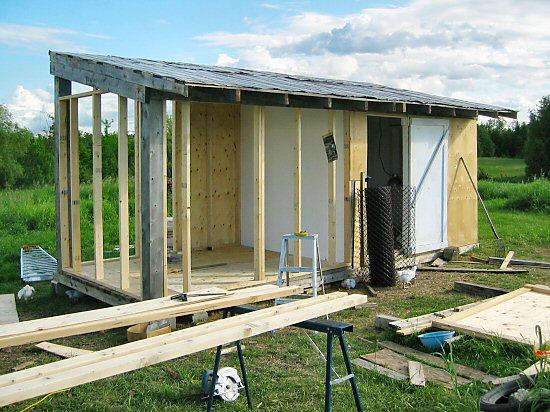
A big shed (aka barn): A barn of some sort is the main, sooner-or-later essential, working structure that separates clear land from a working tiny farm. Really, a basic barn is just a big, all-purpose shed  (this one, 20’x32′, is pretty tiny, just four walls), for getting things out of the weather. You use it to store harvests and gear, and to work out of the wind and rain  (and of course, we have winter). With rough carpentry, you remodel and reconfigure it to fit: an extra hook here, new door there, closed off room in a corner, whatever you need!

Lots of work, all day long: Elsewhere in the pic, less obvious but clear signs of tiny, labor-intensive veggie growing.  In front of the barn, tables of seedlings are hardening off. They’re brought out in the morning, taken in at night, back and forth, back and forth. That’s because the greenhouse (hoophouse frame on the left) isn’t finished yet. And THAT’s because there is just SO MUCH TO DO ALL AT ONCE. Like, mow the grass for mulch, before it gets outta control. And get a new battery for the John Deere riding mower (on the top left), so it can haul around the trailer loaded with whatever we need to get LOTS MORE STUFF done. It all weaves into one big picture of tiny, simple, interdependent tasks that go on and on and on, all day long…

It can get a little intense, but it’s also really fun, if you don’t get all grim and serious about it and try to tie in the state of the entire planet (try to stop following the news!). You get to pretty much see where you’re going. Meet people in a really interesting way. Eat well. Sleep well. Kinda…simple! I think that’s a pretty good start…

A field day

Seeding with the Planet Jr.

At this point in the season, EVERY day is a field day, unless it’s totally rained out. Today was no exception. Lynn brought a couple of friends, Julia and Tom, to check things out and lend a hand. They’re off to work in one of our fine parks this summer, but wanted to see what was going on on this tiny farm. No problem!

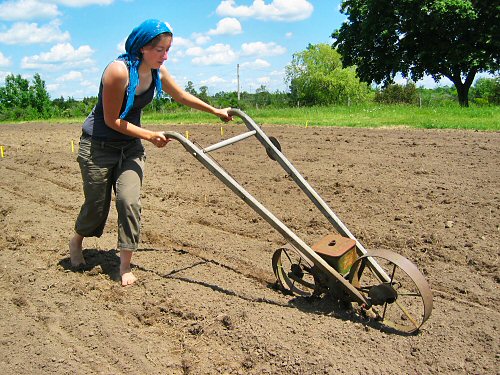
I seem to’ve gotten pretty good at tossing people into the tiny farming action, with little work-up or ceremony. A quick tour around (and here, there’s not much to see just yet), and it’s on to the hands-on. Neither Tom nor Julia had experience with market gardening, but in no time, they were seeding with the seeder of the day, the trusty and heavy Planet Jr. (above). We’re doing a second planting of spinach, and a third of peas…

The Planet Jr. can take a little getting used to, so there I am, explaining how it works as we go! Knowing exactly what a tool is doing and why really makes learning to use it so much more…satisfying. I think.

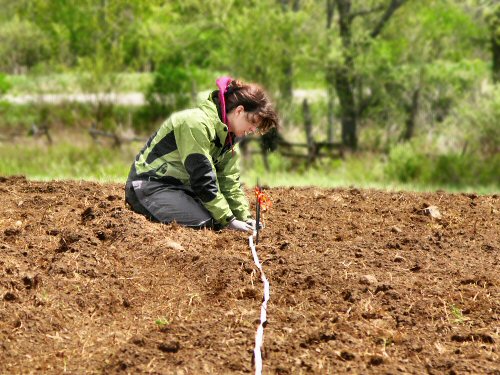
Just about EVERYTHING in tiny farming is quite simple and straightforward (there’s just a LOT of simple things to know!), still, some people have a natural talent for this or that. Like, Tom can clearly walk a very straight line as he measures off more beds for onions and peas. The current bed marking method: measure and stake the path centers at both ends of the bed, and walk ’em in! It’s pretty simple.

For getting your hands dirty, there’s nothing quite like crawling along in the dirt, pushing Stuttgarter-type yellow cooking onion sets into the ground, six inches (15cm) apart, by the hundreds. Once you get into the rhythm, you can sow and chat, and things get done in no time! All in all, relaxing and productive day in the field. Fun and useful, I hope, for all! (Photos 2, 3 by Lynn.)

Ways to spread

Spreading compost by hand

This has gotta be the most painstaking way to plant out two acres of veggies! To recap: different sections of the two fields are at different stages of tillage (Peter down the road has had to come back a couple of times to disc, and there’s STILL a small section to go), and of course there was no time to spread manure in the fall. It’s even a little more complicated, with a fair amount of chopped up sod getting in the way. Sooo, we’re working a few beds at a time, with different treatments depending on the crop.

Here, Tara and Lynn prepare a 50′ x 3′ (15.2m x 0.9m) bed for baby lettuce for mesclun. Because it’s seeded densely and grows quickly, we decided to apply a fair amount of that expensive certified organic compost, and then reuse this bed for at least one or two more mesclun plantings later in the season.

Spreading from Bags Method 1: We brought over a stack of 40lb (18kg) bags in the bucket of the Kubota compact tractor, emptied 8 bags one by one, and lightly raked them in. Thinking about it afterwards, it seemed easier to empty the bags into the bucket, use a shovel to spread, then rake it in. An extra step, but overall quicker to incorporate.

Definitely hand-work, especially compared to loading up an 8-ton manure spreader and driving it around with a big tractor, like we mostly used to do! Good thing we’re only giving this special treatment to a few beds for salad greens. And it is all getting done…

Mixing and repotting

Filling peat pots

Today’s featured task: potting up tomatoes from plug sheets to 3″ peat pots. As with many things here this season, this is a little later than usual, by a week or so, as the new farm set-up gets squared away. (It should all even out sometime in June.)

This batch of seedling mix is about 50% compost, 25% peat and 25% perlite. Lynn and Andie did the blending on top of a stack of 4×8 plywood, using a shovel, and hand-crumbling clumps of peat and compost. With a little experience, it’s easy to judge a mix by squeezing it (or you can just follow a recipe exactly), but a fairly foolproof test, when using compost or soil, is to water-in a loosely packed pot: if the mix collapses into a muddy muck, you need (lots) more perlite/vermiculite/peat. Water should flow through leaving things still kinda fluffy.

Between tomatoes, peppers and eggplant, we’ll end up with maybe 900 potted-up transplants, aimed for the field in about three weeks. I’d decided to stop using peat pots this year because you have to keep buying them (they’re planted with the seedling). BUT: it’s so busy, there was no time for soil blocks, hadn’t had a chance to find a supplier for reasonably priced, small bulk quantity (reusable!) plastic pots, and we found an inexpensive peat pot supplier in town (they’re usually ordered and delivered), so it’s peat once again this year…

Direct seeding

Direct seeding is going ahead at a careful pace. There’s a fair amount of broken up sod in the mix, and it would be nice for it to have more time to settle in and decompose, also for any bits of live grass to start poking up so they can be disrupted again with a light tilling… But we can’t just wait around. Spinach, beets, and radish went in a few days ago, just after the first peas. More peas went in yesterday (Connor for the first time wrestles with the kinda heavy and unwieldy Planet Jr., above, and ends up doing fine on a trial row). Now, the watching and waiting is on for the first plants to emerge in the field…

Direct-seeding peas

The first direct-seeded crop went in today: Sugar Ann snap peas. As usual, the peas were inoculated with Rhizobium bacteria: dampen the seed with a little water, sprinkle with inoculant powder, and shake.

Rhizobium bacteria enter legume roots and form a symbiotic relationship with their hosts, producing plant-usable nitrogen in exchange for carbohydrates and other nutritious goodies from the plants. The net result is…more nitrogen for all! Or as the inoculant package says: “bigger yields and better quality”!

Sounds great. I take it on faith (in the science, I guess), since I haven’t actually observed the with-and-without inoculation difference. I have a couple of times planted without, but I wasn’t taking measurements…

Each legume (peas, beans, clover, etc) needs its own species or strain of Rhizobia. Luckily, there are packets of premixed assortments that cover the common veggie legumes. What I’ve been using, called simply enough, Garden Inoculant, is good for beans, peas, lima beans and sweet peas.

The bacteria do establish in the soil so that they’re available from year to year, but I’m not sure how long and in what quantities it takes to get set up with the strains you need—until I find out, I’ll inoculate every time…

Then it’s on to the seeder. I’m using the older, heavier, probably-antique Planet Jr. over the usual Earthway.

And minutes later, 3oo’ (91m) done. It’s an almost painfully small start for April 20, but I’m figuring that every few days I leave the broken up sod to break down more, the better off we’ll be. Soon, though, all the rest of the early direct seeded crops will just have to go in!