Last day of summer in the garden!

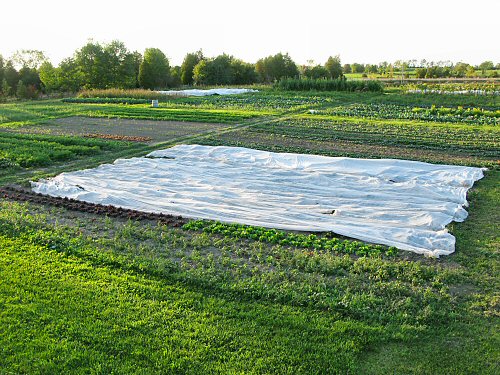
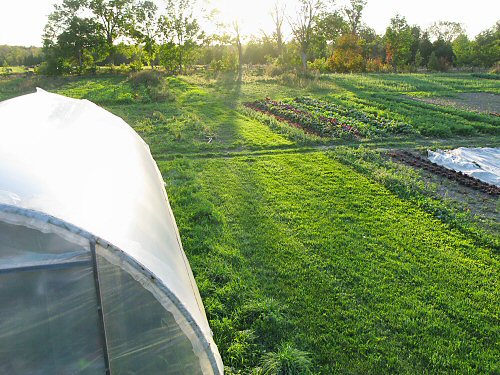
Here we are at the end of the calendar summer, a season of crazy weather largely gone by! Cooler fall conditions have been around for a couple of weeks now, with ample frost watch nights, so summer’s end at this point is only…ceremonial. Still, there’s that little twinge of melancholy that comes with the official end… The fall harvest is looking fine, with lots of brassicas, a good deal of lettuce, and the last of the fall spinach in the north end of the field (above), along with some last tomatoes, lots of peppers and eggplant, spared by frost so far. There’s also Jerusalem artichoke and potatoes, still in the ground. Green beans! And, of course, that section of sweet potato, fully row covered…

Moving down the field, there are the last plantings of beets and carrots, parsnips, some Swiss chard, and lots of mowed but still untilled empty sections…

At the south end of the garden, the herbs and flowers are all hanging in there—row cover has kept even the super-cold-sensitive basils alive and well. If I’ve missed anything in the rundown, well, it’ll still be there!
Restaurant run

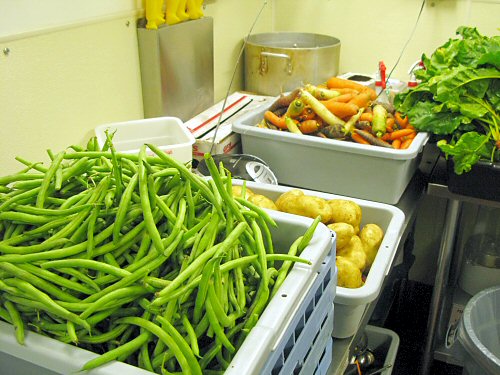
Beans, potatoes, carrots

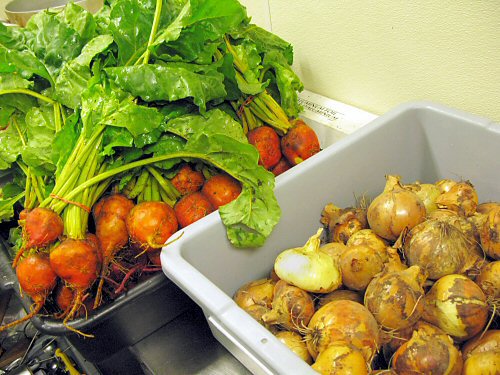
A phone call on the weekend lead to this, our first real restaurant sale. It was cool! A chef called looking for local, organic veggies for a special menu this week. They’d joined at the last minute a regional food festival, featuring local food in restaurants in several towns. I ran down what we had available and followed up with an emailed price and available quantity list. Today, we harvested and delivered: green beans (Jade), potatoes (Kennebec), beets (Golden Detroit, Scarlet Supreme), carrots (Nelson, Purple Haze, White Satin), and onions (Stuttgarter-type yellow cooking, yellow Spanish), in the 25lb (11kg) range for each. Pricing was the normal market unit price, no “wholesale” discount. It was great pulling up to the back of the building, delivering into the kitchen, checking out and describing each veg with the chef. The dinner plans: a “hearty fall soup” and a “steamed vegetable pasta with olive oil and herbs.” Market gardens and progressive local restaurants are a natural and quite common direct fit…as seen on TV (I’ve been known to watch the Food Channel)! I’ve had some minor dealings with restaurants in seasons past, but we’d never got round to a classic chef’s order and kitchen delivery. so it was interesting to go through the whole routine. We had lunch there afterwards, and the food was refreshingly good: bruchetta, flatbread pizza, sweet potato fries, salt and pepper rib tips, an asparagus sandwich (yeah, the asparagus aren’t exactly in season around here, but their special local food menu is a step in a cool direction…). Fun! Oh, and no frost last night.

Fall frost watch 2008

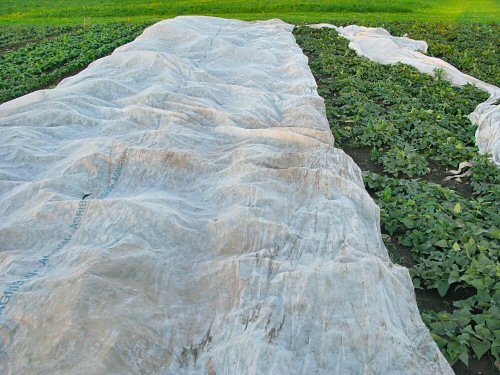
Tonight is the first real frost watch of the year. I covered a bunch of beds for a couple of nights last week, but the chance of frost seemed slim, with the overnight forecast around 35°F (<2°C). Today, they say it’s supposed to go down to 33°F (0.5°C), with clear skies and no wind, perfect frost conditions. Under cover: peppers, eggplant, summer squash, beans, cucumber (a really late experimental planting), basil, sweet potato (above). It’s floating row cover is the usual Agribon AG-19, in 14′ ((4.3m) widths. Let’s see how it goes…!

Fall harvest…

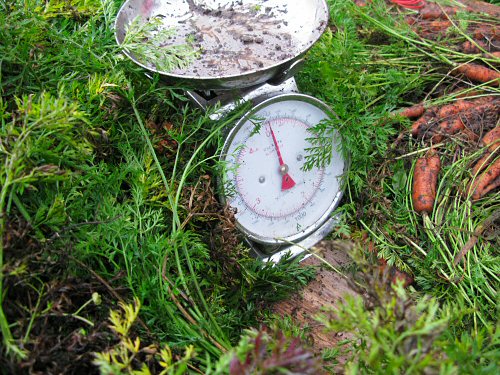
We’re definitely into fall weather now: the thermometer may still read “warm” but there’s always a cool edge in the air. This is the best field-working weather, you can go on for hours. Today was a bit damp, and the abundant root crops were muddy from the overnight rain (they get rinsed, with a spray of the hose on Jet for the roots, then a dunk in the laundry sink to rinse off the leaves). Carrots were in 2 lb (900g) bundles, by the trusty kitchen scale we’re still using…

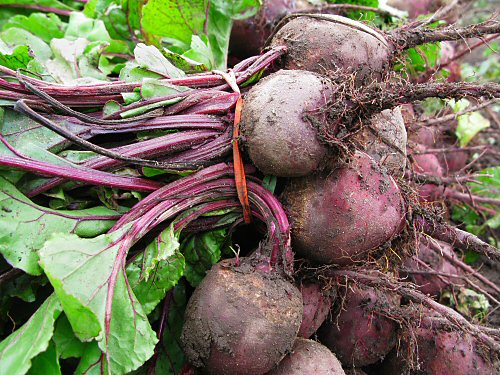
We bundled the beets in the field—these are the red standbys of the season, Scarlet Supreme. Always reliable, they’re in great shape and flavor, and the greens are particularly substantial…

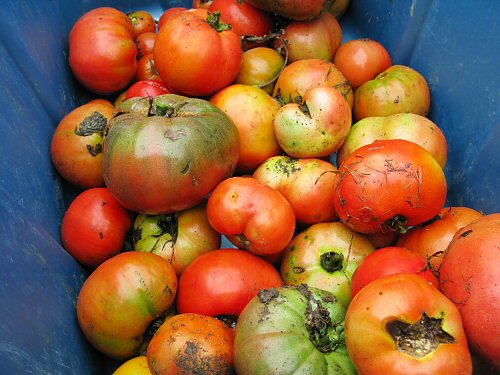
The tomato harvest was fairly slim and motley, maybe 120 lbs (54kg), enough for CSA shares only. We’re picking them even partially ripe—frost may come at any time, no sense in waiting. The toms may not be too pretty, but they’ve somehow become real tasty in the last couple of weeks, steadily developing from the milder flavors of the first pickings, to really quite fine! Was it the recent sunshine?  Whatever the reason, it’s a pleasant surprise!

Trimming garlic

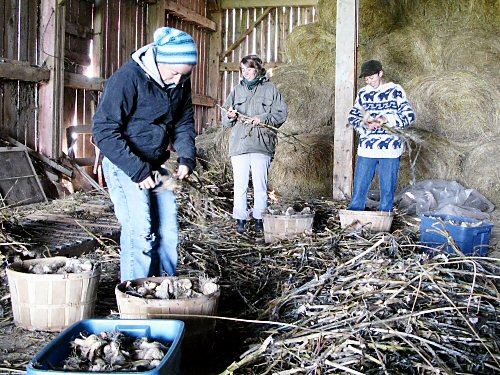
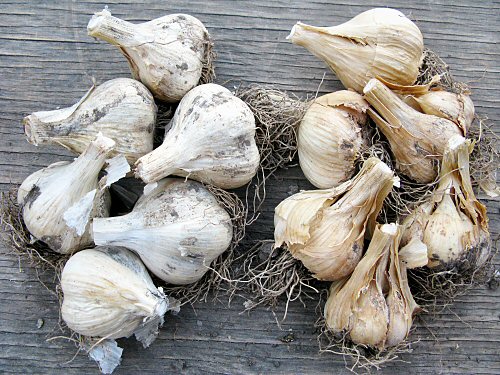
From the long stack of garlic drying in the barn, we’ve been taking out about a bushel a week since harvest began in late July. Today, we finished preparing the rest of the harvest. Lynn, Raechelle and Mel snipped the stems and sorted at the same time. (The roots weren’t trimmed; that can be done for some as we go through the bins and baskets each week for CSA shares and the farmers’ market.) In past years, the sorting was for size: dividing the mostly medium and large bulbs, and putting aside the very few tiny and damaged ones. Garlic does best with a dry final month of growth—this time, coming out of ground that had remained quite wet all summer, the harvest wasn’t in as good shape…

Sizing evened out, with most bulbs about what I call “medium” (this is the most useful size for cooking, but the big ones are so…impressive, everyone loves ’em). A little over half dried not to the usual tight, white skin, instead, to a tan color, wrinkled and split. So, we sorted into “good” and “not so good”… There was also a much higher proportion of really damaged bulbs, maybe 10% compared to a usual couple per hundred. Still, the taste is great, and the cloves themselves are fine. Only appearance and storage life are affected. We’re selling the less pretty, less storable bulbs at a couple of dollars less per pound. They’re good for immediate use (within 3-4 weeks, maybe a little longer) and as seed garlic for fall planting. Overall yield was great, although I’m not sure whether the hugely reduced number of large bulbs was due to weather, or to the more intensive 5-across planting we tried for the first time. As usual, more to observe and learn from. All in all, given the poor garlic weather, it all worked out quite well!

After the market

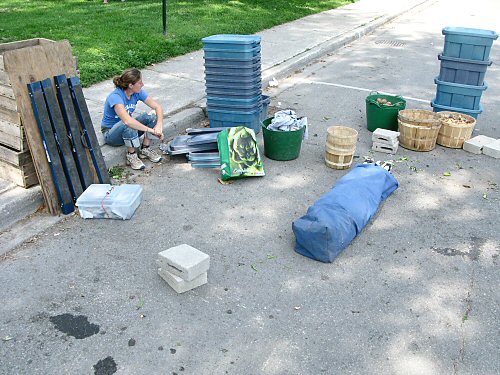
Somehow, I always forget to take enough pictures at the market, of things like setting up the stand. It’s really great, how a plain old small town street, in about an hour, turns into a…farmers’ market. For our stand, basic set-up and teardown—canopy, table, sales gear—is only a matter of maybe 20 minutes at each end. Because I don’t drive, our stand is different from most, where a truck or trailer is the usual veggie stand backdrop. Bob drops us off in the morning in a pick-up: a self-contained veggie sales outpost. When it’s all over, with empty containers nested and packing volume much reduced, we get picked up by truck or smaller mini-van. Here, Lynn and I wait for our ride. There are garlic and potatoes left in a basket and a trug, and the four bins contain mostly crop residue, a bit of miscellaneous garbage, and odds and ends of unsold produce. Neat!

Good beans…

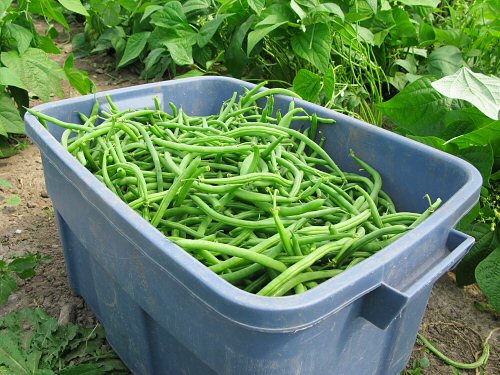
Just a few sunny days and the new planting of snap beans have sized up perfectly for the Friday harvest. They’re the crop of the week, a shade on the young side, maybe 2-3 days from being fully filled out, super-long and slender, with firm, thin pods (compared to the sturdier skins of the slower-growing first set), and only a hint of the actual bean inside. Cool! Because everything is fresh-picked on Fridays, regardless of when the “perfect” picking day may’ve been, it’s interesting to see what the luck of the draw brings to certain crops. These beans are an example. By being a little early, I lose a bit of yield, maybe 10-15%, but the beans are at that elusive, slightly young stage. Mesclun may reach that perfect first cut, when the leaves are still mild-tasting and almost melt-in-your-mouth, on, say, a Monday or Tuesday, and, especially if there’s sunny weather, grow past it by the Friday—still excellent, but a little firmer and stronger-tasting. Same for some of the fastest growing summer squash, like the zucchinis, which can practically double in size in 4-5 days. I’ve found the picking window for tasty veggies is usually quite forgiving for even the fastest growers, at least a week in summer and longer in the fall. As always, it’s mainly about the weather: how much heat, sun, and moisture they get. Since I’m not harvesting or sorting for uniformity—I don’t NEED carrots of a certain length and diameter and so forth—there are no worries on this front, and it’s fun to see and eat the variations of each crop and planting at each harvest all through the season….