
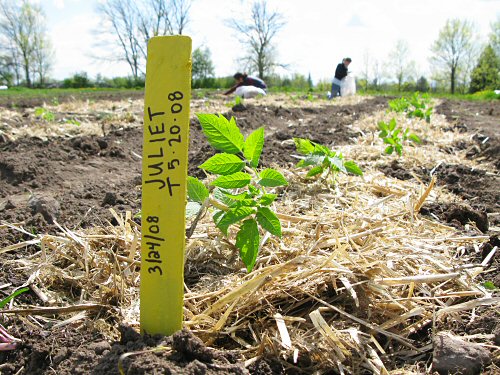
Especially compared to yesterday, today’s mainly sunny, quite warm weather added up to a glorious day in the field. Lynn, Raechelle and Shannon were all on hand, plus the inadvertent pet chicken, Colonel Saunders (I guess there’s no going back to the flock for him now, he’s been separated for a few days and probably wouldn’t be welcome, but, uh, he will be eaten…). It’s so absolutely fun to do even the most potentially tedious tasks (like hand-weeding between tiny green onion seedlings—done!) in a group with such a happy vibe. Besides a good amount of weeding, and putting ALL the chickens outdoors for the first time (those White Rocks don’t seem to want to do anything chicken-normal on their own, except eat), we transplanted the first 100 tomatoes. These were the deluxe early starts (Juliet, Striped German, Big Beef, Stupice), and they got the best transplant treatment ever: a deep, dug hole with a generous amount of compost, burying to the topmost leaves, a thorough watering in, mulching with the oat straw, and then, floating row cover over top for the coming few cold nights—it’s hard to imagine this is a…commercial operation, especially when you’re selling toms for only $1.50-2/lb. :) We mulched directly around the plants with straw, I’ll fill out the rows with grass mulch as soon as there’s enough. On the marker stake, there’s the variety, seedlng start date, and today’s transplanting date. At the other end of the row, Raechelle and Lynn mulch (Shannon seems to mysteriously avoid the occasional snapshots most of the time…). With all of the recent cold, we’re definitely at least a week behind the last couple of years in transplanting and in growth, but with a few hot, sunny days to complement the decent amount of rain we’ve been getting (not usual in recent years at this point), we might even catch up… Anyhow, a fine day!
Work for a dreary day
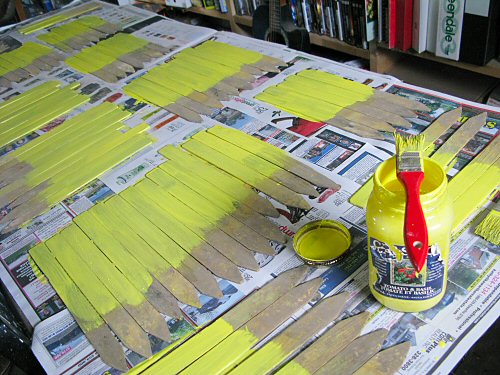
Rain is usually the only thing that stops work in the field, and not even that on harvest days, but this crazy cold May has had it’s particularly nasty, stay-inside days, and today was one of ’em. With a sharp, damp wind, and temperature around 50°F (10°C), stepping outside instantly set you to shivering. It wasn’t THAT bad, of course, and I think it was so off-putting mainly because of the sudden shocks of drastic day-to-day changes we’ve been having lately. In any case, there was no super-urgent fieldwork, that couldn’t wait a day, so we decided to hide out and do…indoor stuff. Bad weather days have their place on the tiny farm, you can catch up on all sorts of things that might get put off otherwise, and later get in the way or interrupt your…flow. Today, we repainted garden marker stakes (these guys are kinda expensive, you don’t wanna waste ’em) with a thinned out latex exterior paint. I’d only done this once before, by dipping (it took 4-5 years to accumulate enough that a good number were so written on and faded, they needed a little makeover!). This time, I figured a brush would be quicker, which it was (except, don’t use a newspaper liner, the paint makes it soggy and then it sticks; for the other side, we just painted on the table directly, and wiped up afterwards).
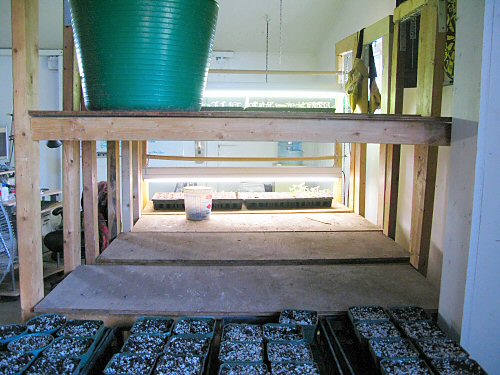
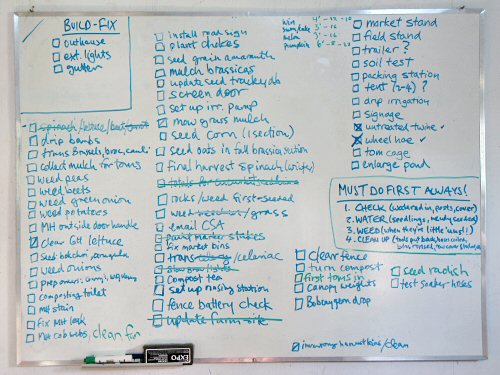
Other pleasantly sheltered jobs included removing the lights and chains to turn the grow racks into harvest bin storage (left a couple of lights on for a last few seedlings) and packing up the lightbox set-up to free up space, reorganizing part of the drive shed with all the farmers’ market gear, doing some work on the enclosure for the composting toilet, seed starting for another wave of broccoli and cauliflower transplants, making some calls,… Most of these weren’t on the whiteboard task list of the most important things for the next few days. For the to-do list, I used to use the notebook I carry in my back pocket everywhere, but since last season, with Conall full-time, I switched to the big board (it joined the smaller harvest board), to make it easier to SHARE the fun with everyone…!
It’s mostly immediate stuff. The list on the top right is bigger projects and purchases to keep in mind. The “Must do first always!” is a distillation of things to do every day, kinda like a day-to-day framework for tiny farming fieldwork, meant for anyone helping in the field on a regular basis—it’s a work in progress! :)
First market 2008…
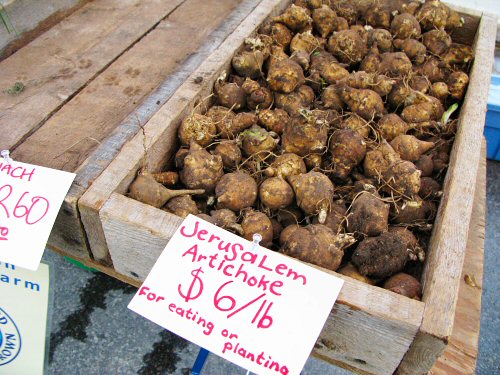
Heavily overcast, downright chilly, with rain threatening at any moment…still, a great first day at the market! In all the excitement, I forgot to take a picture of the stand as it was when we started, it looked good for a tiny spread of three trays… We sold out of mesclun and spinach in a couple of hours, while the Jerusalem artichoke, a veg that like as not had NEVER before been seen at this market, lasted all day but turned out to be a bit of a hit, with maybe 10lbs (4.5kg) sold! A bit of sage, thyme, oregano and chives rounded things out. This early in the season, the vendors were almost all crafts and prepared stuff—baked goods, cheese curd, maple syrup,…—and crafts, plus bedding plants and some fresh produce: storage potatoes, rhubarb, one stand with wild leek… And the traffic wasn’t huge, no surprise, especially with the weather. BUT, chatting with other vendors and regular customers for the first time after the winter was excellent! Really, connecting with people through fresh food at the farmers’ market makes tiny farming all make sense to me…
Free-range chicken
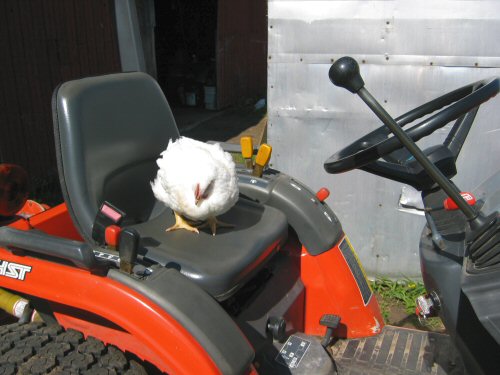
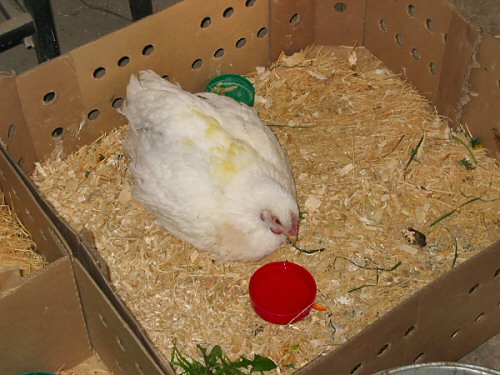
Guest post by Shannon: This is our pet chicken who is named Colonel Saunders. He almost died in the chicken house a couple days ago so we rescued him. He’s very dramatic and plays dead (but not on demand). He’s very chill and doesn’t give us any problems. Mike thinks the colonel has some brain damage due to a recent stroke but I think he’s smart. He gets to live on his own, with lots of space, we feed him whenever he asks (by tapping incessantly on his food dish), and he hangs out with us while we work. I dyed his top feathers yellow with dandelion flowers so we could tell him apart from the rest.
First harvest 2008!
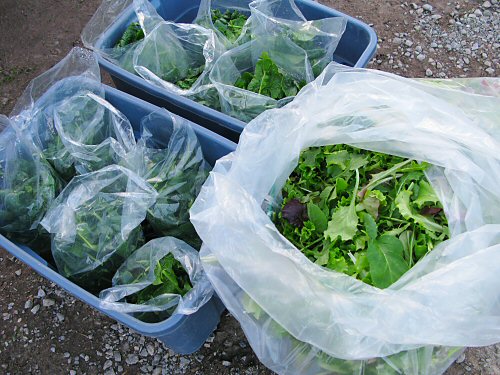
Tomorrow’s farmers’ market, the third of the season, will be the my first. This is the usual timing, although I made it on the second market day last year (our market starts on the first Saturday of May). The earliest harvest for field crops will probably be all-lettuce mesclun in a couple of weeks. But I do have the mesclun in the unheated greenhouse, a small quantity grown specifically for getting to the market as early as possible. So, today’s harvest-for-show: around 20 lbs (9kg) of lettuces-and-arugula mesclun. Not much. But, we also gathered about 10lbs (4.5kg) of “found” spinach (tasty new growth from spinach that made it to baby-leaf stage last year, overwintered, and started again this spring; green onion was last year’s early market found crop). Spinach and salad mixes are sold by the bag, and weight varies slightly depending on what and when: for this round, it was all 400g bags (just under a pound), around 35 units total. Also, collected an assortment from the herb garden: sage, thyme, oregano and chives. Plus, around 20 lbs (9kg) of Jerusalem artichoke. Enough to for a tiny spread! I love the market, for me, it’s as much part of veggie gardening as anything that happens in the field, certainly not a tacked on “business” end… Although cold, rainy weather is in the forecast, people always come out, and tomorrow should be fun!
Not THAT cold…
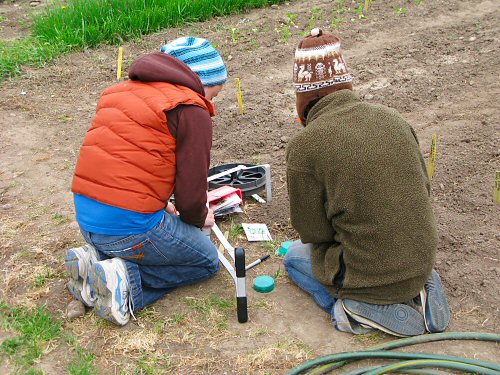
It’s not really as cold as the picture might make it look, but May continues to be an overall chilly one. The hats and extra layers are more a personal preference, but I’ve been wearing a lined flannel workshirt over my regular clothes much of the time. Here, as Lynn and Shannon sort seed for numerous smaller plantings in the herb garden, it’s about 60°F (15°C), cloudy and the kinda damp that can give you a shiver if you’re not a little bundled up. Shannon, sporting an illustrated, ear-flapped cap brought from her travels (it gets cold, especially at higher altitudes, even near the equator), has been back in Canada for less than a month after spending two years on farms in Central and South America, and is still getting used to the local weather. Lynn, in hoodie, vest and classic Canadian cold-weather headgear, was just…chilly! The slowdown in both crop and weed growth from the cold is quite noticeable, still, things are definitely moving along now… Weed watch, and the start of serious WEEDING, is on…
Photo shoot!
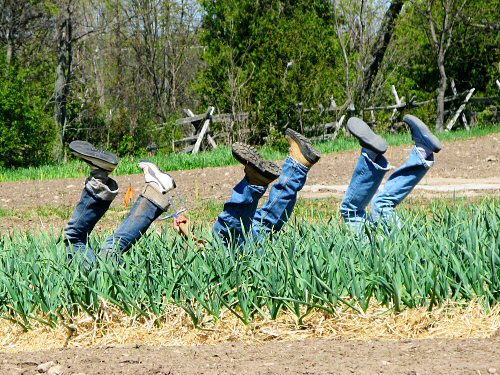
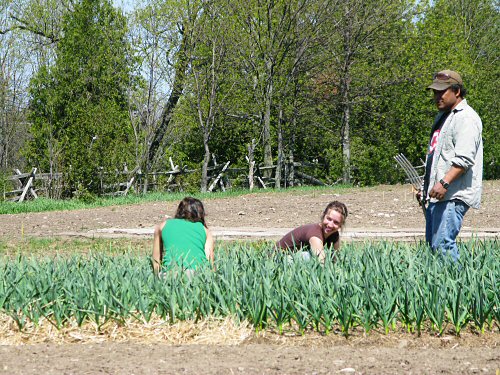
What a funny thing: an instant photo shoot in the field! A few days ago, I (reluctantly) did an interesting-people-in-the-community interview/profile for one of the local newspapers, and early today, I got an email asking for a photo, or the columnist could come out and snap one. They were on a same-day deadline. I said I’d send something along in a couple of hours. Shannon (who’s here every day till June) was working with Raechelle, here on her day-a-week, so I asked them to come up with the photo concept, location, and do the, uh, art/set direction—anything but a typical, kinda impersonal shot of a guy with a field in the background. Karen (Bob’s partner) had dropped by in a wheelchair, her first time at the farm in weeks since breaking her leg. She takes nice pics, so I asked her if she’d do the shoot, and wheeled her into the field with my camera. The concept was: S and R would pretend to mulch the garlic (the mulching’s done, but it’s the only really visible crop in the field), and I’d be around, holding a…well, digging fork (closest thing to a pitchfork, I guess). Anyhow, Karen snapped away, and for an alternate they came up with feet in the air. We emailed both, with a tighter cropping on the top one so it’s about square, with the left chopped out. I found it quite hilarious, because in a past life, I’ve attended and organized “real,” sometimes ridiculously expensive, studio and location photo shoots, with creative meetings, stylists, props, shooting permits and cops detouring traffic, the whole bit. Recreating all the basic parts in an hour or so, in the field, with whoever was around, was great! Devolution on the tiny farm… :) I wonder which one they’ll pick… (Guest photos by Karen.)
