
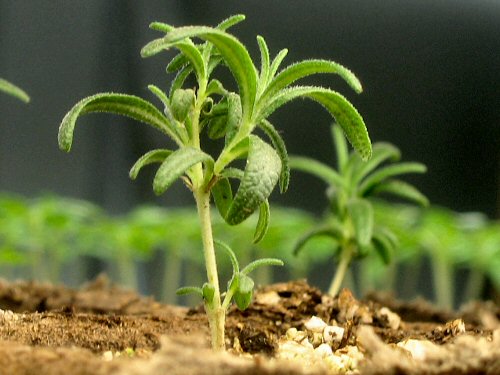
The little gamble on propagating rosemary from frail cuttings paid off at 20%. Out of about 40 starts, eight took root, this without any sort of rooting compound. I put them in 3″ peat pots yesterday. They’re headed for the summer herb garden.
First direct seeding of the year!
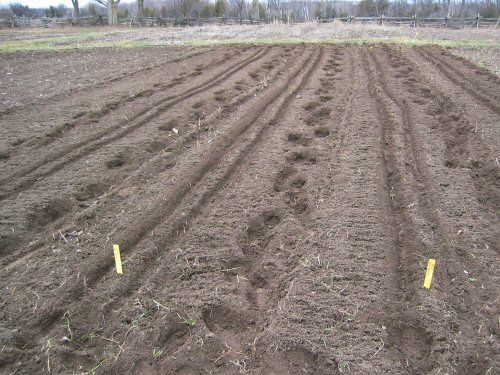
O the excitement and satisfaction. The first 400′ of snap peas (Sugar Ann) are in! This is the first seed to hit the field this year!!
It’s a low-risk gamble for two-three extra early bushels for the market. With over a week of cold days, subzero nights and even snow ahead till mid-month, the peas may germinate unevenly, and there’s little more annoying and unproductive than picking a not-dense-enough pea planting (you pick forever to get relatively little).
Last year, I seeded out this early with two varieties, and neither worked out as well as the next seeding 10 days later.
Here you see the results of my current bed marking technique: using a 100′ reel-type measuring tape, I mark the path centers on both ends with a label stake, walk ’em out, and pull up the stakes. Presto!
These beds are 4-1/2′ wide. The spacing between the double rows is a little wide to what I usually do (4-5″), but the freshly tilled soil made maneuvering the Earthway seeder close to the first row difficult (tight double rows for bush peas let the plants support each other and you don’t have to weed between).
It’ll work out! Delicious edible-pod peas in 60 days?!
Chives
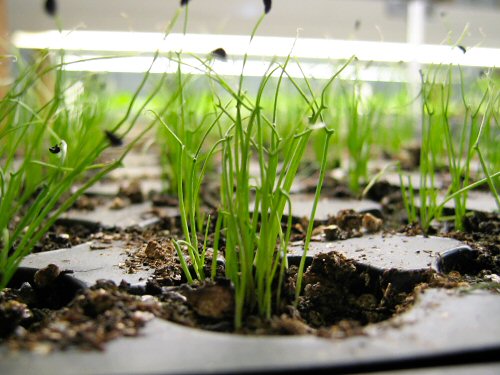
More tiny greenery from the trays! Chives are doing well, they’ve already been out in the sun and wind for a few days to toughen them up, and will be heading to the greenhouse soon to make way for others under the lights. Also in the herb collection this year: sage, parsley, thyme, rosemary, cilantro, dill, oregano, basil, and possibly fennel, marjoram and savory.
CSA shares…
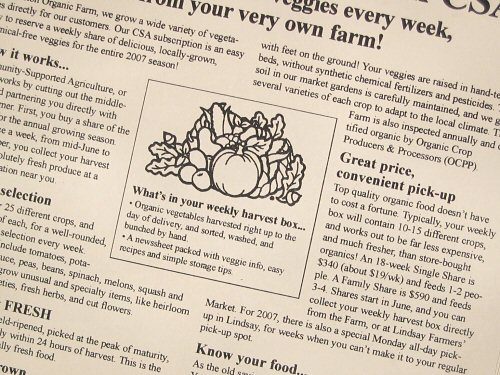
This single printed sheet is the other farming thing on my mind this time of year. It’s the CSA sign-up form, filled in by new members and past shareholders renewing their stake in the harvest. I don’t do any advertising, just word of mouth and leaving off sheets at a handful of local spots. The goal is to have near 100% renewals, but we’re still expanding, aiming for 50 shareholders this season. I don’t think of this as the “business” end. Like the farm stand and farmers’ market stall, it’s another equal part of tiny farming, same as planting, cultivating, harvesting, sharing, eating. By buying into the whole season in advance, and picking up their weekly shares, CSA members become as much a part of growing veggies as if they were out weeding in the field (which some of them are planning to do as well this year).
Horse back in action…

The Troy-Bilt Horse walking rototiller is back in action for the first day of tilling in the field. I prepped a 50’x50′ section for snap peas. The Horse is noisy and uses a fair (though not unreasonable) share of gas, but it’s also a very handy machine for larger areas (in fact, I would’ve used the rototiller on the tractor, but the ground is still too wet to take the weight). All things in moderation on the way to becoming a fully-rounded, taking-it-slow, hand-laboring farmer! (Gear note: This Horse is c. 1995, from the original Troy-Bilt line, before the company was gobbled up by a bigger one and the construction got more lightweight. I bought it used, at half the price of new, and in near mint condition. It should last a long, long time—in my first farming year, I borrowed a rusty 30-year-old Horse that did just fine.)
Floating row cover!
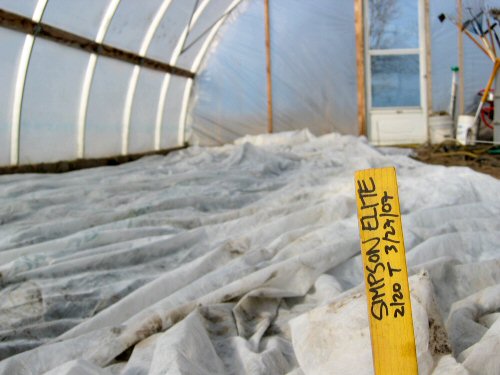
It’s around 8:30 in the morning and I’m about to uncover the early lettuce. Floating row cover is a very lightweight spunbonded polyester, light enough not to crush seedlings when laid down directly on top. It lets in water and sunlight, and also retains heat, to differing degrees depending on weight. This one is medium weight, my all-purpose cover. It transmits 85% of sunlight and keeps the temperature 3-4°F warmer when the surrounding air is around zero. Over the last couple of nights, the greenhouse low was 19°F (-7°C)—the lettuce can take a little freezing, and would probably manage without cover. Still, every edge helps, and this one’s easy. Floating row cover is a common sight around here throughout the year, it’s my main organic alternative to pesticides (it keeps out certain flying insects on certain crops at certain critical times) and also gives you an edge in getting things out early and keeping them out late. Beat that frost!
True leaves
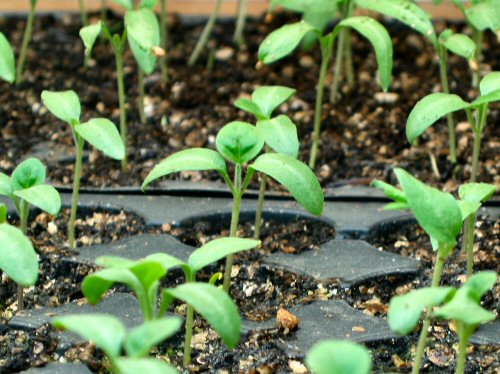
True leaves are starting to appear in the first trays of eggplant and peppers (that’s Dusky, and Vittoria behind, both eggplant). It’s around 20 days from seeding. Rapid growth is on the way!