
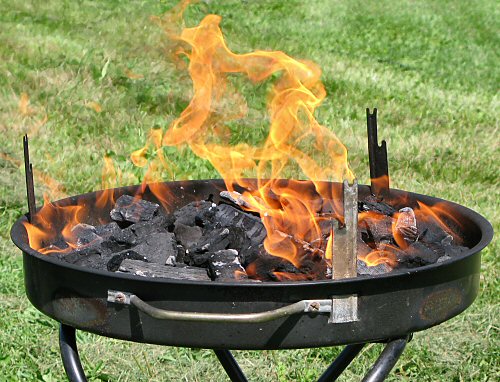
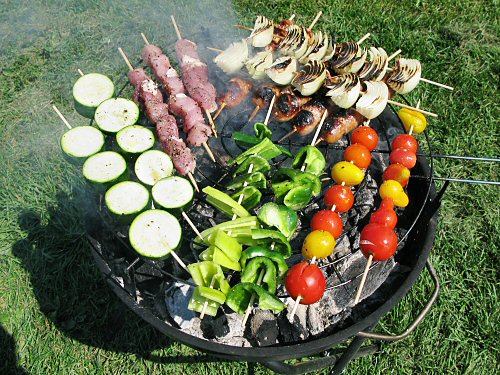
It took a while, but I finally dragged out the classic no-frills barbecue and continued the simpler BBQ approach started last season. This time around, I stumbled onto lump charcoal, which is pure wood carbon, and a step back from additive-rich preformed briquettes (I’m not all that serious about this, I just grabbed a bag and…discovered lump!). And so, on to the basic, quick-lunch-in-the-field experience, with garden veggies plus meat that the local independent butcher declares to be “local” (at least, from around us here in the province of Ontario). Chicken, pork, and several types of pork sausage, plus zucchini, onion, sweet and hot peppers, and cherry tomatoes from the garden. Also tossed rosemary branches right onto the coals for some aromatic smoke—between the breeze and the open grill, it didn’t do much flavoring, but it smelled nice! Cooking time is made easy by putting only one type of meat or veg per skewer—just slide off what you want and combine in your mouth! Simple and…tasty!!
Fall crops
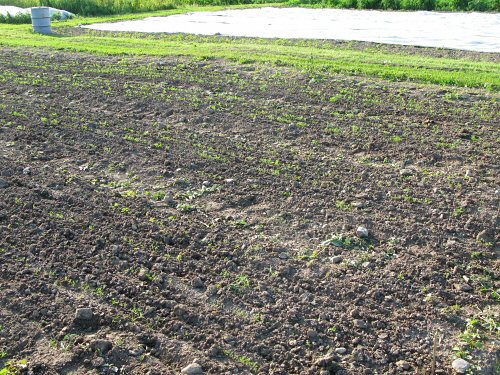
Not much to look at, yet, but the last plantings of 50-day-plus fall crops are doing fine. Here, carrots and, protected from flea beetles by floating row cover, one of two sections of brassicas, including broccoli, cauliflower and kale. There’s a bit of timing risk here, depending on the weather, if growing goes slow, they might not make it to maturity in time for market. But the sun’s been shining for a couple of days now, and the long range forecast is for more of the same. If all goes well, these will be ready for harvest through October!
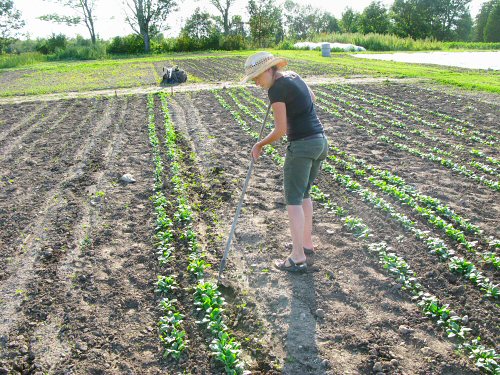
And the summer-seeded spinach couldn’t be doing better. There are two plantings, the first on July 22, and the second (left of the photo) a couple of weeks later. Here, Lynn hoes the first set: in this summer’s wet, cooler, cloudier conditions, germination was absolutely solid, as good as or better than regular spring seedings. Fall spinach has never been this good, by far. Excellent!
Supply run…
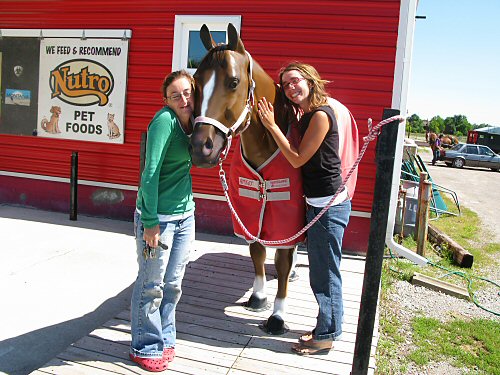
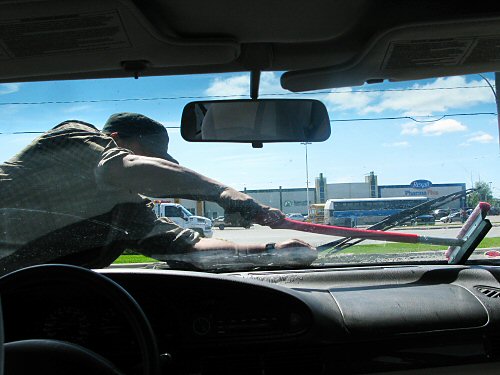
Not a typical farm day in the field, instead, a fairly extended supply run to town: chicken feed, groceries, diesel…ice cream… Moving through the last half of summer, the workload eases up a bit, and you can afford to get a little leisurely. So, three of us headed in…an UNTHINKABLE use of people power any time earlier in the season. Above, at the gas bar across from our local strip of box stores, I’m actually having fun squeegeeing the windshield, just like in the movies (I’m a non-driver, hardly used a gas pump, and maybe never washed a windshield before…). Below, Lynn and Raechelle pose with the wooden horse in front of the feed store. If you look closely down the side of the building, you can see a Mennonite horse and buggy loading up beside a car. Everybody needs feed! Curiously, today was one of those trips to town where I really felt the fine line between being a “new farmer” and…not. As long as you’re surrounded by the garden and a lot of WORK, it’s easy to see a clear course. But when you’re away from your field, you can see how precarious tiny farming really is (at least, for now, in North America). We’re still so reliant on the existing system, for gas, machinery, supplies, even a lot of our year-round food, on taken-for-granted “utilities” like electricity, phone, Internet, and, of course, on a reasonably functional economy that allows others to drive to the farmers’ market or farm to buy our produce. Hmmm… It makes me wonder, how much of my tiny farming simply comes from what I do every day, and how much is a fundamentally changed outlook from my city days, a new state of mind? What would I be now, if I stopped doing this? What a puzzle! ;) Anyhow, as for the weather, it was all beautiful sunshine for this laid-back day… (Windshield photo by Raechelle)
Poor tomatoes
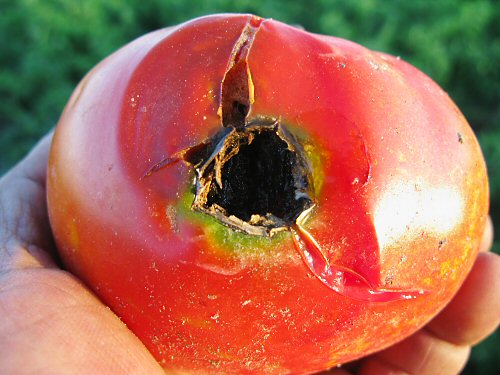
Checking out the tomatoes’ progress is definitely the least happy task of this season. After removing most of the hail-damaged fruit, there’s not that much left, new growth is slow, and what’s there is taking its time to ripen. Also, with the summer’s abundance of water, taste and texture can run to the mushy, and toms are more likely to split. Here, double damage: a hail-nicked spot has grown and rotted, and the tom has split as well. Gruesome! On the upside, the weather has finally changed, with warm, sunny days forecast for weeks to come. It’s about time!
Bean watch
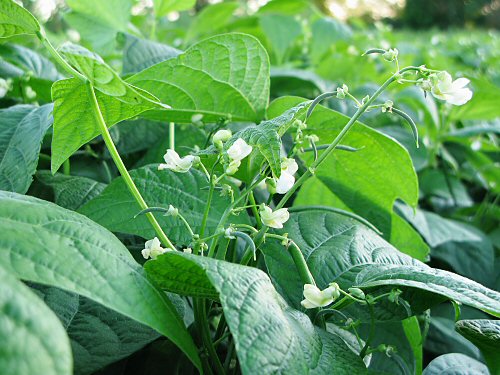
The second bean planting is setting and sizing up nicely, but we didn’t have beans at the farmers’ market today, after a good first and second picking of the first crop over the last two weeks. With succession planting, snap beans are usually a continuous harvest once they start, right through to a killing frost (usually in September, but with row cover, now extended into October in the last couple of years—more of that global warming, I guess). This year, cloudy weather slowed growth and the timing didn’t work out for continuity. There are a couple of ways to insure non-stop beans. Planting really frequently doesn’t work, because if the plantings are too close together, like, only a week or two apart, any two are likely to sync up, either by germinating at different speeds, or catching up during growth (both due to weather), and you’ll have too much one week, and not enough the next. Over-planting is the easiest way to go: if you have a lot ready at once, usually you can hold in the field a week past optimum harvest time and still have good quality, that is, nothing too oversize or woody. Of course, harvesting when ready, then storing in a cooler is the surest way: beans do quite well in cool storage, a good week in the most casual cooler conditions. But of course, there’s fresh and there’s FRESH!
Post-harvest aftermath
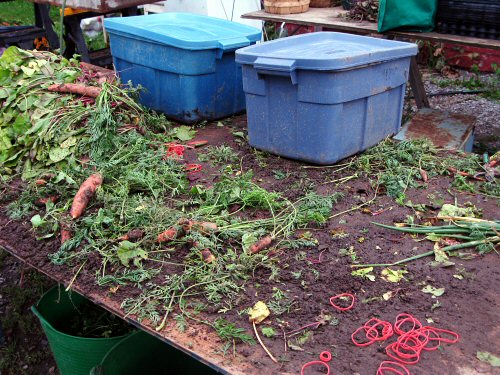
Sorting and packing after harvest—post-harvest processing!—is in good part a wet job, made a lot messier in rainy weather when root crops come in with a load of mud attached. Once again this season, the main work surface for sorting is a 4’x8′ sheet of plywood set on sawhorses. Actually, we added a second table, so now there are…two. Here, we’ve just finished sorting and bundling carrots, which then went for a rinse on the screen table. Sometimes, rinsing is done first, depending mostly on who’s doing what and what else is going on. In the closed blue bins, which hold a little over a bushel each, are carrots already bundled, rinsed and ready to go. This week, there are four bins of carrots, around 160 lbs (73kg). The residue is sorted out: here, damaged carrots will probably be topped and kept for house use, and the greens (there are some beet greens as well at the end of the table) are fed to the goats, some to the chickens, and the rest onto the compost pile. Then the table is hosed off. Couldn’t be simpler or wetter!
Scrabbling for potatoes
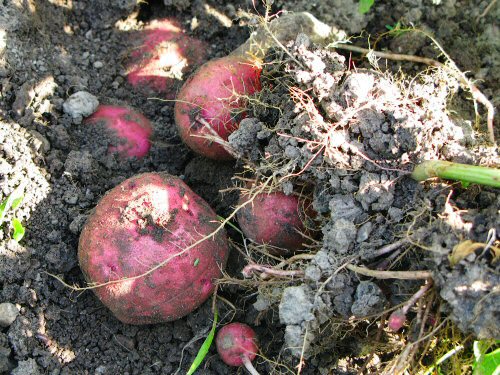
Thursdays are potato harvest days. Without a walk-in cooler, the main weekly harvest for CSA and Saturday farmers’ market is mostly confined to Fridays, with potatoes being one of the few crops that can be done a day or two ahead. Towards the end of the season, we dig up all the remaining spuds in one shot, but until then, it’s easier to go weekly. And since I don’t sell potatoes in bulk, curing them for storage is not an issue. It’s a tiny harvest, and the method of choice goes with it. Simply pull up each plant—they’re at 12″ (30cm) spacing—and scrabble around! Fingers work great. I used to use a digging fork, but that’s more work than it’s worth, and potatoes often get skewered. By hand, it takes 20-30 minutes per bushel (about 50lbs/23kg), really fast this year with quite huge potatoes after all the rain, and sometimes stretching to maybe 40 minutes if they’re small and the ground is drier and harder (this’ll happen in a really dry year, where potatoes get little or no irrigation). When the ground is dry, especially in clayey soil like ours that can get really hard, a hand tool like a trowel or tined cultivator can be good to break things up here and there after pulling. I kind of like how primitive the method is, and most people who try it REALLY seem to enjoy it. For the 2-3 bushels we need most weeks, it’s quick and effective! The variety here is Chieftain…