
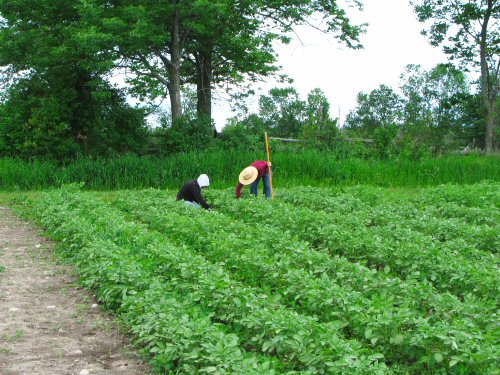
A cool, gray, peaceful day of WEEDING. Lynn and Raechelle combine hoeing and basic hand weeding to pull up a nice mix of pigweed and lamb’s quarters, with a little mallow and orchard grass for variety. I did paths with the wheel hoe. At the same time, we checked for Colorado potato beetle eggs (orange clusters on the undersides of leaves)—they’ve been here for a week or more, but so far not in troublesome numbers. It’s slow work, but satisfying in the end. The potatoes are growing abundantly with all of the moisture (which isn’t a problem so far), so much of what’s weeded now won’t be coming back under the expanding leaf cover. That’s nice.
Measuring peak oil by the can
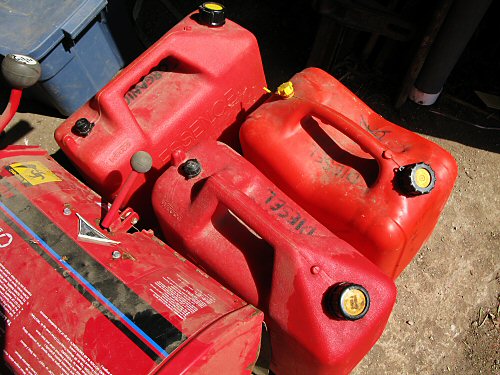
This tiny farm’s entire direct connection with the world of oil is simple: six red, 20-liter gas cans, three for gasoline, three for diesel. It’s a really stark way to watch spiralling gas prices and the so far bubbling-under peak oil panic, made more so for me because I don’t drive (never bothered to get a license), and I’ve lived 100% in big city cores until the farm—North America’s deep-set gas station culture had been a spectator thing for me. And now, gas is suddenly connected in a very straight-flowing line, from pump to a handful of tiny farming tools that perform clear and specific tasks. On the gas side, there’s the riding mower (mowing, mulch collecting, hauling stuff in trailer, used a lot), a walking rototiller (only moderately used since the wheel hoe last year), the pond irrigation pump (with so much RAIN, not used at all this year!), a weed eater (used only moderately), and another weed eater converted into a mini-cultivator (seldom used). On diesel: the Kubota compact tractor (rototilling, moving stuff with the front-end loader, quite used). That’s it! I filled three cans in mid-April, two diesel, one gas (above), today, two months later and all out, I filled two more, one of each. In my five years of tiny farm experience, cost has gone from $15 a can of gas (and quite a bit less for diesel), to about $30-35 a can (with diesel more expensive?!). It’s worrisome, but I don’t get too agitated, probably because the containers are so few and so relatively SMALL. But every time I’m tilling on the Kubota, or driving the length of the field loaded down with harvest and gear, I’m increasingly, acutely aware of the amount of work that comes out of a little gas, and what the manual labor alternative would be like. It’s like a little calculator program running in the back of my mind: how long would it take me to do this by hand? How about with help? What would it be like to do without? I feel great satisfaction when the six cans are filled and set in the drive shed all in a row: supplied for…a while! Of course, gas figures big in getting to the market and getting to town, and I pay my share there (I have an arrangement with Bob for the market season, and for the rest, I get lifts when others are going where I need to). And I also never forget how all those store shelves get filled. And how people get to market, pick up CSA shares, get to the farm. And I’ve started calculating highway mileage to reimburse everyone who volunteers here for their travel. Not to mention all the flying and driving it takes WWOOFers to get here from far and wide. And so on… Oil is everywhere, not easy to avoid or make sense of. At this point, for me, it still comes back to the cans: the color of oil is RED… :)
Weird weather day
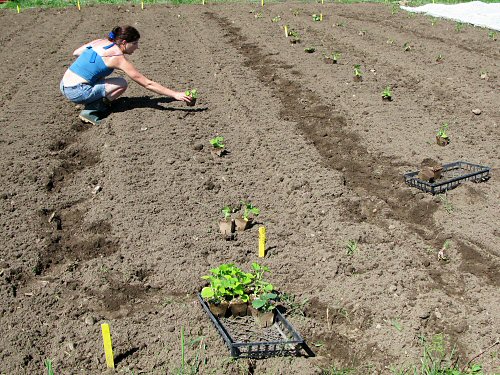
This was one of the strangest single days for weather that I can remember. Transplanting more squash in the morning—Michelle is checking out working on the farm one day a week—it was beautifully sunny, with a nice breeze. Around mid-morning, suddenly, it shifted to humid and sticky. I headed in to change into shorts, but before I’d even walked out of the field, the humidity started fading again, so I didn’t bother. A bit later, covering the squash with row cover, a nice breeze from the north, enough to easily float the cover, casually shifted 180°, coming from the south, in the 20 minutes it took to lay down the cover and unfurl the next. Early afternoon, the wind picked up, and within half an hour what had been a largely clear sky had totally clouded over, then, pounding rain and HAIL (not too big, only some leaves got battered, no smashed plants, you can used the bottlecap below for scale). Then back to calm and clear for a couple of hours. Then heavy clouds again, and a massive wind storm that tore some branches off of trees. Then back to…sunny. As extreme as this day’s been, two or three quite drastic changes in a single day have been happening quite a lot recently. This is our new weather…?

Plastic…fantastic?
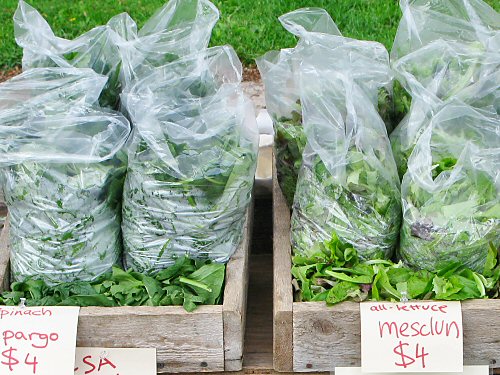
At the market today, greens were finally in great supply, with loads of mesclun and spinach: two giant, clear leaf bags full of each. I went home with quite a bit—no sold out sign this week!—which was great, ’cause I was selling right up to the end. And, as usual, I noticed all of the disposable plastic involved…
Greens, and market/CSA share harvests in general, usually involve lots of PLASTIC BAGS. In the beginning, this didn’t overly concern me on any level, other than that buying bags by the hundreds and thousands was kinda costly. But being on the dispensing side of this steady stream of plastic gradually made me realize how much of it is continuously being tossed out there FOR NO LASTING PURPOSE.
What got to me first wasn’t the environmental issue, but the fact that people were profiting off of this useless mass consumer habit of taking tons of “free” bags at every stop… Don’t like being fooled again and again… This culminated in one way for me about two years ago, when I stopped taking shopping bags for, like, 98% of my store shopping. Last year, I started cutting down on the way I offer shopping bags at the market: instead of automatically grabbing a bag for a customer as I asked if they needed one, I ask in a leading way, kinda eying what they’re carrying already—not surprisingly, with all of the anti-plastic bag attention lately, the majority of people so far this year bring a basket or cart, or fit their purchases into a bag they already have.
I mean, to grow greens, it takes 40-60 days of watching, watering, weeding…and suddenly, in less than 24 hours, they’re harvested, bagged, distributed, and, hopefully, within another 2-3 days, EATEN. And the really useful life of the plastic in a bag of fresh-market greens is more like a very few hours, because once you’ve gotten your greens home, there are many more efficient ways to refrigerate them (like in a nice cotton bag, in a salad spinner, in a big bin,…). But there’s nothing that easily replaces the convenience of plastic for that last little trip between stand and home (a couple of people have asked that everything, greens and all, be tossed loose into their own shopping tote, which is kinda cool and should work no problem, but doesn’t sound too easy to encourage amongst ALL…).
So what am I getting at exactly, besides the OBVIOUS? Well, I guess it’s that plastic is curiously useful stuff, I’m not about to outright REJECT it in all its many handy shapes and forms, but I should learn more about it for a start… More as it unfolds! ;)
More Friday greens…
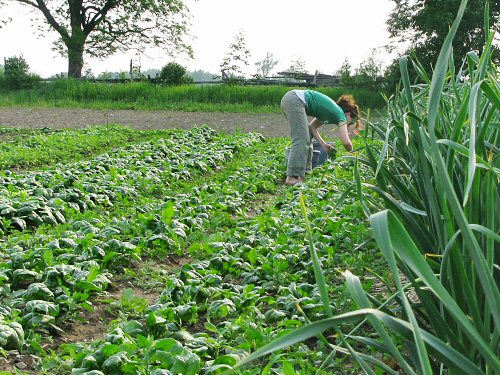
Friday harvest and it’s still all greens: spinach, all-lettuce mesclun, beet greens! Despite the recent heat and ample rain, the overall amount of cloudiness that came with all the rain of the last 40 days has slowed things down quite a bit. It’s still early on, but I’m anticipating next week and the start of CSA shares, when the prospects look to be about the same. Not even RADISHES are growing too quick. Lynn, Erin (harvesting above, right beside the garlic) and Mike were along for a few hours to help out. And there are LOTS of greens for market!! (Guest photo by Lynn)
Outhouse deluxe
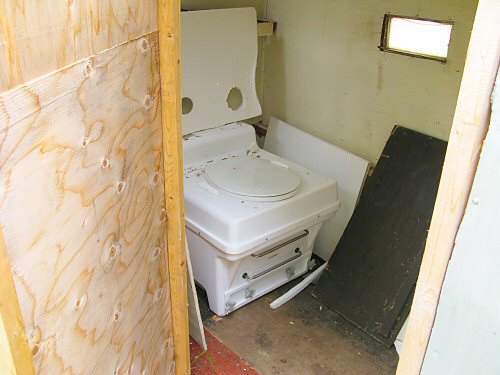
The outhouse updated! This Envirolet composting toilet, the deluxe AC electric model, is possibly the most unusual farm purchase I’ve made so far, mostly because it was quite expensive and I’m not 100% sure why I got it. With a hefty $500 off on special, it was still somewhere around $1,200, which on the tiny farm budget counts as a major purchase (the used John Deere riding mower cost the same, and it does fieldwork!). And considering that you can build a composting toilet for little or no money, from scrap wood… Call it divine inspiration, like: “You must get this toilet”? Anyhow, it’s here, it’s been here since around Feb. 2007 (the special offer was expiring), it hasn’t gone unthought-of or unmentioned,…and it’s finally, slowly, getting installed for this season! The general idea is to have facilities in the field, which is a lot more convenient than heading into the house. Still… These toilets do sound quite amazing: odorless, comfortable, able to compost six months of humanure into a thin layer in a slide-out tray. Models range from no power, to AC/DC (has a fan), to regular AC plug-in (fan plus heater for the coldest days). The more power, the higher capacity, as the fan or fan/heat speed up evaporation: this one is rated for 8 people x 3 “uses” per day. I guess I had visions of LOTS of toilet traffic from the field. And this attractive little waste-handler is quite an inviting intro to personal waste recycling, compared to a hole cut in a board (and you can use these in homes to replace regular flush toilets as well!)… For installation, the original plan was to build an enclosure, but this discarded ice fishing hut came up as a ready-built alternative. Converting it is only a few hours work, but it’s being done in little bits and pieces. First, the rotting door was removed and the frame widened to let the toilet in, the various built-in ice fishing conveniences—bench, shelves—were removed, and some rotting floor replaced. Next step, fitting the toilet’s ventilation pipe through the ceiling. And then, interior decoration! A coat of whitewash for a start… Coming soon!
Sweet potatoes!
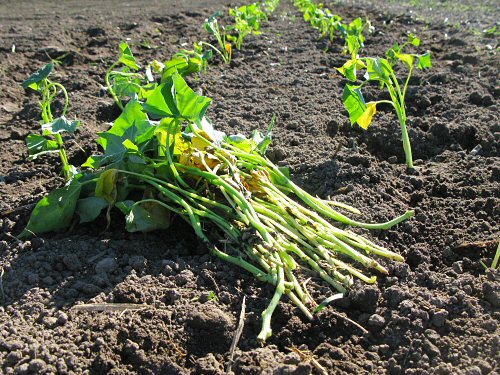
Sweet potatoes are in! They were a last minute addition this year, I was expecting them by the end of May, and then started to write ’em off when I couldn’t get in touch with the grower who was supplying them. But he came through, and they arrived by UPS yesterday, one box with around 1000 slips. Bob P., the sweet potato farmer who sent them, is also here in Ontario, but further south in a microclimate zone near Lake Ontario that’s a lot warmer. Still, they should grow here as well. The variety is Beauregard and they’re started from slips, which are vine cuttings. This is the first crop I’ve started strictly from direct grower-to-grower info, it was great to chat about them on the phone, rather than do the usual new crop…research. And they sound unbelievably trouble-free. Bob’s instructions: stick ’em in the ground with the growing point 2-3″ (5-7.5cm) above the surface, 12″ (30cm) in-row spacing, and as little as 12″ between row, all the way up to 3′ or whatever you like for tractor transplanting and cultivation. That’s it! No watering in, no watering except in extreme drought conditions. Just…weed. Hmmm… I’ll look into them more, but for now, that’s what I did, and there they are. The leaves will probably die off, it’s new rooting that should happen. One mild concern: sweet potato grows best in loose, sandy soil, where here the heavier clay loam is being well-compressed by lots and lots of at times pounding rain. Also, the slips are apparently supposed to be planted within 7 days of cutting, and it’s about a day after that. We’ll see. In 100 days, sweet potatoes? ;)