
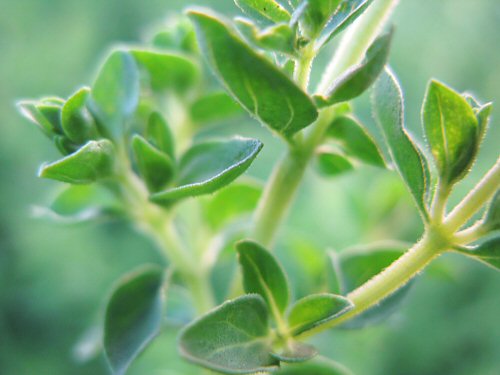
A solo weeding day for me. There’s lots of mostly PIGWEED, shooting up faster than the crops, loving the rain and bursts of heat, with or without sunshine. So, a photo of WEEDS, or a random, up-close look at…oregano? I went for the oregano, which is doing great after thinning the three-year-old patch earlier this year…
Tiny farming: it’s a garden party!?
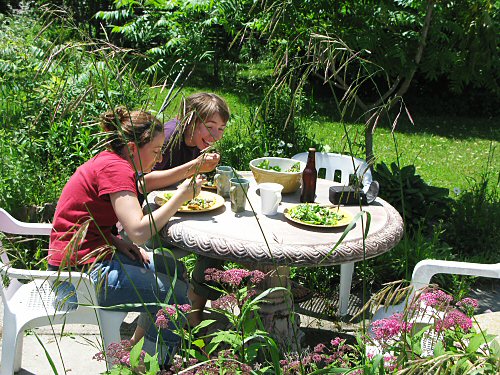
For the month of June, after Shannon, who’d been in the field just about every day in May, and while waiting for Lynn to start full-time for the rest of the season (July 1st!), I’ve been back working in solo mode, which has been, surprisingly to me, a little strange and…unfamiliar. Right now, there are several great people sharing the tiny farm experience (TFE ;) each week, but coming on single days. Here, with Lynn and Raechelle (Tuesdays!), we take an extended Endless Salad lunch break in the backyard. It’s as relaxed and fun as it looks. This, I think, is how it SHOULD BE, a laid back mix of fieldwork and practical leisure. It’s a lot different than the 10-12-hour, garden-obsessed days of the first 3-4 start-up years, when I worked largely alone. After working with Conall right through the season last year, I realized that my original solo mission, one-farmer-one-field mode had…changed. Evolved. To continue to grow on this tiny farm, it seems I’ve taken the path that needs not more production acreage or machinery or straight, head-down hours of labor, but simply more happily committed PEOPLE. Hmmm… Not a brand new discovery, but driven home over the last month. An interesting twist on tiny!
Tiny harvest!
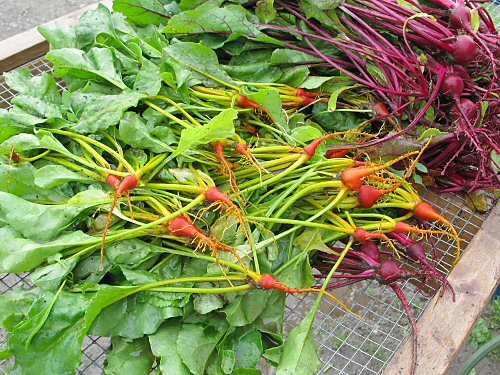
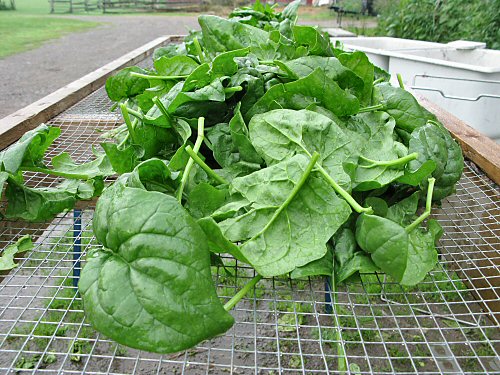
Spent the early morning harvesting a few CSA shares for a Monday drop-off. This is the first week of shares, and they’re still small, mainly greens… There are many tiny farming routines, things you’d probably never do in a bigger operation, that I find extremely relaxing and fun: the final rinsing and putting together of a handful of shares is one of them (it’s not really economical to separately harvest and drop off less than 10 shares or so, this is an…exception). There’s something deeply satisfying about this final post-harvest step, with the veggies together at their finest, the memory of the different quick individual harvests—picking, cutting, pulling—still fresh, that’s…cool! The spinach (above) was quickly dunked in cold well water to rinse off dirt splashed up from recent rain, then allowed to drip dry for a bit on the screen table.
Picked two types of beet greens, Golden Detroit and Scarlet Supreme. The stems are a little long on these—it all depends on the density of the rows, the weather, the harvest timing, leaf size is the luck of the draw since these are really thinnings, they’re not being grown just for the greens. Still young and tender, the baby beets and all can be cooked up, or the leaves used raw in salad (or as a salad!). Really tasty…
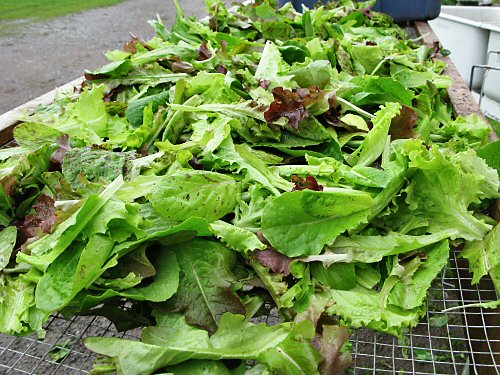
And mesclun, of course. This all-lettuce salad mix is a staple crop this year as usual, always on my mind! This cut’s nice and clean! Unrinsed—I let the morning dew dry off a bit on the screen table… More simple pleasures for the simple of mind! ;)
A simple (chicken!) sandwich
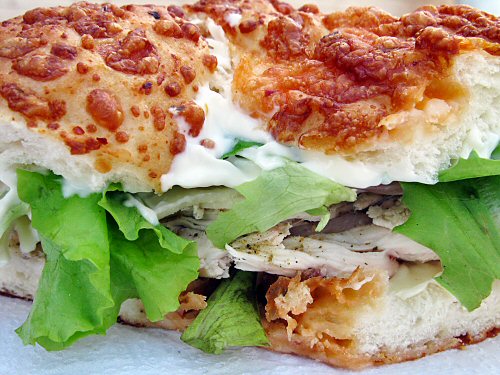
Roasted a White Rock chicken last night, today, got a Spicy Cheese Loaf from Fran, the baker beside me at the farmers’ market. (The market day went well, it was the first day of CSA shares: mesclun, spinach, radishes, garlic scapes, beet greens—it’s still early.) The chicken and the bread naturally organized themselves into a late afternoon simple sandwich…
Looking at it before the first bite, I realized that I’ve been thinking about FOOD a lot more recently. Not exactly my own diet, but on a more personal level than as a local veggie grower, probably something to do with the Endless Salad, more communal cooking and eating lately…
Part of the running stream of thought has to do with nutrition, what I know about it, how much I want to and need to explore further. I mean, do I really have any sort of basic IDEA of what to eat, beyond “lots of veggies, little meat, drink lots of water,” vague general guidelines like that? Do I NEED a plan? Should I RESEARCH? Consult with a nutritionist or a naturopathic doctor (I’ve been considering visiting an ND for an initial workup)? Sheesh, more RULES! All that is really clear is that most people around here (a “developed nation”) don’t know much practical stuff about the food they eat, me included.
The other part is about food quality, and local food. The one thing I’m quite sure of is that it feels way better to eat fresh food that you’ve grown, and to know where the rest comes from and what’s in it, and that wasn’t at all painful to discover. So, I examined this pretty local sandwich. The cheese bread listed the ingredients: flour, water, cheese, sugar, milk, vegetable oil, butter, yeast, dried chili peppers, salt. The chicken was raised here on the farm from two weeks old, fed mainly Purina (Cargill) starter and grower feed (nutritional content in percentages, contact the manufacturer for the actual INGREDIENTS), with some greens from the garden. The lettuce is from the garden. I poured on home-made vinaigrette dressing: extra virgin olive oil from Italy, pink salt from the Himalayas, fresh-ground black pepper, vinegar, Tabasco pepper sauce from…the store. The mayonnaise is from Kraft, it was in the fridge, the bottle says it’s “real.” It’s all ingredients within ingredients… I’m planning to make my own mayo, with eggs from the farm and oil from…Italy. Should I care where the flour in the bread came from? The cheese? The chili peppers? And what about the “vegetable oil,” what’s up with that? Should I make my own cheese and bake my own bread? When do I start looking around for organic chicken feed, how IMPORTANT is that, what’s the priority, how much can I afford to PAY?
I don’t have any neat point to sum up with here, I’m just being a literalist and looking at what I eat. When you start to question your basic eating habits in a very primitive way, they may not hold up to much scrutiny, and that’s unsettling. I’m curious. The story unfolds…
Definitely ready to lay
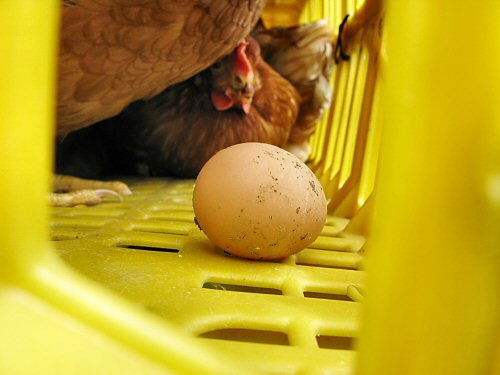
It’s back-to-back chicken stories, from chickens to the slaughter to chickens ready to lay! The hatchery moved up the scheduled delivery of the 20-week-old Shaver Red Sex-Links by three days, and today was it. These girls are cool, and ready to go, dropping a couple of eggs before they were even out of their crates…
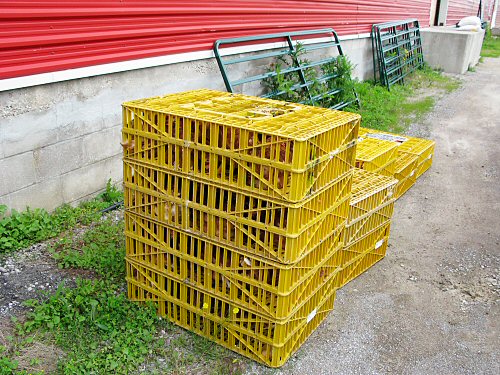
At the feed store in town, the crates were casually stacked near the loading dock (and you can see MORE BAGS OF FEED waiting to be picked up, these are 88lb sacks of layer mash). Our 25 were in two crates.
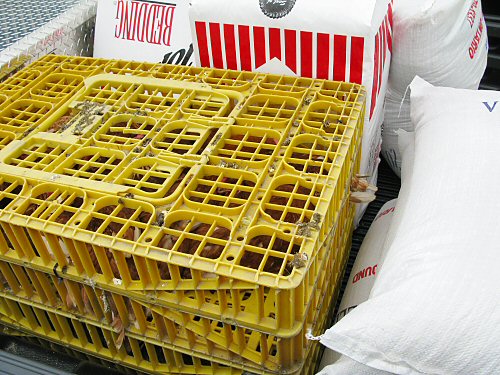
Like any other trip to town, on this chicken run, I ended up with lots of extra stuff besides chickens: several blocks of compressed shavings, the layer feed, and a sack of scratch for the Frey’s dual purpose.
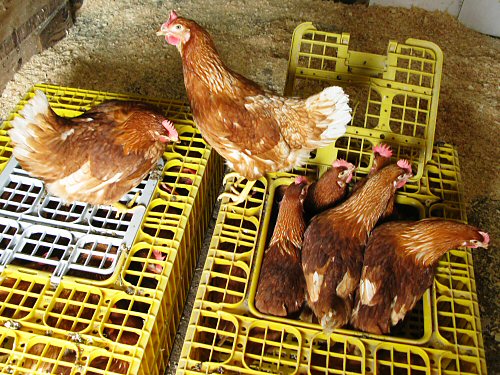
Back at the farm, I opened one crate at a time and let them come out on their own to explore their side of the Chickenhouse. The young ladies seemed happy, unflustered, in fine feather… Within a few hours, I collected the first three, still tiny, warm, fresh eggs! Felt great!
Chickens to the slaughter
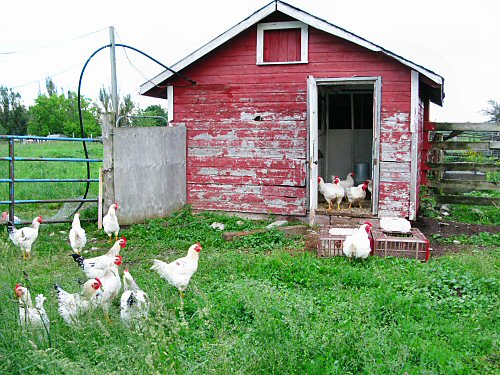
Raising your first chickens, killing them, and eating them has gotta rank up there with other Firsts worth a little attention. Now, I’m at least part of the way there: the killing this time was done behind closed doors, with me on the outside—chicken PROCESSING. Still, first enough to be worth a few photos… I’d been cutting it close with booking a processing day for the White Rocks, the local processor is known to get solidly booked for weeks. I finally called yesterday, looking for a date in two weeks, and was told there was also a cancellation for tomorrow (today!). I checked out the WRs, and, man, how could I imagine them getting any bigger (I think I was mesmerized, waiting for them to explode)? So I called back and booked. We drove over last night to pick up crates (20 minutes each way), then it was up at 5:30 this morning to load ’em. As soon as I opened the door, all of the Frey’s dual purpose darted out immediately, as usual, while the WRs, who mostly go nowhere, stayed in: it was kinda fitting that the Frey’s stood around in unfenced-in freedom, ready to run (and they would’ve!), while the WRs kinda dumbly looked out at their crates (above).
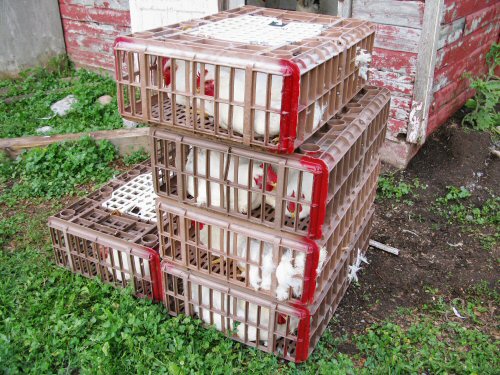
Five to a crate, 25 in all, 30 minutes or so to loaded…no need to chase down these lumbering beasts (while I was packing, most of the Frey’s figured out no good was afoot and entirely disappeared around the other side of the chickenhouse, something they’d never done before, while a couple stayed to watch).
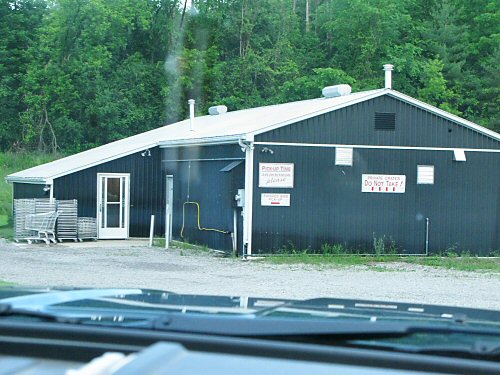
The processor is on a farm, a low building where birds go in live on one side, and come out the other, cleaned and chilled, weighed and government-inspected, ready to go…
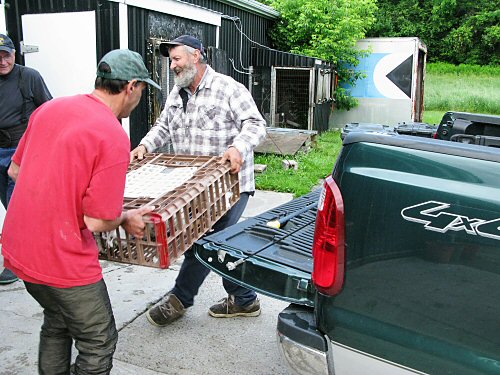
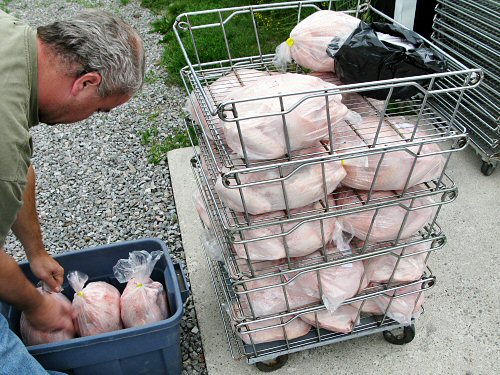
Bob and a processing guy unload. It’s 6:45am. The paperwork is quick and painless, I didn’t even have to write or sign anything. The only sign of bureaucracy in action is the required chicken purchase number, a serial number that’s on the form that you fill out when purchasing the chicks. And the on-premises government inspector popped out and did a little of his own paperwork. Other than that, just processing choices. For a few cents more (like 75-85), you can have the chickens halved and put in separate bags, or halved or quartered in the same bag. We got 10 halved and separated, for when cooking a whole fat chicken would be a little too much. Modern conveniences?! :) I also chose to get the organs back (in the black bag; below).
Eleven hours later, it’s 5:30pm and we’re back. Matthew helps pack the big birds for the trip home and into the freezer. Average weight is around 8lbs (3.6kg), where the Frey’s are maybe barely 3lbs. Hmmm… Not the most satisfying little adventure, with three 40-minute round trip drives, and the chickens disappearing through yet another middleman, reappearing neatly packaged for $3 more… With the processing fee tacked on for good measure, these are EXPENSIVE chickens, but I’ll do the math, and review the overall, somewhat unsettling White Rock Experience…later. On the other hand, you can’t beat the results: a lotta REALLY plump chickens! Next up in Meat Birds, Take 1: waiting for the free-ranging Frey’s to bulk up, and THEN it’ll be a fully DIY field-to-table chicken dinner!
Checking under row cover
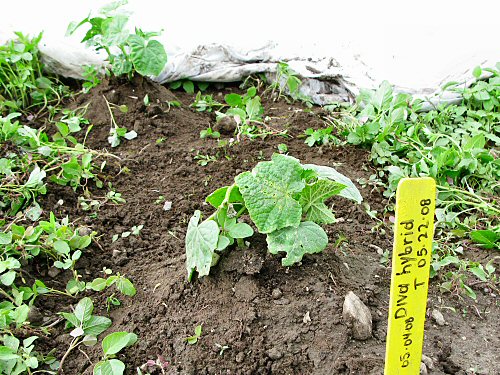
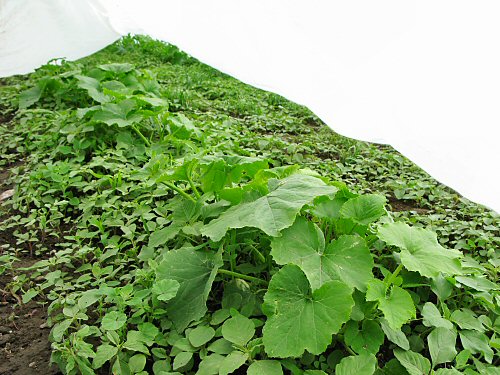
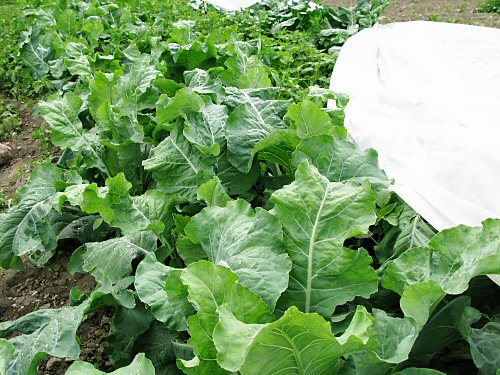
Three weeks ago, it was floating row cover everywhere. So, what was it worth? Today, I checked things out. Overall, growth has been startlingly slow, due to the lack of sun. This is really noticeable in the summer squash (above), which could be huge at this point, but…aren’t. Under cover, these zucchini (I didn’t check the variety) are doing fine, no cucumber beetle damage, but of course, weeds are doing fine as well: unmolested under there, pigweed runs rampant. I’ll take the cover off here in another week or so, and then there’ll be a whole lotta weeding to do… I removed the cover from the first beds of cauliflower (Snow Crown) and broccoli (below), they’re big enough to take a little flea beetle munching. The leaves have shaded out much of the potential weed action in the beds, but you can see a nice collection in the path (top center, where the row cover ends). The plants look untouched, although the flea beetles managed to get under and at the kale and collards, (they’re out of sight just to the left)—I left them covered, back in a week. If there’s any doubt about what the FBs will do, just check the radishes, which grow MUCH faster than these guys and can survive the damage…
Back with the cucurbits, the cucumbers are the most noticeably slow: after a month, they’re hardly bigger than the transplants they started as (hope it’s all going into the roots!)… I’ve cleared away the weeds between a couple of the plants, beetle damage is minimal (they tend to get in at the ends of rows, where the cover can get blown up by the wind), but there are weeds everywhere. Cover goes back on here for a while. Weird stunting weather and floating row cover: not the most peaceful and inspiring natural garden combo, but it should all straighten out in a bit… ;)
