
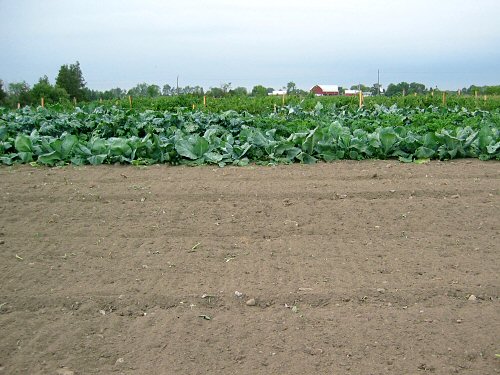
Newly released from row cover, five new beds of brassicas (cabbage, broccoli, cauliflower, kale) get ready for Fall. Beyond, tomatoes (and beyond that, the farm across the road, they gather honey). In front, a vacated section that contained the season’s first planting of peas seeded way back in April, and is now awaiting a mid-August green manure cover crop of…oats! And still, no rain…
broccoli
Late June harvest
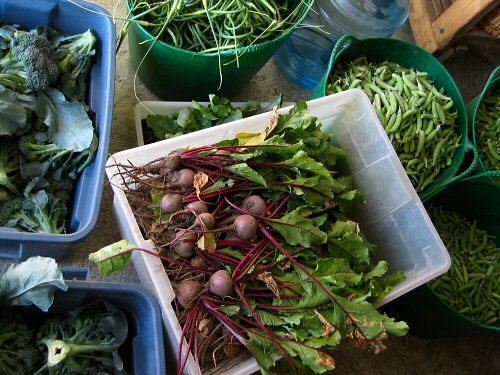
The harvest is still small: snap peas, broccoli, mesclun, the last of the garlic scapes and spring spinach, beet greens, the first few, baby beets. With 50 CSA shares to fill this year (around double from last year), plus the farmers’ market, a couple of local outlets, and the farm stand, I’ve really upped the ante. Even with PEOPLE at work in the field, I’m concerned about quantity. Where bad germination and losses from pest damage here and there have been no real worry so far, now every little setback seems…dire. Probably, most of this is in my head, endless millions of small farmers have done it before and are doing it now. Still, staying tiny and diversified at my particular scale seems tougher than before. It’ll work out, and for now, any uncertainty keeps the adrenaline on a steady slow drip! :)
More hands on deck
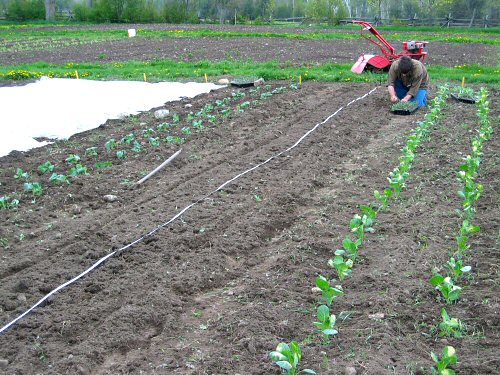
Conall, the all-new organic grower, is back after being unexpectedly called away two and a half weeks ago. That happened after we’d worked together for seven days straight. For me, making the transition from essentially solo tiny farming to having regular help was that quick. Having everything bouncing around in your head, with little need to explain it, is a luxury and efficiency of sorts. On the other hand, if you have people who you can sync with, sharing the gardening in an ongoing way seems like even more fun. And you can grow MORE STUFF with LESS WEEDS!! :) It’s a really welcome return. FREAK FROST: Three nights ago, according to the min/max thermometer, the temperature bottomed at a little below 0°C (and there was no reported cold snap or hard killing frost), but some of the brassicas (Brussels sprouts—see the whitish spots on the leaves on the right of the pic, bok choi, cauliflower) and two out of three varieties of peas got fairly toasted, burnt by the cold. Many of the pea leaves were totally killed off. I only noticed the extent of the brassica damage when we took off the row cover today. This is something I’ve never seen, and Bob, with 40 years of farming, hadn’t either, especially with peas, which can grow in the snow. The additionally odd thing is that some varieties (one of the peas, broccoli) weren’t affected at all. These are all plants that can normally take an overnight freezing and bounce back no problem—temperatures around zero should be nothing. Weird. My random theory: a very rapid temperature drop, many degrees in a few minutes, that didn’t give the plants enough time to adjust…? Anyhow, everything’s recovering just fine! The crazy weather effects continue…
Get it in, get it done!
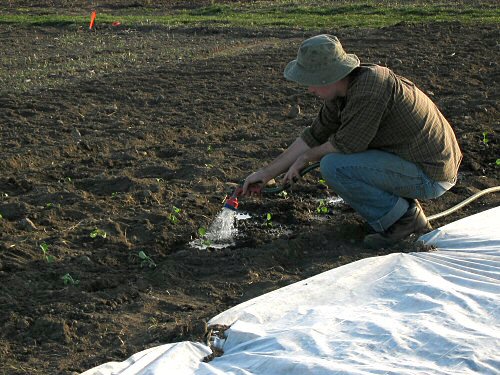
Conall, the all-new organic grower, starting from scratch as our first full-season, full-timer, waters in transplants. Today we set out three more beds of brassicas—so far, there’s cauliflower, broccoli, Brussels sprouts, bok choi—prepared beds for a dozen more crops, set up the irrigation pump for the season, cleaned out the winter storage area of the barn, turned the composting windrow….and more. Still, it’s the rush-to-get-it-in-get-it-done time of the year, and the days never seem long enough (although, they’re getting longer!!).
Heading out…
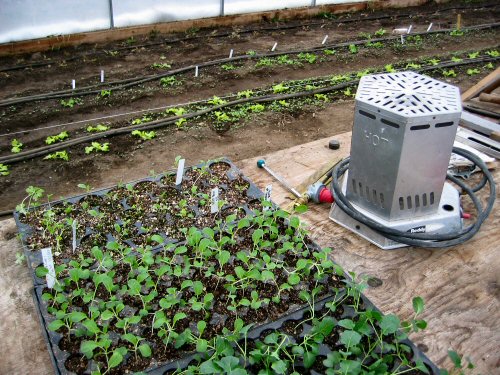
The cold spell seems to be broken, the nights are going down to zero F instead of -10. Time to start moving the main act to the hoophouse. First out, some hardy brassicas: a tray each of broccoli and bok choi, and a mixed tray including some parsley that I set out a couple of days ago as an extreme cold test. This is my first year for early season brassicas, so I’m a little cautious, although I’m well familiar with their general hardiness in the fall. These probably could’ve been out earlier. In front of the table, the lettuce, with the carnage renewed. Overnight, the voles tore apart another 10 seedlings, and I noticed they’d eaten the growing points off another dozen of the red lettuce, taking the toll to 30-40, depending on whether a few recover. Measures, as in, more strategically positioned snap traps and filling in the perimeter, have been taken. In any case, no worries, there’s lots more on the grow! OK, sitting beside the trays on the table, there’s the Heater, intended for construction sites and the like, which hooks up to a regular BBQ propane tank and provides a good amount of heat for surprisingly little gas. It’s not needed yet, but when the tomatoes and other tender guys come out, it will likely be on at night.
Seedlings aplenty
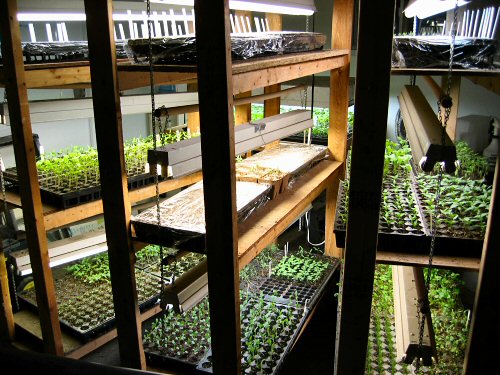
It’s getting crowded on the grow racks and under the four-light fixture tucked away behind (busier than one month ago). Going now, there’s tomato, pepper, eggplant, broccoli, cauliflower, Brussels sprouts, bok choi, chives, parsley, plus more to be started in the next couple of days. Right now, around 2,500 seedlings in all. The plug trays on the top shelves are 200-cell. In a couple of weeks they’ll have to be potted up to larger quarters, and depending on what size I go to, will take up 5x to 10x more space. There are also a few 128s, and even in 72s, the earliest plantings need to be moved up. Already, the light is stretched. The shoplight fixtures are really only good for two trays apiece. I’d gambled on a much warmer April so I could use the unheated greenhouse. Now, I’ll have to spot heat with the propane construction heater, which is a bit of a pain since it has no thermostat—night work. To keep everything reasonably stocky, not stretched or stunted, there’s a lot of juggling coming up! It’s great!!