Tangling with hoses

Sorting out hoses

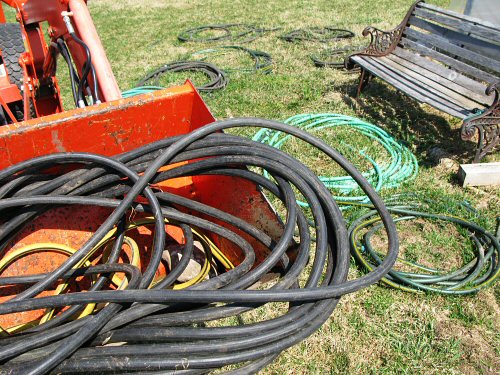
In smaller gardens (tinier farms!), hoses are generally a fact of life. In spring, it’s time to uncoil them all, check the fittings, and get set to deliver water largely by hand.

On BIG veggie farms, “hoses” are usually big pipes (3″/7.5cm and up), part of full-blown irrigation systems that suck up and spew MILLIONS of liters of water a season. Here on this tiny farm, we’re way closer to the garden hose end of the scale.

Our irrigation system is a work in progress. Drip tape is the ultimate goal, but there are obstacles to work around, like the limited water available from the barn well, and the distance to and lack of electricity at the spring-fed pond. Right now, watering is about regular 5/8″ hoses, fed by a 1″ plastic pipe that runs from the barn well to the pond located WAY at the other end of the field, with taps at 100′ intervals.

Actual watering is done with a combination of soaker hoses, sprinklers when there’s no wind, and various hand nozzles for watering in newly seeded beds. Quick connectors are a major convenience when hooking up the various combos of multiple hoses and other attachments. I try to find a balance between not too many hoses, because you can’t leave them lying around, and not so few that you’re moving the same rig all over the plot.

Accidentally tilling hoses that were left snaking around instead of being promptly put away has turned into a not absolutely rare occurrence, and a time-waster (untangling and splicing takes more than a minute). Just put away that 300′ of hose plus 500′ of soaker hose when you’re done! ;)

Spot irrigation with hoses on two acres is a bit tedious, but like everything else, you do get used to it, it’s part of the routine, and it gets the job done, which is satisfying in the end…

That’s the state of the watering art around here as we head into a new season, and I’m promising myself advances on the drip side of things. Of course, it could happen to rain all the time, about an inch (2.5cm) once a week would be fine, and then hoses would largely vanish from the garden landscape. That’s not at all that likely (and when it’s a really rainy year, you wish for hot, sunny hose weather), but…YOU NEVER KNOW!
Field day!

Winter-killed brassicas

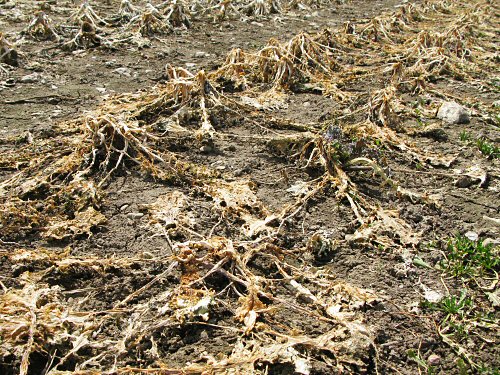
Left to the last possible harvest in the fall, brassicas like kale, Brussels sprouts, cabbage, broccoli and cauliflower (above), were eventually winter-killed and now have to be cleaned up—one of the first field-readying jobs of spring! Today, I started. (EVERY day is a field day from here on in, through November at least, or the first heavy snow that sticks.) A day of tiny farming fieldwork is really just a whole lotta gardening… Now that the ground has dried out enough to be tillable (that could’ve been yesterday, but…errands and CHICKENS), and warmed up enough to direct seed the crops that germinate in cooler soil, it’s a whole new world of things to do…and think about doing. There are two basic ways to ponder the progress of the season’s garden: by timing and by area, each useful in its own way. Timing is mainly about the plants: when to seed, when to water, when to harvest. Area is about where to locate particular plantings, which in my case doesn’t mean absolutely running out of space, since there’s lots more field to expand the garden into if I wanted to (which I don’t), but more like where to position stuff efficiently, so you’re maintaining crop rotation, but not having to, say, drag hoses all the way down the garden to a couple of newly seeded beds that need daily watering in (although there’s a field production plan made up, there are lots of adjustments on the way—where to put stuff will come up again and again!). So, the start of the season is mainly about area, because you have to prep beds and get veggies in in a rough order—cool soil seed, then cool weather transplant, then warm soil seed and transplants—and the timing is a constant: it’s all right away! One way I keep overall track of this garden is by counting sections: it’s about 2.5 acres, divided into 40 50’x50′ squares (each fits 10-16 beds, depending on width). At some point in the next six weeks or so, almost all SHOULD be planted out, nearly 40/40. Today, I started seeding in one…

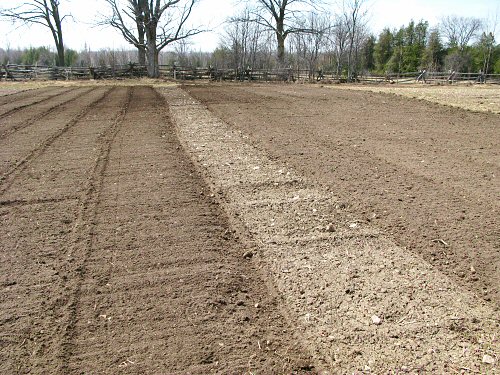
Tilled and untilled: Partially composted cow manure was spread and incorporated in the fall. Now, a light rototilling to prepare for seeding is all that’s needed. Today, I used the tiller on the Kubota compact tractor.

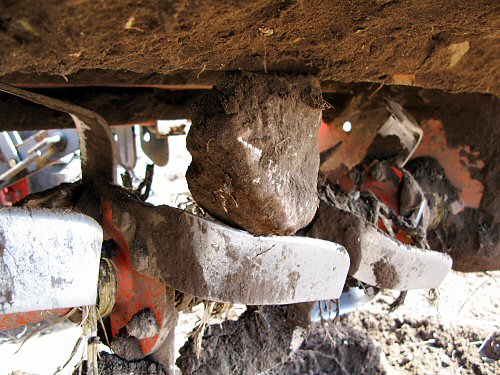
Rock beats tiller: There are lots of stones in this field, they work their way up continually, and even a fist-sized rock, caught in the right way, can stall out the 48″ rototiller on the Kubota (it’s a tiny tractor!). No problem: remove and restart.

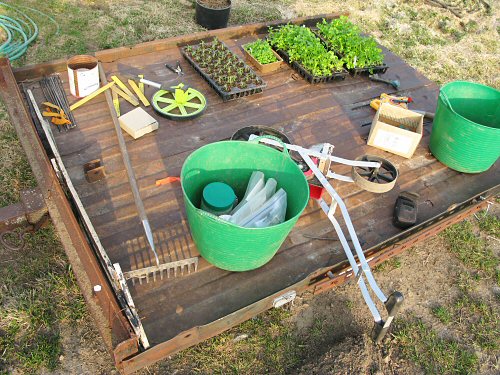
Getting set to seed: I work mostly one or two sections at a time, prepping an area with the tiller, marking the beds, then seeding (or transplanting). This way, I can get the crops that need to be started in as quickly as possible. Here’s the cart towed by the riding mower, loaded with assorted seeding gear (and some transplants being ferried to the greenhouse).

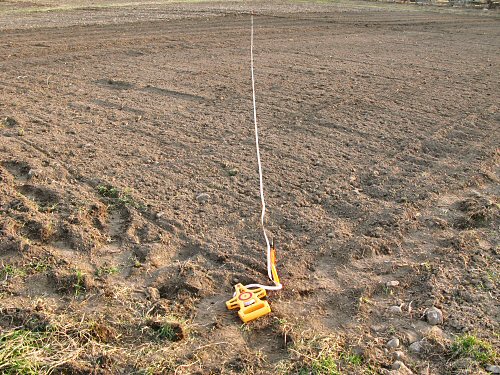
Making beds: Oh, there’s A LOT of tiny farm history behind my bed marking methods. :) I’m still working on the most efficient way to set up beds. Right now, it’s fairly streamlined, involving a 100′ tape measure, stakes, and pacing off distances. This year, I’m planting in 3′, 4′, and 5′ beds (that’s path included), depending on the crop.

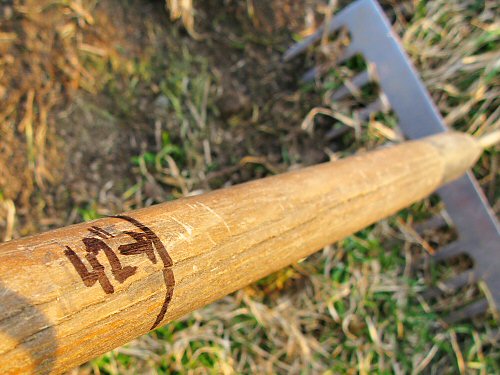
Customizing the Rake: Every season, I re-ink faded measurement markings on a couple of hand tools I use the most. Here’s a convenient mark for 42″ from the top of the handle (that’s the planting area width for a 5′ bed. There are other marks further up the handle, and the whole rake is exactly 5′. It’s convenient for quick checks, especially on the favorite rake that I use for touching up beds right before seeding. And so, off we go…!

Head out on the highway…

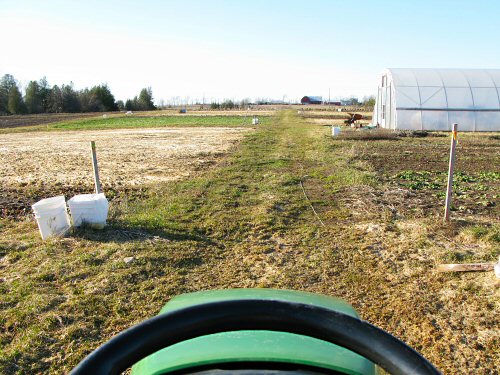
A couple of days ago, things seemed to be moving in slow motion, today, it’s the wide open highway! (A poor analogy, perhaps, given the soaring price of gas, but anyway…) Sitting at the wheel of the little riding mower, heading to the greenhouse down the main path with trays of seedlings in tow, a warm sun shining down, a good part of the field just about ready to work, all the possibility of a brand new garden season ahead, and no weeds in sight felt…really fantastic. With a nice adrenaline rush!

As the warm weather kicks in, there’s a whole series of winter-to-summer changes, and my body memory of fieldwork details starts to come back. It’s not like I’ve been doing this forever, each new season, there’s a spring ramp up of remembering routines, pathways, ways to do a thousand little things.

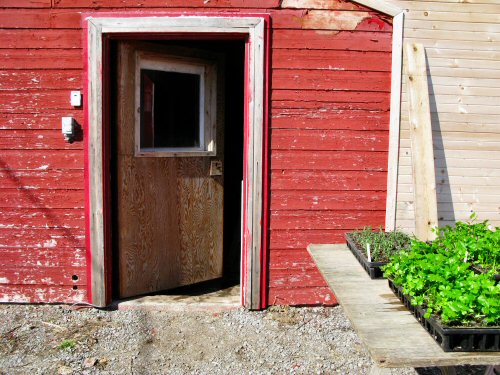
Last week, I moved the Kubota compact tractor and the riding mower out of winter parking in the drive shed, to make room for summer storage. The greenhouse is now almost completely set-up for full seedling mode. Today, I test started the Horse walking rototiller and walked it around, set out the rain gauge, stripped off the draft-sealing duct tape to open the Milkhouse side door (a milestone spring moment!), and hooked up the hose from the barn well to the pipe that runs down the field and supplies the greenhouse (the hose goes through one of the holes at the bottom left of the door). Practically overnight, there is SO MUCH TO DO, RIGHT AWAY. There’s tons of tilling as soon as possible so the cover crop residue can start breaking down, and immediate seeding of, at least, peas and spinach, in the next couple of days of sunny weather, before the big rain forecast for Friday and the weekend. And CHICKENS should be here tomorrow… Fun!

This year’s early lettuce…

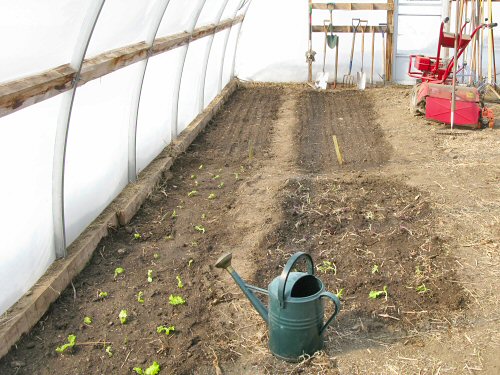
The end-of-March scene in the greenhouse is a lot different than last year, when the growing area was neatly filled with early lettuce. This time around, the early effort has turned into a much more spotty affair. The lettuce started WAY early at the end of January, and held back because of extreme cold earlier in the month, grew and REALLY stretched in the trays, and I only put about half in the ground, just to see what’ll happen. Filling in, there are a couple of beds of direct-seeded, all-lettuce mesclun. The idea of making it to the first market day (this year, it’s Saturday, May 3) is fine if everything else is humming along, but given the slow-leaving winter this year, chances are I’d rather be in the field or doing some other outdoor stuff on the farm at that point than spending a good part of a May day at market with a small quantity of greens, just for show. With this year’s early lettuce and the weather, I’m no longer in such a rush!

New gardener

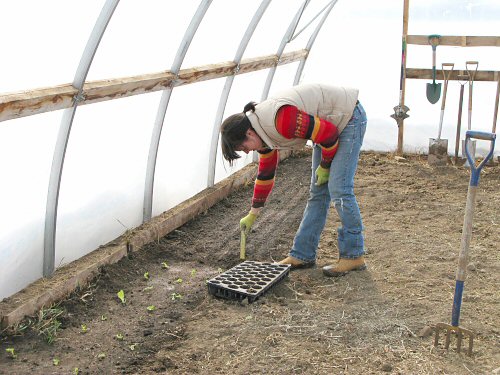
Hannah dropped by today to check things out. She’d gotten in touch through the farm web site, wanted to volunteer for a day or two every week through the season, to learn about small-scale farming and how to grow stuff. No garden experience. We spoke briefly on the phone, but the only way to see is to meet in the field and get hands dirty! It’s amazing how easily people can take to tiny farming when given the chance to dive in. So, a quick tour, and then, to work. She weeded, forked and raked a bed in the greenhouse, transplanted a couple of dozen lettuce, seeded a bed of all-lettuce mesclun using the Earthway seeder (tightly spaced rows), tried out the mini-cultivator (a rototiller attachment on a heavy duty weed eater), drove the Kubota compact tractor and worked the bucket on a big snow bank, trimmed a couple of trays of onion seedlings, checked out the production standards and paperwork for organic certification, and seemed fine with my mildly intense stream of background info and general microfarming explanation. All in three hours. Everything for the first time. She did great, no problem! Just as important, at least for this tiny farm, she seemed to have FUN, had a cool energy, and didn’t make me WONDER when handling machinery, tools and plants! After last year’s great crew, standards are pretty high. Will this season of people in the field go as well or even better? There’s no real advertising or recruiting plan, I’m trusting that, through general word of mouth (and maybe, good karmic energy!), things will…pleasantly unfold. We shall see!

Plugging away in the greenhouse

Taking advantage of the cloudy weather, I moved all of the lettuce out to the greenhouse for some rapid hardening off, and started prepping more ground for transplanting. At the edges, there’s lots of dead grass, and I’ve already pulled out a fair tangle of well-established live grass runners. The grass grows in from outside; the runners are incredibly busy and invasive, and can build up underground and, from what I’ve seen, seem able to noticeably sap resources from the plants above, even when the grass itself hasn’t broken through. This is an observation in progress (more on this later as I prep the field with its grassy paths). For now, I’m slicing deep with an edger right by the boards (if I get the chance sometime during the year, I’ll clear a grass-free strip around the outside of the hoophouse). Anyhow, lettuce will soon be in!

Walk to work

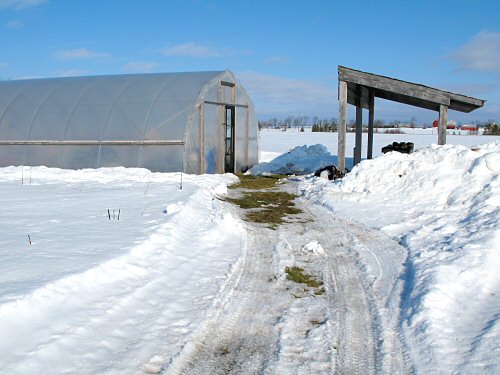
Can’t speak for everyone, for me, heading into the field is the best walk to work I’ve known… The arugula transplants a couple of days ago started this season’s almost ritual morning garden tour. This is an often mildly adrenaline-fueled stroll at the start of every day, from mid-March through early June, and then, mid-September into November, to see what happened with the overnight temperature. Frost-watch, if you like, but actual visible frost you don’t see that often, it’s mostly checking the effect of really cold air on crops in different parts of the garden. Right now, there’s only the bit of arugula to check out (the unheated greenhouse gets as cold as outside once the sun is gone). We’ve kept a path clear to the east side door, where there’s less snow build-up, as the wind usually comes from the west (the greenhouse is laid out east-west, with doors at both ends). Today, all’s well!