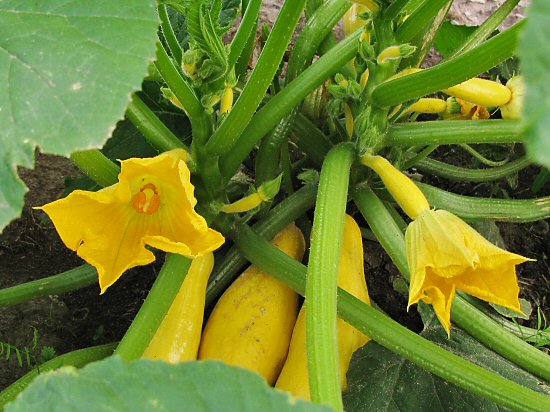
Perfect (market garden) squash!

Early Crookneck summer squash

In the market garden, summer squash can’t get much better than this. These guys, part of the second planting for the season, have it all.

Leaves looking really healthy: green, uneaten, and so far free of the powdery mildew that inflicts itself on many squash varieties and eventually kills some off before their time.

Perfectly ready for picking: These Early Crooknecks are a nice size, there’s a few per plant, and they’re quite easy to get at. All the summer squash were multiplanted, 2-3 plants growing together, so things could get pretty overgrown and hidden. This second planting set fruit fast (unlike the first round!), and the plants are still nice and open for easy reaching in.

More to come: In the small-scale market garden, you’re always thinking quantity and COUNTING. How many pieces do we need for today’s CSA shares, how many bunches for tomorrow’s  farmers’ market, and so forth. You’re thinking for now, and also for Next Week, and then, more weeks ahead. In that order. Today, there are plenty of tiny squash that’ll size up in a week no problem!

Bonus specialty selection: Squash flowers! Lots of veggies have cool options, like broccoli flowers and side shoots, squash blossoms (aka zucchini blossoms), beet greens, pea leaves, and generally, harvesting very small and young (I tend to like things to grow to a nice, solid size). So if you dropped in looking for a few squash blossoms (as seen on Food Network :), we could hook you up!

So there it is, my idea of practically perfect market garden summer squash for the tiny farm harvest. There’s ALWAYS room to improve…but here, how?
Potato digging party

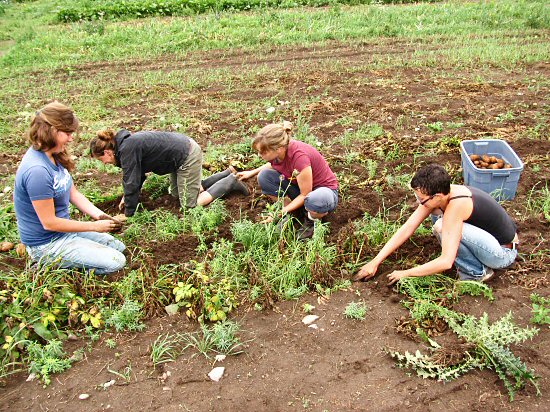
It’ll be hard to top THIS one for extremely labor-intensive tiny farming involving lots of peeps! Here, Libby, Lynn, Andie, and Mel hand-dig potatoes for tomorrow’s farmers’ market. The taters happen to be Gold Rush russets, and they’re in fine form, with a little wireworm damage (surface blemishes or tiny holes) to only a few. We’re right at the end of the first (of three) potato areas of this year, 600′ (183 m), evenly divided between Penta, Chieftan and Gold Rush.

So, what’s with all these people, digging together in a cluster, with just one bin? A little inefficient, pehaps? Well, not really. When there’s a lot of folks happy to mix it up with the dirt, tackling a single task all together can work out! We only needed about 70 lbs of each variety (that blue bin full). With the moist-but-not-mucky soil, pulling plants and scrabbling around was quick and easy. BIG POTATOES helped. Working close together wasn’t a problem because we had so little area to cover. Each bin got filled in maybe 15 minutes. Satisfying!

In the photo, you can also see how relatively good shape we’re in with weeds. The bit of grass growing back is in separate clumps, all the runners haven’t started to reach out and hook up. Further up is a section of more heavily overgrown onions. But that’s actually doing well as well: the onions were thoroughly weeded twice, and hoed a couple more times, so what you see is mainly grass from the last three weeks (without much shading out from the onion plants, everything else grows fast!).

Anyhow, when we tackle the main potato patch, around 2,000′ (609 m), methods will change. But we’ll still be digging in the dirt…!

First peppers

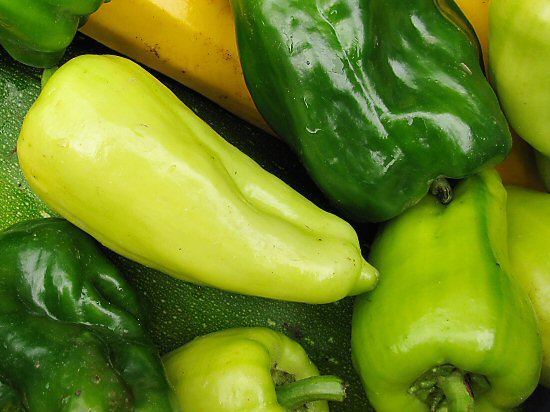
Harvested the season’s first sweet peppers, for the Monday CSA shares. They’re small…but tasty (that description has popped up a few times this year, as we pick early against the slow-growing weather and the flying by of time). The lime-yellow, tapering Gypsy (yellow-to-orange-to-red) are performing well once again, early and prolific, and the always-early, dark green bell peppers are Ace (green-to-red). Both varieties are F-1 hybrids (no seed saving), which isn’t great, but these guys are super-reliable in crazy weather, so I still plant ’em first… Peeking out from underneath, Ambassador (green) and Golden Dawn III (yellow) zucchini (also hybrids; GDIII is a mad producer, yellow zukes everywhere, on and on—another reliable standby that I’d love to replace with an open-pollinated variety)—after finally starting to take off a couple of weeks ago, the first planting of summer squash hasn’t looked back. So that’s something!

Drizzly days

It’s been cloudy a lot this season, but the rain has kept pretty much to a reasonable number of rainy days and single downpours—it hasn’t been too WET. So, not that much fieldwork called for rain. Today was an exception, with a steady on-and-off drizzle from early morning that kept things watered down.

Lynn came out around 8:30 am to weed. Since it didn’t look like the sun would be showing up to dry things out, she finished a bed of onions (these are the last-planted onion seedlings, a fair bit behind the rest) and we called it a day for weeding.

In general, we try not to handle plants when they’re wet so as not to spread any sort of disease. This is a common caution for, for example, beans, and I’m not sure how it applies across the board to all garden veggies.  Still, since wet work in the field is seldom fun anyway, it seems like a good rule in general: No weeding when wet!

So it’s…colors!

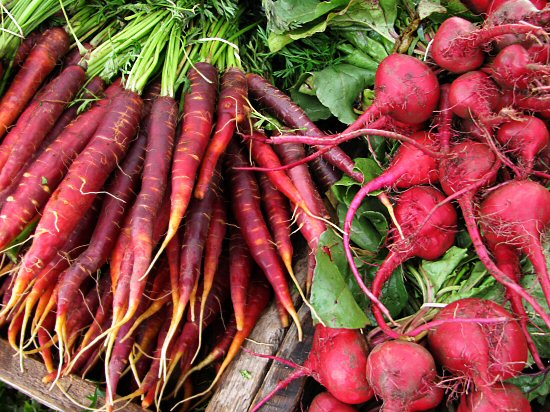
Purple Haze carrots, Chioggia beets

Cloudy, coolish weather continues, and the growing’s so slowwww…  At the farmers’ market today, instead of all-new main season veggies, it’s kinda more of the same. No super-early tomatoes (Stupice!), not even BEANS (not even the super-early yellow wax beans…). But the root crops are doing well with the rain, and their colors are…refreshing. Here, purple Purple Haze carrots, and radish-red Chioggia beets, freshly misted, drenched with…color. That’s nice… :)

Packing shares: done!

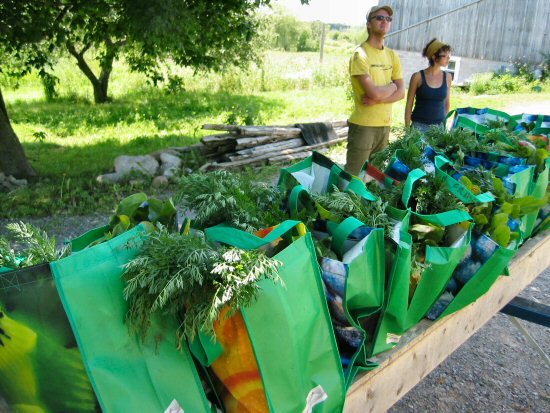
CSA shares are packed for another Monday of on-farm pick-up! It’s one of those great hits of momentary satisfaction to see them all, 100% absolutely and finally done, waiting to be collected. Mel, Jordan (above), Michelle, and Tara were all in the field, and the whole harvest went by kinda quickly, maybe three hours. I’m also figuring out the easiest ways to use different spots around the new farm. Today, as a temporary improvement, we moved the long screen table into a tree-shaded part of the drive, allowing us to line up the bags in one row, instead of grouping them on two smaller tables indoors in a shed (it’s all in the details! :). Keeping the packing space uncluttered is kinda critical if you don’t want to spend half your time rechecking shares to make sure that they’ve got everything. When the set-up works, filling shares is really suprisingly satisfying.  On the tiny farm, assembly lines can be fun!

In the share: baby leaf lettuce salad mix, baby zucchini, cauliflower, garlic scapes, young carrots, beets, new potatoes, curly& flat-leaf parsley.

Working the new potatoes

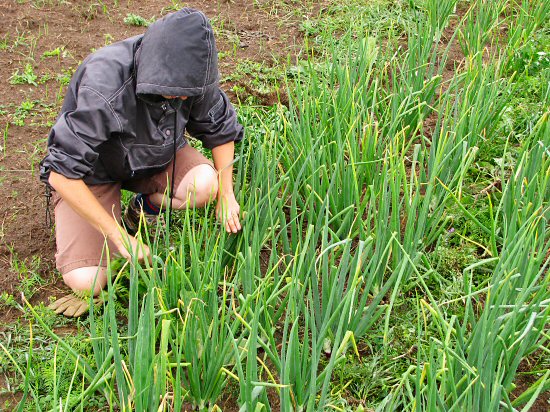
Another installment in the crazily labor-intensive tiny farming techniques series: Andie and Jordan in action, hand-digging for new potatoes without uprooting the plants! This one is hard to top for stunningly low hours-to-yield ratio. It makes picking peas and beans seem like something that goes by quick. Of course, for all its slowness, it has its rewards: beautiful little, amazingly fresh and tasty, new potatoes…and the plants still get to grow some more! Plus, if you don’t have to do it forever, it’s a lot of fun…

The “technique” is simple (and well-suited to the home veggie garden, but not too scalable). Gently feel around the base of the plant for anything that’s golf ball-sized or bigger (this batch is golf ball to XL egg). Stick to the surface, don’t dig too deep, and try not to break the single roots connected to other, littler, potatoes (you’ll easily feel the stringy roots). When you’re done, hill up the earth you’ve moved aside, and it’s on to the next one. That’s our method. ;)

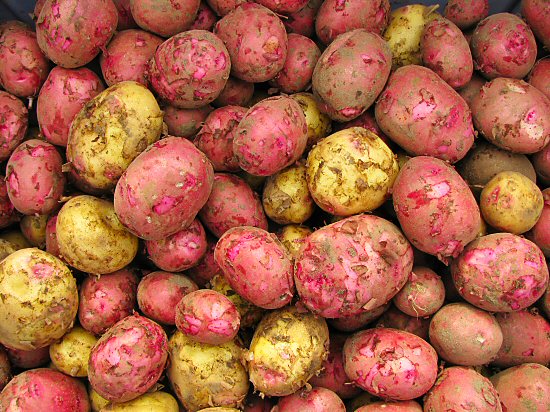
Yield today was pretty good, about 2-3 per plant, and about 40 lbs (18kg) in all. Won’t go into the time per plant and the weight per tater…because I didn’t. Maybe a peaceful hour or so, with three people. We only did this for a CSA share treat, because today it worked out that we had the time. There are red skin/white flesh Chieftan, and yellow-flesh, Yukon Gold-like Penta.

The only downside to the hand scrabbling method: the delicious, delicate skins get quite roughed up. We’ll soon start pulling whole plants for young potatoes, and that tends to leave the skins in better shape (and goes MUCH faster).

Anyhow, slow food, for sure. Tasty!