
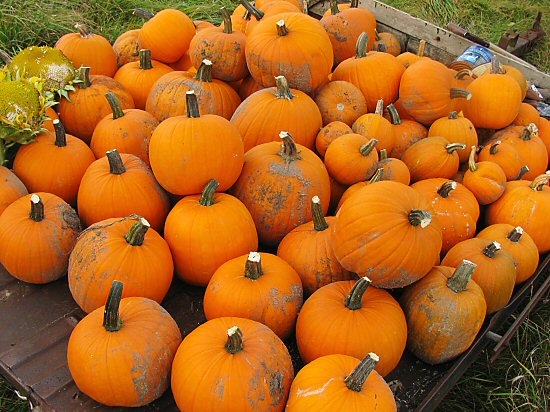
This season didn’t see too much pumpkin action in the garden, with less planted than in the past (although we’ve never planted A LOT). Mixed with winter squash in a couple of locations, the spread-out pumpkin patch added up to somewhere around 50’x50′ (15x15m), about half of the usual, enough for 3 weeks of CSA, plus some for the farmers’ market. The selection was to-the-point as well, with lots of the freakishly fast-growing Neon (60-80 days!), a few Connecticut Field, and some compact Small Sugar for pie and Snackjack for seeds, all basic mildly-ribbed-and-orange, without the unusual extras of most other years. True to past form, the hybrid Neons, even the ones transplanted quite late in June, completely ignored the mysteriously weird conditions this summer that slowed down just about everything else. Here, loaded on the trailer, is about half of the overall harvest. No intriguing pumpkin surprises, still, EVERY successful harvest is ALWAYS worth a high-five, therefore, officially fun… :)
Veggies
Yes, carrots!
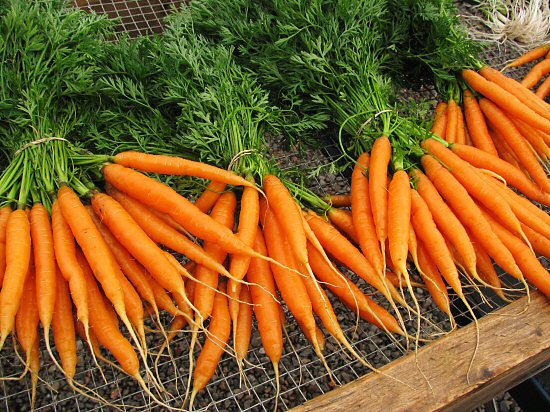
Just-rinsed carrots in the soft light of an overcast day: beautiful every time! Some veggies look particularly good without trying… These are freshly pulled Nelson, at a pretty fair size but not yet fully mature, from our fourth planting of the season. Every year so far, I’ve put in at least four, sometimes five plantings in succession, and we rarely see really fat, full-sized carrots. This has worked well for CSA and farmers’ market: our carrots are freshly harvested every week, never from storage, and at a versatile size, always perfect for eating raw and usually big enough for convenient cooking as well. Today’s haul, bundled and laid out for rinsing on the long screen table, will be heading into CSA share bags in just a minute, for pick-up this afternoon…
Eat good food
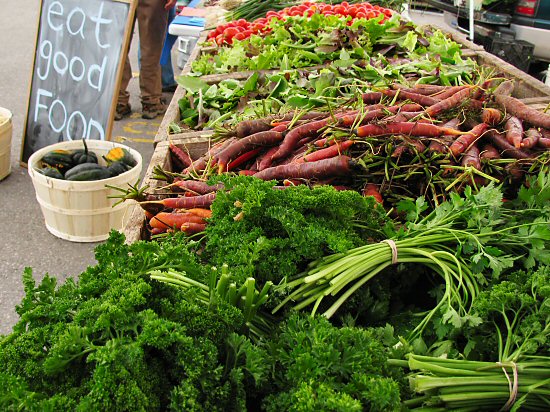
We’ve been faithfully bringing the matching pair of chalkboards to the farmers’ market since we bought them at an office supply box store in mid-summer, but it’s what to put on ’em that’s the puzzle. Today’s new message: “Eat good food”! The other one (out of sight on the left) has been a standing quote from Will Allen: “We need 50 million more people growing food, on porches, in pots, in side yards.” A little odd, perhaps, for the market? Maybe, but there they are. Promotional words on chalkboards is the plan. It’s a work in progress!
Fresh new garlic ARRIVES!
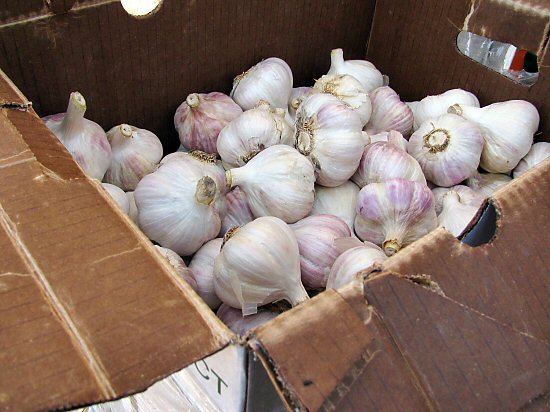
There’s almost no describing how pleased this morning’s delivery made me. Pretty happy! In two sturdy cartons, by FedEx Ground, 80 lbs of certified organic Music garlic, looking so fine! :) This shipment comes from a farmer named Warren, who grows a huge amount of garlic about 200 miles (320 km) from here—I’ve chatted with him about garlic, read his garlic literature, bought garlic from him before, a quirky and fun garlic grower indeed! And you certainly can’t have enough garlic… Possibly the WORST part of this mildly crazy tiny farm transition (moving farms from last year to this) was not being able to plant garlic last fall. On EVERY LEVEL, good garlic is GREAT…and if AT ALL POSSIBLE (it’s easy to grow!), you must have it around at all times! This season’s spring-planted garlic experiment did work out OK, but there wasn’t much of it, in number or in size. Now, we get to go again… Cool!
(By the way, if you’re really into garlic, this is the, um, BEST GARLIC SITE EVER: Gourmet Garlic Gardens! It has everything…)
Harvest board revisited

As the afternoon shadows get longer, Michelle checks out the harvest board to see what’s left to do for tomorrow’s farmers’ market. This same whiteboard is now in its third season of service, a little worse for the wear, with the surface no longer coming clean, and one edge of the frame fallen off (it’s lying there, right behind, waiting for repair), but fully functional. As long as I remember to keep it out of the rain and too much sun, it could have a few years in it yet. And I’ve grown to really like it. The shiny WHITENESS is a little glaring and kinda office-like—I considered switching to a chalkboard—but the printing stands out so well… It makes things clear, which is always good!
The other sunflowers…
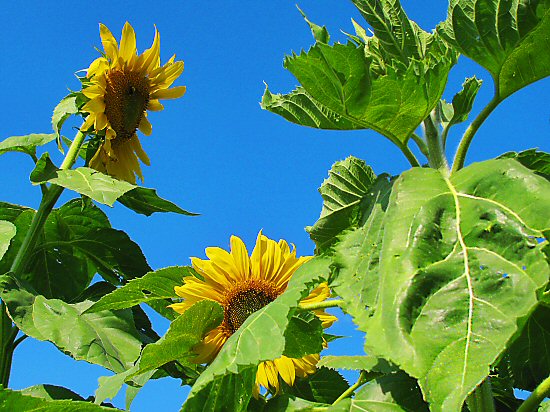
There are pretty ornamental cutting sunflowers, and then there are these monsters of the field, towering Early Russians, and their almost as imposing kin, the rugged Jerusalem artichoke (last photo). They’re the genus Helianthus, North American natives, supposedly dating back 8,000 years, and by the look of it, really not too disturbed by the crazy weather right now.
Both of these are experiments. This is the second season for the Russian giants, grown exclusively for their potential as a plant-protecting wall. It’s the third time around for the JAs, a crop that can do double duty as a living wall… Neither were strategically placed for action this year, but the idea is mainly to use them as shade during scorching summers. They get to a pretty good height by sometime in July, so the timing works. Even at 7-8′, they won’t protect too far out, a dense and high-value crop like all-lettuce mesclun would make it worthwhile. They could be good as windbreaks as well, but I haven’t considered for what…
The sunflowers are around 8′ tall now, it’s quite incredible (with a longer season, they can apparently get up to 14′). You’d think with them growing so fast and big, they’d always stand out, but with all that’s going on in the field, you can forget and then one day, turn around and BAM, there’s that wall o’ green, STARING at you…
The flowers are practically as big as my head, and so heavy, they eventually wind up completely face down.
The Jerusalem artichoke are a little more refined, but still big and resilient. They’re around 7′. Both sunflowers and JAs are planted in double rows, and held up to this year’s helping of storms and massive winds no problem. Reliable…
Garden in transition
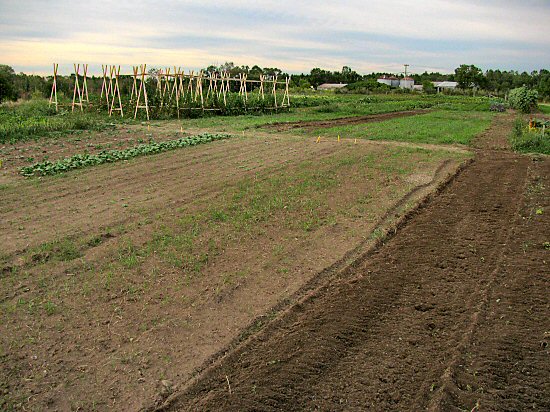
The weather is warm, the days still feel long (although, at 5:00 a.m. for Saturday market, I’m already waking up in the dark)—summer is in full effect, but you know the season’s soon changing because the field is clearing out. Today, I did some tilling, cleaning up before weeds get too established, and preparing for a last seeding of spinach for fall harvest (a gamble, for sure).
In the pic, a couple more passes to the left of the freshly turned strip and we’ll be at the edge of the previous spinach planting, barely visible, seeded about 3 weeks ago. To the left of that, a half-bed of bok choi, delicious and miraculously untouched by flea beetles, at tiny baby stage from seedlings transplanted at the beginning of the month. Beside the bok choi, beds of broccoli and cauliflower, also set out 4 weeks ago, and looking pretty good for harvest in October.
This section was planted out at the start of the season to snap peas, lettuce, and the first spinach. After adding in some of the handy pelletized alfalfa, it gets to go round again!
In the next section (top right of the photo, which is…east), I’ve started tilling in an overgrowth of grass and vetch, where more peas and the first plot of potatoes used to be. That section is done for the year, and may get a protective cover of fall rye, as a green manure to be turned under in spring.
In the market garden, it’s always one thing after another… :)