Potatoes delivered

Seed potatoes arrived today, all the way from tiny PEI (Canada’s potato province!). It’s still difficult to find certified organic potato stock, especially in more-than-home-garden-less-than-big-farm quantities, so it’s back to Veseys for another 300 super-expensive pounds, from 1,000 miles (1,600 km) away. Not too local, but that’s part of the certified organic game, finding seed… This year, the delivery charge upped the price by 60%—it’s expensive to truck stuff.

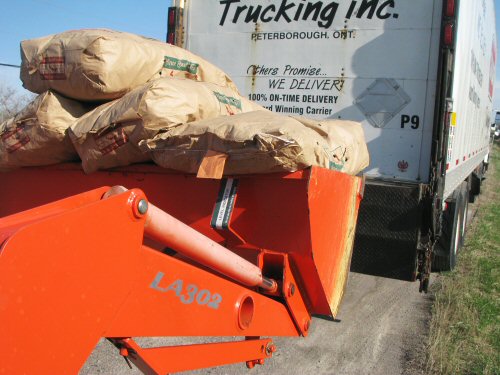
Unloading. The lane to the barn is narrow, has an obstructive tree right beside a slight but critical bend, slopes upwards, and falls off on one side—big trucks don’t even try to get in. We have to unload at the side of the not-too-busy 2-lane secondary road. Once again, the Kubota compact tractor makes up the difference, this time standing in as a forklift replacement.

Transport trucks it seems often don’t have elevating tailgates that can handle weight, they’re set up for forklift loading, so if you don’t have a handy farm forklift, you have to unstrap the pallet and hand-bomb everything off by the piece. The truck drivers are usually really helpful. This was just six 50lb sacks, two each of Penta (like Yukon Gold), Chieftain (red), and Gold Rush (russet-type), so we’re done in no time!

Machines can communicate: See ya!
Red cabbage

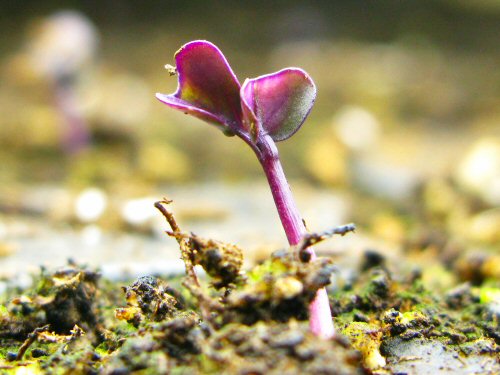
Besides the older seedlings, clamoring to get out, we’ve been starting new guys as well, for later planting. Here, a few days after emerging, a baby Cairo (hybrid) red cabbage, for crowded growing (12″ spacing), to produce “baby,” “gourmet” cabbages—basically, small ones! Elsewhere, Brussels sprouts, savoy cabbage, bok choi, and more. And it’s time for a second set of broccoli and cauliflower, to follow up the first wave. In our short May-September main growing season, now’s the time… Tick-tock!

Disc action

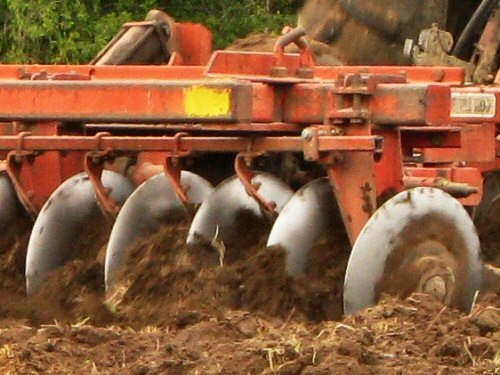
It’s steel in the field… Big machine work was the tiny farm highlight today, not the machinery itself but the intense and much-needed sod-busting action. Peter, a (certified organic) beef and grain farmer on the next two (much bigger) farms down the road,  dropped by just ahead of a bit of a rainstorm, to disc the fields he’d moldboarded in the fall. There was time for two passes on the south field, then the weather hit, bringing plowing to a sudden stop as the ground almost instantly got too slippery and soft.

My experience with big tractor work is limited. Maybe someday I’ll get more involved with heavy machinery—to watch, at least, big machines are fascinating and…cool. Or perhaps I’ll go the other way, d/evolving all the way to Fukuoka-like farming with little more than an intricate method and a stick… Probably stay somewhere in between… :)

In any case, this is all one-time stuff. The double row of discs do some serious pizza-cutter work on the dense, moldboarded strips, so we’ll be able to rototill more easily and effectively, without tearing the little tiller apart. And then, the soil food web can rebuild.

Elsewhere, earlier, I direct seeded the first spinach, beets and radish. Following their progress in the new garden ground will be interesting…

Hoophouse end walls

With the clamoring demand for greenhouse space around here, getting the hoophouse finished now that the frame is up is a PRIORITY. Yet here we are, a week later, framing the end walls and installing the wood along the sides for the roll-up section of the sidewalls. A stretch of wet, cold weather was the main cause for delay. Plus a really long list of other critical things to do at the same time.

For maximum satisfaction on the tiny farm, you want things to effortlessly flow along, from one small task or specific problem, to the next (IMHO, of course!). Right now, there are lots of phone calls to be made, things to follow up on, info to find, bits to write and forms to fill, stuff to source and buy, all sorts of more abstract, open-ended, DISTRACTING activity. Eventually, it will settle down into a more-or-less all-garden flow…

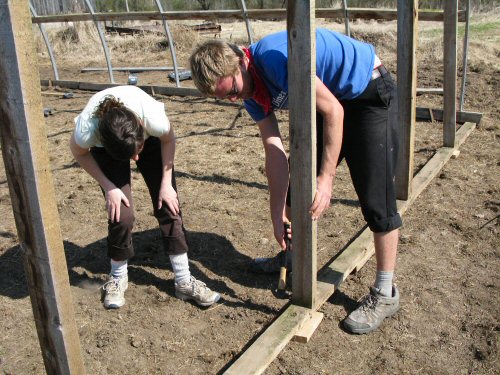
In the pic, Jordan and Lynn work on reassembling the end walls. The ground isn’t absolutely level, there’s a gap to fill underneath the 2×4’s along the bottom (the sill plate). This isn’t a problem as the weight of the hoophouse sits on the 4×4’s running along the sides—they’re firmly anchored, so we’re set.

In this case, we can’t cut the studs longer to extend the wall, because we’re going to reattach the existing, pre-cut plastic. Everything has to come together the way it was. I should’ve numbered and marked each rib and piece of wood as it came apart. I’d usually have thought of that, but in this case, I only marked the main plastic, so that we could reverse it. Now, fitting it back together is a little puzzle… After this, there’s not much more to do, just wait for a windless day to skin with plastic. Onwards!

Jostling tomatoes

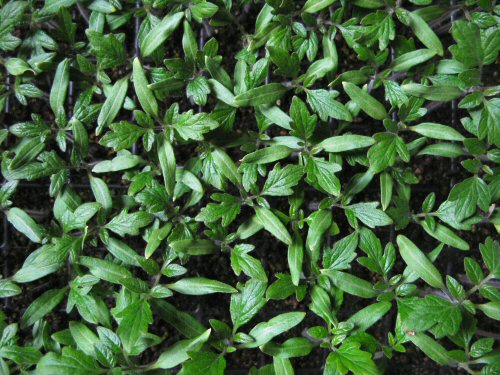
Tomatoes that appeared in their 200-cell trays only a couple of weeks ago are already competing hard (using the old let-my-leaves-overlap-yours tactic) with their neighbors, fighting for a place under the fluorescent sun. A month ago, every seedling looked like a little miracle to be celebrated. Today, they’re an insistent, unrelenting horde, pressing for better conditions NOW. The timing pressure is starting to mount, with the greenhouse to finish and field preparation (aka sod-busting) ongoing. The calendar is getting ready to flip a page, and the 15-day temperature forecast is pointing UP. At this point, after the long wait of winter, and the slow ease into spring, everything suddenly moves so FAST. Remain calm! :)

Tiny farm moving – Part 4

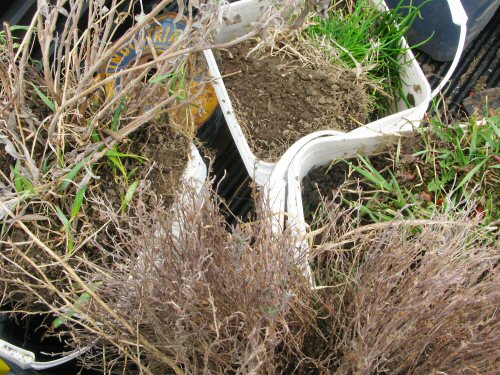
When you’ve seen one 20-foot trailer loaded with tiny farm gear, you’ve seen ’em all?! Well, something like that… Headed back to the old farm today for the final move, and the only photos I ended up taking were of three buckets crammed with dug-up transplants:  thyme, oregano, sage, chives, lovage, tarragon, rhubarb… It’s enough for a small herb garden start—we’re growing new herbs from seed, and may get some seedlings as well—but the feeling of continuity is cool. As for the rest of the load, it was mainly the dismantled farm stand (that is, lots of wood), more spare wood, and a few more hoses. The only more exciting item: the trusty old snowmobile trailer that serves as an all-purpose giant garden cart! And the move is complete…

Direct-seeding peas

The first direct-seeded crop went in today: Sugar Ann snap peas. As usual, the peas were inoculated with Rhizobium bacteria: dampen the seed with a little water, sprinkle with inoculant powder, and shake.

Rhizobium bacteria enter legume roots and form a symbiotic relationship with their hosts, producing plant-usable nitrogen in exchange for carbohydrates and other nutritious goodies from the plants. The net result is…more nitrogen for all! Or as the inoculant package says: “bigger yields and better quality”!

Sounds great. I take it on faith (in the science, I guess), since I haven’t actually observed the with-and-without inoculation difference. I have a couple of times planted without, but I wasn’t taking measurements…

Each legume (peas, beans, clover, etc) needs its own species or strain of Rhizobia. Luckily, there are packets of premixed assortments that cover the common veggie legumes. What I’ve been using, called simply enough, Garden Inoculant, is good for beans, peas, lima beans and sweet peas.

The bacteria do establish in the soil so that they’re available from year to year, but I’m not sure how long and in what quantities it takes to get set up with the strains you need—until I find out, I’ll inoculate every time…

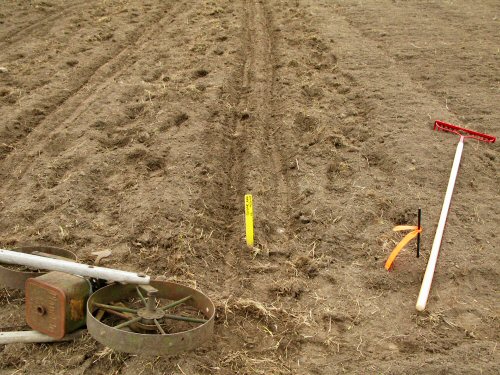
Then it’s on to the seeder. I’m using the older, heavier, probably-antique Planet Jr. over the usual Earthway.

And minutes later, 3oo’ (91m) done. It’s an almost painfully small start for April 20, but I’m figuring that every few days I leave the broken up sod to break down more, the better off we’ll be. Soon, though, all the rest of the early direct seeded crops will just have to go in!

1 63 64 65 66 67 170