
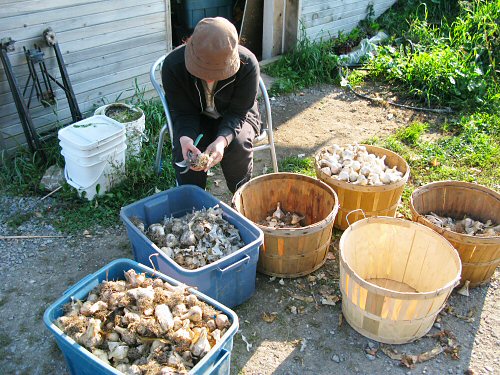
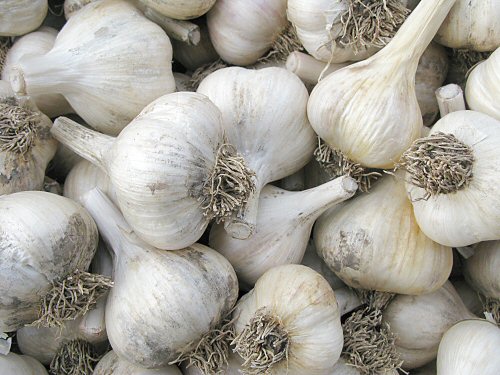
Toshiko, WWOOFing from Osaka, Japan, via Vancouver, where she’d been studying English for the last few months, is our last guest in the field of the year. She arrived last Friday night, and stays until a week from this Sunday, two weeks in all. A couple of years ago, she volunteered on larger farms in Australia, where whole days were spent on one task, like picking a single crop. This is Toshiko’s first taste of really tiny farming, where there’s something different to do every couple of hours. At this point in the season, fieldwork consists mainly of harvest and post-harvest things to do, also, maintaining row cover in case of frost. Here, she does a final, thorough sort through the garlic, separating the good from the damaged bulbs, and trimming the roots of the good stuff.
Pumpkins and pigweed
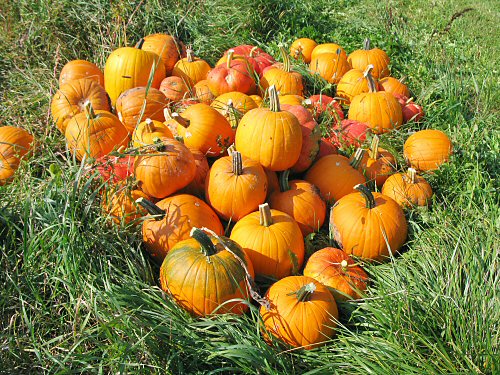
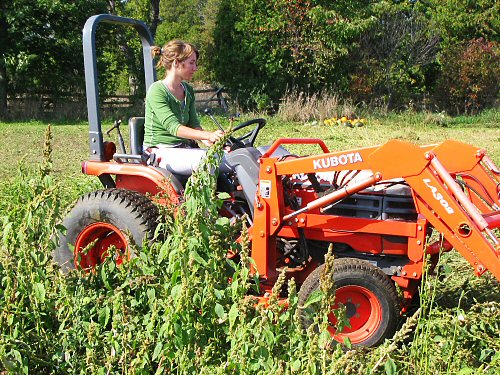
Today, the pumpkins came in, wrested from a jungle of pigweed gone wild. Every year, a few of the 40 50’x50′ sections that make up the 2.5 acre garden get a little overrun with one weed or another (usually, pigweed). This year’s pumpkin patch was a good example, with pigweed growing unchecked for a good six weeks—no time made to weed, not IMPORTANT enough a crop—until today, when Raechelle used the belly-mounted 52″ mower deck on the Kubota compact tractor to mow it down!
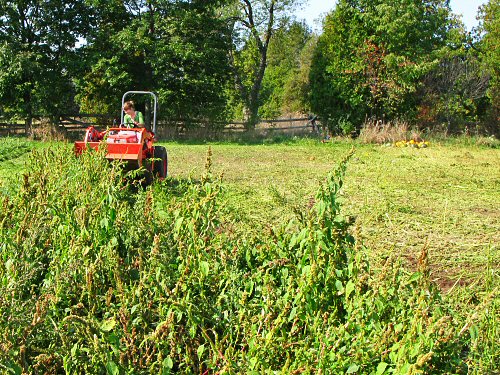
Of course, this is exactly what you DON’T EVER DO in a garden: allow weeds to flourish and go to seed, then mow them down, broadcasting seed everywhere… Oh, well. The alternative, pulling the pigweed by hand, then carting it off, we also do when necessary—see the Pigweed Mountain—but once in a while, I go for the instant gratification of seeing a section clean and clear in an hour or two. The millions of pigweed seeds, ensuring healthy future generations for years to come, will be dealt with…later. (As long as we weed on time next time around, how bad can it get?! :) Anyhow, it’s all part of the grand experiment! Guest pumpkin photo by Lynn.
First frost misses
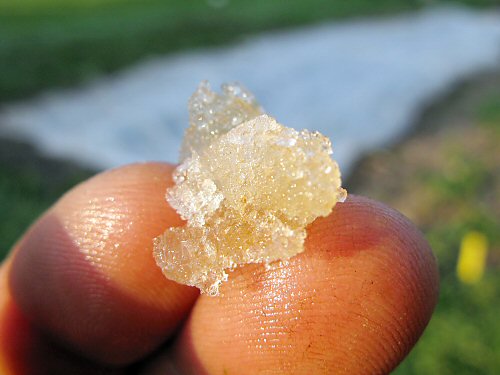
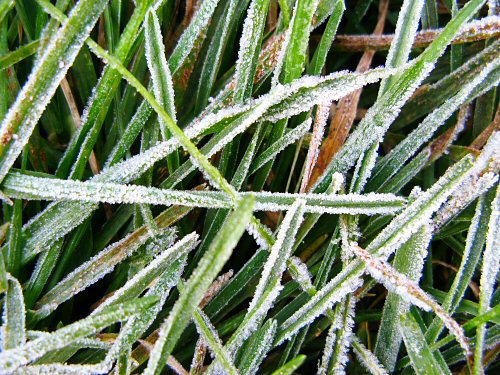
Frost finally hit the garden…but it missed the veggies! Just after sunrise this morning, there was ice on the grass at the very bottom of the field, but it stopped maybe 10′ feet from where the garden begins. Pretty cool. There’s a gentle slope from a high point about two-thirds of the way up the garden, and cold air flowed downhill and pooled at the very bottom of the field. Fun with science: when there’s no wind to mix things up, cold air rolls with gravity along the ground!
Last day of summer in the garden!
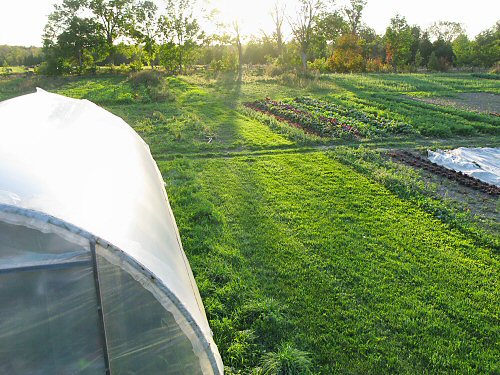
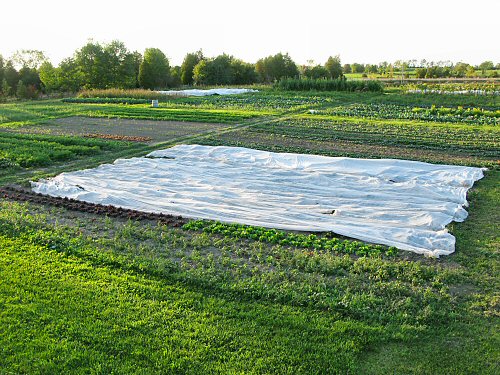
Here we are at the end of the calendar summer, a season of crazy weather largely gone by! Cooler fall conditions have been around for a couple of weeks now, with ample frost watch nights, so summer’s end at this point is only…ceremonial. Still, there’s that little twinge of melancholy that comes with the official end… The fall harvest is looking fine, with lots of brassicas, a good deal of lettuce, and the last of the fall spinach in the north end of the field (above), along with some last tomatoes, lots of peppers and eggplant, spared by frost so far. There’s also Jerusalem artichoke and potatoes, still in the ground. Green beans! And, of course, that section of sweet potato, fully row covered…
Moving down the field, there are the last plantings of beets and carrots, parsnips, some Swiss chard, and lots of mowed but still untilled empty sections…

At the south end of the garden, the herbs and flowers are all hanging in there—row cover has kept even the super-cold-sensitive basils alive and well. If I’ve missed anything in the rundown, well, it’ll still be there!
Last market day of summer
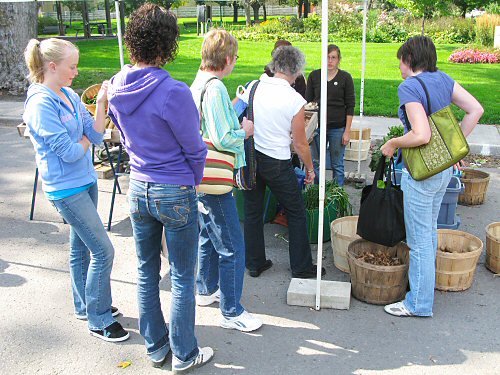
We rang out the summer at the farmers’ market with a really lovely morning. I don’t remember what was going on here, but Lynn is looking a little under siege. You can’t ever call our market EXTREMELY busy, but it’s steady, and we get a few mini-rushes most days, where customers start to queue up. It’s always fun on food’s front line!
Fun with harvest bins

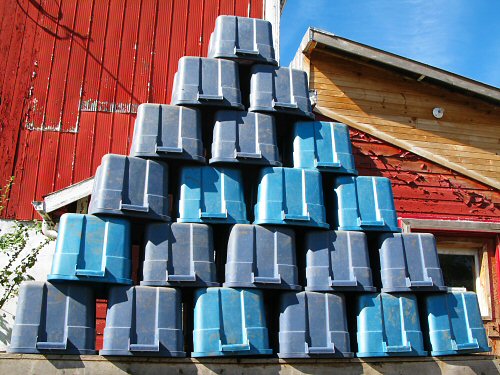
After rinsing harvest bins for the regular Friday harvest, instead of spreading them around to dry as usual, I stacked ’em high to represent the house-of-cards global economy—I was trying to illustrate a point! What on Earth? Well, a few days ago, I became sadly hooked on the US presidential election action, especially on the endlessly fascinating PALIN. I slipped off the wagon and started obsessively sneaking in quick peeks at CNN through the day, and actually WATCHING in the late evening. This is so not in sync with the natural flow of…tiny farming. It’s been a couple of years now since I actively stopped consuming news: no TV, newspapers, Web, radio, just no news, except what came by word-of-mouth. (No-news really does wonders for your head…) Suddenly, I was back in, in an intense but luckily limited-to-presidential-politics way. Or so I thought. Earlier this week—overnight, it seemed—the ENTIRE U.S. ECONOMY STARTED TO MELT DOWN, and now the election thing has gotten SO MUCH CRAZIER. Wow. Anyhow, after I’d stacked the bins, Lynn and Libby tried to rapidly destabilize the economy by throwing potatoes at it—guess my model wasn’t too realistic, ’cause it wasn’t easy to knock down… We went on to a great harvest day, beautiful fall weather, a fine time to be in the field!
Jerusalem artichoke in full flower
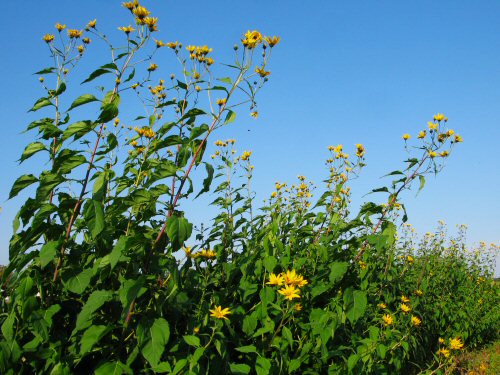
Last seen simply soaring up above 7′ (2m), the Jerusalem artichoke recently exploded with flowers. Last year, flowers appeared on some plants, and I read that flowering chokes isn’t that common. You couldn’t tell from here… The plants continue to thrive, weathering pretty heavy wind recently with only a bit of a lean. I haven’t dug around to see what the tuber harvest may be like, but I expect it’ll be massive…