
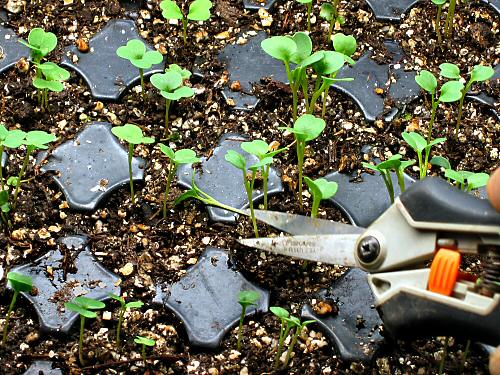
Time to thin out the lettuce and arugula. Between the seven varieties, some of the seed I used was up to four years old, so to be safe, I was quite generous, maybe 4-5 seeds per cell for the arugula, and a bit more for the lettuce (that tiny seed can get away from you, though with new seed, I try to go lighter). Germination was good, and the little seedlings are already shading out each other as they push for the light. I’m still getting used to timely, to-the-point thinning, both in the trays and in the field. I usually have the urge to leave ’em a while longer, but almost always, this ends up being not the best thing to’ve done. Give the best ones the biggest break as early on as possible, which means, kill off the rest. This also takes some timing experience, but in general, it’s hard to go wrong by not waiting around. Sounds brutal, but that’s about it! The lettuce will eventually be one per cell, although for now I’ll leave a couple per. Starting arugula indoors is a first for me, I usually direct-seed, so I’m figuring things out this time around. I’ll leave two per cell, and plant them out two together at 6″ (15cm) spacing and see how that works out. Here, I’m snipping arugula at the soil level with wickedly pointy little shears…
germination
Arugula emerges
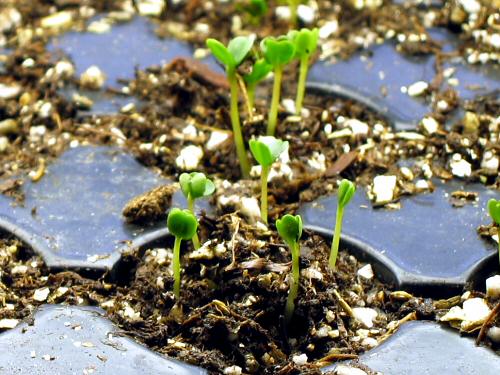
That was quick! Early morning, and the arugula (and Granada lettuce) has popped up in barely two days. Air temperature in the Milkhouse where the grow racks are stays mostly in the 60-65°F (15-17°C) range. Around the plugsheets, the close fluorescents warm things up an extra 5°F or so, and the clear plastic over the trays creates a little greenhouse effect that adds at least a couple more degrees. Altogether, ideal germination temperature! It’s kinda fun to think you’re in control of precisely what’s going on, but in any case, however they pulled it off, the first seedlings of the year are good to see! :)
The seed…
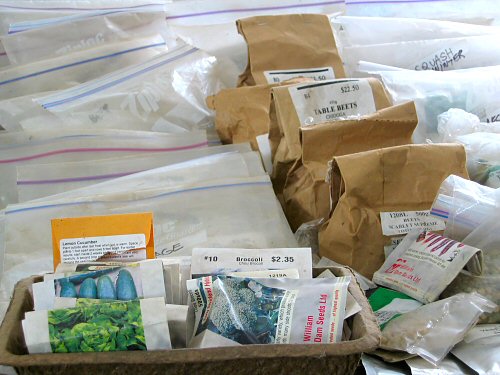
Keeping up with the early start, I got out the seed from its storage chest to take a look. With the tiny farm’s growing HISTORY (hey, Year 6, coming up!), keeping the seeds sorted for freshness is an ever more…serious consideration. Old seed won’t work, and there’s always lots of carryover from year to year. For this garden’s veggie selection, seed life in cool, dry storage conditions falls into three categories: nice and long (around 5 years, for brassicas, cucumber/squash family, lettuce, tomatoes,…), medium (around 3 years: beans, peas, carrots,…), and SHORT (1-2 years, for onions, corn, parsnip, parsley,…not too many here). Luckily, this is all book info, not gathered from painful personal experience! But I listen closely, ’cause one of my biggest garden nightmares is THINGS NOT GERMINATING… There are enough reasons why gazing happily on those newly seeded, semi-straight rows might be the greatest satisfaction they ever offer, and dead seed shouldn’t be one of ’em. My first germination test last year seemed to bear out the wisdom of others: normally-stored seed is not forever… So, it’s checking packs and taking dates!
Unruly heirlooms
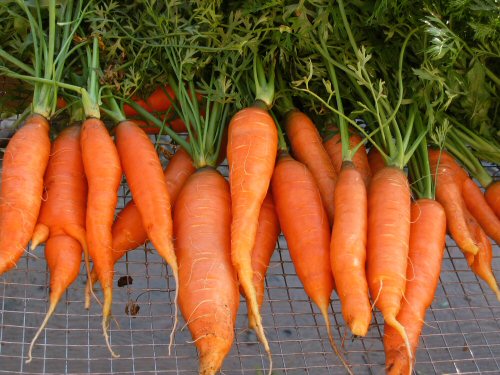
Left to their own devices, these heirloom Touchon carrots grew all over the place, an assortment of shapes and sizes. They’re in a bed where the mid-summer germination was spotty, and uneven spacing no doubt had a lot to do with it. Compared to our other mainstay carrot, the generally uniform Nelson hybrid, Touchons definitely show a lot more individual carrot character… As a trained-from-birth first-world consumer, I guess I’ve tended to automatically favor uniformity in many little things, like…carrots. On the tiny farm, that training’s being undone!
Return of spinach
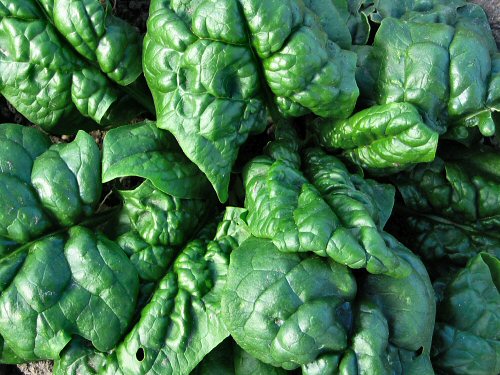
Fall spinach is finally ready to pick! The first five beds are pretty sparse—really poor germination in the dry heat of August—but what’s there is looking…succulent. The scattered new plantings of spinach, radish, mesclun and spicy brassica greens make parts of the field look like a whole new season…
Oats
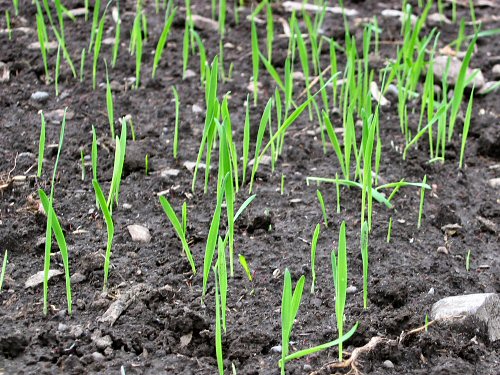
Promptly the day after the first rain in a while, OATS is surging up. Actually, strips of oats in one section planted a few days ago are appearing, the rest to hopefully follow just as vigorously. Oats anywhere but in a breakfast cereal bowl is a first for me. As a fall green manure cover crop, it’s an all new growing experience—if I didn’t know where this had come from, it’d look like an alarmingly healthy new weed attack…but it’s not. A couple of days ago, we seeded most of the open sections with an Earthway broadcast seeder (a simple, fun contraption, a bag with a shoulder strap that flings seed far and wide as you walk along turning the crank). In most sections, I used the rototiller on the Kubota compact tractor to till in the seed, skimming the surface in order to bury the seed no more than an inch or two. A couple of sections were raked so that the oats was lightly covered. In a couple more, the seed was left on the surface, a potential bird buffet. We’ll see what happens! Without the recent rain (we got another 1″/25mm today!), this wouldn’t have had much of a chance (oats needs to germinate by the end of August around here if it’s to get any growth on before winter kill)—we lucked out. So far, I’m liking oats!!
Mesclun on my mind
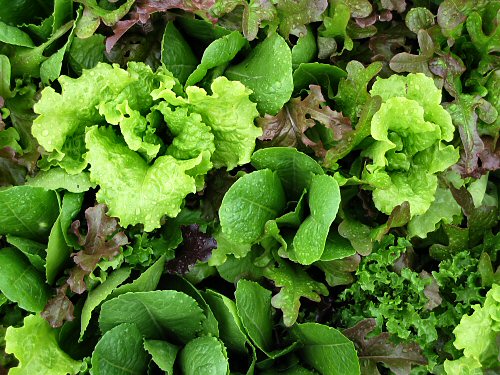
Mesclun remains the mainstay crop on this tiny farm. What I grow is perhaps not strictly “mesclun”, it’s nine varieties of lettuce with no other, more exotic greens—arugula, mizuna, and so forth—mixed in. Also, at times if it gets away a bit, the leaves can be kinda large, making it more of a basic salad mix. Still, it’s all mesclun around here, and this year particularly, we’ve grown LOTS. Salads are popular, and for no reason easily explained, the acceptable price at our farmers’ market is way higher than for any other crop (except, perhaps, blueberries?!). It’s a top seller on market day, it’s dead easy to grow, most of the time, and none of the other, larger local growers bother with it (only one other farm regularly has lettuce). So it’s an all-around winner. Then there’s the big BUT: hot, dry mid-summer weather, when the germination rate is usually terrible, the beds grow rapidly and are hard to time, and the heat can easily turn a fine, fresh-tasting crop into a messier, partially bolted bit of a nightmare. Simply seeding in many extra beds isn’t a solution, because the watering and weeding this would require would be insane. You simply have to keep planting moderately and frequently, and hope for nice weather breaks. Shortages are inevitable, and cut directly into customer satisfaction (expectations, expectations!!). For these reasons, at this time of year, mesclun is always on my mind. For the last couple of plantings, we’ve used…BURLAP for the first few days after seeding, which actually works, reducing watering in time and increasing the germination rate quite a bit. Next year, I intend to finally figure out an even better way…