Virtual local?

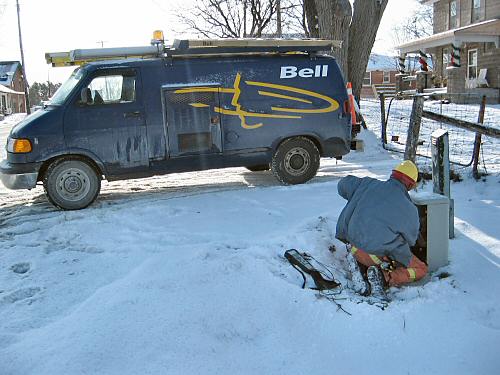
This morning, there was a phone company tech at work on the junction box at the top of the drive into the farm. I’m not sure what the guy and his logo-truck were up to exactly, but the picture made me think about tiny farming and the Web.

Right now, Bell and an independent telecom company are in an extravagant, introductory-offer battle for subscribers to the newly available DSL broadband service. High speed Internet access has been in this area for years, in towns and even villages, but dial-up was the only easy, painfully slow connection for most farms (we’re on the edge of a village, so we’ve had cable modem all the while).

Now, word-of-mouth is that people on farms are signing up for DSL—will more abundant web access mean more interest in having a web presence? This could be interesting because, out of 30+ vendors at the farmers’ market, I think this farm is still the only one with a web site. An odd situation, considering that online is really the only practical place for small producers to let people know what they’re up to. With the novelty of DSL, maybe more farms will finally get around to getting online, which is probably a good thing, because it takes more than a few people to make a local market thrive.

Just as Tiny Farm Blog has rapidly become embedded in my farming life (BTW, TFB isn’t the farm site), maybe this technology, where you sit in front of a screen and TYPE, is what it takes these days to hook people up in the communities where they actually live… I suspect, in some ways, to at least some people, you’re not all that REAL if you’re not represented online. Even if you’re practically next door! A little weird, but whatever works!

Stakes vs cages

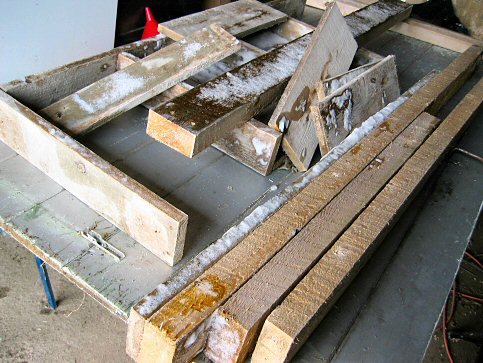
Every year so far, there’ve been two or three major projects that I’m sure just HAVE to be done. They’re usually EXPENSIVE (at least, expensive in the world of tiny farm finances!), which means, they take some thought. We’ve had the seedling greenhouse, excavating the pond, the Milkhouse Extension, the tiny tractor, the first full-time field hand (Conall!), and a few other steps… So far, so good. For the coming year, I have in mind a few more…important upgrades. I was reminded of one of them in the drive shed today, where the stakes used for my semi-effective semi-sprawl method of tomato support are stored, along with some of the couple hundred (largely useless) home-style tomato cages. For a while, I was dreaming of moving up to the basket-weave method—lots of twine and…weaving—although I have a hard time picturing all of that suckering getting done. What I REALLY want is BIG CAGES made from concrete reinforcing mesh…but it seems so expensive. Rough pricing: about $7 a cage times 500 cages, plus a fair bit of labor setting them up and taking them down. I know the method works well, but will it work well HERE, this year? Is it worth the money? For the same cash, I could almost build a second, production-size greenhouse. Or put more into drip irrigation. Or build a cooler for better short-term storage. Come to think of it, does growing dozens of varieties of tomato really make sense, couldn’t I just sprawl two or three big, round red varieties that would be easiest to sell…? In fact, I could grow a lot more of a lot less, cut out many varieties and entire crops, concentrate on the trendy best sellers, and get on the waiting list for an upscale farmers’ market in the big city. Top dollar! Maybe try for a bank loan for a bigger tractor (hey, there’s more acres in the garden field!) and a refrigerated truck?! If this is a (tiny) farm business, that seems to make sense: GROW! Yet somehow I’m heading in the OTHER DIRECTION. Stopping the city CSA to go local. Trying more crops and varieties every year and figuring out ways to buy stuff for them, like big tomato cages… It seems so…contrary. Which, in tiny farming, is something I guess you gotta like!!

Outpost returns

The mildly ambitious veggie outpost experiment of earlier this year has returned in pieces. The stand came back today, courtesy of Conall, who took it apart and dropped it off (you can’t help but notice, he’s pretty thorough when it comes to taking things apart…). In any case, a nearby coffee shop wanted to sell a small, choice selection of organic veggies. They were buying upfront at normal prices and marking them up a bit. Our part was to harvest once or twice a week, and deliver (only 12 miles)—building the stand was basically a last-minute favor… Why it didn’t work came down to that simple consideration that supermarkets are built on: SHELF LIFE. The coffee shop couldn’t get a handle on how to keep the veggies perky and fresh. I heard about an attempt to revive baby eggplants, shriveling after a day in the sun, by misting them like salad greens. Yikes. I would’ve helped if I could’ve, but I have zero experience with storage in a store-type situation. I’d kinda assumed that, since they prepare and sell food, they were equipped to figure it out. Not so. At the farmers’ market, I start in the cool early morning, it’s only six hours, and the veggies move quickly, so it’s all fine, without refrigeration or cooling, even on the hottest summer days. But keeping displayed veggies perfectly presentable for even a couple of days is a whole other specialized thing. Anyhow, after six weeks or so, we stopped. There was no ill will or anything, and we continued to supply mesclun for their salads for the rest of the season. The bottom line is a lesson I learned long ago, but failed to act on in this case: when you’re involved in something NEW, if there’s no plan that clearly deals with the DETAILS, chances are there will be…TROUBLE. I look forward to tackling this particular puzzle—how to handle daily fresh veggie sales—next year, when we FINALLY open the farm stand. ;)

Broccoli vs cauliflower

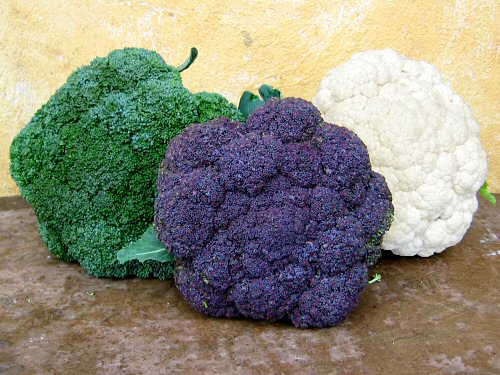
One broccoli (Early Dividend), one cauliflower (Early Dawn), but what’s that Violet Queen in the middle? The EDs are standbys, the VQ is new. It looks like broccoli, cooks like broccoli, tastes like broccoli, but it’s in the seed catalog as a purple cauliflower?! The VQ were transplanted really late, and I didn’t actually expect to see a harvest from them. But they showed up recently, and a couple of days ago, Bert, who buys lots of veggies here, saw them and decided to try a couple. “They’re broccoli,” he said. “Um, I believe they’re…cauliflower,” I said, while for the first time looking closely at ’em. “Don’t argue with him, Bert, Mike knows what he’s talking about,” said Helen, his wife. Last night, we steamed some for dinner. BROCCOLI. Today, I harvested samples for a formal close look, but really, there’s broccoli and there’s cauliflower, it’s not hard. Broccoli. Next, a call to the seed house, where extremely knowledgeable head man Bill assures me that it is…CAULIFLOWER. It beads up more than some varieties, he says. So, I’m confused. It may not sound like a big deal, and it’s not at this time of year, but it does point up yet another aspect of market gardening: knowing what you grow. LOTS of talking about veggies goes on every market day, and I NEVER say things just for the sake of it. I name varieties, explain when I’m very familiar with a particular veggie, or when it’s new to me…honest conversation, although it’s “sales talk” as well. And people trust you to…know stuff. Anyhow, I just looked up Violet Queen online, and it’s indeed, apparently, cauliflower. I’d swear it’s broccoli, and I’m pretty positive that you would, too! Maybe I’ll grow more next year, for when I feel like sounding like a lunatic! :)

Au revoir to the farmers’ market!

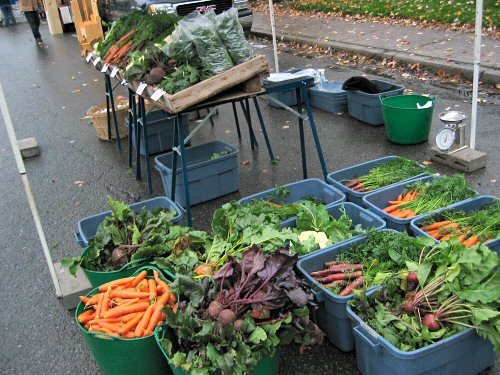
A great last day at the market! We were packing in the rain at 6am, drove in through a drizzle, and by the time I was set up just after 7, the rain had stopped! Despite the dreariness, it was quite warm. So far, so good. I didn’t particularly expect a big turnout, and was happy to find two and three people waiting at a time for a good deal of the peak fall hours, from 9:30-11:30. In the pic, it’s around 8:30, few people around as the weather sorts itself out, time to drink coffee and wander around a bit to chat. Soon, a steady stream of mostly regulars. It’s hard to explain the pleasure I get from this part of the people equation, so at this point I won’t even try. Growing food for people and delivering it directly is simply…great! The stand set-up didn’t change over the season as intended, it’s pretty barebones as it’s been from the start. I’m already renewing plans for a new and improved version for next year. On we go!

Pumpkins on the stand

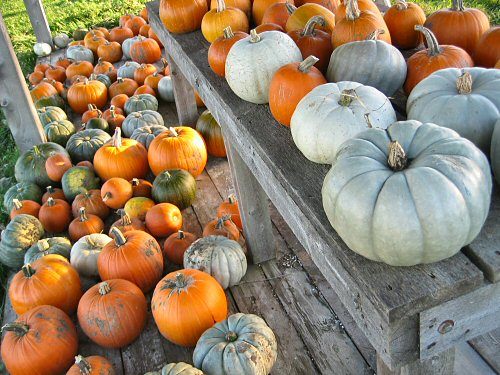
This year’s pumpkins eventually made it to the newly roofed farm stand. It makes a nice autumn scene, especially on a fine, balmy fall day like today. I suppose this coming together of pumpkin and stand is a fitting progression and a good sign, since both are works in progress. For the last couple of seasons, I’ve PLANNED to open the stand full-time for at least a day or two a week, but various things got in the way. And pumpkins have been too bulky to take in quantity to the market so far (we absolutely pack a pick-up truck; a roomy, custom-fitted trailer is on the big-purchases-when- I’m-able list). At least, the pumpkins are now on the stand! Several CSA shareholders have picked some up, and I’ve given away a few, so it’s working, kinda. The greenish-gray ones are Jamboree, the white ones are Lumina…

Seasonal eating

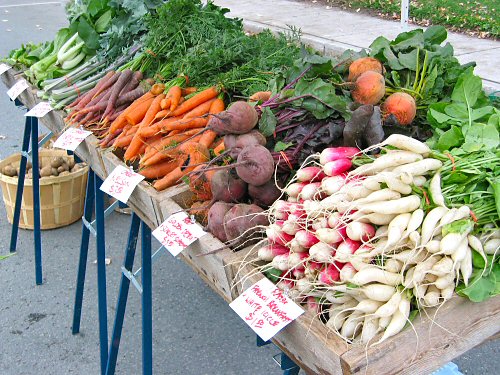
The veggie selection changes over the season, but it’s not necessarily reflected too dramatically on the stand at the farmers’ market this year. Compared to mid-August, the absence of snap beans and tomatoes is clear (with the mild weather, some vendors did have standard field tomatoes today). As for early June, well, more variety now is to be expected. Still, most of the cool-season crops for around here, like broccoli, cauliflower, and collards, also, winter squash, I have only enough of for CSA. On the stand, two types of radish (White Icicle, French Breakfast), three types of beet (Golden Detroit, Scarlet Supreme, Bull’s Blood, in smaller sizes here), two types of carrot (Nelson, Purple Haze), Red Russian kale, two types of bok choi (Mei Quing, Joi) and mesclun, plus Yukon Gold potatoes, Music garlic and Stuttgarter onions in baskets. The stand could be a lot bigger, offering more display space, and the harvest could be expanded (there are still herbs, summer squash, sweet and hot peppers, tomatillos, Brussels sprouts,…) but the marginal sales for many “secondary” veggies at this slowing down time of year don’t make it worthwhile. I’m still working on the balance between production planning, labor, harvest selection, post-harvest prep, and presentation… Sounds complicated, but it’s just…work! ;)