
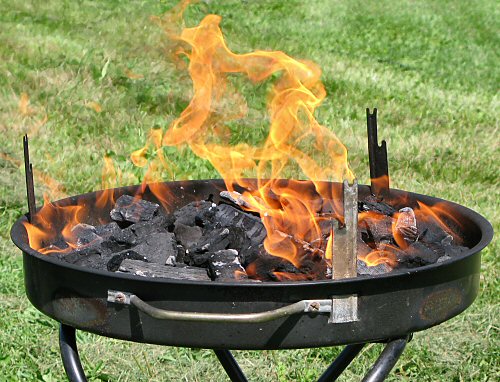
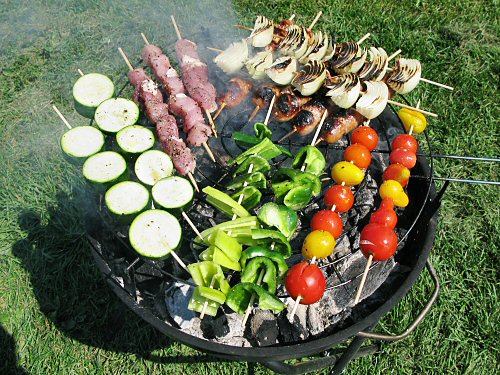
It took a while, but I finally dragged out the classic no-frills barbecue and continued the simpler BBQ approach started last season. This time around, I stumbled onto lump charcoal, which is pure wood carbon, and a step back from additive-rich preformed briquettes (I’m not all that serious about this, I just grabbed a bag and…discovered lump!). And so, on to the basic, quick-lunch-in-the-field experience, with garden veggies plus meat that the local independent butcher declares to be “local” (at least, from around us here in the province of Ontario). Chicken, pork, and several types of pork sausage, plus zucchini, onion, sweet and hot peppers, and cherry tomatoes from the garden. Also tossed rosemary branches right onto the coals for some aromatic smoke—between the breeze and the open grill, it didn’t do much flavoring, but it smelled nice! Cooking time is made easy by putting only one type of meat or veg per skewer—just slide off what you want and combine in your mouth! Simple and…tasty!!
meat
A simple (chicken!) sandwich
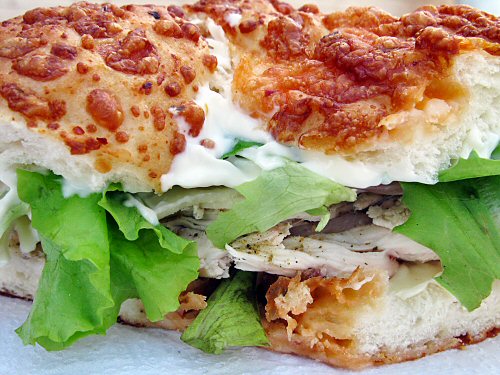
Roasted a White Rock chicken last night, today, got a Spicy Cheese Loaf from Fran, the baker beside me at the farmers’ market. (The market day went well, it was the first day of CSA shares: mesclun, spinach, radishes, garlic scapes, beet greens—it’s still early.) The chicken and the bread naturally organized themselves into a late afternoon simple sandwich…
Looking at it before the first bite, I realized that I’ve been thinking about FOOD a lot more recently. Not exactly my own diet, but on a more personal level than as a local veggie grower, probably something to do with the Endless Salad, more communal cooking and eating lately…
Part of the running stream of thought has to do with nutrition, what I know about it, how much I want to and need to explore further. I mean, do I really have any sort of basic IDEA of what to eat, beyond “lots of veggies, little meat, drink lots of water,” vague general guidelines like that? Do I NEED a plan? Should I RESEARCH? Consult with a nutritionist or a naturopathic doctor (I’ve been considering visiting an ND for an initial workup)? Sheesh, more RULES! All that is really clear is that most people around here (a “developed nation”) don’t know much practical stuff about the food they eat, me included.
The other part is about food quality, and local food. The one thing I’m quite sure of is that it feels way better to eat fresh food that you’ve grown, and to know where the rest comes from and what’s in it, and that wasn’t at all painful to discover. So, I examined this pretty local sandwich. The cheese bread listed the ingredients: flour, water, cheese, sugar, milk, vegetable oil, butter, yeast, dried chili peppers, salt. The chicken was raised here on the farm from two weeks old, fed mainly Purina (Cargill) starter and grower feed (nutritional content in percentages, contact the manufacturer for the actual INGREDIENTS), with some greens from the garden. The lettuce is from the garden. I poured on home-made vinaigrette dressing: extra virgin olive oil from Italy, pink salt from the Himalayas, fresh-ground black pepper, vinegar, Tabasco pepper sauce from…the store. The mayonnaise is from Kraft, it was in the fridge, the bottle says it’s “real.” It’s all ingredients within ingredients… I’m planning to make my own mayo, with eggs from the farm and oil from…Italy. Should I care where the flour in the bread came from? The cheese? The chili peppers? And what about the “vegetable oil,” what’s up with that? Should I make my own cheese and bake my own bread? When do I start looking around for organic chicken feed, how IMPORTANT is that, what’s the priority, how much can I afford to PAY?
I don’t have any neat point to sum up with here, I’m just being a literalist and looking at what I eat. When you start to question your basic eating habits in a very primitive way, they may not hold up to much scrutiny, and that’s unsettling. I’m curious. The story unfolds…
Chickens to the slaughter
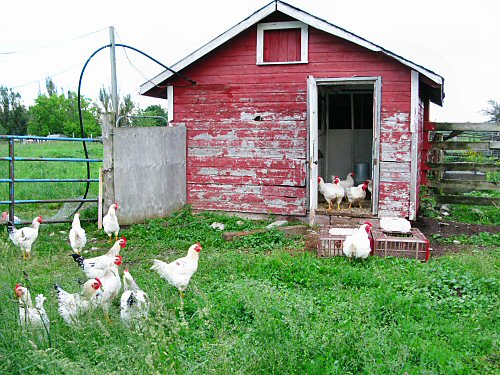
Raising your first chickens, killing them, and eating them has gotta rank up there with other Firsts worth a little attention. Now, I’m at least part of the way there: the killing this time was done behind closed doors, with me on the outside—chicken PROCESSING. Still, first enough to be worth a few photos… I’d been cutting it close with booking a processing day for the White Rocks, the local processor is known to get solidly booked for weeks. I finally called yesterday, looking for a date in two weeks, and was told there was also a cancellation for tomorrow (today!). I checked out the WRs, and, man, how could I imagine them getting any bigger (I think I was mesmerized, waiting for them to explode)? So I called back and booked. We drove over last night to pick up crates (20 minutes each way), then it was up at 5:30 this morning to load ’em. As soon as I opened the door, all of the Frey’s dual purpose darted out immediately, as usual, while the WRs, who mostly go nowhere, stayed in: it was kinda fitting that the Frey’s stood around in unfenced-in freedom, ready to run (and they would’ve!), while the WRs kinda dumbly looked out at their crates (above).
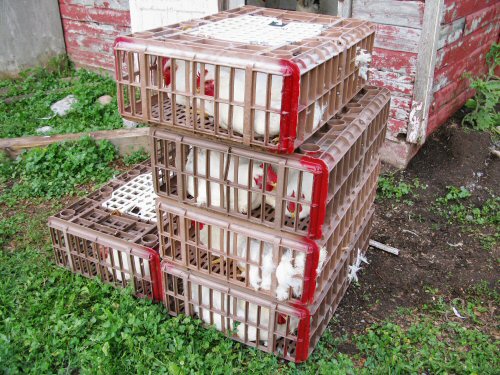
Five to a crate, 25 in all, 30 minutes or so to loaded…no need to chase down these lumbering beasts (while I was packing, most of the Frey’s figured out no good was afoot and entirely disappeared around the other side of the chickenhouse, something they’d never done before, while a couple stayed to watch).
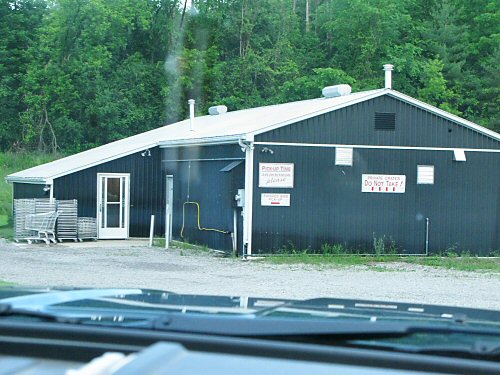
The processor is on a farm, a low building where birds go in live on one side, and come out the other, cleaned and chilled, weighed and government-inspected, ready to go…
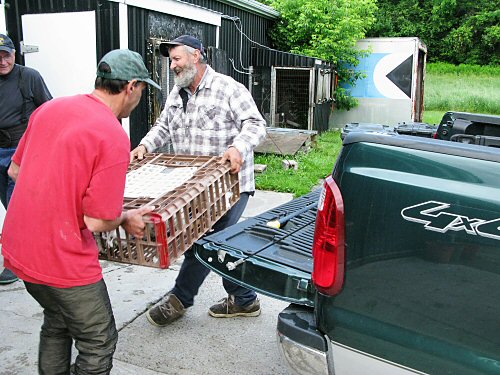
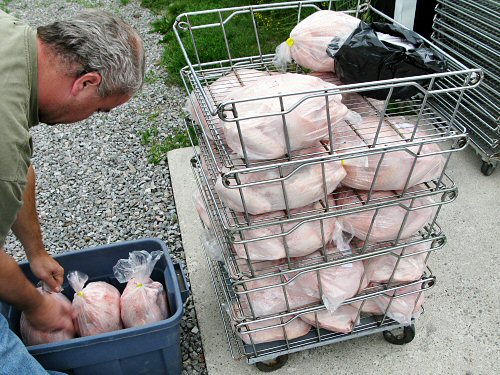
Bob and a processing guy unload. It’s 6:45am. The paperwork is quick and painless, I didn’t even have to write or sign anything. The only sign of bureaucracy in action is the required chicken purchase number, a serial number that’s on the form that you fill out when purchasing the chicks. And the on-premises government inspector popped out and did a little of his own paperwork. Other than that, just processing choices. For a few cents more (like 75-85), you can have the chickens halved and put in separate bags, or halved or quartered in the same bag. We got 10 halved and separated, for when cooking a whole fat chicken would be a little too much. Modern conveniences?! :) I also chose to get the organs back (in the black bag; below).
Eleven hours later, it’s 5:30pm and we’re back. Matthew helps pack the big birds for the trip home and into the freezer. Average weight is around 8lbs (3.6kg), where the Frey’s are maybe barely 3lbs. Hmmm… Not the most satisfying little adventure, with three 40-minute round trip drives, and the chickens disappearing through yet another middleman, reappearing neatly packaged for $3 more… With the processing fee tacked on for good measure, these are EXPENSIVE chickens, but I’ll do the math, and review the overall, somewhat unsettling White Rock Experience…later. On the other hand, you can’t beat the results: a lotta REALLY plump chickens! Next up in Meat Birds, Take 1: waiting for the free-ranging Frey’s to bulk up, and THEN it’ll be a fully DIY field-to-table chicken dinner!
Frey’s vs White Rock
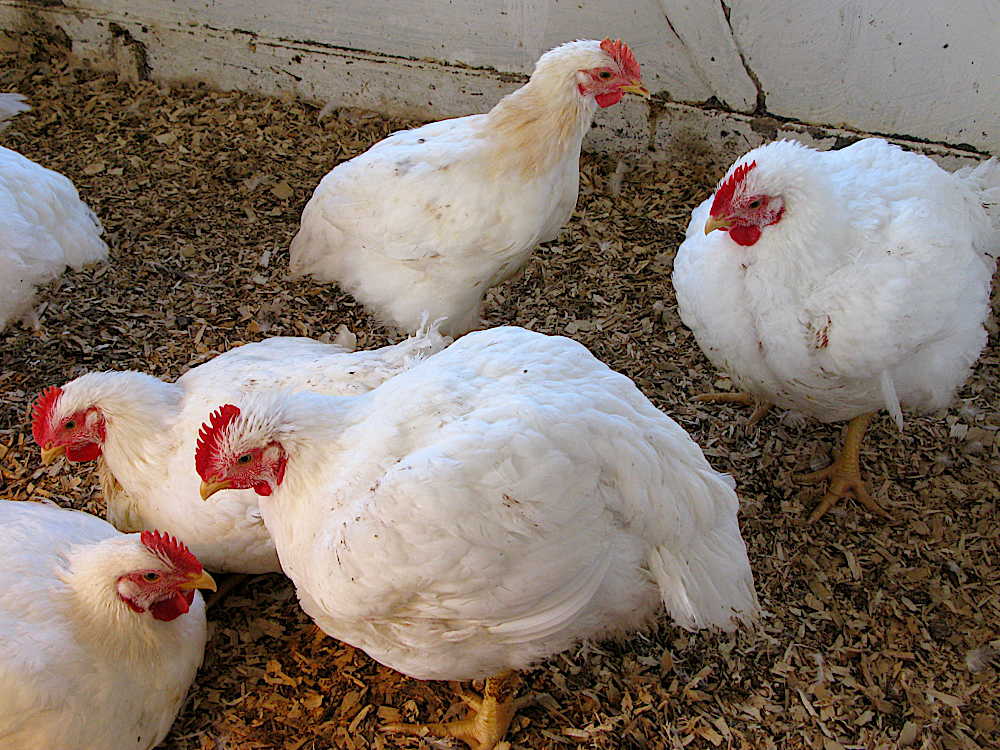
At this point, it’s safe to say that I’m no fan of White Rock Cornish X chickens. Without a doubt, they convert feed to meat incredibly…efficiently—compare the lone Frey’s Special Dual Purpose at the top center of the pic, surrounded by hulking, waddling White Rocks two and three times its size. What they gain in meat, they lose in basic chicken-ness… This first flock of mine are lumbering birds, with no taste for the outdoors, no built-in scratching skills, they’re definitely not up for dust baths or foraging through tall grass. They sit around, eat like crazy, drink, and, here and there, just kinda spontaneously DIE. I’ve learned a lot from this first go-round with meat birds, and I haven’t entirely rejected the White Rocks—I’m saving my final…evaluation for after they’re off to the slaughter in 2-3 weeks. More to follow…
Chickens just wanna eat…
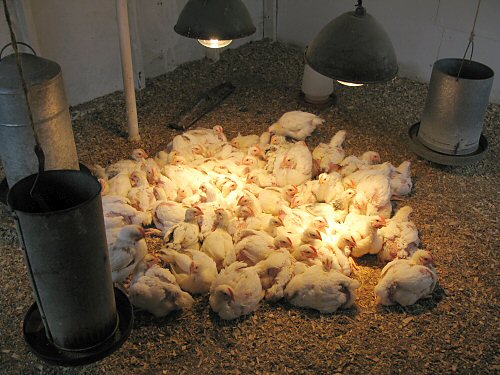
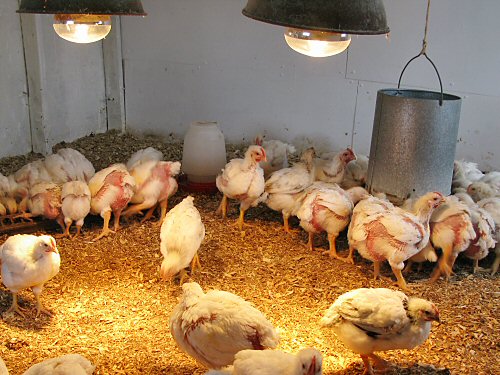
The chickens are blowing up! At least, the White Rock Cornish X super-converting chickens are, turning feed into meat at a startling rate. The 10 or so Frey’s Special Dual Purpose are sleek and speedy, and all their feathers are in, but I guess that’s not what a truly modern meat bird is supposed to be like. Most of the White Rocks are double the size of the Frey’s. When I think of the chickens these last few days, it’s a vision of pink, partially-feathered butts in the air, circled round the feeder… Oh well, we’ll see what happens when we get them outside and cut back a bit on FOOD…
Meanwhile, despite entirely different sizes, speeds and eating habits, they’re still all getting along. My first chicken adventure continues…
Catalog shopping: chickens on order!
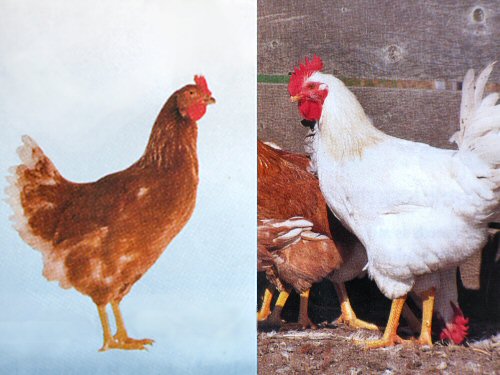
Chickens are on the way! On the left, a reportedly prolific brown egg producer, the Shaver Red Sex-Link. On the right, the reputedly hardy, healthy Frey’s Special Dual Purpose as our meat bird.
I almost broke a pretty basic rule on this one—get your questions answered first!—and ordered White Rock Cornish X for meat. Chatting with Bob, we’d decided on the Frey’s Special, but at the last minute—on the phone ordering them from the feed store—I asked about the Frey’s, and was told that “99%” of the small quantity meat birds were “White Rock” (meaning WR Cornish X), that people were often disappointed with the dual purpose for meat, that for meat, White Rock is the way to go. White Rock! White Rock!
So I got off the phone, and did some quick extra research. Talked to Bob again, who said the thousands of meat chickens he’s raised were all White Rock, BUT, they have to stay indoors, WR just stand around and EAT, which is why he thought Frey’s would be better for outdoors.
Next, hit the Web, and found stories of people successfully free-ranging WRs, even in the heat. BUT, they also said things like: “They did wander around a lot but nothing like the regular birds. They did all the normal bird things just a whole lot less gracefully. Only thing they couldn’t do was perch or fly.” Hmmm…
Which took me back to the original stuff I’d read in the hatchery catalog, things like: “Unfortunately, the White Rock’s increased efficiency at feed conversion has not been matched by improvements in the bird’s cardiovascular system. Simply put, too often the bird’s heart just can’t keep up with the rest of its body.” Yikes… Hello flip-over disease (aka Sudden Death Syndrome, aka…heart attacks), which tends to afflict the biggest, healthiest birds… And there’s lots more disease warnings, feeding restrictions, general strict instructions… Extremely fast-growing meat chickens, no doubt, and I’ll probably try some…later, but too weird for now…
For good measure, I got through to the Frey’s hatchery. The woman on the phone was great. She said most people just want to produce meat quick and go for the WRs, and they may do OK free-ranging, but really, they’ve been bred for rapid growth in a controlled broiler barn environment, AND, for a hardy, free-ranging, TASTY meat bird, dual purpose are great, friends of hers raise the Frey’s Special and love ’em. So Frey’s Special Dual Purpose it is, more traditional chickens that grow a little slower and weigh a little less, but can actually have fun, run around, eat insects, scratch in the dirt, and won’t…flip over! There are 50 2-week Frey’s Special cockerels coming either April 16 or 30, and 25 ready-to-lay Red Sex-Link on June 23.
Entering the world of CHICKENS, I’m excited!
(UPDATE: After writing this post, I read the comments below, did some more online reading, and switched the order to 40 White Rock Cornish X and 10 Frey’s Special…)
(UPDATE 2: It’s a year and a half later, and we recently processed a second flock of White Rocks. My original last-minute double-switch to White Rocks was a good one. I still want to raise other breeds, but you absolutely can keep healthy, free-ranging WRs, and they do get to a good size!)
New cows!
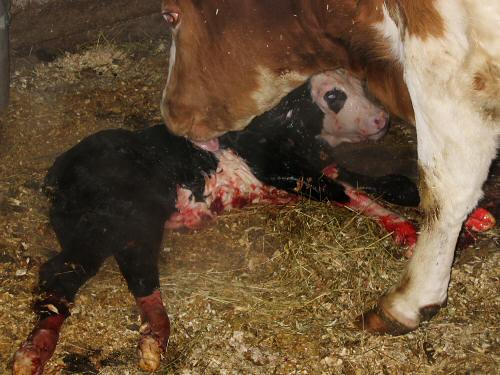
There was action in the barn in the wee hours today. A couple of the cows gave birth. Here’s the first new one, around five minutes after his 4 am delivery into the cold barn.
This is the second time I’ve watched the whole thing unfold. The first was maybe a year ago. In both cases, human intervention was required, which consisted of Bob with a length of chain wrapped around a pair of calf’s feet, pulling.
Last time, he explained it was a dry birth, where the embryonic sac breaks too soon, the head dries out, and, less lubricated, it sticks on the way out. A little feet-planted-firmly tug-o-war type pulling and…a new cow!
This time was a little more complicated, a breech birth, with the calf turned right around so its back end was aiming out instead of the head. Particularly with first-time births, the mothers aren’t relaxed enough to let the bigger back end out first.
To help things along, the stainless steel calving chain was wrapped around the hind legs and attached to a cable with a ratchet, in turn attached to a steel fence post set in concrete.
The long-handled ratchet allows the cable to be pulled with more force than a person alone could manage, as long as the cow stays put and sets herself against the pull (which she seems to do, since I guess she too wants the baby out!).
After some minutes of pulling, out popped the calf. It’s a boy!
There’s lots of bloody fluid and trailing bits, and the calf lies there at first like a limp, wet, bloody corpse. But the mother is right on it, licking away, and within minutes its head is up and peering around, and if all’s well, it’ll awkwardly stagger to its feet in under half an hour. Pretty cool!
The second mother gave birth around four hours later. The first time watching all this was interesting, a little sensational with all the bloody fluid. The second time, it was simply satisfying, another really basic part of life that most of us in the modern world just plain miss (we eat meat and drink milk, don’t we…well, a lot us do)?
I’m not sure about the breeding timing or anything like that, like, Why calves now? With Bob’s cows, I’m an observer, sometime consumer, occasional chaser.
Here’s the second calf, three hours after an 8am arrival, up and tottering around! Sturdy!! It’s fascinating to watch them rapidly get used to their legs, steadier by the hour.