
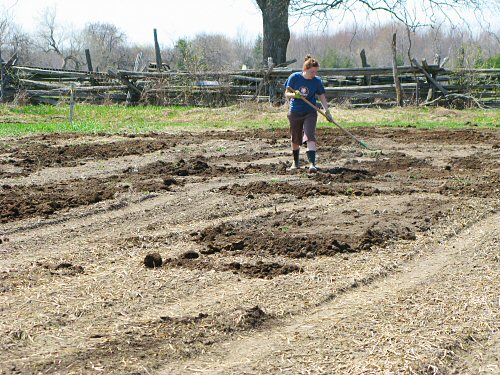
Bed preparation and first seeding continue. Today, Lynn’s tiny farming experience broadened to include rakes, and using them to spread compost. Moderately hard work in the heat, but it was a fairly small area. Overall, things are generally on schedule, but at least a week behind last year for the earliest stuff (and first peas were in last year on April 3rd!). Also, after the lingering snow, conditions changed practically overnight, but with the extremely hot, dry week, despite some watering in, the crops seeded so far are slower to germinate (we need rain!), and may come up a little thin when they do. So far, peas, spinach, beets, radish, all-lettuce mesclun and green onions have gone in over the last few days, and everything but the peas got one watering… I should have direct-seeded leek and parsnips in, but I’m kind of waiting for some rain. Also coming up in the next day or two, carrots and Swiss chard. And there’s a mountain of onion sets and seedlings ready to go, plus a few other transplants. And potatoes arrived today…
peas
The seed…
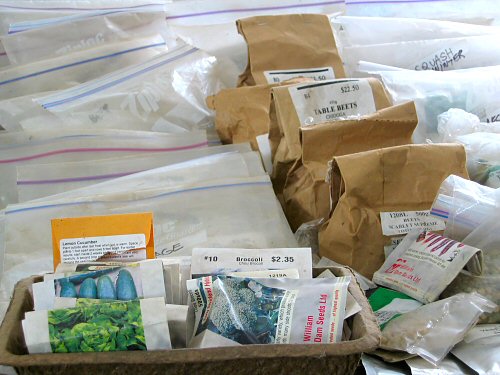
Keeping up with the early start, I got out the seed from its storage chest to take a look. With the tiny farm’s growing HISTORY (hey, Year 6, coming up!), keeping the seeds sorted for freshness is an ever more…serious consideration. Old seed won’t work, and there’s always lots of carryover from year to year. For this garden’s veggie selection, seed life in cool, dry storage conditions falls into three categories: nice and long (around 5 years, for brassicas, cucumber/squash family, lettuce, tomatoes,…), medium (around 3 years: beans, peas, carrots,…), and SHORT (1-2 years, for onions, corn, parsnip, parsley,…not too many here). Luckily, this is all book info, not gathered from painful personal experience! But I listen closely, ’cause one of my biggest garden nightmares is THINGS NOT GERMINATING… There are enough reasons why gazing happily on those newly seeded, semi-straight rows might be the greatest satisfaction they ever offer, and dead seed shouldn’t be one of ’em. My first germination test last year seemed to bear out the wisdom of others: normally-stored seed is not forever… So, it’s checking packs and taking dates!
Late June harvest
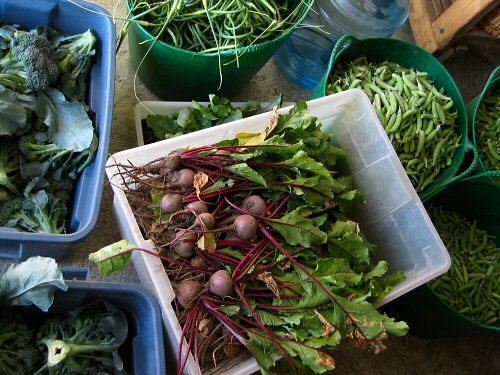
The harvest is still small: snap peas, broccoli, mesclun, the last of the garlic scapes and spring spinach, beet greens, the first few, baby beets. With 50 CSA shares to fill this year (around double from last year), plus the farmers’ market, a couple of local outlets, and the farm stand, I’ve really upped the ante. Even with PEOPLE at work in the field, I’m concerned about quantity. Where bad germination and losses from pest damage here and there have been no real worry so far, now every little setback seems…dire. Probably, most of this is in my head, endless millions of small farmers have done it before and are doing it now. Still, staying tiny and diversified at my particular scale seems tougher than before. It’ll work out, and for now, any uncertainty keeps the adrenaline on a steady slow drip! :)
Packing station
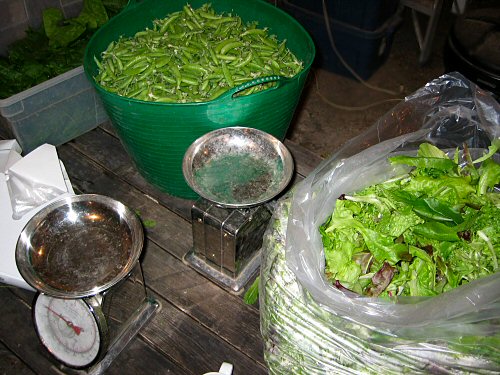
The post-harvest is a simple, straightforward process that has to be done fast since we don’t have a cooler. The set-up is manual and basic. Today, we packed indoors to get out of a stiff breeze that would’ve taken the salad greens sailing (usually, we do everything outside, in the shade of the barn; the indoor option is part of the new luxury of the Extended Milkhouse). There are a couple of 2 kg kitchen scales for the snap peas and lettuce mix. Everything is sold by bunch and bag, not weight, but the scales are useful for keeping things consistent. It’s quite easy to get the right amount by eye, so it’s into plastic bags and pop onto the scale for a quick check. If it’s underweight, add more, otherwise, somewhat over is just fine!
First direct seeding of the year!
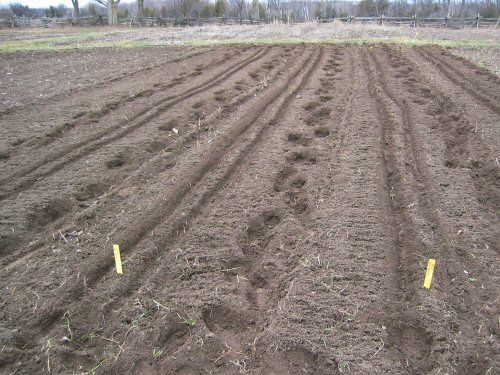
O the excitement and satisfaction. The first 400′ of snap peas (Sugar Ann) are in! This is the first seed to hit the field this year!!
It’s a low-risk gamble for two-three extra early bushels for the market. With over a week of cold days, subzero nights and even snow ahead till mid-month, the peas may germinate unevenly, and there’s little more annoying and unproductive than picking a not-dense-enough pea planting (you pick forever to get relatively little).
Last year, I seeded out this early with two varieties, and neither worked out as well as the next seeding 10 days later.
Here you see the results of my current bed marking technique: using a 100′ reel-type measuring tape, I mark the path centers on both ends with a label stake, walk ’em out, and pull up the stakes. Presto!
These beds are 4-1/2′ wide. The spacing between the double rows is a little wide to what I usually do (4-5″), but the freshly tilled soil made maneuvering the Earthway seeder close to the first row difficult (tight double rows for bush peas let the plants support each other and you don’t have to weed between).
It’ll work out! Delicious edible-pod peas in 60 days?!
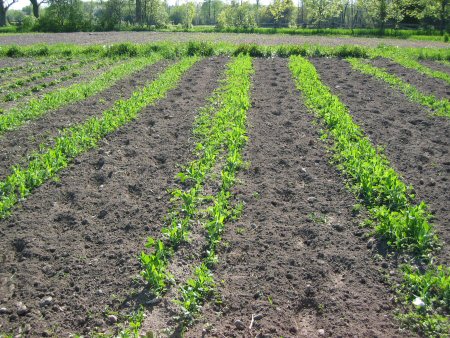
It’s a start…
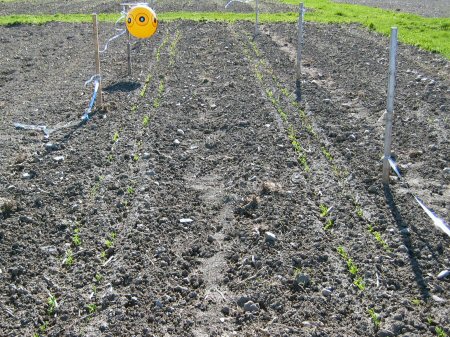
Peas planted in early April finally poking up. These are Sugar Ann snap peas, you can eat the pod and all.