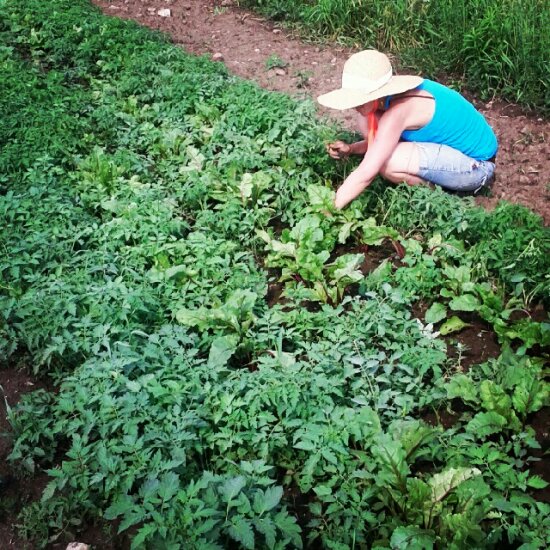
Hand weeding, what can I say, the cornerstone task on a tiny farm. Mel dives in (that’s beets in there, and volunteer tomatoes as weeds). This section has been unusually neglected, and still it’s really not as bad as it might look: in ideal start-of-summer conditions, what a difference just a few days can make, but it’s not too dense or deeply rooted, and a couple of hours of quick hand movements can cover a lot of area. We’ll also wheel hoe down the outside edges of the beds and down the paths, which is at least five times as fast! Give weeds too much of a head start, though, and Hand vs Weed is not a fair fight. Timing!
weeding
Drizzly days
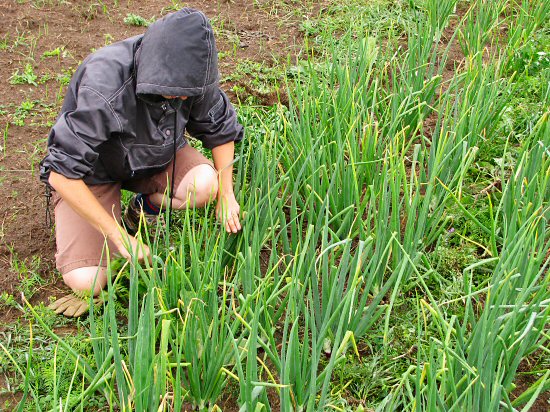
It’s been cloudy a lot this season, but the rain has kept pretty much to a reasonable number of rainy days and single downpours—it hasn’t been too WET. So, not that much fieldwork called for rain. Today was an exception, with a steady on-and-off drizzle from early morning that kept things watered down.
Lynn came out around 8:30 am to weed. Since it didn’t look like the sun would be showing up to dry things out, she finished a bed of onions (these are the last-planted onion seedlings, a fair bit behind the rest) and we called it a day for weeding.
In general, we try not to handle plants when they’re wet so as not to spread any sort of disease. This is a common caution for, for example, beans, and I’m not sure how it applies across the board to all garden veggies. Still, since wet work in the field is seldom fun anyway, it seems like a good rule in general: No weeding when wet!
Early season harvest day
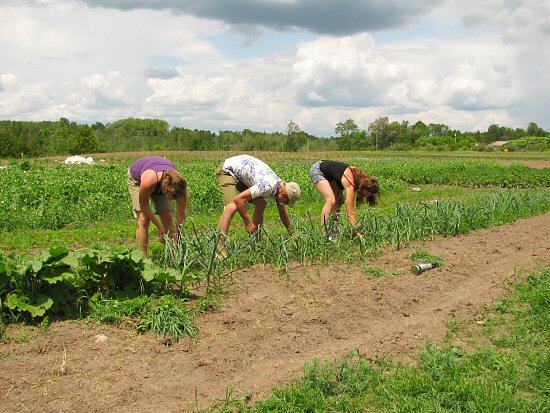
It’s a harvest Friday, second for the farmers’ market, and first for CSA, but the load is still light. After picking snap peas, we spent the day doing other field work. In the photo, Libby, Jordan and Michelle are hand-weeding the small strip of spring-planted garlic, and we spent some labor-intensive time thinning a 400′ (122m) of carrots, and several beds of beets (the thinnings were the beet greens harvest). In late afternoon, time to cut greens: spinach and mesclun. Plus a little parsley.
Checking back over the last four years, at this time, we had broccoli once, radishes usually, baby Swiss chard a couple of times. And, of course, garlic scapes. And, a couple of years, no peas yet. So, all in all, with the slightly slower planting schedule in this start-up this garden, and all the cloudy weather, we’re doing pretty well!
Pumpkins and pigweed
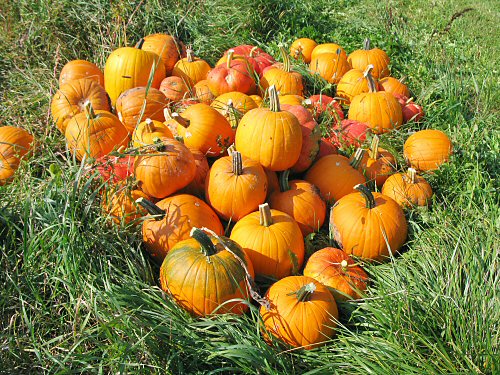
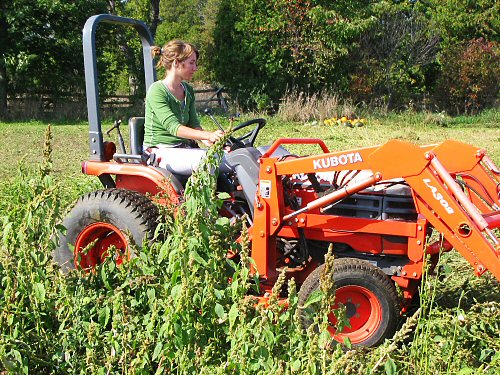
Today, the pumpkins came in, wrested from a jungle of pigweed gone wild. Every year, a few of the 40 50’x50′ sections that make up the 2.5 acre garden get a little overrun with one weed or another (usually, pigweed). This year’s pumpkin patch was a good example, with pigweed growing unchecked for a good six weeks—no time made to weed, not IMPORTANT enough a crop—until today, when Raechelle used the belly-mounted 52″ mower deck on the Kubota compact tractor to mow it down!
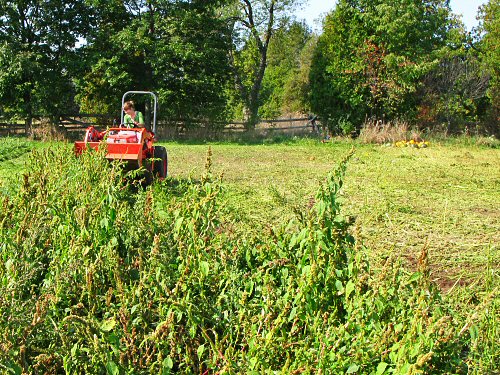
Of course, this is exactly what you DON’T EVER DO in a garden: allow weeds to flourish and go to seed, then mow them down, broadcasting seed everywhere… Oh, well. The alternative, pulling the pigweed by hand, then carting it off, we also do when necessary—see the Pigweed Mountain—but once in a while, I go for the instant gratification of seeing a section clean and clear in an hour or two. The millions of pigweed seeds, ensuring healthy future generations for years to come, will be dealt with…later. (As long as we weed on time next time around, how bad can it get?! :) Anyhow, it’s all part of the grand experiment! Guest pumpkin photo by Lynn.
Fall crop watch
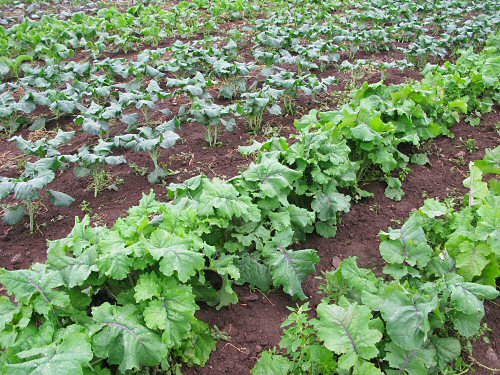
After a good weeding and another round of rainy days, the fall brassicas are pretty well on their own. It’s amazing how quickly growth slows down in September—what a difference the sun pulling away makes! The kale and collards are doing fine—we’ll be harvesting some Red Russian kale tomorrow. Broccoli and cauliflower will come through. Whether cabbage, planted this late for harvesting at baby size, will make it by mid-October is up in the air. More gambling and waiting to see…!
After the row cover: weeding!
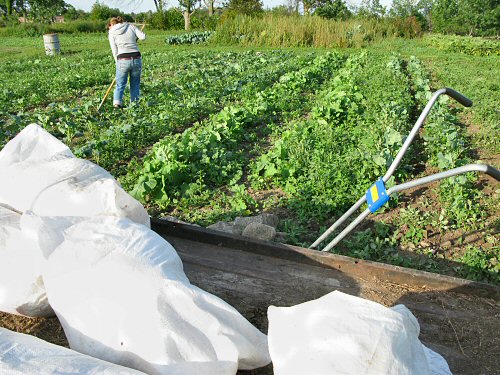
It’s been about six weeks, time to permanently remove the row cover from the last transplanting of fall brassicas! There are two sections, about 20 x 50′ beds in all, with broccoli, caulflower, cabbage, collards, kale. The cover protected against flea beetles, and at this point in the season, the FBs aren’t around much. Which leaves the post-cover weeding! I generally plan to remove the cover earlier, weed, and then replace it quickly, but this seldom seems to happen. Instead, it’s one big weed-a-thon at the end… Here, the mainly pigweed looks fairly big and dense, but it’s actually not much of a problem. The row cover has protected the ground from many days soil-packing rain, so the beds are nice and loose (it’s amazing how much rain can compact clayey soil). Weeds come out easy! With two people, it’s a relatively quick job, 2-3 hours for a pretty thorough clean-up. We worked with a combination of hoe and wheel hoe, me doing the paths and between-row clearing, and Lynn hand hoeing in-row, between the plants spaced at 18″ (45cm)…
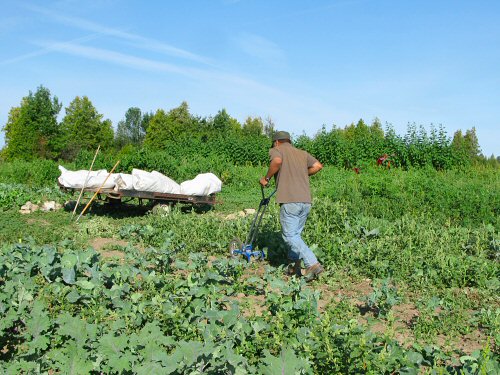
Each time I use the wheel hoe, I grow to love it that much more. So easy, so TIME-SAVING! It’s such a sophisticated yet simple tool, a perfect marriage of wheel, leverage and steel (you could say! :)… Today’s job is heavier work than it’s usually used for, the weeds aren’t just emerging, they’re pretty big. Rather than rolling the wheel hoe continuously down the rows, I’m cutting the weeds with a series of forward and backward strokes that either slice the plants below the surface, or pull them out, roots and all…
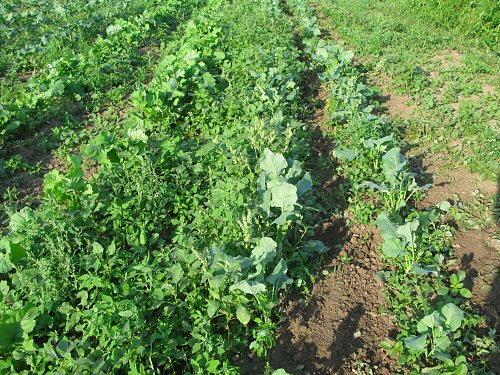
Clearing a path (before and after, above) in the loose soil takes maybe 3 minutes for 50′, many times faster than hoeing or hand pulling…
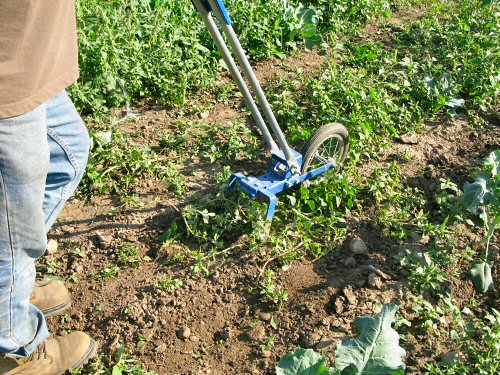
For this heavier weeding work, I use a fairly forceful forward stroke that travels about 1-1.5′ (30-45cm), then raise the blade to clear the felled weeds as I step forward to start the next bit…
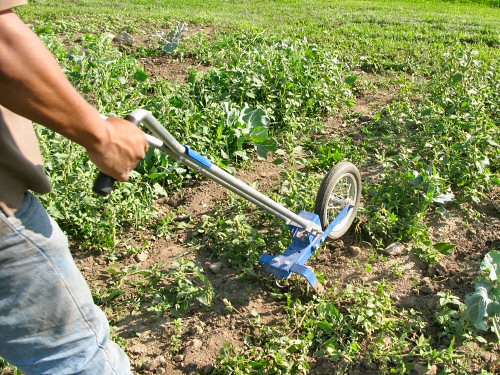
The wheel hoe is equally good at cutting on a backstroke, which comes in handy for dense areas and tough specimens… It’s not particularly strenuous work: the blade is sharp, the wheel and angle of the handles give lots of leverage and momentum, and some part of the hoe is always in contact with the ground, so you’re never completely lifting the whole tool. Like most things I do here in the field, I’ve figured out how to use the wheel hoe on my own, by reading instructions, looking at pictures and applying my version of common sense. Techniques no doubt vary. It’ll be interesting to eventually see how others do things! Meanwhile, everything seems to work out…especially, the wheel hoe! (Wheel hoe action photos by Lynn)
Parsnip surprise
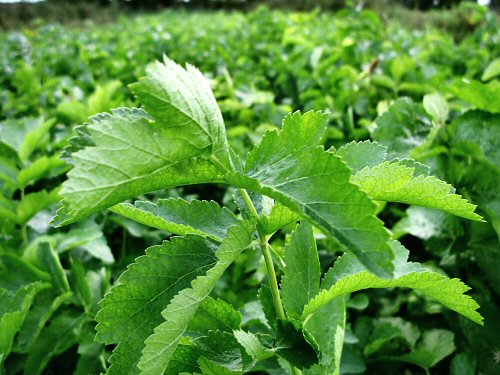
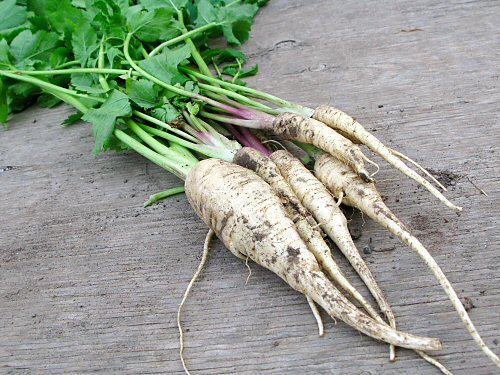
Parsnips, at last! This is a crop I’ve tried to grow almost every year, but until this season, it’ hasn’t come through. Parsnips take a while to germinate, a couple of weeks or more, right in the middle of the spring planting-out rush. Weeds would start to take over, parsnips weren’t a priority, and I’d never find the time to save them. This year’s warm, wet spring made a difference. Germination was quick and the seedlings surged ahead of the weeds! Nearly four months later and, even in dense, unthinned rows, the parsnips are thriving. Yay! Today, I dug up about 6″ (15cm) of a row to check ’em out. With the crowding, there’s a motley assortment of sizes, but overall yield looks good. Another month in the ground, a little post-harvest sorting, and it’ll be parsnips for all!