Carrot-burlap method gets a twist

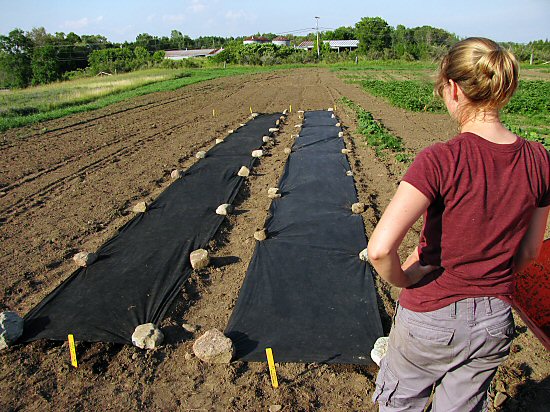
Here’s one of the more extreme displays of crazily labor-intensive tiny farming technique. Andie surveys our work, the result of deciding to try landscape fabric in place of burlap to help carrot seed germination. It’s actually a double experiment, because one of the beds is green onions.

The burlap method has been the way to start carrots around here for the last two seasons: tried and true. The main purpose is to preserve moisture in the seed drills, and the increase in heat helps as well.

After a good run, the first round of burlap expired, and I couldn’t find rolls of it in time for this season (I know it’s out there, somewhere). But, I spotted this gear, landscape fabric, a porous plastic mulch used to permanently suppress weeds in…landscaping. It’s light, and just wide enough (3’/30 cm) to cover 4 rows of carrots (that’s a little closer than usual for the bunching onions). I tried it on two beds earlier in the season, and it works fine!

One little problem: it tears easily, so how to hold it down? With the burlap, we made wire staples out of heavy gauge wire. Here, we placed a LOT of heavy rocks, close enough together that there’s no room for the wind to get under and start really pulling. This does the trick for now, but overall, it’s a little TOO intense. The hunt for burlap: still on!
Direct seeding

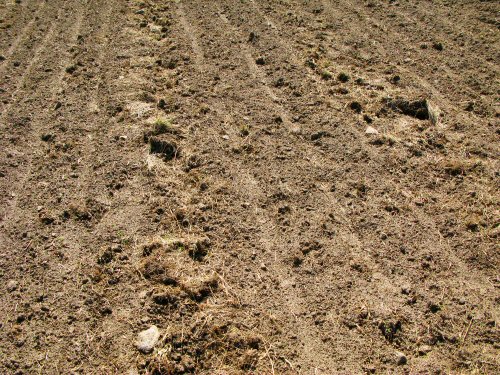
Direct seeding is going ahead at a careful pace. There’s a fair amount of broken up sod in the mix, and it would be nice for it to have more time to settle in and decompose, also for any bits of live grass to start poking up so they can be disrupted again with a light tilling… But we can’t just wait around. Spinach, beets, and radish went in a few days ago, just after the first peas. More peas went in yesterday (Connor for the first time wrestles with the kinda heavy and unwieldy Planet Jr., above, and ends up doing fine on a trial row). Now, the watching and waiting is on for the first plants to emerge in the field…

Tomatoes galore

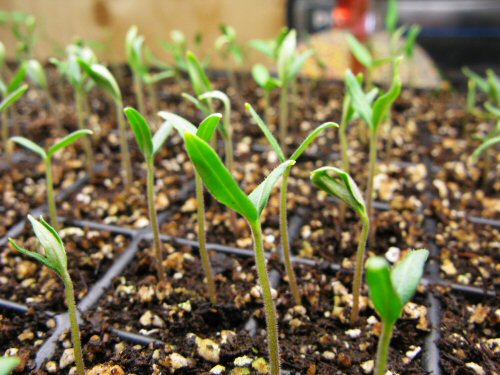
Tomato seedlings are suddenly everywhere! We planted out the whole of this year’s line-up in a couple of days, starting a week ago. The first tray (above) started popping in just 4 days! There are over 60 varieties, including around a dozen cherries. Except for half a dozen hybrids, they’re all heirloom.

Heirloom tomato seed seems to be more quirky than the hybrids, with noticeably different germination speeds and rates from variety to variety, and year to year. Here, we’re waiting on Cherokee Purple from some leftover 2006 seed—one’s up, there in the distance, the rest may come along soon, or not. Meanwhile, right beside, three rows of 2008 CP are up and at ’em, so we’re covered either way.

I haven’t really looked into all this—setting up more efficient storage than my current airtight-bags-and-cool-place method, whether the plastic lined packets from the big seed companies do better than the plain paper ones from many smaller seed houses, presoaking seed for some crops in a kelp solution or whatever, and so forth—because there isn’t much older seed, and most seem to do just fine. So much to try, so little time… Luckily, it always works out!

Kale in survival mode

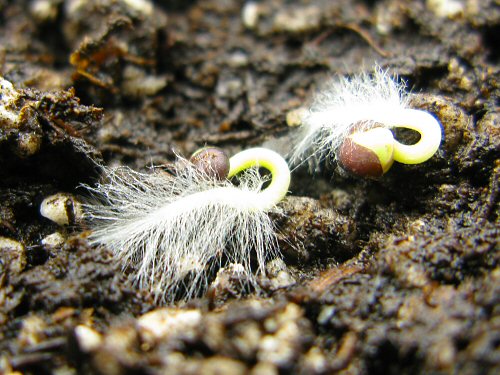
At first, it looks like some sort of horrible, fuzzy mold, about to devour your newly germinated seeds. But when you get really up close, it turns out to be superfine, hairlike extensions growing from the radicle. These kale sprouts pushed themselves right out of the seedling mix, probably because they weren’t pressed in and covered deeply enough.

Kale, broccoli, cauliflower and other brassicas do this in a very visible way during a surface emergency, sending out a mass of fine root hairs in search of water. Root hairs are normal below ground, but I’ve only really noticed them growing exposed on brassicas, other newly emerged seedlings with bared roots usually seem to just dry up. An unusual glimpse of what plants are up to with their vast root systems down below.

Given half a chance—a little surface moisture—these guys can actually manage to burrow down and root themselves. Pretty cool trick.

New eggplant (and peppers)

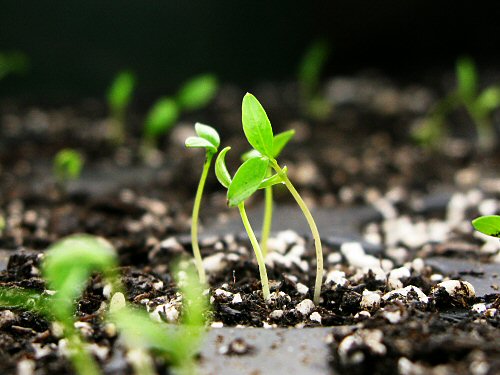
Today I peeled back the plastic on Vittoria, the first eggplant to show up for the season. So far, seeded a week ago, there’s Dusky and Vittoria eggplant, and Ace, North Star and Gypsy peppers, and they’re all just beginning to poke up. These seedlings are ahead, with a little more than a day’s growth.

Peppers and eggplant tend to germinate unevenly, at least in my particular lighting set-up, usually appearing first in the rows directly under the lights, and then making their way to the outer edges of the trays. I’m not sure if it’s the slight differences in light, or in heat from the lamps, that a couple of inches make, but it seems pretty clear that it’s one or the other, or both. Sensitive little guys. There’s a spread of up to a week between first up and mostly germinated… Adding to the unevenness, some varieties come up faster than others.

Give ’em all a few weeks, though, and they all usually even out, either indoors, or in the field…

Useful details? Maybe! :)

More seedlings appear

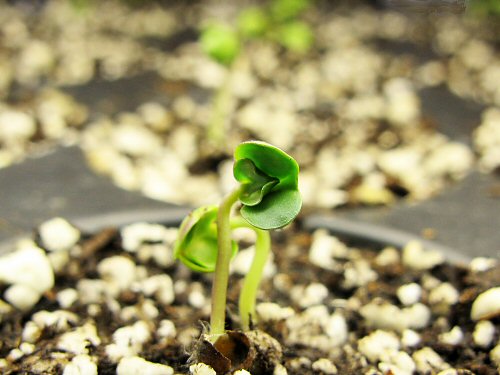
The brassicas—cabbage, broccoli, cauliflower, kale, and so much more—are satisfying at seeding time because they usually come up quick. This tray of Early Dividend broccoli is popping only three days after seeding. I don’t take notes about days to germination, except occasionally here on the blog, but I’m surely watching, especially with older seed. So far this year, with the seedling room usually around 65-68°F (18-20°C), the trays covered with clear plastic, using  new seed, it’s been brassicas in 3 days, onions starting around 5. Where brassicas usually come up all at once, over a couple of days, onions can take a week to emerge right across a tray… Details! They’re everywhere! Some seem useful, some seem not.

Parsley pops up

First parsley appears

Parsley, seeded 11 days ago, began popping up over the last couple of days, so that’s the second crop of the season, underway. Four varieties this year, two each of flat-leaf (Plain Dark Green Italian, Hilmar) and curly (Forest Green, Green Pearl). They’re 18 cells per variety, in a 72-cell plug sheet, around 4-6 seeds per cell—I’ll eventually thin them down to two. They’ve already started to stretch because they’re sharing a light rack shelf where the lights are set higher to accommodate a tray of onions. Parsley is easy to start, I’ve had no problem with transplants, but my  seedlings have always tended to stretch and tangle in the trays before transplant time. Last year, I snipped them back quite a bit so they wouldn’t tie themselves to each other. They seem to like their light strong. These are just early season details that I won’t be much concerned with a little later on, but I’ll see what I can do. I’m gonna hang lights on another shelf for them right now!