Fall harvest…

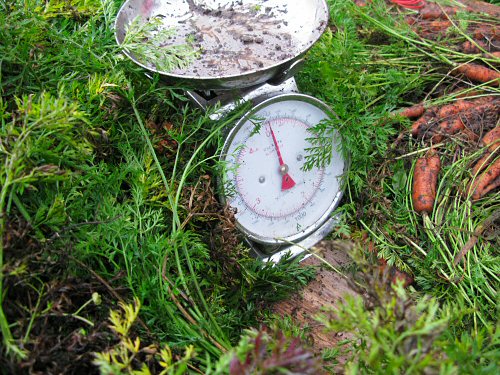
We’re definitely into fall weather now: the thermometer may still read “warm” but there’s always a cool edge in the air. This is the best field-working weather, you can go on for hours. Today was a bit damp, and the abundant root crops were muddy from the overnight rain (they get rinsed, with a spray of the hose on Jet for the roots, then a dunk in the laundry sink to rinse off the leaves). Carrots were in 2 lb (900g) bundles, by the trusty kitchen scale we’re still using…

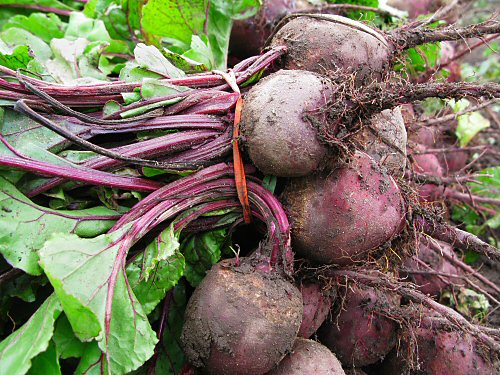
We bundled the beets in the field—these are the red standbys of the season, Scarlet Supreme. Always reliable, they’re in great shape and flavor, and the greens are particularly substantial…

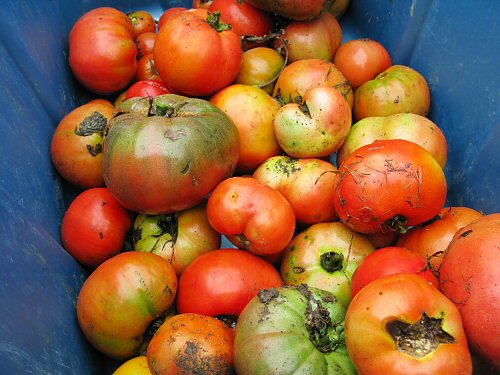
The tomato harvest was fairly slim and motley, maybe 120 lbs (54kg), enough for CSA shares only. We’re picking them even partially ripe—frost may come at any time, no sense in waiting. The toms may not be too pretty, but they’ve somehow become real tasty in the last couple of weeks, steadily developing from the milder flavors of the first pickings, to really quite fine! Was it the recent sunshine?  Whatever the reason, it’s a pleasant surprise!

Violet returns: visiting with worms

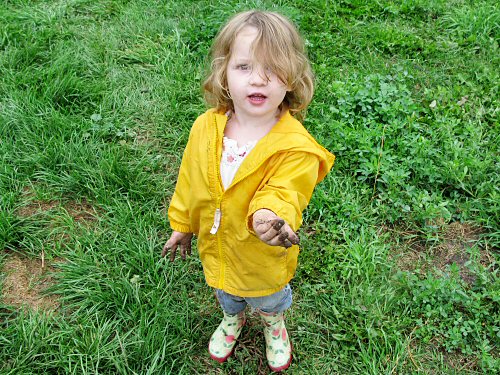
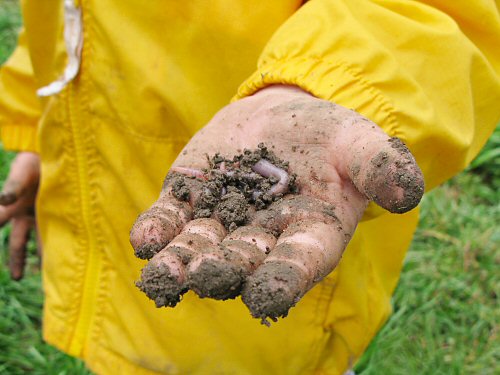
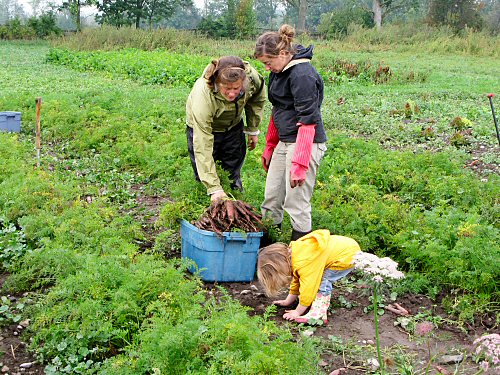
Young Violet (2) returned to the field, sans siblings. She seemed to have fun on her first garden visit, on a sunny afternoon—today’s cool, cloudy, wet conditions didn’t faze her in the least. Interacting with earthworms occupied a good hour…

While Libby and Lynn dug carrots, Violet helpfully and with great interest relocated disturbed worms. A hands-on biology lesson, an early pre-school start… (Looking back, for the most part, I’d have much rather grown up in a field than in a classroom!)

Donkey care

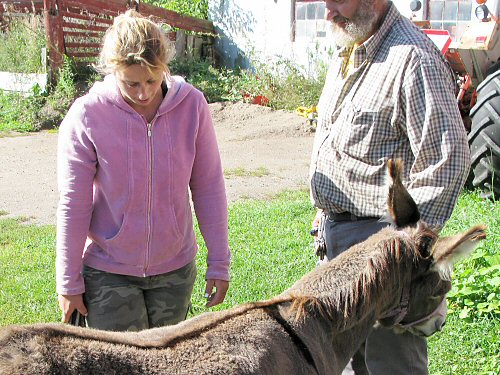
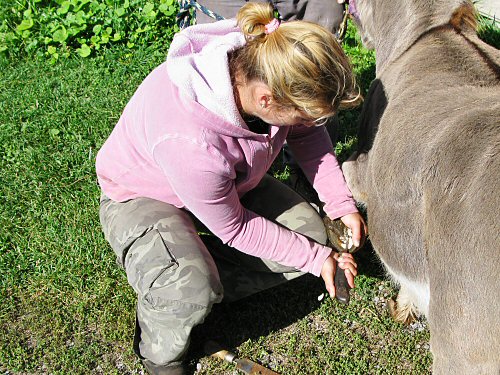
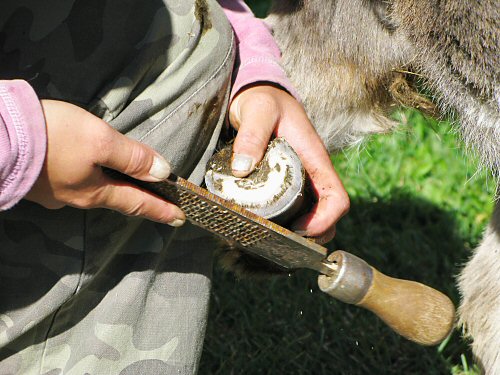
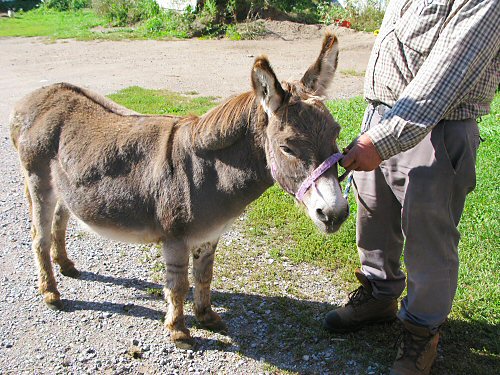
Tanya the Farrier drops in on Jack the Miniature Donkey every 6-8 weeks to clean and trim his hooves. It’s a pretty quick operation, maybe 20 minutes. You might expect trouble, Jack being a fairly frisky, 400+ pounds of muscle, hard head and hoof, but he’s also easy-going, and Tanya seems to have established authority way back. I’ve been watching this routine for the six years I’ve been here. Bob does the holding, and Tanya goes to work…

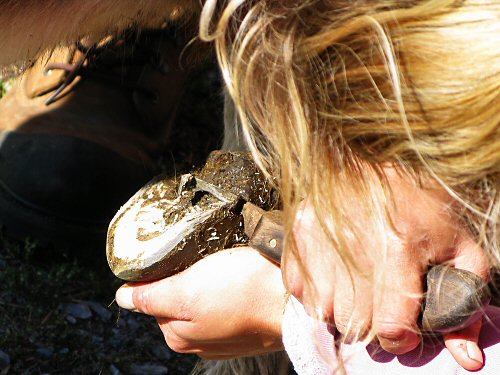
…using a hooked knife to prying out built up gunk…

…and trim down the hoof.

A rasp is used for finishing touches…

…and in no time, Tanya’s gone and Jack’s good to go…

Trimming garlic

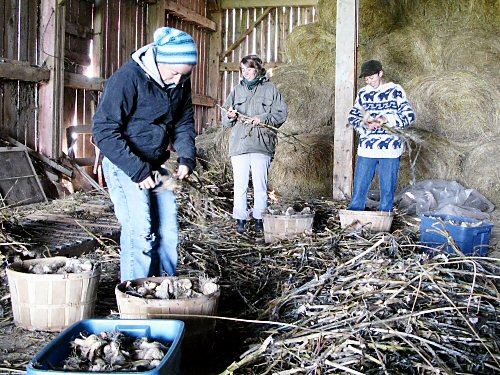
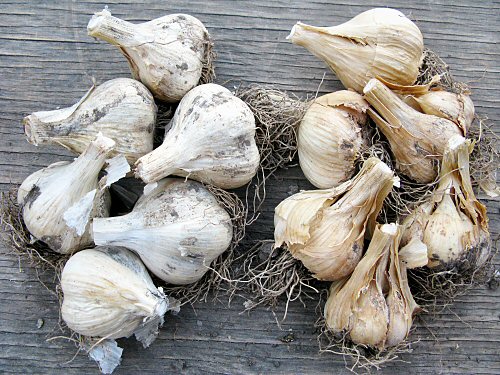
From the long stack of garlic drying in the barn, we’ve been taking out about a bushel a week since harvest began in late July. Today, we finished preparing the rest of the harvest. Lynn, Raechelle and Mel snipped the stems and sorted at the same time. (The roots weren’t trimmed; that can be done for some as we go through the bins and baskets each week for CSA shares and the farmers’ market.) In past years, the sorting was for size: dividing the mostly medium and large bulbs, and putting aside the very few tiny and damaged ones. Garlic does best with a dry final month of growth—this time, coming out of ground that had remained quite wet all summer, the harvest wasn’t in as good shape…

Sizing evened out, with most bulbs about what I call “medium” (this is the most useful size for cooking, but the big ones are so…impressive, everyone loves ’em). A little over half dried not to the usual tight, white skin, instead, to a tan color, wrinkled and split. So, we sorted into “good” and “not so good”… There was also a much higher proportion of really damaged bulbs, maybe 10% compared to a usual couple per hundred. Still, the taste is great, and the cloves themselves are fine. Only appearance and storage life are affected. We’re selling the less pretty, less storable bulbs at a couple of dollars less per pound. They’re good for immediate use (within 3-4 weeks, maybe a little longer) and as seed garlic for fall planting. Overall yield was great, although I’m not sure whether the hugely reduced number of large bulbs was due to weather, or to the more intensive 5-across planting we tried for the first time. As usual, more to observe and learn from. All in all, given the poor garlic weather, it all worked out quite well!

Cutting spinach

Spinach cutting close-up

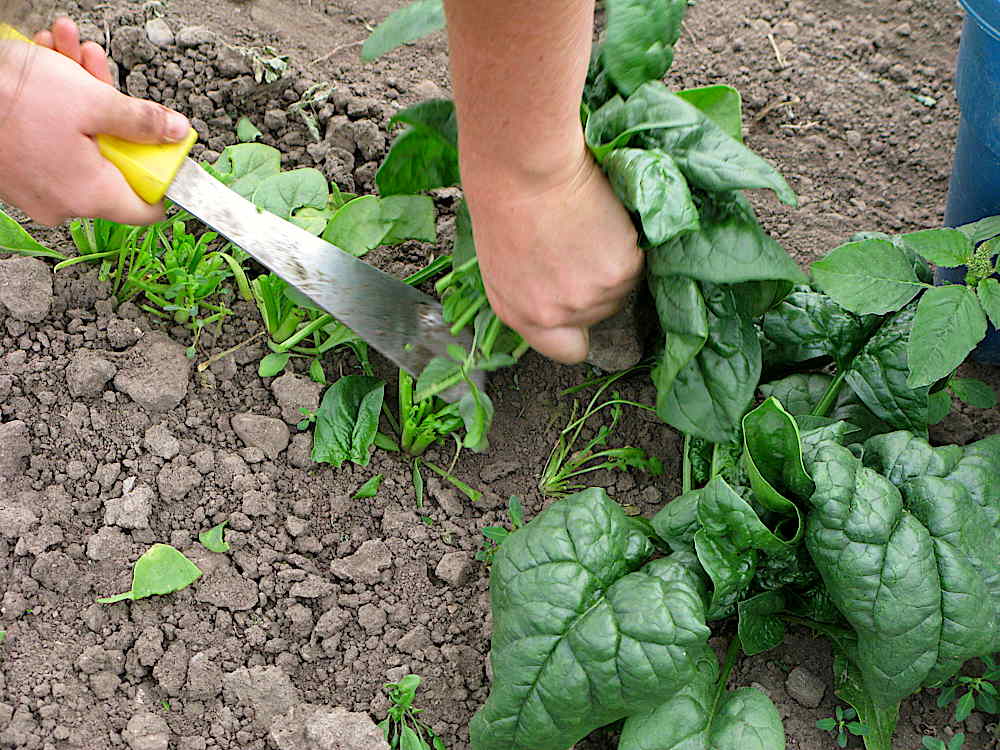
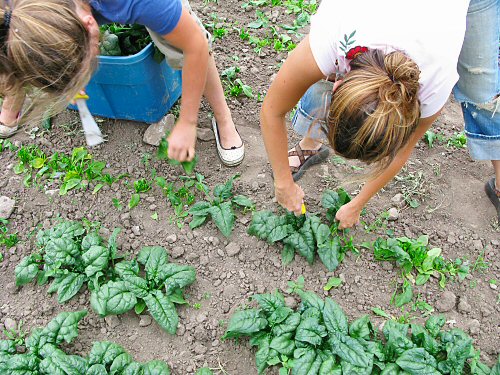
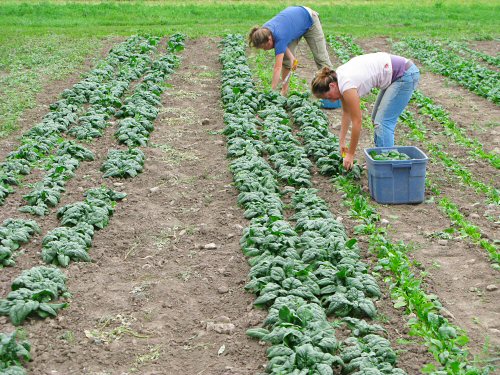
Spinach has kinda been the star of the harvest for the last couple of weeks. After a “normal” summer—hot and dry for the last three years—it’s usually not around at this time of year due to poor germination. This season, with cloudy, cooler days and all the rain, spinach is in abundance: glossy, deep green, succulent, full of flavor. Libby and Lynn chop away, cutting an inch or two up the stems. This technique takes out the small new growth leaves, but it’s fast and efficient, and the plants still grow back for a second harvest. The alternate picking-single-leaves approach is more laid back, great for leisurely field chats—this harvest, we opted for quick…

Nothing like teamwork: head down, knife in hand, side by side…

My, what a nice, wide path!

After the row cover: weeding!

Weeding after row cover

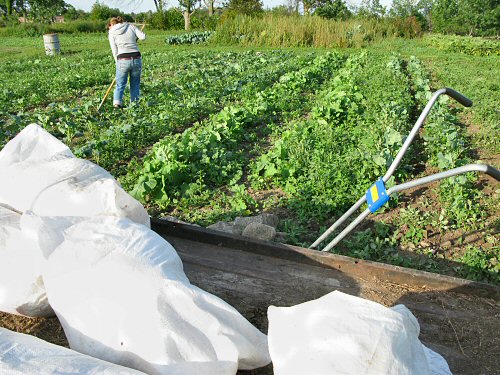
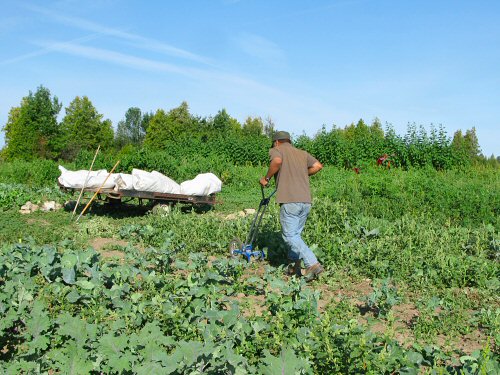
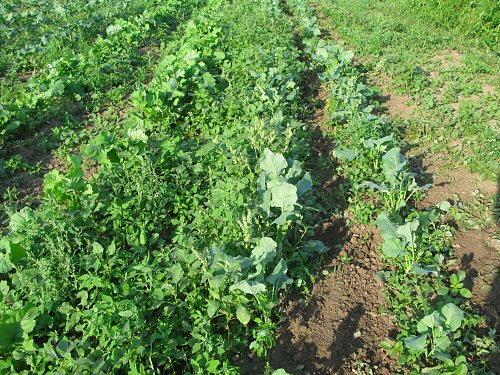
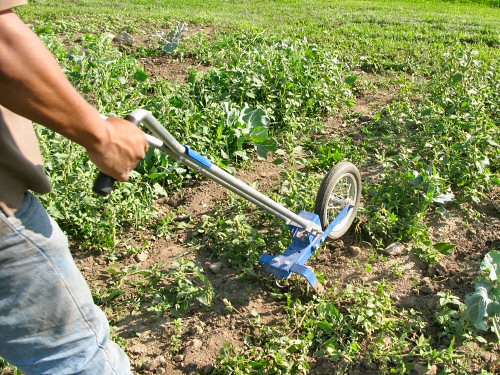
It’s been about six weeks, time to permanently remove the row cover from the last transplanting of fall brassicas! There are two sections, about 20 x 50′ beds in all, with broccoli, caulflower, cabbage, collards, kale. The cover protected against flea beetles, and at this point in the season, the FBs aren’t around much. Which leaves the post-cover weeding! I generally plan to remove the cover earlier, weed, and then replace it quickly, but this seldom seems to happen. Instead, it’s one big weed-a-thon at the end… Here, the mainly pigweed looks fairly big and dense, but it’s actually not much of a problem. The row cover has protected the ground from many days soil-packing rain, so the beds are nice and loose (it’s amazing how much rain can compact clayey soil).  Weeds come out easy! With two people, it’s a relatively quick job, 2-3 hours for a pretty thorough clean-up. We worked with a combination of hoe and wheel hoe, me doing the paths and between-row clearing, and Lynn hand hoeing in-row, between the plants spaced at 18″ (45cm)…

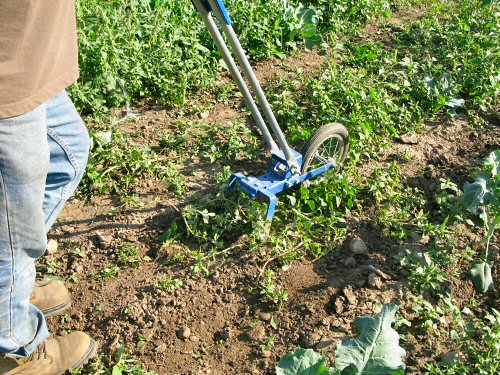
Each time I use the wheel hoe, I grow to love it that much more. So easy, so TIME-SAVING! It’s such a sophisticated yet simple tool, a perfect marriage of wheel, leverage and steel (you could say! :)… Today’s job is heavier work than it’s usually used for, the weeds aren’t just emerging, they’re pretty big. Rather than rolling the wheel hoe continuously down the rows, I’m cutting the weeds with a series of forward and backward strokes that either slice the plants below the surface, or pull them out, roots and all…

Clearing a path (before and after, above) in the loose soil takes maybe 3 minutes for 50′, many times faster than hoeing or hand pulling…

For this heavier weeding work, I use a fairly forceful forward stroke that travels about 1-1.5′ (30-45cm), then raise the blade to clear the felled weeds as I step forward to start the next bit…

The wheel hoe is equally good at cutting on a backstroke, which comes in handy for dense areas and tough specimens… It’s not particularly strenuous work: the blade is sharp, the wheel and angle of the handles give lots of leverage and momentum, and some part of the hoe is always in contact with the ground, so you’re never completely lifting the whole tool. Like most things I do here in the field, I’ve figured out how to use the wheel hoe on my own, by reading instructions, looking at pictures and applying my version of common sense. Techniques no doubt vary. It’ll be interesting to eventually see how others do things! Meanwhile, everything seems to work out…especially, the wheel hoe! (Wheel hoe action photos by Lynn)

After the market

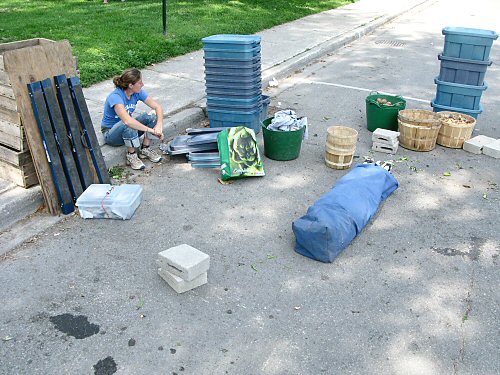
Somehow, I always forget to take enough pictures at the market, of things like setting up the stand. It’s really great, how a plain old small town street, in about an hour, turns into a…farmers’ market. For our stand, basic set-up and teardown—canopy, table, sales gear—is only a matter of maybe 20 minutes at each end. Because I don’t drive, our stand is different from most, where a truck or trailer is the usual veggie stand backdrop. Bob drops us off in the morning in a pick-up: a self-contained veggie sales outpost. When it’s all over, with empty containers nested and packing volume much reduced, we get picked up by truck or smaller mini-van. Here, Lynn and I wait for our ride. There are garlic and potatoes left in a basket and a trug, and the four bins contain mostly crop residue, a bit of miscellaneous garbage, and odds and ends of unsold produce. Neat!