
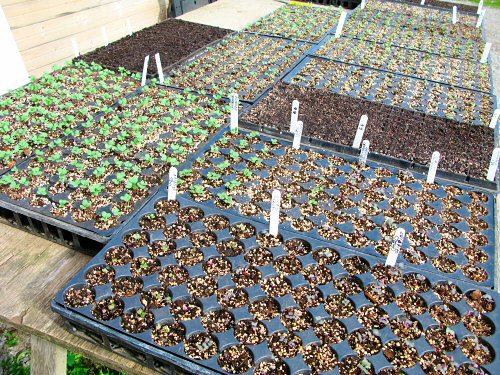
These brassica seedlings—broccoli, cauliflower, kale, early-maturing cabbage—were started a week ago, way late by any planting guide standard for our region, but I’m going by the reality of our recent crazy weather. Last year’s “late” cabbage family seedlings did just fine, so I’m gambling again! There are a couple of 200-cell trays of lettuce in there as well…
Veggies
View from the stand
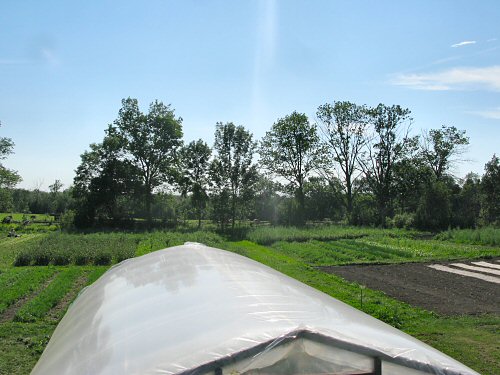
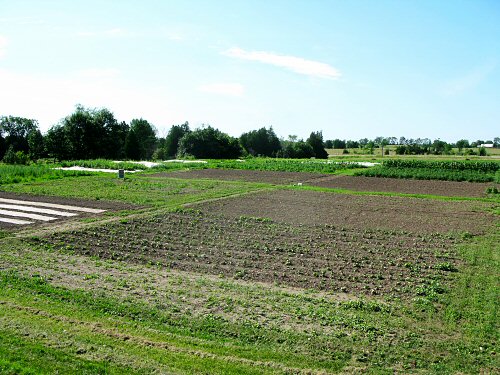
It’s mid-July, and on a (recently rare) sunshiney afternoon, things are looking OK. Better from a distance than up close, because a few sections, like the summer and winter squash, are quite severely in the weeds and in need of intensive hand pulling. And the ground remains almost constantly wet. Our moisture-retaining clay-loam soil, such an advantage in the usual near drought conditions we’ve had over the last three years, is now a bit of a hindrance. Sprawled tomatoes are particularly at risk if they don’t dry out against damp ground, and instead contract early blight (more about that another time!). Still, carpe diem, huh—seize the day! From atop the farm stand, the view is fine! We have the north end (above), with carrots under burlap (third planting), brassicas (newer transplants still under row cover), the cover in the far middle over squash, in front and more to the right, tomatoes, with a windbreak of giant sunflowers at the very right, and sweet potato bottom center. Open sections will include brassica transplants in a couple of weeks, and a fall cover crop. Out of sight to the north are onions…
In the middle, clockwise from the left, there’s a second planting of carrots, fifth mesclun right in the corner (with Maria weeding on the Greens Machine), garlic and parsnips, and potatoes in the distance (with more big WEEDS), the first planting of beets, carrots and green onions, and the edge of the third carrots under burlap from the first photo.
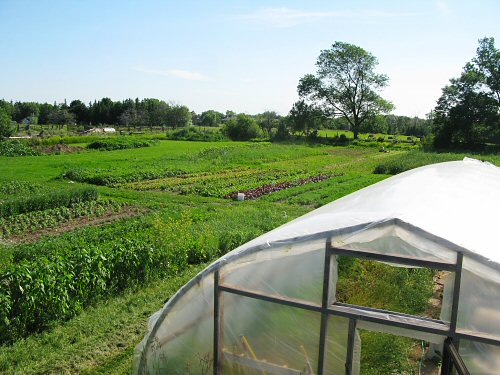
And then, the south end of the field, going left from the peak of the greenhouse, the garlic and Maia in the mesclun, the second planting of carrots and beets (that slash of of red is Bull’s Blood beets), the fourth mesclun , a weedy area with nasturtiums and tomatillos, and to the bottom left, herbs and flowers (fairly towering Jerusalem artichoke at the bottom left). (Guest photos by Lynn)
Dirty hands at the farmers’ market
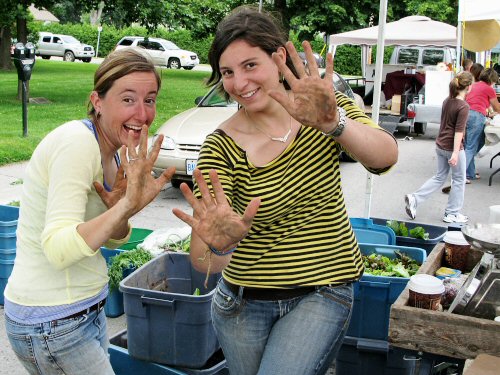
Over the last couple of weeks, we’ve been experimenting again with rinsing versus…not rinsing. This comes up a couple of times every year, where I think (or someone suggests) that rinsing various veggies is not necessary: to save time, to improve storage, to preserve nutrients,…the reasons vary. (For me, the time-saving is always a big attraction!) Sometimes, crops just have to be rinsed to cool them down quickly if harvested in the heat, or because they’re really mucky from heavy, mud-splashing rain. In any case, this week, we didn’t rinse the carrots, beets and beet greens, so sorting at the market was a bit messy. That’s Lynn and Maria, happily dirty-handed… The conclusion is usually the same: when the harvest is really kinda muddy, which is often the case this year with all the rain and wet ground, a quick rinse is better all around, for handling and for presentation. Still, the experimentation continues!
Kids in the field
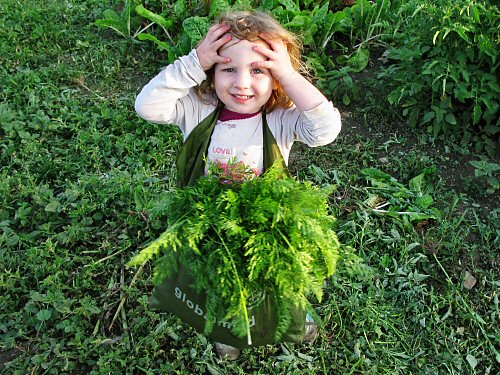
A fair number of kids have dropped by the farm, parents in tow, but today was the first time since I’ve been doing the tiny farm blog WITH PEOPLE INCLUDED, that smaller children figured directly into the fieldwork picture. Michelle, whom I’ve known for 4-5 years from the farmers’ market, and who now comes by to help harvest on Fridays, dropped in today with her three…kids. There’s the impossibly cute and BUSY Violet, age two (above), who was into a bit of everything, like collecting carrots and eating every veggie she got her hands on. Allie (6) was really helpful, harvesting carrots with Lynn and Maria, harvesting beets and cauliflower with me, totally pulling her weight. Big brother Michael (8) kept Violet out of trouble here and there, but mainly chatted with me in some depth about his rugby and hockey teams, his parents views towards his sports performance, the video game he’s currently playing,…and other stuff. While Michelle cut a huge amount of all-lettuce mesclun, the kids hung out, did some useful fieldwork, and overall contributed in a surprisingly great way to the harvest afternoon vibe… Another happy side of the Tiny Farm Experience!
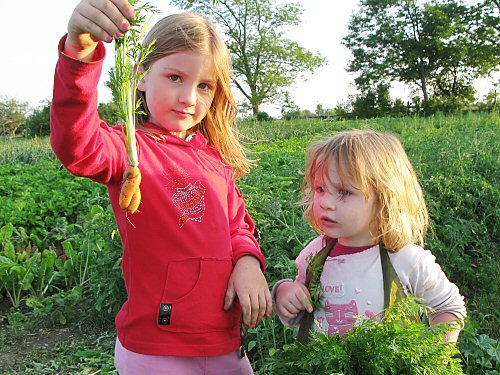
Fun with carrots…
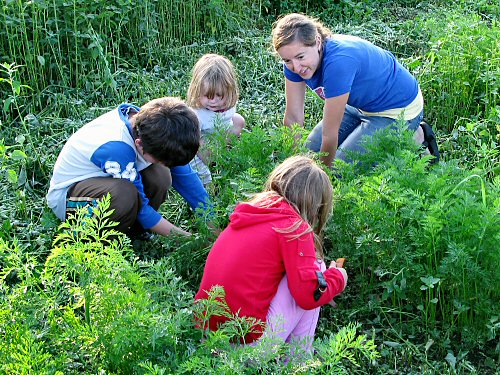
Lynn conducts an impromptu field seminar, featuring…carrots.
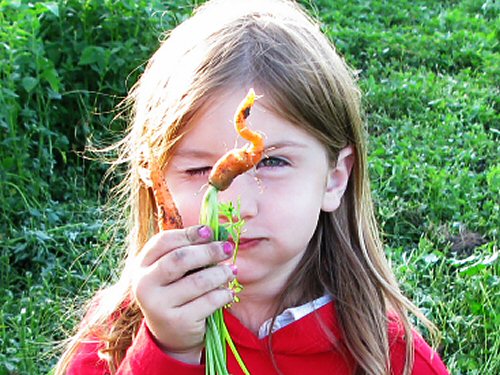
Allie eats and inspects carrots at the same time…
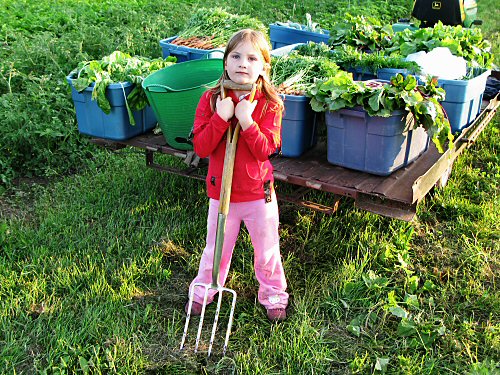
Strike a pose… Kids in the TFE!
Sweet potato thrives
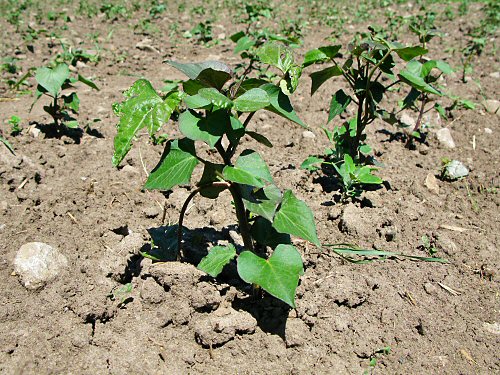
A month after transplanting the slips, the sweet potatoes are thriving! I’m still entirely unsure of the eventual harvest, but these plants are a low-maintenance pleasure so far. Almost every slip, even most of the ones that turned into tiny, leafless stubs for a while, managed to establish without any care at all, not even watering in after transplanting. Cool!
Maria from Barcelona…
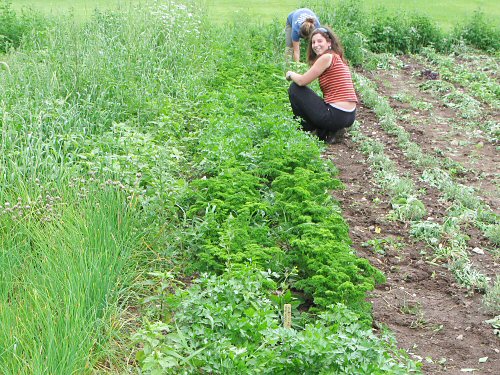
Less than 24 hours after arriving from Barcelona, Spain, WWOOFer Maria is in the weeds! Here, she hand weeds parsley with Lynn. Maria is our first longer-term WWOOFer, staying for about six weeks. I found it a bit tricky, committing to an extended stay without meeting first, but it all seemed good after an exchange of emails, and here she is! She just finished her second year of university in…food engineering. This is her first farm experience, and from what I can gather so far, it’s really at the other end of the scale from the scope of her studies. Her English is quite good, and her vibe seems right. And there’s never been this much steady help in the field. Overall, it should be an interesting exchange!
Still a lot of greens…
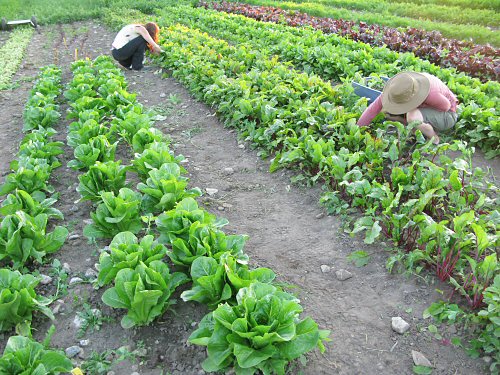
The Friday harvest is still greens-heavy, with beet greens in several varieties leading the way. Here, as the afternoon winds down and the temperature cools, Michelle and Lynn thin the second beets planting of Scarlet Supreme, with Chioggia and Bull’s Blood off to the right. There’s also the fourth planting of all-lettuce mesclun, just cut on the far left, and in the center, Panther romaine, miraculously spared by the earwigs and in excellent shape and taste, to be cut next… Elsewhere, cauliflower, parsley, the last of the spring spinach and peas,…