
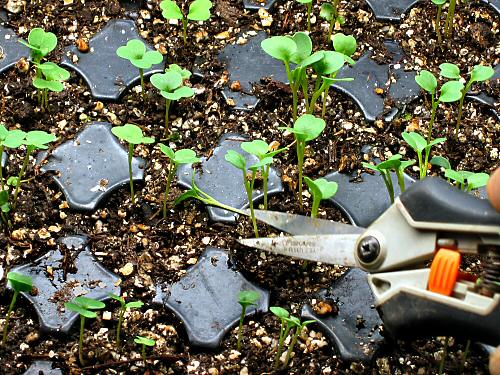
Time to thin out the lettuce and arugula. Between the seven varieties, some of the seed I used was up to four years old, so to be safe, I was quite generous, maybe 4-5 seeds per cell for the arugula, and a bit more for the lettuce (that tiny seed can get away from you, though with new seed, I try to go lighter). Germination was good, and the little seedlings are already shading out each other as they push for the light. I’m still getting used to timely, to-the-point thinning, both in the trays and in the field. I usually have the urge to leave ’em a while longer, but almost always, this ends up being not the best thing to’ve done. Give the best ones the biggest break as early on as possible, which means, kill off the rest. This also takes some timing experience, but in general, it’s hard to go wrong by not waiting around. Sounds brutal, but that’s about it! The lettuce will eventually be one per cell, although for now I’ll leave a couple per. Starting arugula indoors is a first for me, I usually direct-seed, so I’m figuring things out this time around. I’ll leave two per cell, and plant them out two together at 6″ (15cm) spacing and see how that works out. Here, I’m snipping arugula at the soil level with wickedly pointy little shears…
experiments
Getting started
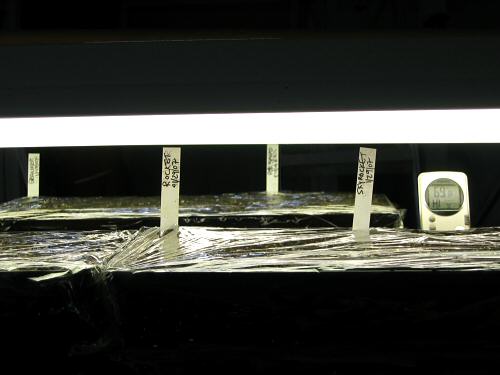
Started the first seeds of the year today: lettuce and arugula. At night, the grow racks remind me of a lab experiment, with the plugsheets in trays, carefully labelled and sheathed in plastic under the intense white light (fluorescents up close are pretty bright). And there’s the digital min/max thermometer, keeping score. The whole set-up looks like what it is. It’s great! In the beginning, I kind of obsessively (and largely unnecessarily) check every few hours to make sure the soil mix is sufficiently moist, the temperature is above 60°F, to see if anything’s emerged and it’s time to take off the plastic. Maybe after another five or 10 years, it will become simply routine, but for now, every single plant to emerge is still cool and exciting… For this, the earliest lettuce attempt yet, I’ve started five varieties, all with maturity dates of 50 days or less. There’s Simpson Elite (a really fast 40-day) and Two Stars, both green leaf, Granada and Red Salad Bowl, both red, and Sierra, which is red tinged. As a salad mix in any combination or all together, they’re a great blend of colors, textures and tastes. The arugula, Rocket and Skyrocket, intended for the mix, is faster growing than lettuce, but I felt like starting some now (I’ll start some more, later). If all goes well, these will hit the unheated greenhouse in the beginning of March, a good three weeks ahead of last year!
Grow lights, on!
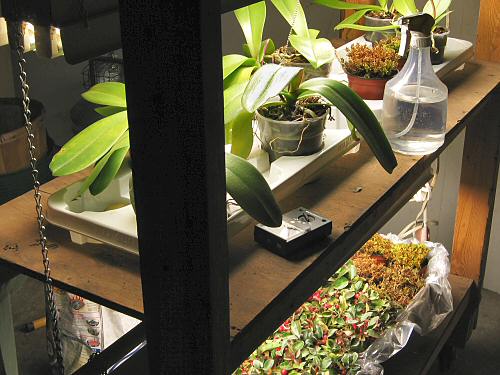
Grow rack lights went on today for the first time this season. They’re only for the rescued houseplants (orchids, wintergreen, heather)—I guess every plant deserves a place in the sun—but, I’ll be starting super-early lettuce soon, a month earlier than ever, for an experiment in planting them out to the greenhouse at the beginning of March. Getting the grow racks ready is another familiar routine. In early summer, I remove the fluorescent light fixtures and the chains and dowels they hang from and store ’em somewhere (last year, it was on the new Big Shelf). For spring, I dust them off, wipe them down, hang them, and a new seedling season begins!
Rye thrives…
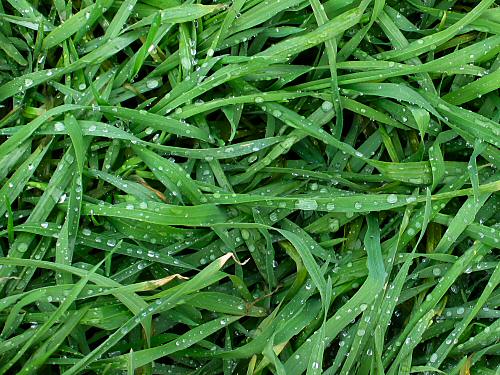
After enduring a pretty wintry two months, the fall rye can only be described as lush and green, the highlight of today’s brief walk around the field. It hasn’t grown much since late November, but it’s alive and kicking. Here, a light dusting of snow has melted as the sun pops in and out. The cover crop experiment continues…
A little fieldwork
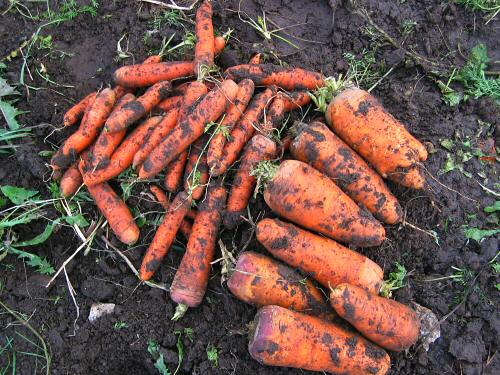
Spent about four hours out in the field. The feeling of calm satisfaction as you head in after doing some work in the garden never fails! I dug up about half a bushel of carrots to see how they’ve done. These are, I think, Nelson and Danvers Half Long (the BIG ones)—the label stakes were out, so I couldn’t immediately check the varieties, it’s not necessarily that easy to tell! They’re mostly in fine shape. On a few, the inch or two exposed above-ground had frozen and thawed, leaving the top tips spongy and mushy, but this didn’t affect too many. I can probably get a couple of bushels! This mid-January harvest is actually consistent with last year, except for the extra 6-7 weeks of RealWinter… I also mulched the garlic, leaving a couple of beds clear as a test (I’m not sure how useful an experiment that is, since I’ll mulch them for moisture and against weeds first thing in spring…). Anyhow, a bit of winter fieldwork…
All clear…
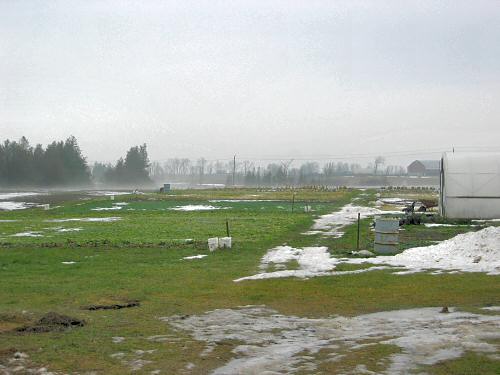
After a night of rain and 50°F (10°C) warmth, the field is just about clear. What a difference a couple of days can make… I took a walk. The ground isn’t even frozen—with the odd way all that snow came before a real cooling down period, the ground was insulated by the snow and didn’t freeze too deeply. It’s quite strange. Usually, during the March end-of-winter melt-off, the clayey soil is wet, sticky, mucky, sucking, and the drainage is slower as the frozen ground thaws out, but now, some areas are dry enough to till! The scene also looks quite differen—greener!—than in previous years, because I’ve left a lot of cover crops (oats, bit of rye), and there were quite of few beds of late harvest veggies caught in the first snow. There’s potentially good stuff out there: huge carrots, beets, spinach. They may be too cold-damaged to be worth a harvest, I’ll check ’em out tomorrow. And the unmulched garlic is doing fine!
Root cellar check-in
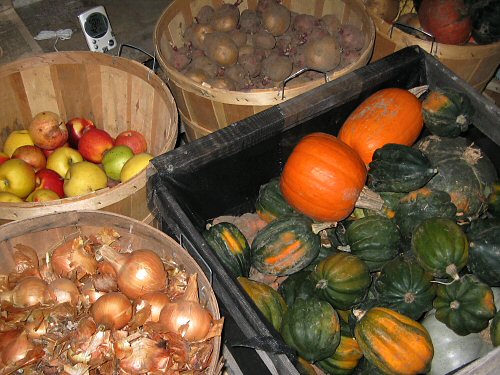
This is going quite well! Mainly, the idea is to do the regular tending, and see how things hold up. Although I’m calling it root cellaring, it’s really quite a limited experiment this first time round. The veggies weren’t too carefully sorted for long-term storage to start with, and I’d pay more attention to getting everything into cool conditions quickly. And really, I’d make sure the space was proper root cellar material! Here, the temperature didn’t drop from 60°F until the last week or so, and it’s only at 50°F now and around 45% humidity. Not exactly ideal. Still, not bad so far. I’ve culled about half a dozen onions from a bushel, lots of the smallest squash (there’s LOTS left), a couple of apples. The pic shows about half of what’s there. If I were holed up in the wilderness and this was my food cache for the next four months, I’d be worried. But I’m not, and we’ll be eating storage veggies for a while… It’ll be interesting to see what’s up in another month. I wonder, how many ways are there to prepare winter squash?!