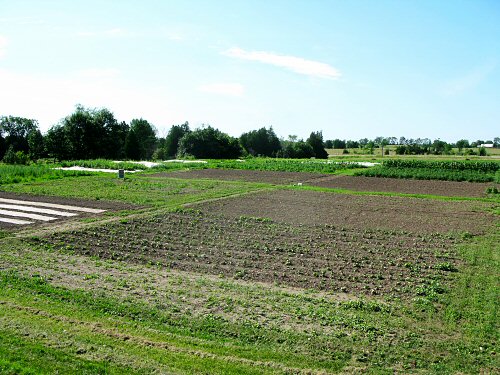
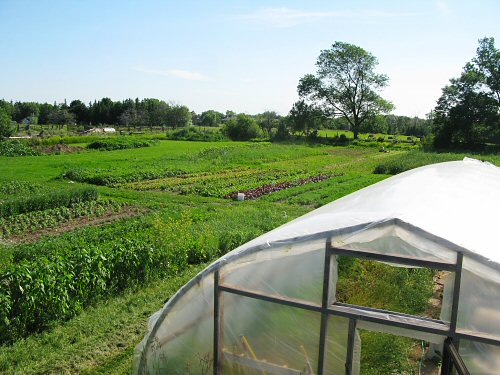
Last day of summer in the garden!

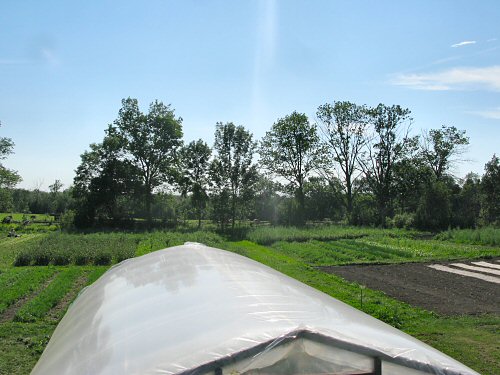
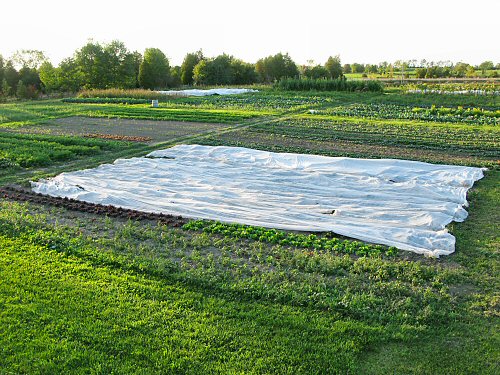
Here we are at the end of the calendar summer, a season of crazy weather largely gone by! Cooler fall conditions have been around for a couple of weeks now, with ample frost watch nights, so summer’s end at this point is only…ceremonial. Still, there’s that little twinge of melancholy that comes with the official end… The fall harvest is looking fine, with lots of brassicas, a good deal of lettuce, and the last of the fall spinach in the north end of the field (above), along with some last tomatoes, lots of peppers and eggplant, spared by frost so far. There’s also Jerusalem artichoke and potatoes, still in the ground. Green beans! And, of course, that section of sweet potato, fully row covered…

Moving down the field, there are the last plantings of beets and carrots, parsnips, some Swiss chard, and lots of mowed but still untilled empty sections…

At the south end of the garden, the herbs and flowers are all hanging in there—row cover has kept even the super-cold-sensitive basils alive and well. If I’ve missed anything in the rundown, well, it’ll still be there!

Restaurant run

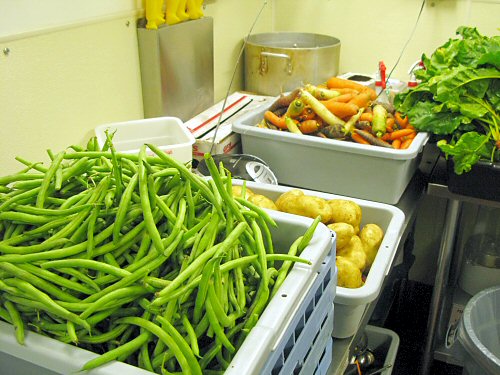
Beans, potatoes, carrots

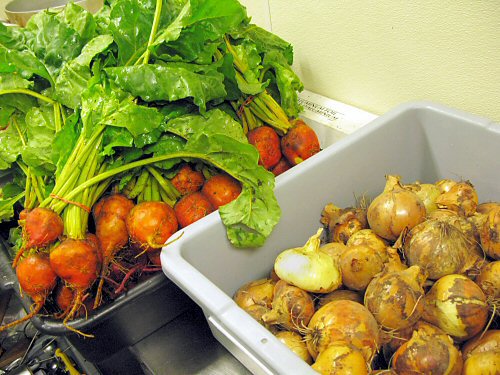
A phone call on the weekend lead to this, our first real restaurant sale. It was cool! A chef called looking for local, organic veggies for a special menu this week. They’d joined at the last minute a regional food festival, featuring local food in restaurants in several towns. I ran down what we had available and followed up with an emailed price and available quantity list. Today, we harvested and delivered: green beans (Jade), potatoes (Kennebec), beets (Golden Detroit, Scarlet Supreme), carrots (Nelson, Purple Haze, White Satin), and onions (Stuttgarter-type yellow cooking, yellow Spanish), in the 25lb (11kg) range for each. Pricing was the normal market unit price, no “wholesale” discount. It was great pulling up to the back of the building, delivering into the kitchen, checking out and describing each veg with the chef. The dinner plans: a “hearty fall soup” and a “steamed vegetable pasta with olive oil and herbs.” Market gardens and progressive local restaurants are a natural and quite common direct fit…as seen on TV (I’ve been known to watch the Food Channel)! I’ve had some minor dealings with restaurants in seasons past, but we’d never got round to a classic chef’s order and kitchen delivery. so it was interesting to go through the whole routine. We had lunch there afterwards, and the food was refreshingly good: bruchetta, flatbread pizza, sweet potato fries, salt and pepper rib tips, an asparagus sandwich (yeah, the asparagus aren’t exactly in season around here, but their special local food menu is a step in a cool direction…). Fun! Oh, and no frost last night.

Potato fruit

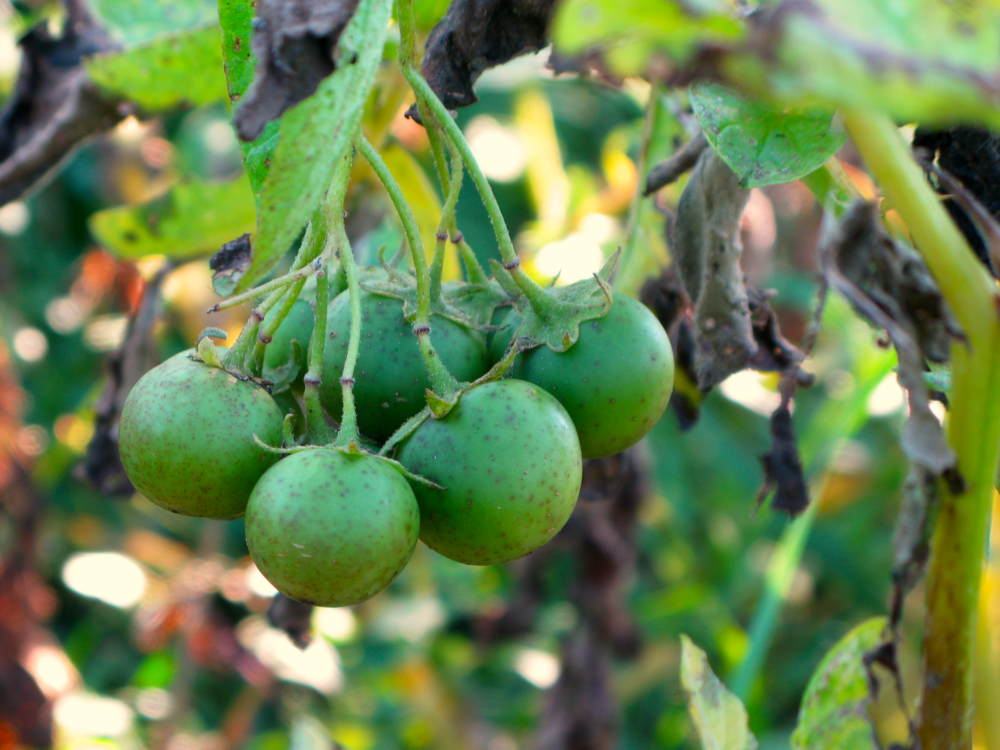
Potato fruit on Chieftain variety

Here’s something I haven’t seen before in my, uh, six years of growing potatoes: green, tomato-like, walnut-sized potato fruit. Bob hadn’t seen ’em either, in 40 plus years of farming. I hit the web for education.

These are genuine fruit (also called berries), but not that common. Usually, potato flowers just drop off. Pollination can be an issue, but even when pollinated, little details of the season’s growing conditions can make the the difference. When fruit do form, they’re more likely found on certain varieties, like Yukon Gold. This year, there were fruit on just about every Chieftain plant, here and there on the Kennebec, and none that I noticed on the Yukon Gold. Since they suddenly appeared this year on two varieties I regularly grow, I’d guess it was about the weather!

Each fruit contains 300-500 seeds that don’t come true: planting them doesn’t result in the same potatoes as the parent plant or each other, there’s lots of genetic variation, each seed will produce a genetically different plant! Potato breeders plant out thousands of seeds, check out the results, then keep replanting the most desirable potatoes for many years or generations to get new commercial varieties—this is the traditional way new potatoes are bred.

Meanwhile, it takes only two seasons and one generation to breed a new potato, so for the small farm or home garden, as opposed to the big potato breeder, this seems worth a try. At least as an experiment. Harvest seed one season—you can hand-pollinate to cross two varieties—plant out the next and select the best-looking plants. The tubers (potatoes) from each individual plant are ready to go: planting out the tubers will produce genetically identical plants.

But there’s a kinda big BUT: even though a potato grown from a tuber is genetically the same, you can’t be sure how its genetic makeup will react to different growing conditions. For example, it may be the perfect potato after a wet summer, and quite different after a dry one. (That’s why professional breeders check over several generations, and now there’s also high tech genetic analysis, to make sure it will be the same potato in the full range of growing conditions.) Still, at the very least, fun to see what happens!

And, the fruit are poisonous, rich in solanine, not for eating. Potatoes, tomatoes, peppers, eggplant and tobacco are all members of the “deadly nightshade” family, all prone to having toxic parts (potato fruit are somewhat similar to little, hard green tomatoes). Interesting!

Since this is such a popular post, being dug up over and over via Google, I’ve started to update the article as I discover more. The post sounds the same as it always did, just surgically filled out a bit with more info. This is unusual. In general, I don’t edit old blog posts, and clearly mark the updates when I do!

Scrabbling for potatoes

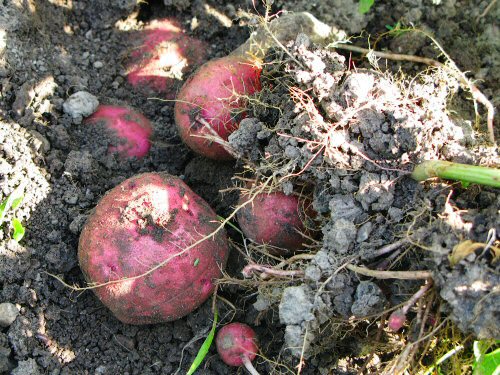
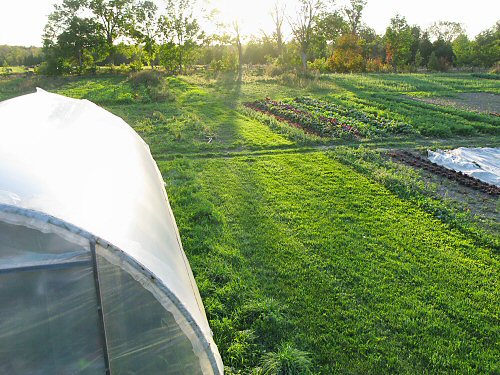
Thursdays are potato harvest days. Without a walk-in cooler, the main weekly harvest for CSA and Saturday farmers’ market is mostly confined to Fridays, with potatoes being one of the few crops that can be done a day or two ahead. Towards the end of the season, we dig up all the remaining spuds in one shot, but until then, it’s easier to go weekly. And since I don’t sell potatoes in bulk, curing them for storage is not an issue. It’s a tiny harvest, and the method of choice goes with it. Simply pull up each plant—they’re at 12″ (30cm) spacing—and scrabble around! Fingers work great. I used to use a digging fork, but that’s more work than it’s worth, and potatoes often get skewered. By hand, it takes 20-30 minutes per bushel (about 50lbs/23kg), really fast this year with quite huge potatoes after all the rain, and sometimes stretching to maybe 40 minutes if they’re small and the ground is drier and harder (this’ll happen in a really dry year, where potatoes get little or no irrigation). When the ground is dry, especially in clayey soil like ours that can get really hard, a hand tool like a trowel or tined cultivator can be good to break things up here and there after pulling. I kind of like how primitive the method is, and most people who try it REALLY seem to enjoy it. For the 2-3 bushels we need most weeks, it’s quick and effective! The variety here is Chieftain…

Massive new potatoes

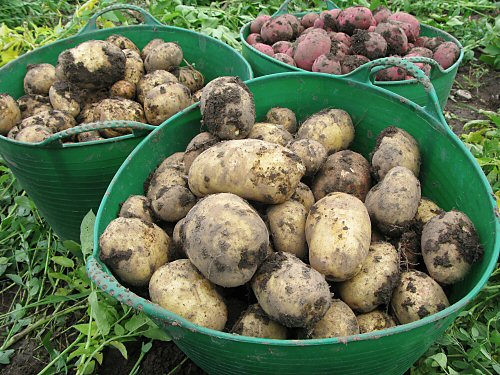
Our first potatoes of the year are HUGE, some of the biggest potatoes I’ve grown by far. I guess they really liked the rain. First dug: Yukon Gold and Chieftain. As usual, the harvest method is as manual as it gets: crawling along the rows, pulling up the plants, and scrabbling around by hand. More fun in the mud…

View from the stand

It’s mid-July, and on a (recently rare) sunshiney afternoon, things are looking OK. Better from a distance than up close, because a few sections, like the summer and winter squash, are quite severely in the weeds and in need of intensive hand pulling. And the ground remains almost constantly wet. Our moisture-retaining clay-loam soil, such an advantage in the usual near drought conditions we’ve had over the last three years, is now a bit of a hindrance. Sprawled tomatoes are particularly at risk if they don’t dry out against damp ground, and instead contract early blight (more about that another time!). Still, carpe diem, huh—seize the day! From atop the farm stand, the view is fine! We have the north end (above), with carrots under burlap (third planting), brassicas (newer transplants still under row cover), the cover in the far middle over squash, in front and more to the right, tomatoes, with a windbreak of giant sunflowers at the very right, and sweet potato bottom center. Open sections will include brassica transplants in a couple of weeks, and a fall cover crop. Out of sight to the north are onions…

In the middle, clockwise from the left, there’s a second planting of carrots, fifth mesclun right in the corner (with Maria weeding on the Greens Machine), garlic and parsnips, and potatoes in the distance (with more big WEEDS), the first planting of beets, carrots and green onions, and the edge of the third carrots under burlap from the first photo.

And then, the south end of the field, going left from the peak of the greenhouse, the garlic and Maia in the mesclun, the second planting of carrots and beets (that slash of of red is Bull’s Blood beets), the fourth mesclun , a weedy area with nasturtiums and tomatillos, and to the bottom left, herbs and flowers (fairly towering Jerusalem artichoke at the bottom left). (Guest photos by Lynn)

Weeding day

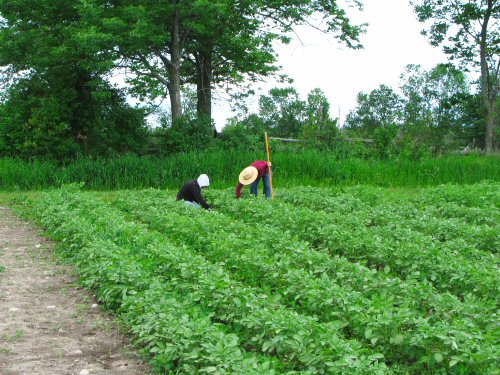
A cool, gray, peaceful day of WEEDING. Lynn and Raechelle combine hoeing and basic hand weeding to pull up a nice mix of pigweed and lamb’s quarters, with a little mallow and orchard grass for variety. I did paths with the wheel hoe. At the same time, we checked for Colorado potato beetle eggs (orange clusters on the undersides of leaves)—they’ve been here for a week or more, but so far not in troublesome numbers. It’s slow work, but satisfying in the end. The potatoes are growing abundantly with all of the moisture (which isn’t a problem so far), so much of what’s weeded now won’t be coming back under the expanding leaf cover. That’s nice.