Thinning and weeding

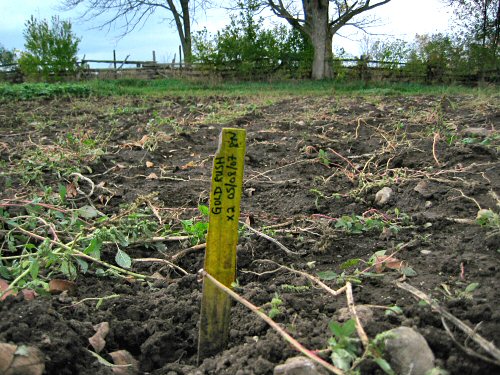
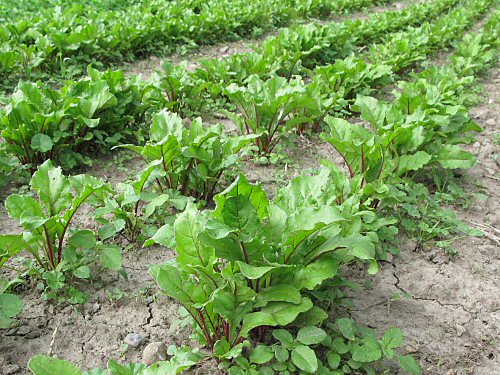
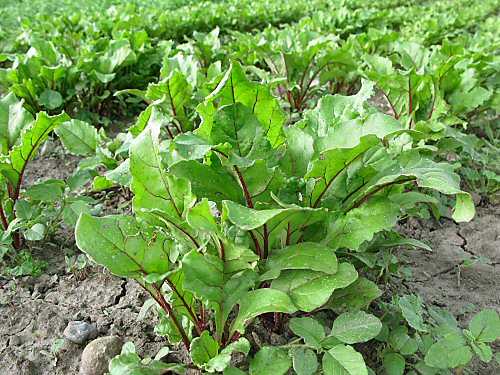
The first beet greens have sized up: lush and looking delicious, they’re ready to harvest. I love beet greens, both raw in salad, and lightly sauteed in olive oil and/or butter (a kind of deluxe spinach). I’ve never grown them as a separate crop, instead, they’re a happy byproduct of thinning the beets—removing the extra plants so that the remaining beets have room to grow. So the greens are both a harvest crop…and a weed. (I guess this is a continuation of yesterday’s post about WEEDS!) As you can see below, with the exception of a few gaps where nothing germinated, the first-planted beets are growing quite solid in their rows, which means a lot of plants have to be removed, maybe as much as 6-8 out for every one left behind (did you know, beet “seed” is actually tiny dried beet fruit containing several seeds?). There’ll be so much from four or five 3-row beds of beets, I won’t be able sell, eat, store or give away all of the greens that’ll pile up, but I can’t leave them in to stunt each other, so at at some point, the thinning becomes…weeding. Funny how that works! :)

Meanwhile, after a quite intensive weeding by hand and hoe a few days ago, the beet beds and paths are in fine shape, with only some growth near the plants that’ll come out during the thinning. (The cracks in the ground are what happens with our heavyish clay-loam soil: it’s not at all concrete-solid, it’s nicely moist, but as the surface dries out, it tends to…crack.) As far as overall weeding, with some quick touch-up hoeing along the way, these beds should be fine till harvest in 3-4 weeks (maybe earlier for some). The increasing leaf cover will keep down weeds near the plants, and the increasingly narrow paths and between-row strips can be quickly walked down with the weed hoe. It should be…sweet! On the other hand, in the potato patch…

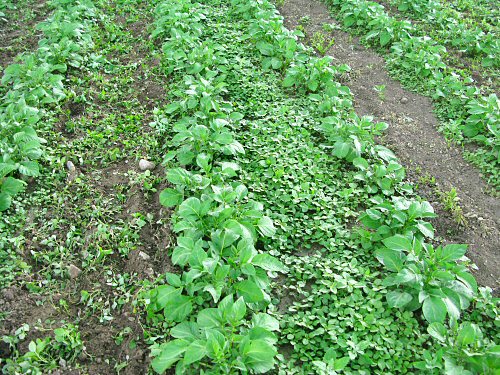
…things have gotten a little crazier. A dense and vigorous mix of mostly pigweed and some lamb’s quarters has carpeted one of the two potato sections. Here, you can see the difference a pass with the wheel hoe makes. On the left, a just-hoed path still looks pretty green. In the middle, it’s untouched and looking a little scary. I’d call this…Stage 2: leave these little guys just a few days longer, and it’ll be a fight to hoe as the pigweed stems in particular will start to get tougher. On the right, a path weed-hoed a couple of days ago (I was on the way through while walking back from hoeing another area)—after a day of sunshine, the cut and uprooted weeds dry up, and you can see how much weeding you’ve really done. There’s still a lot of close work around the plants, but the potatoes are really shooting up now, so once that final weeding is done, the plants will shade out and prevent germination of whatever weed seed’s still near the surface. On the other potato section, the weeds aren’t nearly so…dense. On this one, some of last year’s weeds obviously went to seed, which really increases this year’s population. It almost fee;s like a closed system: what work you get away with not doing now, you eventually pay for later, usually with a little interest…
Onions and potatoes go in

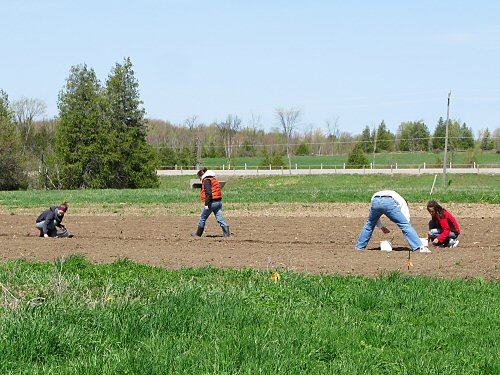
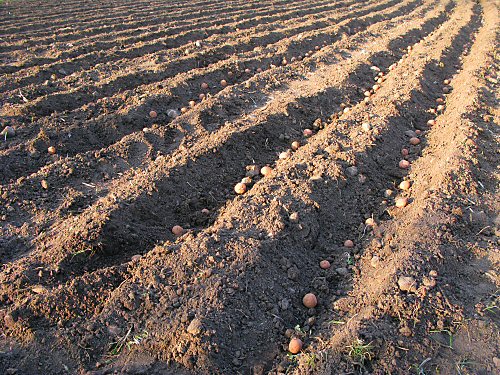
A satisfying planting day: all of the onion sets (around 2,500) and 300 lbs (136kg) of potatoes are in.

For the onions, Raechelle (first day in the field), Lynn, Jamie (a new CSA member), Shannon (here for a month), and I made quick work of the onions: Stuttgarter yellow cooking and yellow Spanish.

It’s amazing how much fun people working together in a garden can be, there’s a positive, happy, energy that I think comes from sharing time in the dirt (maybe that’s just the tiny farming romantic in me, but I think not… :). Plus, potentially tedious tasks are done in no time!

For an encore, Shannon and I polished off the potatoes, finishing just as the sun set and another chilly evening set in. This year, I used the furrower attachment on the Horse walking rototiller to plow what turned out to be excellent trenches, in ground that had been tilled up about a week ago. Varieties are Yukon Gold, Chieftan (red), and Kennebec. In this batch, all varieties were about chicken egg-sized, so, no need to cut ’em into pieces. In-row spacing is 12″ (30cm), between row is 24″ (60cm), with a bit wider path every two rows. We covered them by hand-raking. In all, 40 x 50′ (15m) rows, which is about 2000 plants.

Every year, I’ve tried a different potato approach. Last year, I made much shallower trenches with a hoe. As far as set-up, this time around was the best yet.

The onions are in a bit later than usual, I’ve had them done as early as mid-April, but no worries, and potatoes are around the usual timing. I grow a relatively small quantity of both of these crops, they always sell out, and they feel like a good fit for CSA and farmers’ market from the middle of summer on, so having them at the absolutely earliest date isn’t that important at this stage. And what would tiny farming be without lots of room to improve?! :)

Putting food by

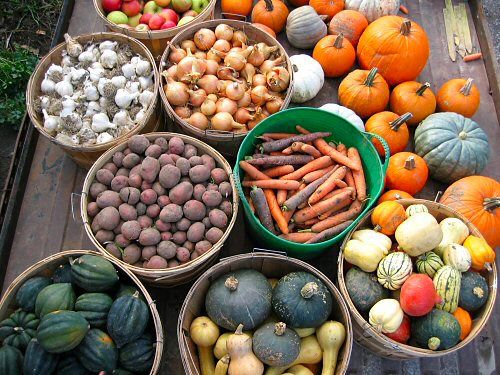
With the farmers’ market over, time to turn to fall-and-winter things. This year, I’m for the first time organizing a proper veggie selection for storage (it’s about time I started…training for that future CSA root cellar!). Instead of the usual bushel baskets of this and that, casually left around the barn to take their chances with temperature and location, now, there’s a bit of plan. For a root cellar, the basement of the farmhouse, the side with a dirt floor that used to be filled with potatoes when this was a fully working, big family farm. For the veggies, today’s haul has a mix of potatoes, assorted winter squash and pumpkins, various carrots, onions, garlic, plus apples picked up at the market. It’s a first step, there’s still lots more in the field: beets, spinach, collards and kale, herbs, and more carrots to go… Harvesting isn’t history just yet!

Seasonal eating

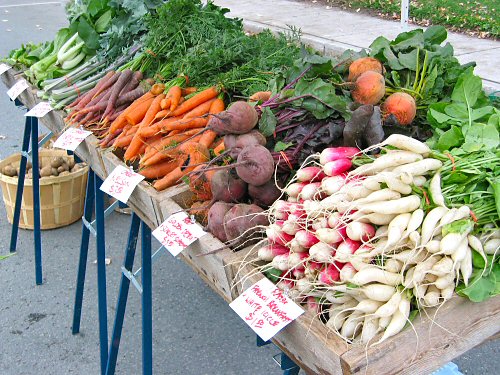
The veggie selection changes over the season, but it’s not necessarily reflected too dramatically on the stand at the farmers’ market this year. Compared to mid-August, the absence of snap beans and tomatoes is clear (with the mild weather, some vendors did have standard field tomatoes today). As for early June, well, more variety now is to be expected. Still, most of the cool-season crops for around here, like broccoli, cauliflower, and collards, also, winter squash, I have only enough of for CSA. On the stand, two types of radish (White Icicle, French Breakfast), three types of beet (Golden Detroit, Scarlet Supreme, Bull’s Blood, in smaller sizes here), two types of carrot (Nelson, Purple Haze), Red Russian kale, two types of bok choi (Mei Quing, Joi) and mesclun, plus Yukon Gold potatoes, Music garlic and Stuttgarter onions in baskets. The stand could be a lot bigger, offering more display space, and the harvest could be expanded (there are still herbs, summer squash, sweet and hot peppers, tomatillos, Brussels sprouts,…) but the marginal sales for many “secondary” veggies at this slowing down time of year don’t make it worthwhile. I’m still working on the balance between production planning, labor, harvest selection, post-harvest prep, and presentation… Sounds complicated, but it’s just…work! ;)

After the harvest

Finally, today, no more potatoes in the ground! After a near-pristine potato patch for much of the season, field priorities got switched around and pigweed had its turn with the taters. Eradicating the weeds before digging up the last 50’x50′ section seemed to take forever (but was actually a few hours spread over the last couple of weeks). Anyhow, this last haul is about 200 lbs (91 kg). It’s not much when you can buy a 50lb (22 kg) bag of great, unsprayed, unwashed potatoes for $14CDN at the farmers’ market. But in my crop mix, it makes sense. We harvested somewhere around 1,000 lbs (454 kg) this year. In the usual 1-2 lb bags, some sold at a by the pound (not bulk!) price, and the majority used for CSA shares, that works out just fine… Of the Yukon Gold, Norland and Gold Rush, YG performed the best, from small, early, supertasty new potatoes to a good amount of nicely big mature ones—they’re not for storage, but who stores a pound!

Share of the week

CSA harvest share

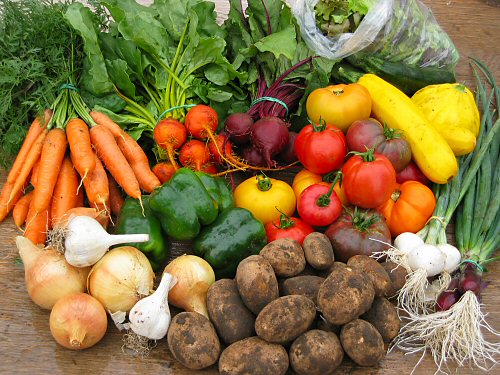
A specially Thursday-picked Large share, tiny farm flexibility in action for a shareholder who missed the weekend pick-up. A Large is about one and a half the size of the standard Single share. This week: carrot (Touchon), beet (Golden Detroit, Scarlet Supreme), tomato (assorted heirloom), mesclun (9-lettuce), spring onion (Ramrod, Red Baron), summer squash (Sunburst, Golden Dawn III, Ambassador), potato (Gold Rush), pepper (Ace), onion (Stuttgarter), garlic (Music). The shares have been pretty good this year, not over the top (in a superabundant way) as they have been at times in the past, but definitely solid value for the fresh, local, organic dollar!

Fish in the field

Trout dinner

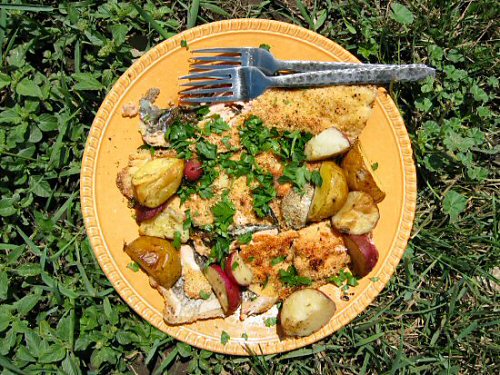
A different order of fieldwork: eating up the leftovers! A couple of rainbow trout left over from yesterday had to be used, so I coated them in cornmeal, pan-fried ’em in olive oil and butter, with a sprinkling of salt and pepper, squeezed some lemon over, and took ’em out to be picked at in the field. The trout was joined by leftover roasted potatoes from last night’s dinner harvest, and fresh flat leaf parsley. Fast, no fuss (my cooking skills are so far…basic!). The photo’s kinda funny. I set the plate down on a path to get the parsley, which is growing two feet away, snapped the shot, then noticed what all was in it: a little pigweed growing on the left, some mallow on the right, and grass all around, my weed friends looking on… Rain: another intense storm overnight finally gave us just over an inch (25mm), and then gave way to this beautiful, sunshiny day. Still, that’s only about 40mm in 40 days!